


Exodus 37:3
Bible text: King James Version (1769 Blayney text) · Public domain
Bible text: King James Version with Strong's numbers · Public domain
Bible text: Berean Standard Bible · Public domain
Bible text: American Standard Version (1901) · Public domain
Bible text: World English Bible, Messianic edition · Public domain
Bible text: Geneva Bible (1599) · Public domain
Bible text: Young's Literal Translation · Public domain
- וַיִּצֹקvai·yi·Tzokand he castH3332Conj-w ¦ V-Qal-ConsecImperf-3msVerb Qal Consecutive Imperfect 3rd Singular Masculineוַandיִּצֹקhe cast
- לוֹlofor <the> itPrep-l ¦ 3msSuffix Personal 3rd Singular Masculineלfor <the>וֹit
- אַרְבַּע'ar·Ba'fourH702Adj-csAdjective Numerical Singular common gender Absolute
- טַבְּעֹתta·be·'Otrings ofH2885N-fpcNoun Plural Feminine Construct
- זָהָבza·HavgoldH2091N-msNoun Singular Masculine Absolute
- עַל'alonH5921PrepPreposition
- אַרְבַּע'ar·Ba'[the] fourH702Adj-cscAdjective Numerical Singular common gender Construct
- פַּעֲמֹתָיוpa·'a·mo·Tavits feetH6471N-fpc ¦ 3msNoun Plural Feminine Constructפַּעֲמֹתָיfeetוits
- וּשְׁתֵּיu·she·Teiand twoH8147Conj-w ¦ Adj-fdcAdjective Numerical Dual Feminine Constructוּandשְׁתֵּיtwo
- טַבָּעֹתta·ba·'OtringsH2885N-fpNoun Plural Feminine Absolute
- עַל'al[were] onH5921PrepPreposition
- צַלְעוֹtzal·'Oits sideH6763N-fsc ¦ 3msNoun Singular Feminine Constructצַלְעsideוֹits
- הָאֶחָתha·'e·Chat<the> oneH259Art ¦ Adj-fsAdjective Numerical Singular Feminine Absoluteהָ<the>אֶחָתone
- וּשְׁתֵּיu·she·Teiand twoH8147Conj-w ¦ Adj-fdcAdjective Numerical Dual Feminine Constructוּandשְׁתֵּיtwo
- טַבָּעוֹתta·ba·'otringsH2885N-fpNoun Plural Feminine Absolute
- עַל'al[were] onH5921PrepPreposition
- צַלְעוֹtzal·'Oits sideH6763N-fsc ¦ 3msNoun Singular Feminine Constructצַלְעsideוֹits
- הַשֵּׁנִיתha·she·Nit<the> secondH8145Art ¦ Adj-fsAdjective Numerical Position Singular Feminine Absoluteהַ<the>שֵּׁנִיתsecond
English is a literal word-by-word gloss of the Hebrew, not the KJV's wording. Why?
This is the original text the KJV's translators worked from — each Hebrew word with its own literal English meaning in this verse, prepared by scholars at Tyndale House, Cambridge. The KJV translates whole sentences, not word by word, so its wording differs: one Hebrew word can become several English words, and the KJV may choose “the LORD” where the gloss reads “Yahweh”. Both are faithful — they answer different questions. For the KJV's own rendering, switch to the KJV text.
Details
See on the biblical-era maps

Study this verse
Public-domain commentary
Matthew Henry
From his Commentary on the Whole Bible. Henry comments on passages, not single verses — this entry covers Exodus 37:1–9. His two-level outline is real structure in the source text, so it is rendered as structure.
I.It may be thought strange that Moses, when he had recorded so fully the instructions given him upon the mount for the making of all these things, should here record as particularly the making of them, when it might have sufficed only to have said, in a few words, that each of these things was made exactly according to the directions before recited. We are sure that Moses, when he wrote by divine inspiration, used no vain repetitions; there are no idle words in scripture. Why then are so many chapters taken up with this narrative, which we are tempted to think needless and tedious? But we must consider,
1.That Moses wrote primarily for the people of Israel, to whom it would be of great use to read and hear often of these divine and sacred treasures with which they were entrusted. These several ornaments wherewith the tabernacle was furnished they were not admitted to see, but the priests only, and therefore it was requisite that they should be thus largely described particularly to them. That which they ought to read again (lest they should fail of doing it) is written again and again: thus many of the same passages of the history of Christ are in the New Testament related by two or three, and some by four of the evangelists, for the same reason. The great things of God's law and gospel we need to have inculcated upon us again and again. To write the same (says St. Paul) to me is not grievous, but for you it is safe, Phi 3:1.
2.Moses would thus show the great care which he and his workmen took to make every thing exactly according to the pattern shown him in the mount. Having before given us the original, he here givers us the copy, that we may compare them, and observe how exactly they agree. Thus he appeals to every reader concerning his fidelity to him that appointed him, in all his house, and in all the particulars of it, Heb 3:5. And thus he teaches us to have respect to all God's commandments, even to every iota and tittle of them.
3.It is intimated hereby that God takes delight in the sincere obedience of his people, and keeps an exact account of it, which shall be produced to their honour in the resurrection of the just. None can be so punctual in their duty, but God will be as punctual in his notices of it. He is not unrighteous to forget the work and labour of love, in any instance of it, Heb 6:10.
4.The spiritual riches and beauties of the gospel tabernacle are hereby recommended to our frequent and serious consideration. Go walk about this Zion, view it and review it: the more you contemplate the glories of the church, the more you will admire them and be in love with them. The charter of its privileges, and the account of its constitution, will very well bear a second reading.
II.In these verses we have an account of the making of the ark, with its glorious and most significant appurtenances, the mercy-seat and the cherubim. Consider these three together, and they represent the glory of a holy god, the sincerity of a holy heart, and the communion that is between them, in and by a Mediator.
1.It is the glory of a holy god that he dwells between the cherubim; that is, is continually attended and adored by the blessed angels, whose swiftness was signified by their faces being one towards another.
2.It is the character of an upright heart that, like the ark of the testimony, it has the law of God hid and kept in it.
3.By Jesus Christ, the great propitiation, there is reconciliation made, and a communion settled, between us and God: he interposes between us and God's displeasure; and not only so, but through him we become entitled to God's favour. If he write his law in our heart, he will be to us a God and we shall be to him a people. From the mercy-seat he will teach us, there he will accept us, and show himself merciful to our unrighteousness; and under the shadow of his wings we shall be safe and easy.
Continue studying Exodus 37:3 across the web’s major study libraries — every link below opens this exact verse, chapter, or book on the destination site.
Read & Compare
 BibleGatewayThis verse in more than 200 translations and 70 languages.
 Bible.comThe YouVersion reader — hundreds of translations, reading plans, and highlights.
 ESV.orgCrossway's official English Standard Version reader.
 NET BibleThe NET translation with 60,000+ translators' notes on every rendering decision.
 STEP BibleTyndale House's free study tool — original text, vocabulary, and scholarly resources.
 BibliaLogos Bible Software's free web reader.
 USCCBThe New American Bible (Revised Edition) with the U.S. bishops' study notes.
Commentaries
 BibleHub CommentariesDozens of classic commentaries on this verse, gathered on one page.
 StudyLightMore than 100 commentary sets — the largest collection on the web.
 BibleRefPlain-English commentary on what this verse means, verse by verse.
 Enduring WordDavid Guzik's free commentary on this chapter, widely used by Bible teachers.
 Bible Study ToolsVerse commentary alongside Greek and Hebrew study aids.
Original Language & Research
- BibleHub InterlinearThe verse word by word — original language, transliteration, and English.
- BibleHub LexiconEvery word's original-language definition and Strong's entry.
 Blue Letter BibleDeep-study tools — Strong's numbers, concordance, and word studies.
 SefariaThe Hebrew text with Rashi and centuries of Jewish commentary.
Sermons, Hymns & Audio


TrulyRandomVerse is not affiliated with these sites and doesn’t control their content. They’re linked because they’re genuinely useful.
Summary
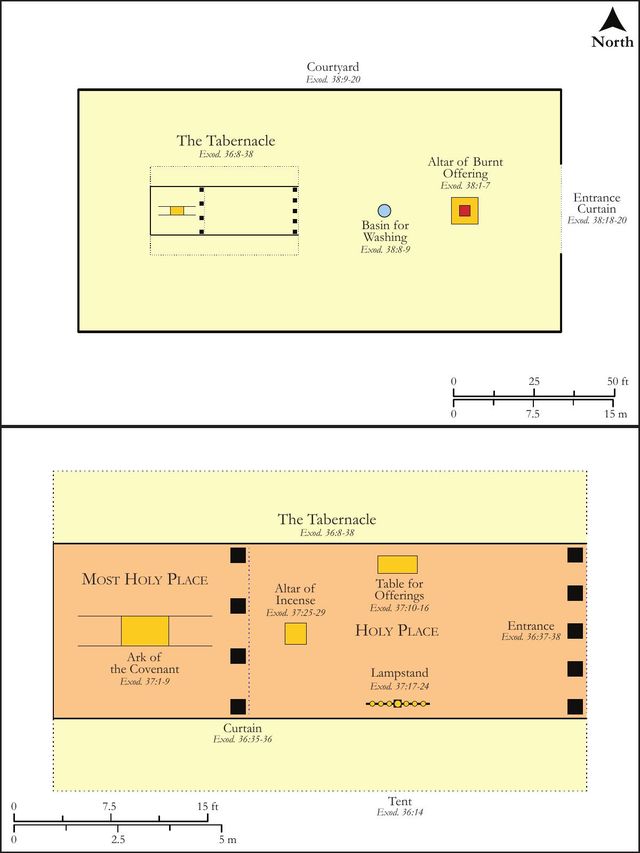
Exodus 37:3 meticulously details the casting of four gold rings for the Ark of the Covenant, specifying their precise placement on its four corners—two rings on each side. This seemingly minor architectural detail is profoundly significant, underscoring the divine blueprint for the Ark's construction, emphasizing the Ark's essential portability for Israel's wilderness journey, and reinforcing the absolute holiness of God's dwelling place, which necessitated a means of transport that prevented direct human contact.
Context
ShowHideLiterary Context
Exodus 37:3 is situated within the detailed account of Bezalel's execution of the Tabernacle's furnishings, precisely as commanded by God to Moses on Mount Sinai. Chapters 36-39 describe the actual construction, fulfilling the divine instructions laid out in Exodus 25-31. Specifically, this verse follows the description of the Ark's overall dimensions and the crafting of its mercy seat in Exodus 37:1-2. The rings described here are integral to the Ark's function, directly referencing the initial divine command for their inclusion in Exodus 25:12. The subsequent verses, such as Exodus 37:4-5, describe the poles that would pass through these rings, highlighting the functional continuity of the design. This meticulous recounting emphasizes the exact fulfillment of God's detailed instructions, signaling the sacredness and divine origin of every component of the Tabernacle.
Historical & Cultural Context
The construction of the Tabernacle occurred during Israel's nomadic journey through the wilderness after their liberation from Egypt. The Ark of the Covenant was the central piece of this mobile sanctuary, symbolizing God's covenantal presence among His people. Among the nations, their gods were associated with fixed temples and specific locations, such as the house of Dagon at Ashdod. However, the portable nature of the Tabernacle and the Ark underscored the unique character of Israel's God, Yahweh, who was not confined to a single place but actively journeyed with His people. The precise instructions for the Ark's rings and carrying poles (as seen in Numbers 4) were crucial for maintaining the Ark's holiness, as direct contact with it was forbidden and punishable by death (2 Samuel 6:6-7). This cultural emphasis on ritual purity and the extreme reverence for divine objects was common, but Israel's system, particularly concerning the Ark, was uniquely tied to their covenant with a holy God who demanded specific, obedient worship.
Key Themes
ShowHideThis verse contributes significantly to several overarching themes within Exodus and the Pentateuch. Firstly, it underscores the theme of Divine Sovereignty and Meticulous Design, demonstrating that God's plan for worship and His presence is exact and perfect, leaving no room for human improvisation (Exodus 25:9). Secondly, the rings' function for portability highlights God's Dynamic Presence with His people, emphasizing that He is not a static deity but one who actively journeys with Israel through the wilderness, providing guidance and protection (Numbers 10:33-36). Thirdly, the use of gold and the precise instructions for handling the Ark reinforce the theme of God's Absolute Holiness and the reverence required in approaching Him, emphasizing the sacredness of His dwelling place and the need for ritual purity (Leviticus 10:1-3). Finally, Bezalel's faithful execution of these details speaks to the theme of Obedient Craftsmanship, showcasing how human skill, divinely inspired, becomes an act of worship in fulfilling God's commands (Exodus 31:1-5).
Exposition and Analysis
ShowHideKey Word Analysis
ShowHideThis Hebrew verb signifies the act of pouring molten metal into a mold. It implies a deliberate, skilled, and precise process of creation, rather than simply hammering or shaping. The use of "cast" emphasizes Bezalel's craftsmanship as divinely gifted and executed with exactitude, ensuring the rings were perfectly formed and integrated into the Ark's design, reflecting the solidity and permanence intended for these functional elements.
This term refers to circular objects, often used for sealing, binding, or, as here, for holding. Their circular shape can symbolize completeness, eternity, or an unbroken connection. In this context, the rings were not merely decorative but served a vital, practical purpose: to securely hold the poles by which the Ark was carried. This highlights the functional yet symbolic nature of every element of the Tabernacle.
Gold is consistently used throughout the Tabernacle's construction for its preciousness, purity, and enduring quality. Symbolically, it represents divinity, glory, and supreme value. Its use for the rings, though functional, elevates their status, signifying that even the utilitarian components of the Ark were consecrated and imbued with sacred significance, reflecting the divine nature of the object they served.
Verse Breakdown
ShowHide"And he cast for it four rings of gold"
This clause describes Bezalel's skillful execution of a specific divine command. The act of "casting" indicates a deliberate, high-level metallurgical process, ensuring durability and precision. The "four rings of gold" signify a specific number and material, emphasizing the Ark's preciousness and the exactitude of the divine instructions.
"[to be set] by the four corners of it;"
This phrase specifies the strategic placement of the rings. "Corners" (from H6471, paʻam, literally "feet" or "legs" in Hebrew, referring to the base or supports) implies stability and balance. Placing a ring at each corner ensured that the Ark, when lifted by the poles, would be evenly supported and carried securely, preventing tilting or instability during transport.
"even two rings upon the one side of it, and two rings upon the other side of it."
This further clarifies the symmetrical and balanced distribution of the rings. The equal number of rings on opposing sides ensured that the Ark could be carried by two individuals (or pairs of individuals) simultaneously, maintaining its horizontal orientation and solemn bearing. This precision in placement underscores the functional design, which was paramount for the Ark's portability and the reverence with which it was to be handled.
Literary Devices
ShowHideThe description in Exodus 37:3, like much of the Tabernacle account, employs Precision and Detail as a primary literary device. The meticulous enumeration of "four rings," their placement "by the four corners," and the symmetrical distribution of "two rings upon the one side... and two rings upon the other" serves to emphasize the divine origin and perfect design of the Ark. This level of detail is not merely architectural instruction but a literary technique to convey the absolute authority and wisdom of God, whose plan leaves no room for human improvisation. Furthermore, the repeated mention of "gold" throughout the Tabernacle accounts, including for these rings, functions as Symbolism, associating the Ark and its components with purity, divinity, and immense value. The very act of "casting" the rings also highlights Craftsmanship and Skill, implicitly attributing these qualities to Bezalel as divinely inspired, thereby elevating the human act of construction to a sacred art.
Theological and Thematic Connections
ShowHideExodus 37:3, though a detail, powerfully communicates core theological truths about God's nature and His relationship with His people. The meticulous design of the rings, enabling the Ark's portability, signifies that God's presence is not static or confined to a single location but is dynamic and moves with His people. This underscores His commitment to journeying with Israel, adapting to their nomadic existence, and providing continuous guidance and protection. Moreover, the absolute precision of the divine instructions for these rings highlights God's sovereignty and His demand for obedient and exact worship. Every detail matters to God, reflecting His perfect order and holiness, and inviting His people to approach Him with reverence and faithfulness in every aspect of their service.
Reflection and Application
ShowHideThe seemingly small detail of four gold rings on the Ark of the Covenant offers profound lessons for believers today. God's meticulous attention to every component of the Tabernacle, even the means by which it was carried, reminds us that He is a God of order, precision, and purpose. This should inspire us to approach our own service and worship with similar diligence and intentionality, recognizing that even the "small" details of our obedience matter to Him. Just as the Ark's portability symbolized God's active presence with His people on their journey, so too are we called to understand that God's presence is not confined to church buildings or specific rituals, but is meant to be carried into every sphere of our lives and into the world. We are living temples of the Holy Spirit, commissioned to manifest God's presence and character wherever we go. This calls for a deep reverence for God's holiness, ensuring that our lives reflect the sacredness of His indwelling Spirit and that we handle His truth and His mission with the utmost care and respect.
Questions for Reflection
ShowHideFAQ
ShowHideWhy were these rings made of gold, and not a less expensive metal?
ShowHideThe rings were made of gold because the Ark of the Covenant, as the most sacred object in the Tabernacle, was to be entirely covered and adorned with the purest and most precious materials. Gold symbolized God's divinity, glory, purity, and supreme value. Its use for the rings, though functional, elevated their status, signifying that even the utilitarian components of the Ark were consecrated and imbued with sacred significance, reflecting the divine nature of the object they served. This was consistent with the overall design of the Ark, which was overlaid with pure gold both inside and out, as commanded in Exodus 25:11.
Were these rings purely functional, or did they have symbolic meaning as well?
ShowHideWhile primarily functional, enabling the Ark's portability, these rings also carried significant symbolic meaning. Their circular shape can symbolize completeness, eternity, and the unbroken covenant between God and Israel. Their gold material speaks to the Ark's divine nature and holiness. Moreover, the very necessity of these rings for carrying the Ark without direct human contact underscored the absolute holiness of God and the reverence required in approaching His presence, a theme consistently reinforced throughout the Tabernacle's design and the laws surrounding its use (Numbers 4:15).
Christ-Centered Fulfillment
ShowHideThe detailed description of the Ark's gold rings in Exodus 37:3, designed for its portability and the preservation of its holiness, finds its ultimate fulfillment in Jesus Christ. The Ark symbolized God's dwelling presence among His people, but Christ is Emmanuel, "God with us" (Matthew 1:23). Unlike the Ark, which required physical rings and poles to be carried from place to place, Christ's presence is not confined by physical limitations or external apparatus. Through His incarnation, death, resurrection, and ascension, He has made God's presence accessible to all believers by the indwelling Holy Spirit (John 14:16-17). The "portability" of God's presence, once facilitated by the Ark's rings, is now realized in the lives of believers, who are called to be living temples of the Holy Spirit (1 Corinthians 6:19) and to carry the good news of God's presence and salvation into all the world (Matthew 28:19-20). The Ark's holiness, which demanded careful handling, foreshadowed the perfect holiness of Christ, whose sacrificial blood grants us direct access to God's presence without fear, fulfilling the shadows of the old covenant with the reality of the new (Hebrews 10:19-22).