


2 Chronicles 36:9
Bible text: King James Version (1769 Blayney text) · Public domain
Bible text: King James Version with Strong's numbers · Public domain
Bible text: Berean Standard Bible · Public domain
Bible text: American Standard Version (1901) · Public domain
Bible text: World English Bible, Messianic edition · Public domain
Bible text: Geneva Bible (1599) · Public domain
Bible text: Young's Literal Translation · Public domain
- בֶּןben[was] a son ofH1121N-mscNoun Singular Masculine Construct
- שְׁמוֹנֶהshe·mo·NeheightH8083N-csNoun Singular common gender Absolute
- שָׁנִיםsha·NimyearsH8141N-mpNoun Plural Masculine Absolute
- יְהוֹיָכִיןye·ho·ya·KhinJehoiachinH3078N-proper-mNoun Proper Masculine
- בְּמָלְכוֹbe·ma·le·Khowhen he became kingH4427Prep-b ¦ V-Qal-Inf ¦ 3msVerb Qal Infinitive Constructבְּwhenמָלְכbecame kingוֹhe
- וּשְׁלֹשָׁהu·she·lo·Shahand threeH7969Conj-w ¦ N-csNoun Singular common gender Absoluteוּandשְׁלֹשָׁהthree
- חֳדָשִׁיםcho·da·ShimmonthsH2320N-mpNoun Plural Masculine Absolute
- וַעֲשֶׂרֶתva·'a·Se·retand tenH6235Conj-w ¦ N-fscNoun Singular Feminine Constructוַandעֲשֶׂרֶתten
- יָמִיםya·MimdaysH3117N-mpNoun Plural Masculine Absolute
- מָלַךְma·Lakhhe reignedH4427V-Qal-Perf-3msVerb Qal Perfect 3rd Singular Masculine
- בִּירוּשָׁלִָםbi·ru·sha·Limin JerusalemH3389Prep-b ¦ N-properNoun Proper LocationבִּinירוּשָׁלִָםJerusalem
- וַיַּעַשׂvai·Ya·'asand he didH6213Conj-w ¦ V-Qal-ConsecImperf-3msVerb Qal Consecutive Imperfect 3rd Singular Masculineוַandיַּעַשׂhe did
- הָרַעha·Ra'the evilH7451Art ¦ Adj-msAdjective Singular Masculine Absoluteהָtheרַעevil
- בְּעֵינֵיbe·'ei·Neiin [the] eyes ofH5869Prep-b ¦ N-fdcNoun Dual Feminine Constructבְּinעֵינֵי[the] eyes of
- יְהוָהYah·wehYahwehH3068N-properNoun Proper Title
English is a literal word-by-word gloss of the Hebrew, not the KJV's wording. Why?
This is the original text the KJV's translators worked from — each Hebrew word with its own literal English meaning in this verse, prepared by scholars at Tyndale House, Cambridge. The KJV translates whole sentences, not word by word, so its wording differs: one Hebrew word can become several English words, and the KJV may choose “the LORD” where the gloss reads “Yahweh”. Both are faithful — they answer different questions. For the KJV's own rendering, switch to the KJV text.
Details
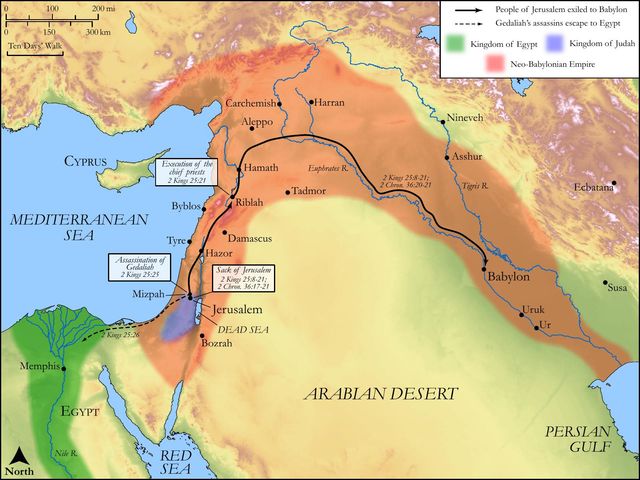
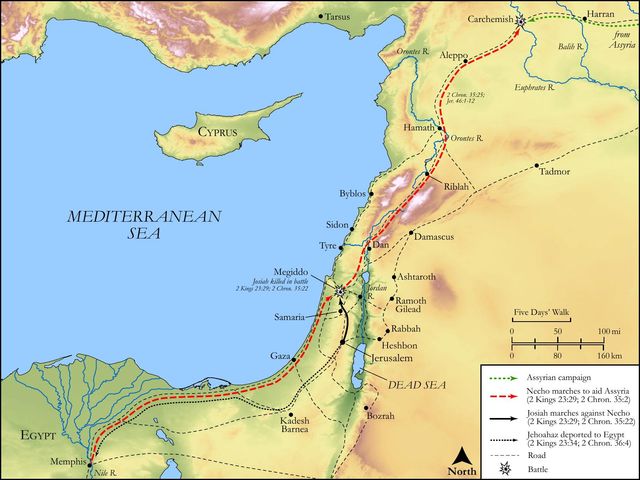
See on the biblical-era maps
Study this verse
Public-domain commentary
Matthew Henry
From his Commentary on the Whole Bible. Henry comments on passages, not single verses — this entry covers 2 Chronicles 36:1–10.
The destruction of Judah and Jerusalem is here coming on by degrees. God so ordered it to show that he has no pleasure in the ruin of sinners, but had rather they would turn and live, and therefore gives them both time and inducement to repent and waits to be gracious. The history of these reigns was more largely recorded in the last three chapters of the second of Kings. 1. Jehoahaz was set up by the people (Ch2 36:1), but in one quarter of a year was deposed by Pharaoh-necho, and carried a prisoner to Egypt, and the land fined for setting him up, Ch2 36:2-4. Of this young prince we hear no more. Had he trodden in the steps of his father's piety he might have reigned long and prospered; but we are told in the Kings that he did evil in the sight of the Lord, and therefore his triumphing was short and his joy but for a moment. 2. Jehoiakim was set up by the king of Egypt, an old enemy to their land, gave what king he pleased to the kingdom and what name he pleased to the king! Ch2 36:4. He made Eliakim king, and called him Jehoiakim, in token of his authority over him. Jehoiakim did that which was evil (Ch2 36:5), nay, we read of the abominations which he did (Ch2 36:8); he was very wild and wicked. Idolatries generally go under the name of abominations. We hear no more of the king of Egypt, but the king of Babylon came up against him (Ch2 36:6), seized him, and bound him with a design to carry him to Babylon; but, it seems, he either changed his mind, and suffered him to reign as his vassal, or death released the prisoner before he was carried away. However the best and most valuable vessels of the temple were now carried away and made use of in Nebuchadnezzar's temple in Babylon (Ch2 36:7); for, we may suppose, no temple in the world was so richly furnished as that of Jerusalem. The sin of Judah was that they had brought the idols of the heathen into God's temple; and now their punishment was that the vessels of the temple were carried away to the service of the gods of the nations. If men will profane God's institutions by their sins, it is just with God to suffer them to be profaned by their enemies. These were the vessels which the false prophets flattered the people with hopes of the return of, Jer 27:16. But Jeremiah told them that the rest should go after them (Jer 27:21, Jer 27:22), and they did so. But, as the carrying away of these vessels to Babylon began the calamity of Jerusalem, so Belshazzar's daring profanation of them there filled the measure of the iniquity of Babylon; for, when he drank wine in them to the honour of his gods, the handwriting on the wall presented him with his doom, Dan 5:3, etc. In the reference to the book of the Kings concerning this Jehoiakim mention is made of that which was found in him (Ch2 36:8), which seems to be meant of the treachery that was found in him towards the king of Babylon; but some of the Jewish writers understand it of certain private marks or signatures found in his dead body, in honour of his idol, such cuttings as God had forbidden, Lev 19:28. 3. Jehoiachin, or Jeconiah, the son of Jehoiakim, attempted to reign in his stead, and reigned long enough to show his evil inclination; but, after three months and ten days, the king of Babylon sent and fetched him away captive, with more of the goodly vessels of the temple. He is here said to be eight years old, but in Kings he is said to be eighteen when he began to reign, so that this seems to be a mistake of the transcriber, unless we suppose that his father took him at eight years old to join with him in the government, as some think.
Historical interpretation
Historical reception
1 surviving comment on this verse from the historical church.
Eight years old: He was associated by his father to the kingdom, when he was but eight years old; but after his father's death, when he reigned alone, he was eighteen years old. 4 Kings 24. 8.
Continue studying 2 Chronicles 36:9 across the web’s major study libraries — every link below opens this exact verse, chapter, or book on the destination site.
Read & Compare
 BibleGatewayThis verse in more than 200 translations and 70 languages.
 Bible.comThe YouVersion reader — hundreds of translations, reading plans, and highlights.
 ESV.orgCrossway's official English Standard Version reader.
 NET BibleThe NET translation with 60,000+ translators' notes on every rendering decision.
 STEP BibleTyndale House's free study tool — original text, vocabulary, and scholarly resources.
 BibliaLogos Bible Software's free web reader.
 USCCBThe New American Bible (Revised Edition) with the U.S. bishops' study notes.
Commentaries
 BibleHub CommentariesDozens of classic commentaries on this verse, gathered on one page.
 StudyLightMore than 100 commentary sets — the largest collection on the web.
 BibleRefPlain-English commentary on what this verse means, verse by verse.
 Enduring WordDavid Guzik's free commentary on this chapter, widely used by Bible teachers.
 Bible Study ToolsVerse commentary alongside Greek and Hebrew study aids.
Original Language & Research
- BibleHub InterlinearThe verse word by word — original language, transliteration, and English.
- BibleHub LexiconEvery word's original-language definition and Strong's entry.
 Blue Letter BibleDeep-study tools — Strong's numbers, concordance, and word studies.
 SefariaThe Hebrew text with Rashi and centuries of Jewish commentary.
Sermons, Hymns & Audio


TrulyRandomVerse is not affiliated with these sites and doesn’t control their content. They’re linked because they’re genuinely useful.
Summary
Second Chronicles 36:9 introduces Jehoiachin, a young king of Judah whose brief three-month and ten-day reign in Jerusalem was unequivocally condemned as "evil in the sight of the LORD." This concise verdict highlights the rapid moral decline of Judah's monarchy and underscores the imminent divine judgment, setting the immediate stage for the final destruction of Jerusalem and the Babylonian exile.
Context
ShowHideLiterary Context
This verse is situated within the Chronicler's highly condensed account of Judah's final kings, a narrative designed to illustrate the accelerating moral decay and the direct theological reasons for the nation's downfall. It follows the equally wicked reign of Jehoiachin's father, Jehoiakim, whose death and the initial Babylonian incursion are detailed in 2 Chronicles 36:5-8. The brevity of Jehoiachin's reign, immediately followed by his deportation and the installation of Zedekiah in 2 Chronicles 36:10, emphasizes the rapid succession of failed kings and the kingdom's terminal state. The Chronicler's primary concern is not political detail but the consistent pattern of royal disobedience that culminated in the fulfillment of prophetic warnings and the devastating exile.
Historical & Cultural Context
Jehoiachin's brief reign in 597 BCE occurred at a critical juncture in Judah's history, as the Neo-Babylonian Empire, under Nebuchadnezzar, solidified its dominance over Judah and the nations round about following the collapse of Assyria. Judah, a small kingdom in subjection to Babylon, found itself precariously positioned amidst these shifting global powers. Jehoiachin ascended the throne during Nebuchadnezzar's first major siege of Jerusalem, a direct consequence of his father Jehoiakim's rebellion against Babylon. Culturally, the kings of Judah were expected to uphold the Mosaic covenant, promote righteousness, and maintain exclusive worship of Yahweh. The recurring theological judgment, "did that which was evil in the sight of the LORD," signifies a profound failure to meet these divine standards, often involving idolatry, oppression, and a disregard for God's revealed will and prophetic counsel.
Key Themes
ShowHideThe account of Jehoiachin's reign, though remarkably short, contributes significantly to several overarching themes in the book of Chronicles. Foremost among these is the theme of Divine Judgment and Covenant Faithfulness. The consistent pattern of kings doing "that which was evil in the sight of the LORD" (a verdict echoed for Jehoiakim in 2 Chronicles 36:5 and Zedekiah in 2 Chronicles 36:12) highlights Judah's persistent rebellion against God's covenant and the inevitable, divinely ordained consequences. This narrative also powerfully illustrates the Consequences of Leadership, demonstrating how the spiritual and moral choices of the king directly determined the destiny of the entire nation, leading to national catastrophe. Finally, the swift and decisive end of Jehoiachin's reign, culminating in exile, reinforces the Sovereignty of God in History. Even amidst human wickedness and political turmoil, God remains in control, orchestrating events to fulfill His righteous purposes, including the discipline of His people through exile, a period also envisioned as preparation for future restoration as prophesied by Jeremiah (Jeremiah 25:11-12).
Exposition and Analysis
ShowHideKey Word Analysis
ShowHideMeaning "Jehovah will establish." The name itself carries a profound, tragic irony. Despite the divine promise embedded in his name, Jehoiachin's reign was anything but established; it was remarkably brief and ended in immediate exile. This serves as a stark reminder that God's promises are not unconditional guarantees for individuals regardless of their actions, but rather tied to covenant faithfulness, and His ultimate establishment is often realized through unexpected means, even judgment.
A primitive root meaning "to reign; inceptively, to ascend the throne; causatively, to induct into royalty." This word emphasizes the act of assuming and exercising royal authority. In Jehoiachin's case, the brevity of his "reigning" highlights the futility and instability of the Davidic monarchy in its final days, where the act of ruling was immediately met with divine disapproval and foreign subjugation, rendering his kingship largely nominal.
Meaning "bad or (as noun) evil (natural or moral)." This term is a comprehensive theological and moral indictment. When applied to a king, it signifies a profound failure to adhere to God's covenant standards, often encompassing idolatry, injustice, and a disregard for the Law and prophetic warnings. Jehoiachin's actions, though unspecified, were deemed by God to be morally corrupt and antithetical to His will, leading directly to the severe consequences that followed.
Verse Breakdown
ShowHide"Jehoiachin [was] eight years old when he began to reign"
This clause introduces the new king and immediately presents a striking detail regarding his extreme youth at the time of his ascension. While the parallel account in 2 Kings 24:8 states he was eighteen, the Chronicler's emphasis on "eight years old" (whether a textual variant or deliberate choice) underscores the kingdom's desperate state, where even a child (or very young man) was thrust into a position of immense responsibility, yet still held accountable for his actions.
"and he reigned three months and ten days in Jerusalem"
This exceptionally brief duration underscores the profound instability and rapid deterioration of the kingdom of Judah. It signifies the terminal stage of the Davidic monarchy, where kings were mere temporary figures caught between overwhelming Babylonian power and divine judgment. This brevity is a direct consequence of the nation's and its leaders' persistent sin and rebellion against God.
"and he did [that which was] evil in the sight of the LORD"
This concluding phrase delivers the definitive divine judgment on Jehoiachin's reign. Despite his youth and the very short time he spent on the throne, he is unequivocally condemned by God's righteous standard. This moral failure, consistent with his father and predecessor, confirms that the kingdom's downfall was not merely a political misfortune but a direct result of its spiritual rebellion and covenant unfaithfulness.
Literary Devices
ShowHideThe Chronicler masterfully employs several literary devices in this concise verse to convey its profound theological message. Repetition is evident in the formulaic phrase "did that which was evil in the sight of the LORD," which echoes throughout the accounts of Judah's later kings, creating a cumulative sense of pervasive moral decay and divine displeasure. This repetition emphasizes the consistent pattern of sin that inevitably led to the nation's downfall. Juxtaposition is powerfully used by placing Jehoiachin's extreme youth ("eight years old") immediately alongside the divine verdict of his evil actions. This stark contrast highlights the tragic inevitability of the royal line's corruption, suggesting that even a young king, perhaps influenced by his predecessors or the prevailing culture, was unable to escape the pervasive spiritual sickness that afflicted Judah. Finally, the extraordinary brevity of Jehoiachin's reign, coupled with his moral failure, serves as a potent form of foreshadowing, hinting at the imminent and complete destruction of Jerusalem and the exile of its people, which would follow shortly thereafter under Zedekiah.
Theological and Thematic Connections
ShowHideThe brief, tragic account of Jehoiachin's reign in 2 Chronicles 36:9 stands as a poignant theological statement about the consequences of persistent covenant unfaithfulness and the unwavering nature of divine justice. His short tenure, marked by the familiar verdict of "evil in the sight of the LORD," encapsulates the terminal decline of the Davidic monarchy and the nation of Judah. It demonstrates that God's patience, while vast, is not infinite, and that repeated rebellion against His commands inevitably leads to severe judgment, culminating in the exile. This period, though dark and painful, was also part of God's sovereign plan to purge His people and prepare them for future restoration, even as it brought to a temporary end the line of kings reigning in Jerusalem.
Reflection and Application
ShowHideThe account of King Jehoiachin, despite its remarkable brevity, offers profound and enduring lessons for contemporary believers. It underscores the critical importance of spiritual integrity and moral uprightness, particularly for those entrusted with leadership, reminding us that God holds all individuals accountable for their actions and influence, regardless of their age or the duration of their authority. Jehoiachin's immediate failure, even in a short reign, highlights that the trajectory of our lives, whether long or short, is ultimately defined by our alignment with God's revealed will and our commitment to His covenant. Furthermore, this narrative serves as a sobering reminder of the destructive and pervasive nature of sin, especially when it becomes widespread or is embraced by those in positions of power. It illustrates how individual choices can have far-reaching and devastating consequences, impacting entire communities and even generations. Ultimately, it calls us to a deep and honest self-examination, prompting us to consider whether our own lives, and the communities we belong to, are truly "in the sight of the LORD" doing what is good and righteous, or if we are subtly or overtly embracing practices that are evil in His eyes, inviting His righteous discipline.
Questions for Reflection
ShowHideFAQ
ShowHideWhy does 2 Chronicles say Jehoiachin was eight years old, while 2 Kings says eighteen?
ShowHideThis is a well-known textual variant among biblical scholars. 2 Chronicles 36:9 states Jehoiachin was eight years old, while the parallel account in 2 Kings 24:8 states he was eighteen. Most scholars consider the "eighteen years old" reading in 2 Kings to be the more historically accurate, original text, with the "eight years old" in Chronicles likely being a scribal error (a common type of error in ancient Hebrew manuscripts involving similar-looking letters or numbers). While an eight-year-old king would be highly unusual, the Chronicler's primary concern is not precise biographical detail but the theological verdict on the king's reign, emphasizing his immediate failure to uphold God's standards regardless of his exact age.
What was the specific "evil" Jehoiachin did?
ShowHideThe text of 2 Chronicles 36:9 does not specify the particular "evil" Jehoiachin committed. However, the recurring phrase "did that which was evil in the sight of the LORD" (also used for his father Jehoiakim in 2 Chronicles 36:5) is a theological indictment used throughout Kings and Chronicles. It typically refers to a king's failure to uphold the Mosaic covenant, which included tolerating or promoting idolatry, engaging in oppression, and disregarding the prophetic word. Given the extreme brevity of his reign and the context of Judah's profound spiritual decline, it's highly probable that Jehoiachin continued the pattern of unfaithfulness established by his predecessors, failing to lead the nation in obedience to Yahweh.
How significant was Jehoiachin's reign despite its brevity?
ShowHideDespite reigning for only "three months and ten days," Jehoiachin's reign was profoundly significant in the history of Judah. It marked the first major deportation of the Jewish elite to Babylon in 597 BCE, including skilled craftsmen, warriors, and prominent figures like the prophet Ezekiel (Ezekiel 1:1-3). This event, often referred to as the first Babylonian exile, effectively ended Judah's independent monarchy and signaled the beginning of the end for the kingdom of Judah. It was a pivotal moment in the fulfillment of God's judgment against His people's persistent sin, ushering in the period of the Babylonian Captivity that would profoundly shape Jewish identity and theology for centuries to come.
Christ-Centered Fulfillment
ShowHideThe brief and failed reign of Jehoiachin in 2 Chronicles 36:9 serves as a powerful testament to the inherent brokenness of human kingship and the ultimate, desperate need for a perfect, righteous King. His short tenure, marked by the damning verdict of "evil in the sight of the LORD," underscores the tragic trajectory of the Davidic line, which, despite God's eternal covenant with David (2 Samuel 7:12-16), consistently produced flawed rulers who led the nation astray. Jehoiachin's immediate failure and subsequent exile highlight the profound inability of any earthly monarch to truly fulfill God's righteous demands or secure lasting peace and salvation for His people. This historical reality points forward to Jesus Christ, the true Son of David, in whose genealogy Jehoiachin (also known as Jeconiah or Coniah) is explicitly named (Matthew 1:11-12, 17). Unlike Jehoiachin, Jesus' reign is not marked by evil but by perfect righteousness and absolute sinlessness (Hebrews 7:26, 1 Peter 2:22). He is the King who truly takes away the sin of the world (John 1:29) and whose kingdom is eternal, unshakable, and not of this world (Luke 1:32-33, John 18:36), providing the ultimate and complete fulfillment of God's promise for a perfect, everlasting ruler.