


2 Chronicles 36:8
Bible text: King James Version (1769 Blayney text) · Public domain
Bible text: King James Version with Strong's numbers · Public domain
Bible text: Berean Standard Bible · Public domain
Bible text: American Standard Version (1901) · Public domain
Bible text: World English Bible, Messianic edition · Public domain
Bible text: Geneva Bible (1599) · Public domain
Bible text: Young's Literal Translation · Public domain
- וְיֶתֶרve·ye·Terand [the] rest ofH3499Conj-w ¦ N-mscNoun Singular Masculine Constructוְandיֶתֶר[the] rest of
- דִּבְרֵיdiv·Rei[the] matters ofH1697N-mpcNoun Plural Masculine Construct
- יְהוֹיָקִיםye·ho·ya·KimJehoiakimH3079N-proper-mNoun Proper Masculine
- וְתֹעֲבֹתָיוve·to·'a·vo·Tavand his abominationsH8441Conj-w ¦ N-fpc ¦ 3msNoun Plural Feminine Constructוְandתֹעֲבֹתָיabominationsוhis
- אֲשֶׁר'a·SherwhichH834RelParticle Relative
- עָשָׂה'a·Sahhe didH6213V-Qal-Perf-3msVerb Qal Perfect 3rd Singular Masculine
- וְהַנִּמְצָאve·ha·nim·Tza'and <the> [what] was foundH4672Conj-w ¦ Art ¦ V-Niphal-Prtcpl-msVerb Niphal Participle Singular Masculine Absoluteוְandהַ<the>נִּמְצָא[what] was found
- עָלָיו'a·Lavon himH5921Prep ¦ 3msPrepositionעָלָיonוhim
- הִנָּםhi·Namthere theyH2005Prt ¦ 3mpParticle Interjectionהִנָּthereםthey
- כְּתוּבִיםke·tu·Vim[are] writtenH3789V-Qal-PassPrtcpl-mpVerb Qal Participle Passive Plural Masculine Absolute
- עַל'alonH5921PrepPreposition
- סֵפֶרSe·fer[the] scroll ofH5612N-mscNoun Singular Masculine Construct
- מַלְכֵיmal·Khei[the] kings ofH4428N-mpcNoun Plural Masculine Construct
- יִשְׂרָאֵלYis·ra·'ElIsraelH3478N-properNoun Proper Location
- וִיהוּדָהvi·hu·Dahand JudahH3063Conj-w ¦ N-properNoun Proper LocationוִandיהוּדָהJudah
- וַיִּמְלֹךְvai·yim·Lokhand he became kingH4427Conj-w ¦ V-Qal-ConsecImperf-3msVerb Qal Consecutive Imperfect 3rd Singular Masculineוַandיִּמְלֹךְhe became king
- יְהוֹיָכִיןye·ho·ya·KhinJehoiachinH3078N-proper-mNoun Proper Masculine
- בְּנוֹbe·Nohis sonH1121N-msc ¦ 3msNoun Singular Masculine Constructבְּנsonוֹhis
- תַּחְתָּיוtach·Tavin place of himH8478N-mpc ¦ 3msNoun Plural Masculine Constructתַּחְתָּיin place ofוhim
English is a literal word-by-word gloss of the Hebrew, not the KJV's wording. Why?
This is the original text the KJV's translators worked from — each Hebrew word with its own literal English meaning in this verse, prepared by scholars at Tyndale House, Cambridge. The KJV translates whole sentences, not word by word, so its wording differs: one Hebrew word can become several English words, and the KJV may choose “the LORD” where the gloss reads “Yahweh”. Both are faithful — they answer different questions. For the KJV's own rendering, switch to the KJV text.
Details
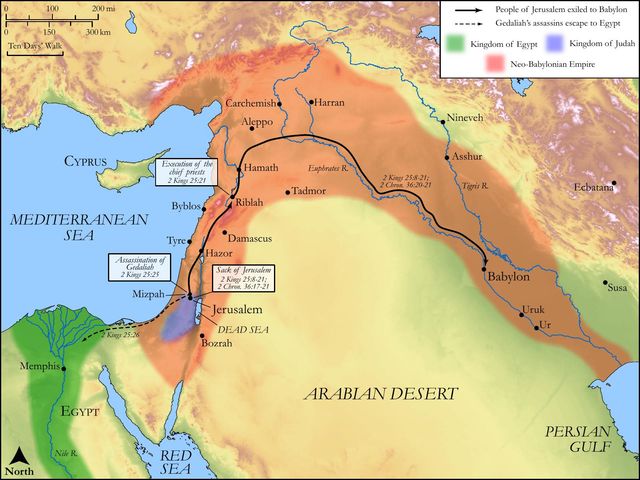
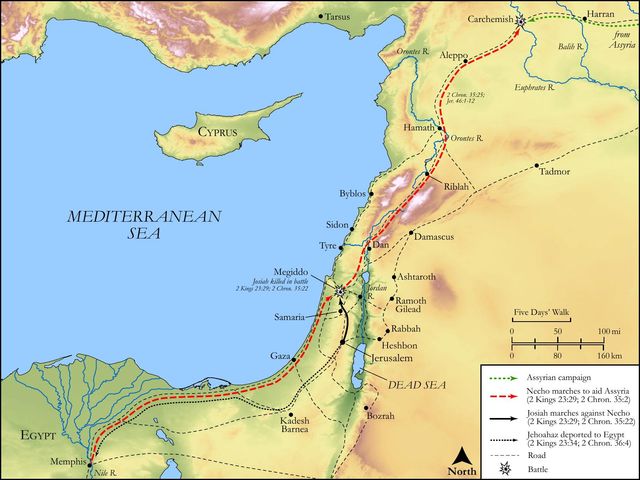
See on the biblical-era maps
Study this verse
Public-domain commentary
Matthew Henry
From his Commentary on the Whole Bible. Henry comments on passages, not single verses — this entry covers 2 Chronicles 36:1–10.
The destruction of Judah and Jerusalem is here coming on by degrees. God so ordered it to show that he has no pleasure in the ruin of sinners, but had rather they would turn and live, and therefore gives them both time and inducement to repent and waits to be gracious. The history of these reigns was more largely recorded in the last three chapters of the second of Kings. 1. Jehoahaz was set up by the people (Ch2 36:1), but in one quarter of a year was deposed by Pharaoh-necho, and carried a prisoner to Egypt, and the land fined for setting him up, Ch2 36:2-4. Of this young prince we hear no more. Had he trodden in the steps of his father's piety he might have reigned long and prospered; but we are told in the Kings that he did evil in the sight of the Lord, and therefore his triumphing was short and his joy but for a moment. 2. Jehoiakim was set up by the king of Egypt, an old enemy to their land, gave what king he pleased to the kingdom and what name he pleased to the king! Ch2 36:4. He made Eliakim king, and called him Jehoiakim, in token of his authority over him. Jehoiakim did that which was evil (Ch2 36:5), nay, we read of the abominations which he did (Ch2 36:8); he was very wild and wicked. Idolatries generally go under the name of abominations. We hear no more of the king of Egypt, but the king of Babylon came up against him (Ch2 36:6), seized him, and bound him with a design to carry him to Babylon; but, it seems, he either changed his mind, and suffered him to reign as his vassal, or death released the prisoner before he was carried away. However the best and most valuable vessels of the temple were now carried away and made use of in Nebuchadnezzar's temple in Babylon (Ch2 36:7); for, we may suppose, no temple in the world was so richly furnished as that of Jerusalem. The sin of Judah was that they had brought the idols of the heathen into God's temple; and now their punishment was that the vessels of the temple were carried away to the service of the gods of the nations. If men will profane God's institutions by their sins, it is just with God to suffer them to be profaned by their enemies. These were the vessels which the false prophets flattered the people with hopes of the return of, Jer 27:16. But Jeremiah told them that the rest should go after them (Jer 27:21, Jer 27:22), and they did so. But, as the carrying away of these vessels to Babylon began the calamity of Jerusalem, so Belshazzar's daring profanation of them there filled the measure of the iniquity of Babylon; for, when he drank wine in them to the honour of his gods, the handwriting on the wall presented him with his doom, Dan 5:3, etc. In the reference to the book of the Kings concerning this Jehoiakim mention is made of that which was found in him (Ch2 36:8), which seems to be meant of the treachery that was found in him towards the king of Babylon; but some of the Jewish writers understand it of certain private marks or signatures found in his dead body, in honour of his idol, such cuttings as God had forbidden, Lev 19:28. 3. Jehoiachin, or Jeconiah, the son of Jehoiakim, attempted to reign in his stead, and reigned long enough to show his evil inclination; but, after three months and ten days, the king of Babylon sent and fetched him away captive, with more of the goodly vessels of the temple. He is here said to be eight years old, but in Kings he is said to be eighteen when he began to reign, so that this seems to be a mistake of the transcriber, unless we suppose that his father took him at eight years old to join with him in the government, as some think.
Continue studying 2 Chronicles 36:8 across the web’s major study libraries — every link below opens this exact verse, chapter, or book on the destination site.
Read & Compare
 BibleGatewayThis verse in more than 200 translations and 70 languages.
 Bible.comThe YouVersion reader — hundreds of translations, reading plans, and highlights.
 ESV.orgCrossway's official English Standard Version reader.
 NET BibleThe NET translation with 60,000+ translators' notes on every rendering decision.
 STEP BibleTyndale House's free study tool — original text, vocabulary, and scholarly resources.
 BibliaLogos Bible Software's free web reader.
 USCCBThe New American Bible (Revised Edition) with the U.S. bishops' study notes.
Commentaries
 BibleHub CommentariesDozens of classic commentaries on this verse, gathered on one page.
 StudyLightMore than 100 commentary sets — the largest collection on the web.
 BibleRefPlain-English commentary on what this verse means, verse by verse.
 Enduring WordDavid Guzik's free commentary on this chapter, widely used by Bible teachers.
 Bible Study ToolsVerse commentary alongside Greek and Hebrew study aids.
Original Language & Research
- BibleHub InterlinearThe verse word by word — original language, transliteration, and English.
- BibleHub LexiconEvery word's original-language definition and Strong's entry.
 Blue Letter BibleDeep-study tools — Strong's numbers, concordance, and word studies.
 SefariaThe Hebrew text with Rashi and centuries of Jewish commentary.
Sermons, Hymns & Audio


TrulyRandomVerse is not affiliated with these sites and doesn’t control their content. They’re linked because they’re genuinely useful.
Summary
Second Chronicles 36:8 serves as a concise yet powerful epilogue to King Jehoiakim's tumultuous eleven-year reign, highlighting his profound spiritual "abominations" and confirming that his deeds are meticulously documented in the historical annals of Judah. This pivotal verse immediately transitions to the succession of his son, Jehoiachin, to the throne, underscoring the rapid and tragic decline of the Davidic monarchy and Judah's accelerating descent towards the inevitable Babylonian exile, a direct consequence of persistent unfaithfulness to God.
Context
ShowHideLiterary Context
This verse is strategically placed at the culmination of 2 Chronicles, a book meticulously tracing the history of the Davidic monarchy from its zenith under Solomon to its nadir in the Babylonian exile. The Chronicler's primary theological agenda is to demonstrate the consequences of covenant faithfulness and unfaithfulness, particularly among the kings of Judah. Chapter 36, in particular, dramatically accelerates the narrative, detailing the swift succession of Judah's final four kings—Jehoahaz, Jehoiakim, Jehoiachin, and Zedekiah—each reigning briefly and proving unfaithful, thereby precipitating Judah's divine judgment. Verse 8 functions as a stark epitaph for Jehoiakim, mirroring the Chronicler's characteristic pattern of summarizing each king's rule with a theological assessment. Its brevity, especially concerning Jehoiakim's "abominations," serves to underscore the Chronicler's disinterest in merely historical detail, instead focusing on the spiritual depravity that led to Judah's downfall. It directly follows the account of Jehoiakim's installation by Pharaoh Necho and his unrighteous rule, setting the stage for the even briefer and more tragic reign of Jehoiachin, who ruled for only three months and ten days.
Historical & Cultural Context
King Jehoiakim's reign (609-598 BC) unfolded during a period of intense geopolitical flux among the kingdoms of that day. Installed as a puppet king by Pharaoh Necho of Egypt after the death of his righteous father, Josiah, at Megiddo 2 Kings 23:34, Jehoiakim later shifted allegiance to the ascendant Babylonian Empire under Nebuchadnezzar. His rule was characterized by profound spiritual apostasy, marked by a reversal of Josiah's reforms, and by severe injustice and oppression. The prophet Jeremiah vehemently condemned Jehoiakim for his greed, injustice, and blatant defiance of God's word, famously recounting how Jehoiakim cut up and burned Jeremiah's prophetic scroll Jeremiah 36:23. The "abominations" mentioned in 2 Chronicles 36:8 would have encompassed a range of practices detestable to the Lord, including the reintroduction of idolatry, the shedding of innocent blood, and the exploitation of his people, mirroring the abhorrent customs of surrounding pagan nations. These actions directly provoked divine wrath, culminating in the inevitable Babylonian invasions and the eventual exile of Judah.
Key Themes
ShowHideThis verse encapsulates several critical themes prevalent throughout 2 Chronicles and the broader Old Testament narrative. Firstly, it powerfully illustrates the Consequences of Disobedience, particularly for those in positions of leadership. Jehoiakim's "abominations" are presented as the direct catalyst for divine judgment, reinforcing the principle that persistent sin, especially against God's covenant, inevitably leads to national ruin and divine abandonment. Secondly, the declaration "behold, they are written in the book of the kings of Israel and Judah" highlights the theme of Divine Record-Keeping and Accountability. It underscores that all human actions, whether righteous or wicked, are meticulously observed and recorded, serving as an enduring testament to God's omniscience and ultimate justice. This emphasizes that no ruler, however powerful, escapes the divine reckoning, a theme echoed in Revelation 20:12-13. Thirdly, the swift mention of Jehoiachin's succession points to the theme of Succession and Accelerating Decline. The rapid turnover of unrighteous kings in Judah's final years vividly portrays a kingdom spiraling out of control, devoid of godly leadership, and rushing headlong towards its divinely ordained destruction and exile. This tragic sequence of events ultimately underscores God's unwavering Sovereignty over history, even amidst human wickedness, as His purposes and prophetic pronouncements are brought to pass.
Exposition and Analysis
ShowHideKey Word Analysis
ShowHideMeaning "an overhanging, i.e. (by implication) an excess, superiority, remainder; also a small rope (as hanging free)." In this context, "the rest" refers to the remainder or residue of Jehoiakim's acts, implying that the Chronicler is providing a summary rather than an exhaustive account. It suggests that what is recorded is merely a selection of his deeds, but crucially, it includes the most significant and damning aspects: his "abominations." This word subtly points to the vastness of his unrighteousness, only a "remainder" of which is highlighted.
A feminine active participle meaning "properly, something disgusting (morally), i.e. (as noun) an abhorrence; especially idolatry or (concretely) an idol." This term is profoundly strong, denoting actions utterly repugnant and contrary to God's holy character and covenant commands. In the Old Testament, tôwʻēḇâ is consistently used for idolatrous practices (e.g., child sacrifice, worship of foreign gods), sexual perversions, and severe oppression. Jehoiakim's "abominations" thus signify his profound spiritual rebellion and defiance of God's law, which were central to Judah's downfall.
A primitive root meaning "to grave, by implication, to write (describe, inscribe, prescribe, subscribe)." The passive participle "written" emphasizes the permanence and established fact of the record. It signifies that Jehoiakim's acts and abominations are not merely remembered but formally documented in official annals. This highlights the Chronicler's reliance on and affirmation of existing historical records, lending credibility to the biblical narrative. More profoundly, it speaks to the divine principle of accountability, where every action is recorded and will ultimately be brought to light, underscoring God's meticulous oversight of human history and His unwavering justice.
Verse Breakdown
ShowHide"Now the rest of the acts of Jehoiakim, and his abominations which he did, and that which was found in him"
This opening clause serves as a comprehensive summary of Jehoiakim's reign. "The rest of the acts" indicates that the Chronicler is providing a concise overview rather than a full biography, focusing on the most salient points. The phrase "his abominations which he did" specifically singles out his detestable, covenant-breaking actions as the defining characteristic of his rule, highlighting the profound spiritual depravity that marked his kingship. "And that which was found in him" suggests a deeper, more intrinsic assessment of his character—perhaps his inherent wickedness, his true nature revealed through his deeds, or the specific charges and judgments leveled against him by God. This implies a divine assessment of his heart and motives, beyond just his external actions.
"behold, they [are] written in the book of the kings of Israel and Judah"
This clause functions as an authoritative historical and theological reference. The "book of the kings of Israel and Judah" refers to the royal annals or state chronicles maintained by the kingdoms, which the Chronicler consulted and affirmed as reliable sources. The inclusion of "behold" serves as an interjection, drawing the reader's attention to the certainty and veracity of this historical documentation. Theologically, it asserts the factual basis of the biblical narrative and powerfully reinforces the theme of divine accountability, where the actions of kings are not forgotten but are permanently recorded for historical memory and ultimate divine judgment.
"and Jehoiachin his son reigned in his stead"
This final clause marks the immediate and direct succession of Jehoiakim's son, Jehoiachin. While signifying the continuity of the Davidic line, in this specific context, it emphasizes the rapid and tragic turnover of unrighteous kings in Judah's final years. This swift transition sets the stage for the next phase of Judah's accelerating decline, as Jehoiachin's reign would prove to be even shorter and would culminate in the first major deportation to Babylon, signaling the imminent destruction of Jerusalem and the fulfillment of prophetic warnings.
Literary Devices
ShowHideThe Chronicler employs several potent literary devices in this remarkably concise verse to convey significant theological and historical truths. Conciseness is paramount, as Jehoiakim's entire reign, despite its length and wickedness, is summarized in a single sentence. This brevity reflects the Chronicler's theological focus, prioritizing the spiritual implications of each king's rule over exhaustive historical detail, and subtly conveying divine judgment by not dwelling on unrighteousness. The phrase "his abominations which he did" functions as a powerful instance of Synecdoche or Metonymy, where a part (abominations) stands for the whole of his wicked reign, or a characteristic (abominations) represents the king himself. This broad term, without explicit enumeration, allows the reader to infer the depth of his depravity based on prior knowledge of Judah's history and the broader context of God's law. The reference to the "book of the kings of Israel and Judah" serves as an Appeal to Authority, lending historical veracity and weight to the Chronicler's summary and reinforcing the idea of a verifiable historical record. Furthermore, the rapid succession and the emphasis on "abominations" implicitly employ Foreshadowing, pointing towards the impending and inevitable Babylonian exile, which is presented as the ultimate, divinely ordained consequence of such persistent rebellion.
Theological and Thematic Connections
ShowHideSecond Chronicles 36:8 serves as a stark and sobering reminder of the profound biblical principle that actions have inescapable consequences, particularly for those entrusted with leadership. Jehoiakim's "abominations" were not merely personal failings but acts of profound covenant unfaithfulness that directly contributed to the accelerating divine judgment upon Judah. This verse underscores God's unwavering commitment to His covenant, which meticulously outlined both blessings for obedience and severe curses for disobedience. The meticulous recording of Jehoiakim's deeds in the "book of the kings" powerfully highlights God's perfect knowledge and ultimate justice, affirming that all human history unfolds under His sovereign gaze, and no deed, good or evil, escapes His notice or accountability. The rapid succession of unrighteous kings, epitomized by Jehoiakim's brief and wicked reign, vividly illustrates the accelerating spiritual decay of Judah, a nation that had repeatedly rejected God's warnings through His prophets, thereby sealing its own tragic fate and demonstrating the devastating end of a people who abandon their divine covenant.
Reflection and Application
ShowHideThe brief, sobering account of Jehoiakim's reign in 2 Chronicles 36:8 offers profound and timeless lessons for contemporary believers regarding accountability, the insidious nature of sin, and the far-reaching impact of leadership. Jehoiakim's "abominations" serve as a stark warning that defiance against God's commands inevitably leads to ruin, not only for the individual but for those under their influence. This verse compels us to deeply consider the gravity of our own choices, recognizing that our actions, whether in public or private, are not inconsequential but are observed and ultimately accounted for before a holy God. It challenges us to honestly examine what is "found in" us—our true character, underlying motives, and ultimate allegiances—and to courageously confront any "abominations" in our lives, whether they be overt acts of rebellion or subtle compromises with the world's values. Furthermore, the divine record-keeping reminds us that true justice will prevail, and God's sovereignty extends even over the rise and fall of leaders and nations, ensuring that His eternal purposes are fulfilled despite human wickedness. This profound truth should inspire both humility and a renewed, fervent commitment to living lives of integrity, righteousness, and humble obedience to God's revealed will, seeking always to honor Him in every sphere of influence and personal conduct.
Questions for Reflection
ShowHideFAQ
ShowHideWhat were Jehoiakim's "abominations" mentioned in 2 Chronicles 36:8?
ShowHideWhile 2 Chronicles 36:8 does not explicitly list Jehoiakim's "abominations," the broader biblical narrative, particularly the book of Jeremiah, provides significant insight. The term "abominations" (Hebrew: tôwʻēḇâ) in the Old Testament refers to actions that are morally repugnant and deeply offensive to God, often including idolatry, injustice, and violence. Jehoiakim was known for reversing his righteous father Josiah's reforms, reintroducing pagan worship, and building his palace through forced labor and injustice, directly defying God's law Jeremiah 22:13-17. He also famously and defiantly burned the scroll of Jeremiah's prophecy, demonstrating his utter contempt for God's word Jeremiah 36:23. His reign was characterized by oppression, unrighteousness, and a general disregard for the covenant, all of which contributed to Judah's accelerating downfall and the impending Babylonian invasion.
What is the "book of the kings of Israel and Judah" mentioned in this verse?
ShowHideThe "book of the kings of Israel and Judah" refers to the royal annals or official historical records maintained by the kingdoms of Israel and Judah. These were not necessarily the biblical books of Kings or Chronicles as we know them today, but rather the original source documents from which the biblical authors drew their information. The Chronicler frequently cites these external records throughout 1 and 2 Chronicles (e.g., [1_chronicles/9-1 "1 Chronicles 9:1 - Genealogies of Israel and Judah"]), affirming the historical basis of the biblical narrative. The mention here underscores the veracity of the account of Jehoiakim's reign and highlights that his deeds, both good and evil, were officially documented, serving as a testament to God's oversight of human history and the ultimate accountability of all rulers before Him.
Why does 2 Chronicles summarize Jehoiakim's reign so briefly, especially given its historical significance?
ShowHideThe Chronicler's primary purpose is theological rather than purely historical. While the books of Kings provide more detailed accounts of Jehoiakim's reign, 2 Chronicles focuses intently on the spiritual trajectory of Judah, emphasizing the consequences of faithfulness and unfaithfulness to the Davidic covenant. The brevity of Jehoiakim's summary, particularly the pointed emphasis on his "abominations," serves to highlight the pervasive wickedness that characterized Judah's final kings and directly led to the Babylonian exile. The Chronicler is less interested in exhaustive political details and more in demonstrating that Judah's downfall was a direct result of its persistent sin and rejection of God's repeated warnings. This concise summary underscores the accelerating pace of divine judgment and the tragic culmination of a nation's rebellion, ultimately leading to the kingdom's destruction.
Christ-Centered Fulfillment
ShowHideThe tragic account of Jehoiakim's reign in 2 Chronicles 36:8, marked by "abominations" and leading to Judah's precipitous decline, powerfully foreshadows the ultimate failure of all human kingship and underscores humanity's profound need for a perfect, righteous King. The record of Jehoiakim's sin, "written in the book of the kings," points to the universal human condition of sinfulness, where all have fallen short of God's glory and stand condemned by a divine record Romans 3:23. The "abominations" of Jehoiakim, representing humanity's pervasive rebellion against God's holy standard, highlight the desperate need for a Savior who can not only forgive but also eradicate the power and stain of sin. This is precisely where Jesus Christ enters the narrative as the true and eternal King, the Son of David, who perfectly fulfills the Davidic covenant 2 Samuel 7:12-16. Unlike Jehoiakim, in whom "abominations" were found, Jesus was utterly without sin, perfectly righteous in all His ways Hebrews 4:15. His "acts" were not abominations but perfect obedience to the Father, culminating in His sacrificial death on the cross, where He bore the "abominations" of humanity, taking away the sin of the world John 1:29. His reign is not fleeting and destructive like Jehoiakim's, but eternal, bringing true justice, righteousness, and salvation to all who believe. The "book of the kings" that recorded human failure is ultimately superseded by the Lamb's Book of Life, where the names of those redeemed by Christ are eternally recorded, securing their place in His everlasting kingdom.