


2 Chronicles 34:26
Bible text: King James Version (1769 Blayney text) · Public domain
Bible text: King James Version with Strong's numbers · Public domain
Bible text: Berean Standard Bible · Public domain
Bible text: American Standard Version (1901) · Public domain
Bible text: World English Bible, Messianic edition · Public domain
Bible text: Geneva Bible (1599) · Public domain
Bible text: Young's Literal Translation · Public domain
- וְאֶלve·'eland toH413Conj-w ¦ PrepPrepositionוְandאֶלto
- מֶלֶךְMe·lekh[the] king ofH4428N-mscNoun Singular Masculine Construct
- יְהוּדָהye·hu·DahJudahH3063N-properNoun Proper Location
- הַשֹּׁלֵחַha·sho·Le·achwho sentH7971Art ¦ V-Qal-Prtcpl-msVerb Qal Participle Singular Masculine Absoluteהַwhoשֹּׁלֵחַsent
- אֶתְכֶם'et·Khem<obj.> youH853DirObjM ¦ 2mpParticle Object Indicatorאֶתְ<obj.>כֶםyou
- לִדְרוֹשׁlid·Ro·oshto consultH1875Prep-l ¦ V-Qal-InfVerb Qal Infinitive Constructלִtoדְרוֹשׁconsult
- בַּיהוָהba·Yah·weh<in> YahwehH3068Prep-b ¦ N-properNoun Proper Titleבַּ<in>יהוָהYahweh
- כֹּהkohthusH3541AdvAdverb
- תֹאמְרוּto·me·Ruyou will sayH559V-Qal-Imperf-2mpVerb Qal Imperfect 2nd Plural Masculine
- אֵלָיו'e·Lavto himH413Prep ¦ 3msPrepositionאֵלָיtoוhim
- כֹּהkohthusH3541AdvAdverb
- אָמַר'a·Marhe saysH559V-Qal-Perf-3msVerb Qal Perfect 3rd Singular Masculine
- יְהוָהYah·wehYahwehH3068N-properNoun Proper Title
- אֱלֹהֵי'e·lo·Hei[the] God ofH430N-mpcNoun Plural Masculine Construct
- יִשְׂרָאֵלYis·ra·'ElIsraelH3478N-properNoun Proper Location
- הַדְּבָרִיםha·de·va·Rimthe wordsH1697Art ¦ N-mpNoun Plural Masculine Absoluteהַtheדְּבָרִיםwords
- אֲשֶׁר'a·SherwhichH834RelParticle Relative
- שָׁמָעְתָּsha·Ma·'e·tayou have heardH8085V-Qal-Perf-2msVerb Qal Perfect 2nd Singular Masculine
English is a literal word-by-word gloss of the Hebrew, not the KJV's wording. Why?
This is the original text the KJV's translators worked from — each Hebrew word with its own literal English meaning in this verse, prepared by scholars at Tyndale House, Cambridge. The KJV translates whole sentences, not word by word, so its wording differs: one Hebrew word can become several English words, and the KJV may choose “the LORD” where the gloss reads “Yahweh”. Both are faithful — they answer different questions. For the KJV's own rendering, switch to the KJV text.
Details
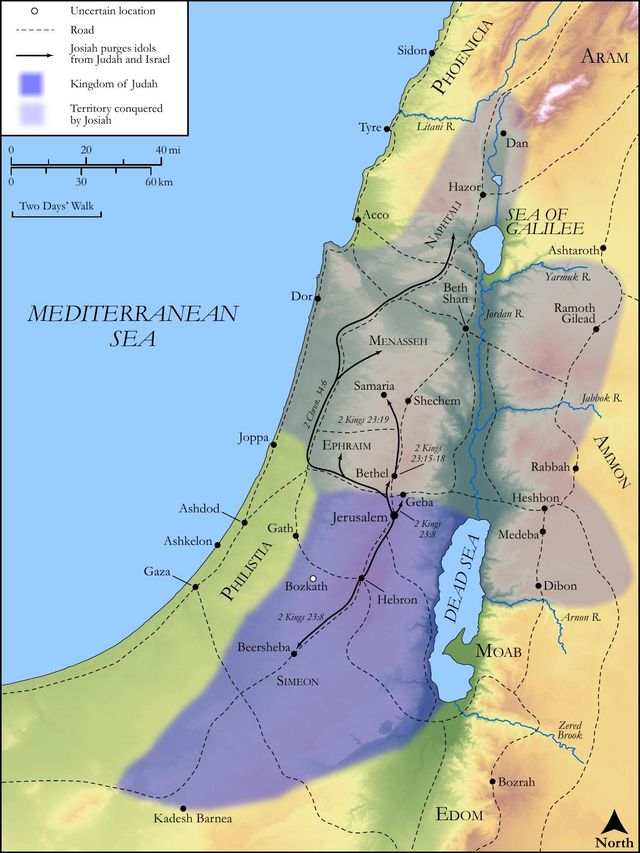
See on the biblical-era map
Study this verse
Public-domain commentary
Matthew Henry
From his Commentary on the Whole Bible. Henry comments on passages, not single verses — this entry covers 2 Chronicles 34:14–28.
This whole paragraph we had, just as it is here related, Kg2 22:8-20, and have nothing to add here to what was there observed. But, 1. We may hence take occasion to bless God that we have plenty of Bibles, and that they are, or may be, in all hands, - that the book of the law and gospel is not lost, is not scarce, - that, in this sense, the word of the Lord is not precious. Bibles are jewels, but, thanks be to God, they are not rarities. The fountain of the waters of life is not a spring shut up or a fountain sealed, but the streams of it, in all places, make glad the city of our God. Usus communis aquarum - These waters flow for general use. What a great deal shall we have to answer for if the great things of God's law, being thus made common, should be accounted by us as strange things! 2. We may hence learn, whenever we read or hear the word of God, to affect our hearts with it, and to get them possessed with a holy fear of that wrath of God which is there revealed against all ungodliness and unrighteousness of men, as Josiah's tender heart was. When he heard the words of the law he rent his clothes (Ch2 34:19), and God was well pleased with his doing so, Ch2 34:27. Were the things contained in the scripture new to us, as they were here to Josiah, surely they would make deeper impressions upon us than commonly they do; but they are not the less weighty, and therefore should not be the less considered by us, for their being well known. Rend the heart therefore, not the garments. 3. We are here directed when we are under convictions of sin, and apprehensions of divine wrath, to enquire of the Lord; so Josiah did, Ch2 34:21. It concerns us to ask (as they did, Act 2:37), Men and brethren, what shall we do? and more particularly (as the jailor), What must I do to be saved? Act 16:30. If you will thus enquire, enquire (Isa 21:12); and, blessed be God, we have the lively oracles to which to apply with these enquiries. 4. We are here warned of the ruin that sin brings upon nations and kingdoms. Those that forsake God bring evil upon themselves (Ch2 34:24, Ch2 34:25), and kindle a fire which shall not be quenched. Such will the fire of God's wrath be when the decree has gone forth against those that obstinately and impenitently persist in their wicked ways. 5. We are here encouraged to humble ourselves before God and seek unto him, as Josiah did. If we cannot prevail thereby to turn away God's wrath from our land, yet we shall deliver our own souls, Ch2 34:27, Ch2 34:28. And good people are here taught to be so far from fearing death as to welcome it rather when it takes them away from the evil to come. See how the property of it is altered by making it the matter of a promise: Thou shalt be gathered to thy grave in peace, housed in that ark, as Noah, when a deluge is coming.
Continue studying 2 Chronicles 34:26 across the web’s major study libraries — every link below opens this exact verse, chapter, or book on the destination site.
Read & Compare
 BibleGatewayThis verse in more than 200 translations and 70 languages.
 Bible.comThe YouVersion reader — hundreds of translations, reading plans, and highlights.
 ESV.orgCrossway's official English Standard Version reader.
 NET BibleThe NET translation with 60,000+ translators' notes on every rendering decision.
 STEP BibleTyndale House's free study tool — original text, vocabulary, and scholarly resources.
 BibliaLogos Bible Software's free web reader.
 USCCBThe New American Bible (Revised Edition) with the U.S. bishops' study notes.
Commentaries
 BibleHub CommentariesDozens of classic commentaries on this verse, gathered on one page.
 StudyLightMore than 100 commentary sets — the largest collection on the web.
 BibleRefPlain-English commentary on what this verse means, verse by verse.
 Enduring WordDavid Guzik's free commentary on this chapter, widely used by Bible teachers.
 Bible Study ToolsVerse commentary alongside Greek and Hebrew study aids.
Original Language & Research
- BibleHub InterlinearThe verse word by word — original language, transliteration, and English.
- BibleHub LexiconEvery word's original-language definition and Strong's entry.
 Blue Letter BibleDeep-study tools — Strong's numbers, concordance, and word studies.
 SefariaThe Hebrew text with Rashi and centuries of Jewish commentary.
Sermons, Hymns & Audio


TrulyRandomVerse is not affiliated with these sites and doesn’t control their content. They’re linked because they’re genuinely useful.
Summary
Second Chronicles 34:26 introduces the divine oracle delivered by the prophetess Huldah to King Josiah, serving as God's authoritative response to the king's sincere inquiry. This verse emphatically establishes the absolute authority and divine origin of the message that follows, underscoring that the words Josiah is about to receive are not human counsel but a direct communication from the LORD God of Israel, given in response to the profound conviction and humility displayed by the king upon hearing the recently discovered Book of the Law.
Context
ShowHideLiterary Context
This verse is situated at a pivotal moment in the reign of King Josiah, a righteous monarch of Judah who initiated widespread religious reforms. Earlier in 2 Chronicles 34, while overseeing repairs to the Temple, the High Priest Hilkiah discovered the "Book of the Law" (2 Chronicles 34:14), likely a portion of Deuteronomy or the Pentateuch. Upon hearing its words, particularly the pronouncements of covenant curses and judgment for disobedience, Josiah was deeply convicted, tearing his clothes in an act of profound humility and repentance (2 Chronicles 34:19). In response, he sent a delegation, including Hilkiah and Shaphan the scribe, to "inquire of the LORD" (2 Chronicles 34:21) concerning the implications of these words for Judah. They sought counsel from Huldah, a respected prophetess in Jerusalem, and this verse marks the precise beginning of God's authoritative message conveyed through her to the king, setting the stage for the pronouncements of both judgment and grace that follow.
Historical & Cultural Context
Josiah's reign (640-609 BC) occurred during a period of relative weakness for the Assyrian Empire, which had long dominated Judah. This geopolitical shift provided Josiah with the opportunity to implement significant religious reforms, purging idolatry and restoring true worship. The discovery of the "Book of the Law" was a monumental event, as its contents had seemingly been lost or neglected for generations, leading to widespread spiritual decline and a departure from the covenant. In ancient Israel, prophets and prophetesses served as God's direct spokespersons, conveying divine messages to kings and the people. Huldah's prominence as a prophetess, consulted by the king's highest officials, underscores the respect accorded to genuine prophetic authority, in a society where such divine guidance was highly valued for navigating national crises and understanding God's will. The act of "inquiring of the LORD" was a standard practice for seeking divine direction, often through prophets, priests, or the Urim and Thummim, particularly in times of national crisis or moral dilemma.
Key Themes
ShowHideThis verse contributes significantly to several overarching themes within 2 Chronicles and the broader biblical narrative. Firstly, it highlights the theme of Divine Authority and Revelation, emphasizing that God's word, delivered through His chosen messengers, carries ultimate weight and truth. The phrase "Thus saith the LORD God of Israel" is a powerful declaration of divine origin, crucial for authenticating the message. Secondly, it underscores the theme of Responsiveness to God's Word and True Repentance. Josiah's immediate and humble reaction to the discovered Law, followed by his earnest desire to "enquire of the LORD," exemplifies a heart sensitive to divine truth and a genuine commitment to obedience, contrasting sharply with many of his idolatrous predecessors. This sensitivity is precisely what God honors in the subsequent verses (2 Chronicles 34:27-28). Finally, the verse implicitly points to the theme of God's Attentiveness to Humble Hearts, demonstrating His willingness to engage with and respond to those who genuinely seek Him and humble themselves under His word, even in the face of impending judgment for national sin.
Exposition and Analysis
ShowHideKey Word Analysis
ShowHideThis verb (H1875) signifies a deep, earnest seeking or searching, often with the intent to understand or obey. It implies more than a casual question; it suggests a diligent investigation or consultation, particularly in a religious or spiritual context. When applied to seeking the LORD, it denotes a humble and sincere desire for divine guidance, wisdom, or revelation. Josiah's act of sending to "enquire of the LORD" highlights his profound conviction and his earnest desire to align himself and his kingdom with God's will after realizing the extent of their deviation from the Law.
This noun (H1697) is multifaceted, encompassing "a word," "a matter," "a thing," or "a cause." In this context, it refers specifically to the content of the Book of the Law that Josiah had heard, particularly the pronouncements of judgment for covenant disobedience. The divine message that follows is a direct response "concerning" these very words, underscoring the direct causal link between Josiah's hearing of God's revealed will and God's subsequent communication.
The verb (H8085) means "to hear," but in a biblical context, it often carries the richer connotation of "to hear and obey" or "to pay attention to." In this verse, it refers to Josiah's act of hearing the words of the Book of the Law. His hearing was not passive; it led to conviction, repentance, and action. This active, attentive hearing is precisely what God responds to, distinguishing Josiah from those who heard God's word but did not heed it, and setting the stage for the specific message of grace for him personally.
Verse Breakdown
ShowHide"And as for the king of Judah, who sent you to enquire of the LORD,"
This introductory clause clearly identifies the recipient of the divine message—King Josiah of Judah—and the precise reason for the delegation's visit to Huldah: to "enquire of the LORD." It sets the stage by acknowledging Josiah's initiative and his humble posture in seeking divine counsel, which is the immediate context for God's forthcoming revelation. This highlights Josiah's spiritual sensitivity and his desire to understand God's will for himself and his kingdom.
"so shall ye say unto him,"
This phrase serves as Huldah's direct instruction to the delegation regarding how they are to present the message to the king. It underscores the formality and directness of the prophetic communication, ensuring that the message is conveyed precisely as God intends, without alteration or personal interpretation by the messengers. It emphasizes the prophetess's role as a faithful conduit for divine revelation.
"Thus saith the LORD God of Israel"
This is the authoritative prophetic formula, a solemn declaration that the words which follow originate directly from God. It authenticates Huldah's message as divine revelation, establishing its absolute truth and binding authority. The specific title "LORD God of Israel" emphasizes God's covenant relationship with His people and His sovereign control over their destiny, grounding the message in His unique identity as the God of His chosen nation.
"[concerning] the words which thou hast heard;"
This concluding phrase directly links the divine message back to the Book of the Law that Josiah had heard read. It confirms that God's response is a direct address to the king's conviction and concern regarding the implications of the Law's pronouncements, particularly those concerning judgment and disobedience. It signifies that God is responding specifically to Josiah's humble and attentive "hearing" of His word, validating his profound spiritual distress.
Literary Devices
ShowHideThe primary literary device at play in 2 Chronicles 34:26 is the Prophetic Formula, specifically the use of "Thus saith the LORD God of Israel." This is a quintessential example of Formulaic Language used throughout the prophetic books of the Old Testament to authenticate the divine origin of a message. It functions as an explicit declaration that the words are not the prophet's own, but a direct utterance from God, thereby establishing the message's infallible authority and demanding the listener's attention and obedience. This formula transforms Huldah from a mere human speaker into a conduit for the divine voice, imbuing her subsequent pronouncements with ultimate weight. Additionally, the verse employs Direct Discourse, as Huldah is commanded to relay God's words verbatim ("so shall ye say unto him"), emphasizing the precise and unmediated nature of the divine communication. The structure also exhibits a form of Framing, where Josiah's inquiry frames the divine response, highlighting God's direct engagement with human seeking.
Theological and Thematic Connections
ShowHideThis verse powerfully articulates the principle of divine revelation and God's responsiveness to human humility and repentance. It demonstrates that God is not silent but actively communicates His will and judgment, especially when His people stray from His covenant. Josiah's sincere "hearing" and subsequent "enquiring" of the LORD illustrate the ideal response to God's Word: not just intellectual assimilation, but a profound conviction that leads to seeking divine guidance and aligning one's life with God's commands. God's immediate and specific response through Huldah underlines His attentiveness to a contrite heart, affirming that while judgment for sin is certain, true repentance can lead to a measure of divine grace and a delay of wrath, particularly for the individual who humbles themselves. This interaction highlights the enduring truth that God honors those who honor His Word and seek Him diligently, offering a powerful testament to His character as both just and merciful.
Reflection and Application
ShowHideThe account of Josiah's encounter with the Book of the Law and God's subsequent response through Huldah offers profound lessons for contemporary believers. Like Josiah, we are called to approach God's Word with reverence and a spirit of deep inquiry, allowing its truths to convict us and expose areas of disobedience in our lives. The discovery of the Law was transformative for Josiah, prompting immediate repentance and a desire for divine guidance. Similarly, when the Bible speaks to us, whether through a direct command, a warning, or a promise, our response should be one of humility and a sincere desire to understand and obey. This verse reminds us that God is not a distant deity but one who hears the cries of His people, especially those who humble themselves and earnestly seek His will. Our willingness to "enquire of the LORD" through prayer, diligent study of Scripture, and seeking wise, godly counsel positions us to receive His wisdom and direction, enabling us to live lives that honor Him and reflect His character in a world often adrift from divine truth and moral anchors.
Questions for Reflection
ShowHideFAQ
ShowHideWhy did Josiah send to Huldah, a prophetess, instead of Jeremiah or Zephaniah, who were also prophets at that time?
ShowHideWhile Jeremiah and Zephaniah were indeed active prophets during Josiah's reign, the biblical text does not explicitly state why Huldah was chosen over them. Several factors might have contributed to this decision. Firstly, Accessibility and Location: Huldah resided in Jerusalem, specifically in the "Second Quarter" (2 Chronicles 34:22), making her readily accessible to the king's delegation. Jeremiah, though active, might have been in Anathoth, and Zephaniah's specific location isn't given, but Huldah was clearly known and available in the capital. Secondly, Known Authority and Respect: Huldah was clearly a recognized and respected prophetess, as evidenced by the high-ranking delegation sent to her, which included the High Priest Hilkiah and the king's scribe Shaphan. Her prophetic authority was well-established and trusted by the king and his officials. Finally, and most importantly, Divine Sovereignty: Ultimately, the choice of messenger rests with God. He chose Huldah to deliver this particular message, highlighting His sovereign freedom to use whomever He wills. Her message was authenticated by its divine origin ("Thus saith the LORD") rather than by the personal status of the messenger, ensuring its reception as God's infallible word.
Christ-Centered Fulfillment
ShowHideThe encounter in 2 Chronicles 34:26, where God's authoritative word is delivered in response to a king's humble hearing of the Law, finds its ultimate fulfillment in Jesus Christ. Josiah's profound conviction upon hearing the written Law foreshadows the coming of the living Word of God, Jesus, who perfectly embodies and fulfills the Law (Matthew 5:17). While Josiah received a message of delayed judgment due to his personal repentance, Christ's coming ushered in the new covenant, offering not merely a reprieve but complete forgiveness and eternal life through His atoning sacrifice (Hebrews 9:15). Josiah's act of "enquiring of the LORD" points to the ultimate revelation of God in Christ, who is the "exact imprint of his nature" (Hebrews 1:3) and the one through whom God has spoken His final and most comprehensive word to humanity (Hebrews 1:1-2). The authority of Huldah's "Thus saith the LORD" pales in comparison to the inherent divine authority of Jesus, who spoke with unparalleled power and truth, declaring, "Truly, truly, I say to you" (John 5:24). In Christ, we find not just words about God, but God's very self, offering a path to reconciliation and transformation far beyond what the Law alone could provide, culminating in the complete and final revelation of God's redemptive plan.