


2 Chronicles 34:15
Bible text: King James Version (1769 Blayney text) · Public domain
Bible text: King James Version with Strong's numbers · Public domain
Bible text: Berean Standard Bible · Public domain
Bible text: American Standard Version (1901) · Public domain
Bible text: World English Bible, Messianic edition · Public domain
Bible text: Geneva Bible (1599) · Public domain
Bible text: Young's Literal Translation · Public domain
- וַיַּעַןvai·Ya·'anand he answeredH6030Conj-w ¦ V-Qal-ConsecImperf-3msVerb Qal Consecutive Imperfect 3rd Singular Masculineוַandיַּעַןhe answered
- חִלְקִיָּהוּchil·ki·Ya·huHilkiahH2518N-proper-mNoun Proper Masculine
- וַיֹּאמֶרvai·Yo·merand he saidH559Conj-w ¦ V-Qal-ConsecImperf-3msVerb Qal Consecutive Imperfect 3rd Singular Masculineוַandיֹּאמֶרhe said
- אֶל'eltoH413PrepPreposition
- שָׁפָןsha·FanShaphanH8227N-proper-mNoun Proper Masculine
- הַסּוֹפֵרha·so·Ferthe scribeH5608Art ¦ N-msNoun Singular Masculine Absoluteהַtheסּוֹפֵרscribe
- סֵפֶרSe·fer[the] scroll ofH5612N-mscNoun Singular Masculine Construct
- הַתּוֹרָהha·to·Rahthe lawH8451Art ¦ N-fsNoun Singular Feminine Absoluteהַtheתּוֹרָהlaw
- מָצָאתִיma·Tza·tiI have foundH4672V-Qal-Perf-1csVerb Qal Perfect 1st Singular common gender
- בְּבֵיתbe·Veitin [the] house ofH1004Prep-b ¦ N-mscNoun Singular Masculine Constructבְּinבֵית[the] house of
- יְהוָהYah·wehYahwehH3068N-properNoun Proper Title
- וַיִּתֵּןvai·yi·Tenand he gaveH5414Conj-w ¦ V-Qal-ConsecImperf-3msVerb Qal Consecutive Imperfect 3rd Singular Masculineוַandיִּתֵּןhe gave
- חִלְקִיָּהוּchil·ki·Ya·huHilkiahH2518N-proper-mNoun Proper Masculine
- אֶת'et<obj.>H853DirObjMParticle Object Indicator
- הַסֵּפֶרha·Se·ferthe scrollH5612Art ¦ N-msNoun Singular Masculine Absoluteהַtheסֵּפֶרscroll
- אֶל'eltoH413PrepPreposition
- שָׁפָןsha·FanShaphanH8227N-proper-mNoun Proper Masculine
English is a literal word-by-word gloss of the Hebrew, not the KJV's wording. Why?
This is the original text the KJV's translators worked from — each Hebrew word with its own literal English meaning in this verse, prepared by scholars at Tyndale House, Cambridge. The KJV translates whole sentences, not word by word, so its wording differs: one Hebrew word can become several English words, and the KJV may choose “the LORD” where the gloss reads “Yahweh”. Both are faithful — they answer different questions. For the KJV's own rendering, switch to the KJV text.
Details
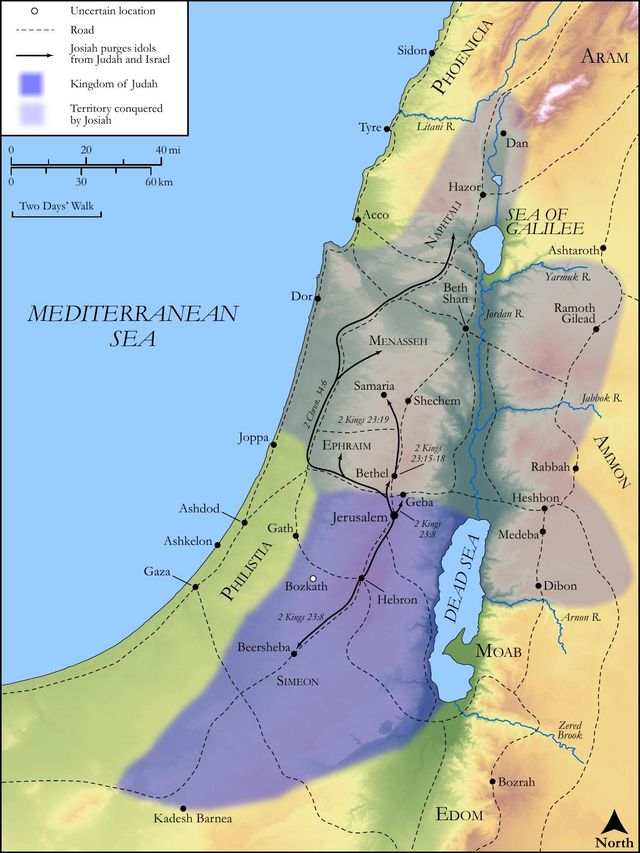
See on the biblical-era map
Study this verse
Public-domain commentary
Matthew Henry
From his Commentary on the Whole Bible. Henry comments on passages, not single verses — this entry covers 2 Chronicles 34:14–28.
This whole paragraph we had, just as it is here related, Kg2 22:8-20, and have nothing to add here to what was there observed. But, 1. We may hence take occasion to bless God that we have plenty of Bibles, and that they are, or may be, in all hands, - that the book of the law and gospel is not lost, is not scarce, - that, in this sense, the word of the Lord is not precious. Bibles are jewels, but, thanks be to God, they are not rarities. The fountain of the waters of life is not a spring shut up or a fountain sealed, but the streams of it, in all places, make glad the city of our God. Usus communis aquarum - These waters flow for general use. What a great deal shall we have to answer for if the great things of God's law, being thus made common, should be accounted by us as strange things! 2. We may hence learn, whenever we read or hear the word of God, to affect our hearts with it, and to get them possessed with a holy fear of that wrath of God which is there revealed against all ungodliness and unrighteousness of men, as Josiah's tender heart was. When he heard the words of the law he rent his clothes (Ch2 34:19), and God was well pleased with his doing so, Ch2 34:27. Were the things contained in the scripture new to us, as they were here to Josiah, surely they would make deeper impressions upon us than commonly they do; but they are not the less weighty, and therefore should not be the less considered by us, for their being well known. Rend the heart therefore, not the garments. 3. We are here directed when we are under convictions of sin, and apprehensions of divine wrath, to enquire of the Lord; so Josiah did, Ch2 34:21. It concerns us to ask (as they did, Act 2:37), Men and brethren, what shall we do? and more particularly (as the jailor), What must I do to be saved? Act 16:30. If you will thus enquire, enquire (Isa 21:12); and, blessed be God, we have the lively oracles to which to apply with these enquiries. 4. We are here warned of the ruin that sin brings upon nations and kingdoms. Those that forsake God bring evil upon themselves (Ch2 34:24, Ch2 34:25), and kindle a fire which shall not be quenched. Such will the fire of God's wrath be when the decree has gone forth against those that obstinately and impenitently persist in their wicked ways. 5. We are here encouraged to humble ourselves before God and seek unto him, as Josiah did. If we cannot prevail thereby to turn away God's wrath from our land, yet we shall deliver our own souls, Ch2 34:27, Ch2 34:28. And good people are here taught to be so far from fearing death as to welcome it rather when it takes them away from the evil to come. See how the property of it is altered by making it the matter of a promise: Thou shalt be gathered to thy grave in peace, housed in that ark, as Noah, when a deluge is coming.
Continue studying 2 Chronicles 34:15 across the web’s major study libraries — every link below opens this exact verse, chapter, or book on the destination site.
Read & Compare
 BibleGatewayThis verse in more than 200 translations and 70 languages.
 Bible.comThe YouVersion reader — hundreds of translations, reading plans, and highlights.
 ESV.orgCrossway's official English Standard Version reader.
 NET BibleThe NET translation with 60,000+ translators' notes on every rendering decision.
 STEP BibleTyndale House's free study tool — original text, vocabulary, and scholarly resources.
 BibliaLogos Bible Software's free web reader.
 USCCBThe New American Bible (Revised Edition) with the U.S. bishops' study notes.
Commentaries
 BibleHub CommentariesDozens of classic commentaries on this verse, gathered on one page.
 StudyLightMore than 100 commentary sets — the largest collection on the web.
 BibleRefPlain-English commentary on what this verse means, verse by verse.
 Enduring WordDavid Guzik's free commentary on this chapter, widely used by Bible teachers.
 Bible Study ToolsVerse commentary alongside Greek and Hebrew study aids.
Original Language & Research
- BibleHub InterlinearThe verse word by word — original language, transliteration, and English.
- BibleHub LexiconEvery word's original-language definition and Strong's entry.
 Blue Letter BibleDeep-study tools — Strong's numbers, concordance, and word studies.
 SefariaThe Hebrew text with Rashi and centuries of Jewish commentary.
Sermons, Hymns & Audio


TrulyRandomVerse is not affiliated with these sites and doesn’t control their content. They’re linked because they’re genuinely useful.
Summary
This pivotal verse in 2 Chronicles 34 records the momentous discovery of "the book of the law" by Hilkiah the high priest within the Temple during King Josiah's extensive restoration efforts. This finding, immediately reported to Shaphan the scribe, served as the catalyst for a profound spiritual awakening and comprehensive national reformation in Judah, marking a crucial turning point in the nation's spiritual history after generations of neglect and idolatry.
Context
ShowHideLiterary Context
This verse is situated within the broader narrative of King Josiah's righteous reign, specifically detailing the eighteenth year of his rule. Chapters 34 and 35 of 2 Chronicles focus intensely on Josiah's reforms, portraying him as a king who "did what was right in the eyes of the LORD" (2 Chronicles 34:2). Prior to this discovery, Josiah had already begun a zealous campaign to purge Judah and Jerusalem of idolatry, destroying altars, Asherah poles, and carved images, even extending his efforts into the northern territories of Manasseh, Ephraim, and Simeon (2 Chronicles 34:3-7). The discovery of the Law occurs precisely as the king initiates the repair and purification of the Temple, indicating that God's revelation of His Word coincided with the people's active pursuit of righteousness and restoration of proper worship, setting the stage for the dramatic covenant renewal described later in the chapter (2 Chronicles 34:29-32). The narrative structure highlights the divine timing of this finding, linking it intrinsically to the ongoing work of spiritual renewal.
Historical & Cultural Context
Josiah ascended the throne of Judah at the tender age of eight (2 Chronicles 34:1), following the wicked reigns of his grandfather Manasseh and father Amon, who had plunged the nation into deep idolatry, even desecrating the Temple with pagan altars and practices (2 Chronicles 33:1-9). By Josiah's time, the "book of the law" had evidently been lost or neglected for generations, perhaps hidden away for safekeeping during periods of intense persecution, or simply forgotten amidst the pervasive apostasy. The Temple itself, once the sacred center of Yahweh worship, had fallen into severe disrepair and was defiled by pagan cult objects. The discovery of the Law during its renovation underscores the dire spiritual state of the nation and the profound impact a return to God's authoritative Word would have on a society that had largely forgotten its covenant obligations and divine instructions.
Key Themes
ShowHideThe central theme highlighted by this verse is the Rediscovery of God's Word and its transformative power. The "book of the law" (Hebrew: sepher ha-Torah) was not merely an ancient artifact but the foundational covenant document, likely a copy of Deuteronomy or a significant portion of the Pentateuch, containing God's instructions for Israel's life and worship. Its finding signifies a divine intervention, demonstrating God's Providence in preserving and revealing His truth at a critical juncture when the nation was poised for repentance. This discovery served as the Catalyst for Revival and Reformation, directly leading to Josiah's personal repentance (2 Chronicles 34:19), the eradication of idolatry, and a national covenant renewal (2 Chronicles 34:30-32), emphasizing that genuine spiritual renewal is always rooted in a fresh encounter with and obedience to God's authoritative, living Word.
Exposition and Analysis
ShowHideKey Word Analysis
ShowHideThis verb signifies not merely a casual discovery but an active search culminating in the attainment or occurrence of something previously hidden or lost. In this context, it highlights the miraculous nature of the book's re-emergence, implying divine orchestration rather than mere chance. The word suggests that the book had been out of circulation or forgotten, making its finding a significant event that would profoundly impact the nation.
This term refers to a written document, scroll, or register. Here, it specifically denotes an authoritative text, distinguishing it from ordinary writings. Coupled with "law" (tôwrâh), it emphasizes the nature of the document as a divinely inspired and binding record of God's instructions and covenant stipulations for Israel. Its physical form as a "book" underscores its tangible reality and the weight of its contents.
More than just a set of legal statutes, tôwrâh encompasses divine instruction, teaching, and guidance for life. It refers to the comprehensive body of God's revelation to Israel through Moses, particularly the Pentateuch. The "book of the law" thus represents the foundational covenant document that outlined Israel's relationship with God, their responsibilities, and the blessings or curses associated with obedience or disobedience. Its rediscovery meant the re-establishment of God's authoritative voice in the nation.
"House" (bayith) here refers to the Temple, the central place of worship and God's dwelling among His people. "LORD" (Yᵉhôvâh) is the covenant name of God, emphasizing His self-existence and eternal nature. The fact that the book was found in the Temple highlights the irony of its loss in the very place dedicated to God's worship, yet also underscores the divine providence in preserving it within His sacred space until the opportune moment for its re-emergence and the subsequent national revival.
Verse Breakdown
ShowHide"And Hilkiah answered and said to Shaphan the scribe"
This opening clause establishes the immediate communication between the high priest, Hilkiah, and the royal scribe, Shaphan. Hilkiah, as the spiritual head responsible for the Temple and its sacred contents, and Shaphan, as the literate and trusted royal official responsible for royal decrees and records, represent the two key figures who would mediate this momentous discovery to the king. The phrase "answered and said" implies that Hilkiah's statement was a response to an ongoing conversation or the general context of the Temple repairs, indicating the urgency and significance of his finding.
"I have found the book of the law in the house of the LORD"
This is the core declaration of the verse, carrying immense theological weight. Hilkiah explicitly states the nature of his discovery ("the book of the law") and its precise location ("in the house of the LORD," i.e., the Temple). The declaration that it was "found" implies it had been lost, forgotten, or hidden for an extended period, underscoring the depth of Judah's spiritual decline and neglect of God's Word. Its discovery within the sacred precincts of the Temple itself suggests a divine preservation and timing, as if God Himself had kept it safe until the opportune moment of Josiah's reforms, ready to ignite a spiritual awakening.
"And Hilkiah delivered the book to Shaphan"
This final clause describes the immediate, practical action taken by Hilkiah. The physical transfer of the book from the high priest to the royal scribe signifies the formal and authoritative presentation of the rediscovered Word. Shaphan's role as scribe would be to read, verify, and present the document to King Josiah, ensuring its proper introduction into the royal court and, subsequently, to the nation. This act of delivery is crucial, as it sets in motion the chain of events leading to the king's personal repentance and the subsequent national reformation.
Literary Devices
ShowHideThe narrative of 2 Chronicles 34:15 employs several significant literary devices that amplify its impact. The most prominent is Irony, as the very place intended for the worship of God—the Temple—had become so neglected and defiled that the foundational text of God's covenant could be "lost" within its walls. This highlights the profound spiritual decay that had afflicted Judah, where the source of divine truth was buried beneath layers of apostasy and disrepair. There is also a strong element of Symbolism: the "book of the law" itself symbolizes God's enduring truth, His covenant faithfulness, and His active presence, even when forgotten or ignored by humanity. Its rediscovery symbolizes the potential for spiritual renewal, a return to divine order, and the re-establishment of a right relationship with God. The narrative also uses Foreshadowing, as this momentous discovery immediately portends the dramatic repentance of King Josiah and the sweeping reforms that will follow, indicating that the Word of God, once unleashed and received, possesses immense power to transform individuals and nations.
Theological and Thematic Connections
ShowHideThe discovery of the book of the law in 2 Chronicles 34:15 profoundly underscores the enduring power and necessity of God's revealed Word for the spiritual health of individuals and nations. It illustrates that true revival is not merely an emotional experience but is rooted in a fresh encounter with and submission to divine truth. The neglect of God's Word inevitably leads to spiritual darkness, idolatry, and societal decay, while its rediscovery and diligent application bring light, conviction, repentance, and restoration. This account serves as a powerful reminder that God's truth is always present, even when hidden or forgotten, and that He sovereignly orchestrates its re-emergence to call His people back to Himself, demonstrating His faithfulness even in the midst of human unfaithfulness.
Reflection and Application
ShowHideThe account of Hilkiah's discovery of the book of the law in 2 Chronicles 34:15 offers profound and timeless lessons for contemporary believers and the Church today. Just as Judah had allowed the foundational truths of God's covenant to become buried under layers of neglect, idolatry, and disrepair, so too can individuals and communities become spiritually adrift when they lose touch with the authoritative and transformative voice of Scripture. This verse calls us to a diligent, humble, and reverent engagement with God's Word, recognizing its indispensable role as the primary source of truth, guidance, and spiritual vitality. It challenges us to actively seek out, read, study, meditate upon, and obey the Scriptures, allowing them to expose our sin, correct our paths, and ignite genuine repentance and profound transformation in our lives. Furthermore, it highlights the crucial role of spiritual leaders in faithfully unearthing, preserving, proclaiming, and applying God's truth to a generation that desperately needs its light and life.
Questions for Reflection
ShowHideFAQ
ShowHideWhat was "the book of the law" that Hilkiah found?
ShowHideWhile the text of 2 Chronicles 34:15 does not specify the exact book, scholarly consensus, supported by the narrative's details, suggests it was likely a copy of the book of Deuteronomy, or at least a significant portion of the Pentateuch (the first five books of Moses). The detailed curses and blessings described in Deuteronomy 28 align perfectly with King Josiah's intense reaction of tearing his clothes and repenting upon hearing its contents, as recorded in 2 Chronicles 34:19-21. This book contained the covenant stipulations, laws, and instructions given by God to Israel through Moses, serving as the foundational guide for their national and spiritual life. Its rediscovery was so impactful because it vividly reminded the nation of their forgotten covenant obligations and the dire consequences of disobedience, prompting a desperate need for repentance and reform.
Christ-Centered Fulfillment
ShowHideThe discovery of "the book of the law" in 2 Chronicles 34:15, while a pivotal moment in Old Testament history, finds its ultimate fulfillment and deeper meaning in the person and redemptive work of Jesus Christ. The Law, though holy and good, primarily served to reveal humanity's inability to perfectly obey God's righteous standards, thus functioning as a "tutor to bring us to Christ, that we might be justified by faith" (Galatians 3:24). Just as the physical book was rediscovered in the Temple, so too did God, in the fullness of time, reveal His ultimate "Word" not on tablets of stone or ancient scrolls, but in the living person of Jesus, the Word made flesh, who dwelt among us, full of grace and truth (John 1:1). Jesus perfectly fulfilled the righteous demands of the Law (Matthew 5:17), offering Himself as the perfect, once-for-all sacrifice to atone for the sins that the Law exposed but could not remove. Through Him, the Law is no longer an external code that condemns, but by the power of the Holy Spirit, it is written on the hearts of believers in the new covenant (Jeremiah 31:33 and Hebrews 8:10), enabling them to walk in obedience and experience true spiritual life, a life that the mere discovery of the physical Law could only foreshadow.