


2 Chronicles 13:2
- שָׁלוֹשׁsha·Lo·oshthreeH7969N-csNoun Singular common gender Absolute
- שָׁנִיםsha·NimyearsH8141N-mpNoun Plural Masculine Absolute
- מָלַךְma·laKhhe reignedH4427V-Qal-Perf-3msVerb Qal Perfect 3rd Singular Masculine
- בִּירוּשָׁלִַםbi·Ru·sha·Limin JerusalemH3389Prep-b ¦ N-properNoun Proper LocationבִּinירוּשָׁלִַםJerusalem
- וְשֵׁםve·Shemand [the] name ofH8034Conj-w ¦ N-mscNoun Singular Masculine Constructוְandשֵׁם[the] name of
- אִמּוֹ'i·Mohis motherH517N-fsc ¦ 3msNoun Singular Feminine Constructאִמּmotherוֹhis
- מִיכָיָהוּmi·kha·Ya·hu[was] MicaiahH4322N-proper-mNoun Proper Masculine
- בַתvat[the] daughter ofH1323N-fscNoun Singular Feminine Construct
- אוּרִיאֵל'u·ri·'ElUrielH222N-proper-mNoun Proper Masculine
- מִןminfromH4480PrepPreposition
- גִּבְעָהgiv·'AhGibeahH1390N-properNoun Proper Location
- וּמִלְחָמָהu·mil·cha·Mahand warH4421Conj-w ¦ N-fsNoun Singular Feminine Absoluteוּandמִלְחָמָהwar
- הָיְתָהha·ye·Tahit wasH1961V-Qal-Perf-3fsVerb Qal Perfect 3rd Singular Feminine
- בֵּיןbeinbetweenH996Adj-mscAdjective Numerical Singular Masculine Construct
- אֲבִיָּה'a·vi·YahAbijahH29N-proper-mNoun Proper Masculine
- וּבֵיןu·Veinand betweenH996Conj-w ¦ Adj-mscAdjective Numerical Singular Masculine Constructוּandבֵיןbetween
- יָרָבְעָםya·ra·ve·'AmJeroboamH3379N-proper-mNoun Proper Masculine
English is a literal word-by-word gloss of the Hebrew, not the KJV's wording. Why?
This is the original text the KJV's translators worked from — each Hebrew word with its own literal English meaning in this verse, prepared by scholars at Tyndale House, Cambridge. The KJV translates whole sentences, not word by word, so its wording differs: one Hebrew word can become several English words, and the KJV may choose “the LORD” where the gloss reads “Yahweh”. Both are faithful — they answer different questions. For the KJV's own rendering, switch to the KJV text.
Details
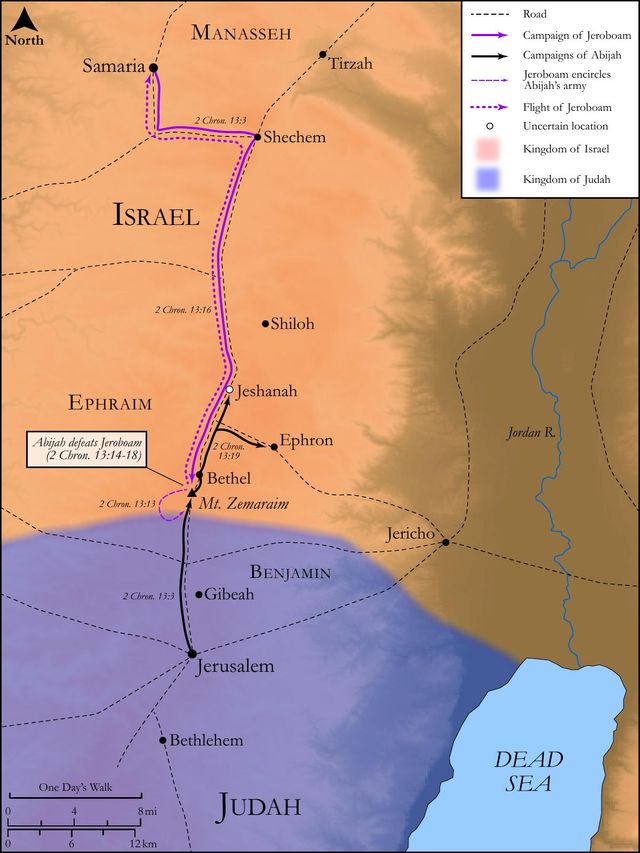
See on the biblical-era map
Study this verse
Public-domain commentary
Matthew Henry
From his Commentary on the Whole Bible. Henry comments on passages, not single verses — this entry covers 2 Chronicles 13:1–12. His four-level outline is real structure in the source text, so it is rendered as structure.
Abijah's mother was called Maachah, the daughter of Absalom, Ch2 11:20; here she is called Michaiah, the daughter of Uriel. It is most probable that she was a grand-daughter of Absalom, by his daughter Tamar (Sa2 14:27), and that her immediate father was this Uriel. But we are here to attend Abijah into the field of battle with Jeroboam king of Israel.
I.God gave him leave to engage with Jeroboam, and owned him in the conflict, though he would not permit Rehoboam to do it, Ch2 11:4.
1.Jeroboam, it is probable, was now the aggressor, and what Abijah did was in his own necessary defence. Jeroboam, it may be, happening to survive Rehoboam, claimed the crown of Judah be survivorship, at least hoped to get it from this young king, upon his accession to the throne. Against these impudent pretensions it was brave in Abijah to take up arms, and God stood by him.
2.When Rehoboam attempted to recover his ten tribes Jeroboam was upon his good behaviour, and there must be some trial of him; but now that he had discovered what manner of man he was, by setting up the calves and casting off the priests, Abijah is allowed to chastise him, and it does not appear that he intended any more; whereas Rehoboam aimed at no less than the utter reduction of the ten tribes, which was contrary to the counsel of God.
II.Jeroboam's army was double in number to that of Abijah (Ch2 13:3), for he had ten tribes to raise an army out of, while Abijah had but two.
Of the army on both sides it is said, they were mighty men, chosen men, and valiant; but the army of Judah consisted only of 400,000, while Jeroboam's army amounted to 800,000. The inferior number however proved victorious; for the battle is not always to the strong nor the cause to the majority.
III.Abijah, before he fought them, reasoned with them, to persuade them, though not to return to the house of David (that matter was settled by the divine determination and he acquiesced), yet to desist from fighting against the house of David. He would not have them withstand the kingdom of the Lord in the hands of the sons of David (Ch2 13:8), but at least to be content with what they had. Note, It is good to try reason before we use force. If the point may be gained by dint of argument, better so than by dint of sword. We must never fly to violent methods till all the arts of persuasion have been tried in vain. War must be the ultima ratio regum - the last resort of kings. Fair reasoning may do a great deal of good and prevent a good deal of mischief. How forcible are right words! Abijah had got with his army into the heart of their country; for he made this speech upon a hill in Mount Ephraim, where he might be heard by Jeroboam and the principal officers, with whom it is probable he desired to have a treaty, to which they consented. It has been usual for great generals to make speeches to their soldiers to animate them, and this speech of Abijah had some tendency to do this, but was directed to Jeroboam and all Israel. Two things Abijah undertakes to make out, for the satisfaction of his own men and the conviction of the enemy: -
1.That he had right on his side, a jus divinum - a divine right: "You know, or ought to know, that God gave the kingdom to David and his sons for ever" (Ch2 13:5), not by common providence, his usual way of disposing of kingdoms, but by a covenant of salt, a lasting covenant, a covenant made by sacrifice, which was always salted; so bishop Patrick. All Israel had owned that David was a king of God's making, and that God had entailed the crown upon his family; so that Jeroboam's taking the crown of Israel at first was not justifiable: yet it is not certain that Abijah referred chiefly to that, for he knew that Jeroboam had a grant from God of the ten tribes. His attempt, however, to disturb the peace and possession of the king of Judah was by no means excusable; for when the ten tribes were given to him two were reserved for the house of David. Abijah shows,
(1.)That there was a great deal of dishonesty and disingenuousness in Jeroboam's first setting himself up: He rebelled against his lord (Ch2 13:6) who had preferred him (Kg1 11:28), and basely took advantage of Rehoboam's weakness in a critical juncture, when, in gratitude to his old master and in justice to his title, he ought rather to have stood by him, and helped to secure the people in their allegiance to him, than to head a party against him and make a prey of him, which was unworthily done and what he could not expect to prosper in. Those that supported him are here called vain men (a character perhaps borrowed from Jdg 11:3), men that did not act from any steady principle, but were given to change, and men of Belial, that were for shaking off the yoke of government and setting those over them that would do just as they would have them do.
(2.)That there was a great deal of impiety in his present attempt; for, in fighting against the house of David, he fought against the kingdom of the Lord. Those who oppose right oppose the righteous God who sits in the throne judging right, and cannot promise themselves success in so doing. Right may indeed go by the worst for a time, but it will prevail at last.
2.That he had God on his side. This he insisted much upon, that the religion of Jeroboam and his army was false and idolatrous, but that he and his people, the men of Judah, had the pure worship of the true and living God among them. It appears from the character given of Abijah (Kg1 15:3) that he was not himself in this war chiefly from the religion of his kingdom. For,
(1.)Whatever he was otherwise, it should seem that he was no idolator, or, if he connived at the high places and images (Ch2 14:3, Ch2 14:5), yet he constantly kept up the temple-service.
(2.)Whatever corruptions there were in the kingdom of Judah, the state of religion among them was better than in the kingdom of Israel, with which they were now contending.
(3.)It is common for those that deny the power of godliness to boast of the form of it.
(4.)It was the cause of his kingdom that he was pleading; and, though he was not himself so good as he should have been, yet he hoped that, for the sake of the good men and good things that were in Judah, God would now appear for them. Many that have little religion themselves yet have so much sense and grace as to value it in others. See how he describes,
[1.]The apostasy of Israel from God. "You are a great multitude," said he, "far superior to us in number; but we need not fear you, for you have that among yourselves which is enough to ruin you. For," First, "You have calves for your gods (Ch2 13:8), that are unable to protect and help you and will certainly cause the true and living God to oppose you. Those will be Achans, troublers of your camp." Secondly, "You have base men for your priests, Ch2 13:9. You have cast off the tribes of Levi, and the house of Aaron, whom God appointed to minister in holy things; and, in conformity to the custom of the idolatrous nations, make any man a priest that has a mind to the office and will be at the charge of the consecration, though ever so much a scandal to the office." Yet such, though very unfit to be priests, were fittest of all to be their priests; for what more agreeable to gods that were no gods than priests that were no priests? Like to like, both pretenders and usurpers.
[2.]The adherence of Judah to God: "But as for us (Ch2 13:10) we have not forsaken God. Jehovah is our God, the God of our fathers, the God of Israel, who is able to protect us, and give us success. He is with us, for we are with him." First, "At home in his temple: We keep his charge, Ch2 13:10, Ch2 13:11. We worship no images, have no priests but what he has ordained, no rites of worship but what he has prescribed. Both the temple service and the temple furniture are of his appointing. His appointment we abide by, and neither add nor diminish. These we have the comfort of, these we now stand up in the defence of: so that upon a religious as well as a civil account we have the better cause. Secondly, Here in the camp; he is our captain, and we may therefore be sure that he is with us, because we are with him, Ch2 13:12. And, as a token of his presence, we have here with us his priests, sounding his trumpets according to the law, as a testimony against you, and an assurance to us that in the day of battle we shall be remembered before the Lord our God and saved from our enemies;" for so this sacred signal is explained, Num 10:9. Nothing is more effectual to embolden men, and put spirit into them, than to be sure that God is with them and fights for them. He concludes with fair warning to his enemies. "Fight not against the God of your fathers. It is folly to fight against the God of almighty power; but it is treachery and base ingratitude to fight against your fathers' God, and you cannot expect to prosper."
Historical interpretation
Historical reception
1 surviving comment on this verse from the historical church.
Michaia: Alias Maacha. Her father had also two names, viz., Absalom, or Abessalom, and Uriel.
Continue studying 2 Chronicles 13:2 across the web’s major study libraries — every link below opens this exact verse, chapter, or book on the destination site.
Read & Compare
 BibleGatewayThis verse in more than 200 translations and 70 languages.
 Bible.comThe YouVersion reader — hundreds of translations, reading plans, and highlights.
 ESV.orgCrossway's official English Standard Version reader.
 NET BibleThe NET translation with 60,000+ translators' notes on every rendering decision.
 STEP BibleTyndale House's free study tool — original text, vocabulary, and scholarly resources.
 BibliaLogos Bible Software's free web reader.
 USCCBThe New American Bible (Revised Edition) with the U.S. bishops' study notes.
Commentaries
 BibleHub CommentariesDozens of classic commentaries on this verse, gathered on one page.
 StudyLightMore than 100 commentary sets — the largest collection on the web.
 BibleRefPlain-English commentary on what this verse means, verse by verse.
 Enduring WordDavid Guzik's free commentary on this chapter, widely used by Bible teachers.
 Bible Study ToolsVerse commentary alongside Greek and Hebrew study aids.
Original Language & Research
- BibleHub InterlinearThe verse word by word — original language, transliteration, and English.
- BibleHub LexiconEvery word's original-language definition and Strong's entry.
 Blue Letter BibleDeep-study tools — Strong's numbers, concordance, and word studies.
 SefariaThe Hebrew text with Rashi and centuries of Jewish commentary.
Sermons, Hymns & Audio


TrulyRandomVerse is not affiliated with these sites and doesn’t control their content. They’re linked because they’re genuinely useful.
Summary
Second Chronicles 13:2 serves as a pivotal biographical and narrative bridge, concisely detailing King Abijah's brief three-year reign in Jerusalem and establishing his maternal lineage through Michaiah, daughter of Uriel of Gibeah. Crucially, the verse immediately sets the stage for the defining conflict of his rule by declaring "there was war between Abijah and Jeroboam," thereby introducing the central narrative of the chapter and underscoring the persistent political and spiritual schism between the divided kingdoms of Judah and Israel.
Context
ShowHideLiterary Context
This verse immediately follows the introduction of Abijah's ascension to the throne in 2 Chronicles 13:1, establishing him as the successor to Rehoboam. It functions as a concise yet rich biographical interlude, providing essential details about the new monarch before the Chronicler launches into the detailed account of the significant war between Abijah and Jeroboam, which dominates the remainder of the chapter from 2 Chronicles 13:3 onwards. By precisely stating the length of his reign, identifying his mother, and announcing the impending conflict, the verse efficiently transitions from the king's enthronement to the pivotal event of his brief rule, grounding the subsequent narrative in specific historical and familial parameters that are crucial for the Chronicler's theological agenda.
Historical & Cultural Context
Abijah reigned over the southern kingdom of Judah, which comprised the tribes of Judah and Benjamin, maintaining the Davidic dynasty and the Jerusalem temple worship. His contemporary, Jeroboam, ruled the northern kingdom of Israel, which had seceded under his leadership following the death of Solomon and Rehoboam's folly, as detailed in 1 Kings 12. Jeroboam had established alternative worship centers at Bethel and Dan, introducing golden calves, a practice consistently denounced as idolatry by the Chronicler. The mention of Abijah's mother, Michaiah the daughter of Uriel of Gibeah, is culturally significant, as the queen mother often held considerable influence and status in ancient Near Eastern monarchies. Gibeah, a town in Benjaminite territory, carried historical weight, notably as Saul's hometown and the site of a notorious incident in Judges 19-21 that led to a tribal war, suggesting Uriel's family might have been of some standing or historical connection. The declaration of war underscores the deep-seated political and religious animosity that persisted between the two kingdoms since their division, reflecting the ongoing struggle for legitimacy and spiritual allegiance.
Key Themes
ShowHideThe verse subtly introduces and reinforces several key themes prevalent in the Chronicler's theological framework. Firstly, it highlights the consequences of national division and apostasy, as the ongoing conflict between Judah and Israel stems directly from the schism and Jeroboam's idolatrous practices, which are consistently condemned throughout the Chronicler's narrative. Secondly, it touches upon the sovereignty of God over human affairs and kings, even in times of intense strife; the Chronicler consistently portrays God as actively involved in the outcomes of battles and the rise and fall of rulers, often in response to their faithfulness or unfaithfulness. Thirdly, the emphasis on Judah's lineage and Jerusalem as the seat of power reinforces the Chronicler's focus on the legitimacy of the Davidic covenant and the southern kingdom as the true inheritors of God's promises, in stark contrast to the illegitimate northern kingdom. This is a recurring motif, for example, in the Chronicler's account of Rehoboam's initial response to the division in 2 Chronicles 11:4. Finally, the brevity of Abijah's reign and the immediate mention of war underscore the fragility of human leadership and the constant challenges faced by those in authority, particularly in a period marked by profound spiritual and political instability.
Exposition and Analysis
ShowHideKey Word Analysis
ShowHideMeaning "Who is like Yahweh?" or "Who is like God?". This theophoric name, incorporating the divine name "Yahweh," carries a profound theological meaning, even if the individual bearing it (or her actions, as seen in the variant Maacah in 1 Kings 15:2) did not always reflect its high aspiration. The discrepancy with "Maacah" in the book of Kings is often reconciled by scholars as either a variant spelling of the same name, or "daughter" (H1323, bath) being used in a broader sense to mean granddaughter or descendant, a common practice in biblical genealogies. This detail emphasizes the importance of lineage and the queen mother's status in ancient Judah.
Meaning "hill." This geographical marker identifies the origin of Abijah's maternal grandfather, Uriel. Gibeah was a significant town in the territory of Benjamin, known historically as the hometown of King Saul and the site of a horrific incident involving a Levite's concubine that led to a near-annihilation of the tribe of Benjamin (see Judges 19-21). Its mention here suggests that Uriel's family was likely of some prominence or connection within the Benjaminite tribal structure, further rooting Abijah's background in the historical fabric of Israel.
This term denotes a significant military conflict, not merely a skirmish. Its immediate declaration after the biographical details signifies that this war was the defining event of Abijah's short reign. For the Chronicler, such conflicts were often seen as divine judgments or tests, and their outcomes were directly tied to the faithfulness or unfaithfulness of the kings and the people. The ensuing narrative in 2 Chronicles 13:3-22 confirms its pivotal nature, portraying it as a divinely orchestrated event rather than a mere geopolitical dispute.
Verse Breakdown
ShowHide"He reigned three years in Jerusalem."
This clause concisely states the duration and location of Abijah's rule. A three-year reign is relatively brief, suggesting a period of intense activity or instability rather than prolonged peace or a long-term dynasty. Jerusalem, as the capital of Judah and the legitimate seat of the Davidic dynasty and the central place of worship, signifies the continuation of the covenantal monarchy and the centrality of the temple in the Chronicler's theological narrative.
"His mother's name also [was] Michaiah the daughter of Uriel of Gibeah."
This provides crucial genealogical information, which the Chronicler meticulously records to establish legitimacy and continuity within the Davidic line. In ancient Near Eastern monarchies, the queen mother often held a position of significant influence and authority. Identifying her by name and lineage (daughter of Uriel of Gibeah) firmly places Abijah within a specific social and geographical context, connecting him to a notable family from Benjamin, a tribe closely aligned with Judah.
"And there was war between Abijah and Jeroboam."
This declarative statement immediately introduces the central conflict that will define Abijah's reign and occupy the remainder of the chapter. It highlights the ongoing, bitter antagonism between the two divided kingdoms, rooted in both political rivalry and deep spiritual divergence. The Chronicler presents this war as a significant event, not just a border dispute, but a confrontation with profound theological implications, setting the stage for divine intervention and the demonstration of God's power.
Literary Devices
ShowHideThe verse employs several effective literary devices to convey its multifaceted message. Conciseness is evident as it packs vital biographical, genealogical, and narrative-setting information into a single, compact sentence. The declaration "And there was war between Abijah and Jeroboam" functions as clear foreshadowing, immediately signaling the primary narrative event that will unfold in the subsequent verses and creating anticipation for the conflict. This underscores the pivotal nature of the impending war. The verse also utilizes juxtaposition, placing the seemingly mundane details of reign length and maternal lineage directly alongside the dramatic announcement of war. This highlights the immediate challenges and defining events that marked Abijah's brief time on the throne, emphasizing that his reign was characterized by conflict from its outset. Furthermore, the detailed genealogical marker (mother's name, father's name, place of origin) serves to firmly anchor Abijah within the historical and geographical framework of Judah, reinforcing the Chronicler's emphasis on historical accuracy and the continuity of the Davidic line.
Theological and Thematic Connections
ShowHideThis verse, though brief, is rich in theological implications, reflecting the Chronicler's overarching perspective on divine sovereignty over human history. Abijah's short reign, his specific lineage, and the immediate declaration of war with Jeroboam all underscore that the events of Israel's history are not random but are orchestrated or permitted by God. The conflict between Judah and Israel is not merely a political struggle but a spiritual one, reflecting the consequences of Jeroboam's apostasy and the ongoing tension between faithfulness to Yahweh and idolatry. The Chronicler consistently portrays God as actively involved in the affairs of nations, shaping their destinies based on their adherence to His covenant. Even in the midst of human division and strife, God's purposes for the Davidic line and the temple in Jerusalem remain central, providing a framework through which these historical events are to be understood. The details of Abijah's background set the stage for a narrative where God's intervention will ultimately secure victory for Judah, reinforcing the Chronicler's message that reliance on God brings success and blessing.
Reflection and Application
ShowHideThe concise details of 2 Chronicles 13:2 offer profound lessons for contemporary believers, inviting us to consider the brevity of life, the inevitability of conflict, and the significance of our heritage. Abijah's brief three-year reign reminds us that the significance of a period is not measured solely by its length, but by the pivotal events, faithful responses, and choices made within it. Our own lives, whether short or long, are opportunities for God's purposes to unfold, and even seemingly minor biographical details contribute to the larger narrative of His working in the world. The reality of "war" between Abijah and Jeroboam underscores that conflict, both external (societal, relational) and internal (spiritual, personal), is an inevitable part of the human experience, and particularly of leadership. How we navigate these "wars"—whether they are relational tensions, spiritual battles, or societal challenges—reveals our character and our reliance on God. The mention of Abijah's lineage also reminds us that while our background and heritage shape us, it is our personal choices and our faithfulness to God that ultimately define our legacy and influence. This verse encourages us to consider how God uses all circumstances, even conflict and brevity, to reveal His power, demonstrate His sovereignty, and advance His kingdom, calling us to respond with unwavering faith and courage.
Questions for Reflection
ShowHideFAQ
ShowHideWhy is Abijah's mother's name listed as Michaiah here, but as Maacah in 1 Kings 15:2?
ShowHideThis apparent discrepancy is common in biblical genealogies and can be reconciled in a few ways. "Michaiah" (H4322, Mîykâyâhûw) and "Maacah" could be variant names for the same person, much like "Saul" and "Paul" for the apostle. Alternatively, "daughter" (H1323, bath) can sometimes be used in a broader sense to refer to a granddaughter or a female descendant, meaning Michaiah might have been Maacah's daughter or a later descendant. This practice was common in ancient Near Eastern genealogies, which often focused on establishing lineage rather than strict biological parentage in every instance. Both names point to her prominent lineage, emphasizing the importance of the queen mother's position in the royal court. The Chronicler often provides additional details or emphasizes different aspects compared to the book of Kings, but these do not undermine the historical accuracy of the accounts.
What was the significance of Gibeah, Abijah's mother's hometown?
ShowHideGibeah (H1390, Gibʻâh) was a town located in the territory of Benjamin, north of Jerusalem. It held significant historical importance, notably as the hometown of Israel's first king, Saul (1 Samuel 10:26). More dramatically, it was the site of a horrific incident involving a Levite and his concubine, which led to a devastating civil war against the tribe of Benjamin, almost wiping them out (Judges 19-21). The mention of Uriel of Gibeah as Michaiah's father suggests a connection to a family of some standing or historical significance within the Benjaminite tribe, further grounding Abijah's lineage within the broader historical and geographical context of Israel and highlighting the deep roots of the Davidic line within the covenant community.
Christ-Centered Fulfillment
ShowHideThe brief reign of Abijah, marked by conflict and the persistent division between Judah and Israel, powerfully foreshadows the ultimate need for an eternal King who would bring true peace and lasting victory. Abijah's short three years in Jerusalem highlight the transience and imperfection of all earthly rule, contrasting sharply with the enduring, perfect reign of Jesus Christ, the true Son of David. The "war between Abijah and Jeroboam" points to the pervasive spiritual conflict that plagues humanity, a conflict that only the Lamb of God could definitively resolve. Unlike Abijah's temporary triumph over Jeroboam, Jesus' victory on the cross, as described in Colossians 2:15, was absolute and eternal, disarming the spiritual powers of darkness. He is the ultimate Prince of Peace, whose kingdom is not of this world (John 18:36) and whose reign knows no end (Revelation 11:15). In Christ, the division between God's people is ultimately healed, and His sacrifice brings reconciliation not just between warring kingdoms, but between humanity and God (2 Corinthians 5:18-19). Thus, Abijah's limited kingship and the conflict he faced serve as a poignant backdrop, magnifying the glory and eternal efficacy of Christ's perfect, sovereign, and reconciling reign, which truly fulfills the longing for a just and lasting peace.