


- וַיֹּאמֶרvai·Yo·merand he saidH559Conj-w ¦ V-Qal-ConsecImperf-3msVerb Qal Consecutive Imperfect 3rd Singular Masculineוַandיֹּאמֶרhe said
- אֵלָיו'e·Lavto himH413Prep ¦ 3msPreposition Definiteאֵלָיtoוhim
- שְׁמוּאֵלshe·mu·'ElSamuelH8050N-proper-mNoun Proper Masculine
- קָרַעka·Ra'he has tornH7167V-Qal-Perf-3msVerb Qal Perfect 3rd Singular Masculine
- יְהוָהYah·wehYahwehH3068N-properNoun Proper Title
- אֶת'et<obj.>H853DirObjMParticle Object Indicator
- מַמְלְכוּתmam·le·Khut[the] kingdom ofH4468N-fscNoun Singular Feminine Construct
- יִשְׂרָאֵלYis·ra·'ElIsraelH3478N-properNoun Proper Location
- מֵעָלֶיךָme·'a·Lei·khafrom with <the> youH5921Prep-m ¦ Prep ¦ 2msPreposition Definiteמֵfromעָלֶיwith <the>ךָyou
- הַיּוֹםhai·Yomthis dayH3117Art ¦ N-msNoun Singular Masculine Absoluteהַthisיּוֹםday
- וּנְתָנָהּu·ne·ta·Nahand he will give itH5414Conj-w ¦ V-Qal-ConsecPerf-3ms ¦ 3fsVerb Qal Consecutive Perfect 3rd Singular Masculineוּandנְתָנָhe will giveהּit
- לְרֵעֲךָle·re·'a·Khato your neighborH7453Prep-l ¦ N-msc ¦ 2msNoun Singular Masculine Constructלְtoרֵעֲneighborךָyour
- הַטּוֹבha·Tov<the> goodH2896Art ¦ Adj-msAdjective Singular Masculine Absoluteהַ<the>טּוֹבgood
- מִמֶּךָּmi·Me·kamore than youH4480Prep ¦ 2msPreposition Definiteמִמֶּmore thanךָּyou
English is a literal word-by-word gloss of the Hebrew, not the KJV's wording. Why?
This is the original text the KJV's translators worked from — each Hebrew word with its own literal English meaning in this verse, prepared by scholars at Tyndale House, Cambridge. The KJV translates whole sentences, not word by word, so its wording differs: one Hebrew word can become several English words, and the KJV may choose “the LORD” where the gloss reads “Yahweh”. Both are faithful — they answer different questions. For the KJV's own rendering, switch to the KJV text.
See on the biblical-era map
Study this verse
Public-domain commentary
Matthew Henry
From his Commentary on the Whole Bible. Henry comments on passages, not single verses — this entry covers 1 Samuel 15:24–31. His two-level outline is real structure in the source text, so it is rendered as structure.
Saul is at length brought to put himself into the dress of the penitent; but it is too evident that he only acts the part of a penitent, and is not one indeed. Observe,
I.How poorly he expressed his repentance.
It was with much ado that he was made sensible of his fault, and not till he was threatened with being deposed. This touched him in a tender part. Then he began to relent, and not till then. When Samuel told him he was rejected from being king, then he said, I have sinned, Sa1 15:24. His confession was not free nor ingenuous, but extorted by the rack, and forced from him. We observe here several bad signs of the hypocrisy of his repentance, and that it came short even of Ahab's.
1.He made his application to Samuel only, and seemed most solicitous to stand right in his opinion and to gain his favour. He makes a little god of him, only to preserve his reputation with the people, because they all knew Samuel to be a prophet, and the man that had been the instrument of his preferment. Thinking it would please Samuel, and be a sort of bribe to him, he puts it into his confession: I have transgressed the commandment of the Lord and thy word; as if he had been in God's stead, Sa1 15:24. David, though convinced by the ministry of Nathan, yet, in his confession, has his eye to God alone, not to Nathan. Psa 51:4 Against thee only have I sinned. But Saul, ignorantly enough, confesses his sin as a transgression of Samuel's word; whereas his word was no other than a declaration of the commandment of the Lord. He also applies to Samuel for forgiveness (Sa1 15:25): I pray thee, pardon my sin; as if any could forgive sin but God only. Those wretchedly deceive themselves who, when they have fallen into scandalous sin, think it enough to make their peace with the church and their ministers, by the show and plausible profession of repentance, without taking care to make their peace with God by the sincerity of it. The most charitable construction we can put upon this of Saul is to suppose that he looked upon Samuel as a sort of mediator between him and God, and intended an address to God in his application to him. However, it was very weak.
2.He excused his fault even in the confession of it, and that is never the fashion of a true penitent (Sa1 15:24): I did it because I feared the people, and obeyed their voice. We have reason enough to think that it was purely his own doing and not the people's; however, if they were forward to do it, it is plain, by what we have read before, that he knew how to keep up his authority among them and did not stand in any awe of them. So that the excuse was false and frivolous; whatever he pretended, he did not really fear the people. But it is common for sinners, in excusing their faults, to plead the thoughts and workings of their own minds, because those are things which, how groundless soever, no man can disprove; but they forget that God searchest the heart.
3.All his care was to save his credit, and preserve his interest in the people, lest they should revolt from him, or at least despise him. Therefore he courts Samuel with so much earnestness (Sa1 15:25) to turn again with him, and assist in a public thanksgiving for the victory. Very importunate he was in this matter when he laid hold on the skirt of his mantle to detain him (Sa1 15:27), not that he cared for Samuel, but he feared that if Samuel forsook him the people would do so too. Many seem zealously affected to good ministers and good people only for the sake of their own interest and reputation, while in heart they hate them. But his expression was very gross when he said (Sa1 15:30), I have sinned, yet honour me, I pray thee, before my people. Is this the language of a penitent? No, but the contrary: "I have sinned, shame me now, for to me belongs shame, and no man can loathe me so much as I loathe myself." Yet how often do we meet with the copies of this hypocrisy of Saul! It is very common for those who are convicted of sin to show themselves very solicitous to be honoured before the people. Whereas he that has lost the honour of an innocent can pretend to no other than that of a penitent, and it is the honour of a penitent to take shame to himself.
II.How little he got by these thin shows of repentance. What point did he gain by them?
1.Samuel repeated the sentence passed upon him, so far was he from giving any hopes of the repeal of it, Sa1 15:26, the same with Sa1 15:23. He that covers his sins shall never prosper, Pro 28:13. Samuel refused to turn back with him, but turned about to go away, Sa1 15:27. As the thing appeared to him upon the first view, he thought it altogether unfit for him so far to countenance one whom God had rejected as to join with him in giving thanks to God for a victory which was made to serve rather Saul's covetousness than God's glory. Yet afterwards he did turn again with him (Sa1 15:31), upon further thoughts, and probably by divine direction, either to prevent a mutiny among the people or perhaps not to do honour to Saul (for, though Saul worshipped the Lord, Sa1 15:31, it is not said Samuel presided in that worship), but to do justice on Agag, Sa1 15:32.
2.He illustrated the sentence by a sign, which Saul himself, by his rudeness, gave occasion for. When Samuel was turning from him he tore his clothes to detain him (Sa1 15:27), so loth was he to part with the prophet; but Samuel put a construction upon this accident which none but a prophet could do. He made it to signify the rending of the kingdom from him (Sa1 15:28), and that, like this, was his own doing. "He hath rent it from thee, and given it to a neighbour better than thou," namely, to David, who afterwards, upon occasion, cut off the skirt of Saul's robe (Sa1 24:4), upon which Saul said (Sa1 24:20), I know that thou shalt surely be king, perhaps remembering this sign, the tearing of the skirt of Samuel's mantle.
3.He ratified it by a solemn declaration of its being irreversible (Sa1 15:29): The Strength of Israel will not lie. The Eternity or Victory of Israel, so some read it; the holy One, so the Arabic; the most noble One, so the Syriac; the triumphant King of Israel, so bishop Patrick. "He is determined to depose thee, and he will not change his purpose. He is not a man that should repent." Men are fickle and alter their minds, feeble and cannot effect their purposes; something happens which they could not foresee, by which their measures are broken. But with God it is not so. God has sometimes repented of the evil which he thought to have done, repentance was hidden from Saul, and therefore hidden from God's eyes.
Historical interpretation
Three Centuries of Reception
3 surviving comments on this verse. Each one is dated, so this reads as a timeline rather than a list.
Select a marker to jump to its quote. Markers stagger vertically where authors wrote within a few decades of each other.
Again Saul sinned by disobedience, and again Samuel addressed to him the Lord’s word: “Inasmuch, therefore, as you have rejected the word of the Lord, the Lord has also rejected you as king.” And again, because of the same sin, when Saul admitted it and sought pardon, beseeching Samuel to go back with him and appease God, the prophet said, “I will not return with you, because you have rejected the word of the Lord, and the Lord has rejected you as king over Israel.” And Samuel turned about to go away; but he grabbed hold of the skirt of his mantle, and it tore. And Samuel said to him, “The Lord has torn the kingdom from Israel from your hand this day and has given it to your neighbor who is better than you, and Israel shall be divided in two. But the triumpher in Israel will not spare and will not be moved to repentance; for he is not a man that he should repent. He threatens and does not persist.”Actually, the man to whom these words were spoken, “The Lord shall reject you as king over Israel,” and, “The Lord has torn the kingdom of Israel from you this day,” ruled over Israel for forty years—for the same duration as David did—and he heard this pronouncement in the early part of his reign. Accordingly, we are to understand it to mean that no one of Saul’s posterity was to rule after him—an admonition to look to David’s stock whence was to stem, according to the flesh, Jesus Christ, the Mediator between God and humanity.
In many Latin versions we find one of the above verses in the following form: “The Lord has torn the kingdom of Israel from your hand.” But I have quoted from the Greek text: “The Lord has torn the kingdom from Israel from your hand”—the expression “from Israel” being equivalent to “from your hand.” In this way, Samuel stood figuratively for the people of Israel which was to lose the kingdom when our Lord Jesus Christ would come to reign—spiritually, not carnally—in the New Testament. The reference to him in the words “and he has given it to your neighbor” is an allusion to the racial relationship, for Christ in the flesh derived from Israel just as did Saul.
Political prosperity is the business of emperors; the condition of the church is the concern of shepherds and teachers. Any other method is piracy, brothers. Saul tore Samuel’s cloak, and what was the consequence? God tore the kingdom away from him and gave it to David the meek.… We will obey you, O emperor, in those matters which pertain to our daily lives: payments, taxes, tributes; these are your due, and we will give them to you. But as far as the government of the church is concerned, we have our pastors, and they have preached the word to us; we have those who interpret the ordinances of the church.
Continue studying 1 Samuel 15:28 across the web’s major study libraries — every link below opens this exact verse, chapter, or book on the destination site.
Read & Compare
 BibleGatewayThis verse in more than 200 translations and 70 languages.
 Bible.comThe YouVersion reader — hundreds of translations, reading plans, and highlights.
 ESV.orgCrossway's official English Standard Version reader.
 NET BibleThe NET translation with 60,000+ translators' notes on every rendering decision.
 STEP BibleTyndale House's free study tool — original text, vocabulary, and scholarly resources.
 BibliaLogos Bible Software's free web reader.
 USCCBThe New American Bible (Revised Edition) with the U.S. bishops' study notes.
Commentaries
 BibleHub CommentariesDozens of classic commentaries on this verse, gathered on one page.
 StudyLightMore than 100 commentary sets — the largest collection on the web.
 BibleRefPlain-English commentary on what this verse means, verse by verse.
 Enduring WordDavid Guzik's free commentary on this chapter, widely used by Bible teachers.
 Bible Study ToolsVerse commentary alongside Greek and Hebrew study aids.
Original Language & Research
- BibleHub InterlinearThe verse word by word — original language, transliteration, and English.
- BibleHub LexiconEvery word's original-language definition and Strong's entry.
 Blue Letter BibleDeep-study tools — Strong's numbers, concordance, and word studies.
 SefariaThe Hebrew text with Rashi and centuries of Jewish commentary.
Sermons, Hymns & Audio


TrulyRandomVerse is not affiliated with these sites and doesn’t control their content. They’re linked because they’re genuinely useful.
Summary
1 Samuel 15:28 delivers a profound and irreversible divine judgment from the prophet Samuel to King Saul, definitively marking the end of Saul's reign and the transfer of the Israelite monarchy. This pivotal verse declares that due to Saul's persistent disobedience, particularly in his failure to fully execute God's command concerning the Amalekites, the LORD Himself has violently torn the kingdom from him and will bestow it upon a "neighbor" who is deemed "better" in God's sight, foreshadowing the rise of David.
Context
Literary Context
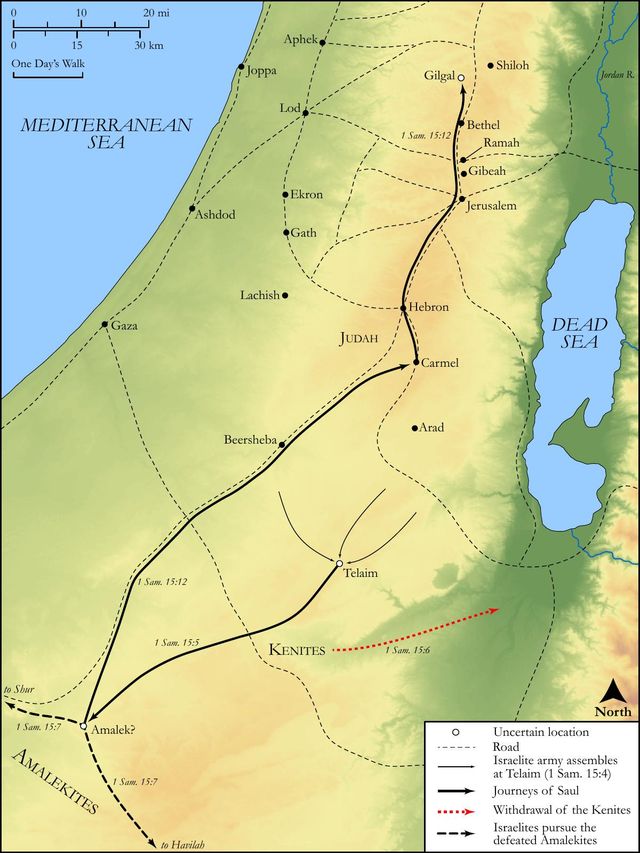
This pronouncement is the climax of a series of confrontations between Samuel and Saul, culminating in God's definitive rejection of Saul as king. The immediate narrative begins with God's explicit command to Saul to utterly destroy the Amalekites, a long-standing enemy of Israel, including all their livestock, as detailed in 1 Samuel 15:1-3. Saul, however, partially obeys, sparing King Agag and the best of the sheep and oxen under the pretext of offering sacrifices to the LORD. This act of selective obedience, driven by fear of the people and a desire for personal gain or glory, is met with Samuel's stern rebuke, famously stating that "to obey is better than sacrifice, and to hearken than the fat of rams" in 1 Samuel 15:22. The tearing of Samuel's robe in 1 Samuel 15:27 immediately precedes this verse, serving as a powerful visual metaphor for the tearing of the kingdom from Saul. Thus, 1 Samuel 15:28 is the ultimate declaration of God's final decision regarding Saul's kingship, setting the stage for the anointing of David in 1 Samuel 16.
Historical & Cultural Context
Israel at this time was a nascent monarchy, transitioning from a tribal confederacy led by judges to a centralized kingdom. Crucially, this was a theocracy, meaning God was the ultimate King, and the human king was merely His chosen representative or vice-regent, expected to rule in full alignment with divine will and the Mosaic Law. Saul's failure to fully obey the herem (devotion to destruction) command against the Amalekites was not merely a military misstep but a profound act of rebellion against God's direct authority. The Amalekites had a long history of antagonism towards Israel, starting from their attack on the Israelites in the wilderness (Exodus 17:8-16), making their complete destruction a divine imperative for Israel's purity and security. Culturally, kingship in the ancient Near East often involved divine legitimation, but in Israel, this legitimation was contingent upon absolute obedience to Yahweh. The "tearing" of a kingdom or garment was a common symbolic act signifying irreversible separation, judgment, or a covenant being broken.
Key Themes
This verse powerfully underscores several critical theological and narrative themes. Firstly, it highlights Divine Judgment and Rejection, demonstrating God's unwavering justice and His prerogative to remove leaders who prove unfaithful to His covenant and commands. Saul's rejection is a direct consequence of his Disobedience and Self-Will, emphasizing that God values sincere and complete obedience over outward religious performance or human-pleasing acts. Saul's repeated attempts to justify himself and prioritize his own will or the people's desires over God's clear instructions reveal a fundamental flaw in his kingship. Secondly, the passage reinforces God's Sovereignty in Leadership, asserting that He is the ultimate authority who establishes and removes rulers according to His divine purposes, not based on human preferences or traditions. This divine prerogative ensures that His overarching plan for Israel's salvation history will progress. Finally, the verse introduces the theme of Transition to a New, "Better" Leader, prophetically pointing to David, who would be chosen by God not for his physical stature or military prowess but because he was "a man after his own heart" (1 Samuel 13:14), demonstrating a deeper commitment to God's will and a repentant spirit.
Exposition and Analysis
Key Word Analysis
This verb (H7167) literally means "to tear," "to rend," or "to rip apart." It conveys a sense of violent, decisive, and irreversible separation. The imagery is vivid, suggesting that the kingdom was not merely taken away from Saul, but forcefully ripped from him, much like Samuel himself had just torn his robe in 1 Samuel 15:27. This emphasizes the finality and severity of God's judgment, signifying a complete and irreparable break in Saul's relationship with God as king. It underscores that God's action is not a gentle withdrawal but a forceful, definitive removal.
This term (H7453) typically refers to an associate, friend, companion, or fellow citizen. In this context, it highlights that the successor would be someone from within Israel, perhaps even someone in close proximity to Saul's circle, yet distinct and chosen by God. It subtly foreshadows David, who would eventually serve in Saul's court, initially as a musician and armor-bearer, before being recognized as God's chosen king. The use of "neighbor" rather than a more direct "successor" or "new king" adds a layer of prophetic ambiguity that would soon be clarified.
While "better" (H2896) can imply superiority in various aspects, in this theological context, it signifies moral, spiritual, and relational superiority in God's eyes. The new king would be "better" not necessarily in terms of military might or political acumen, but in his heart's disposition towards God, his obedience, and his alignment with divine will. This points directly to David, who, despite his flaws, demonstrated a profound commitment to Yahweh and a repentant spirit when confronted with his sin, qualities that Saul consistently lacked.
Verse Breakdown
"And Samuel said unto him"
This phrase emphasizes the prophetic authority of Samuel. He is not speaking his own opinion but delivering a direct, divine oracle. As God's chosen prophet, his words carry the weight of God's own declaration, making the pronouncement undeniable and final.
"The LORD hath rent the kingdom of Israel from thee this day"
This is the core of the judgment. "The LORD" (Yahweh) is the active agent, underscoring that this is a divine act, not a human coup or political maneuver. The use of the perfect tense ("hath rent") indicates a completed action with lasting consequences, signifying the irreversible nature of the decision. "This day" emphasizes the immediacy and finality of the judgment; the kingdom is taken from Saul now, effectively ending his legitimate reign in God's eyes. The kingdom of Israel, being God's special possession, is subject to His sovereign rule.
"and hath given it to a neighbour of thine, [that is] better than thou"
This clause reveals the divine transfer of power and introduces the prophetic element of the verse. God, who removed Saul, is also the one who has already chosen and will install his successor. The identity of the "neighbour" is initially veiled but clearly points to David, who will soon be anointed. The critical distinction is that this new king is "better" than Saul, not in human terms of strength or appearance, but in terms of his heart's disposition towards God and his willingness to obey. This "better" quality is the divine criterion for kingship.
Literary Devices
The verse is rich in Symbolism, primarily through the act of "rending" or "tearing." This imagery, reinforced by Samuel's tearing of his own robe in the preceding verse, powerfully symbolizes the violent and irreversible separation of the kingdom from Saul. It signifies a covenant broken and a relationship severed. The verse also functions as a direct Prophecy, foretelling the transfer of the kingdom to a new, unnamed individual who will be superior in God's estimation. There is a subtle Irony in Saul's downfall; he was chosen by God as Israel's first king, yet his reign is prematurely ended by God due to his disobedience, a stark contrast to the initial hopes and promises. Furthermore, the passage employs Foreshadowing, as the mention of a "neighbour... better than thou" clearly anticipates the anointing and rise of David, setting the narrative trajectory for the subsequent chapters of 1 Samuel.
Theological and Thematic Connections
1 Samuel 15:28 profoundly illustrates God's unwavering commitment to His own character and His covenantal demands. It reveals that God's choices are not arbitrary but are rooted in His righteousness and sovereignty, particularly His demand for genuine obedience over outward religious performance. Saul's rejection serves as a stark reminder that divine favor is not a permanent entitlement but is contingent upon faithful stewardship and humble submission to God's will. God's judgment is not capricious but a just response to persistent rebellion and a failure to honor His authority. This passage underscores that God is ultimately in control of human history and leadership, raising up and bringing down rulers according to His eternal purposes, ensuring that His kingdom agenda will prevail regardless of human failings.
Reflection and Application
1 Samuel 15:28 serves as a timeless and sobering lesson for all believers, particularly those in positions of leadership. It challenges us to examine the sincerity and completeness of our obedience to God. Saul's tragic downfall reminds us that partial obedience is, in God's eyes, full disobedience, especially when motivated by self-preservation, fear of man, or a desire for personal glory rather than genuine devotion to God's will. We are called to prioritize God's commands above all else, recognizing that He values a humble, contrite, and obedient heart far more than any outward religious act or sacrifice. This passage compels us to consider whether we are truly seeking God's heart in all our decisions, or if we are, like Saul, prone to self-justification and compromising God's clear instructions for our own perceived benefit or comfort. It also highlights the immense responsibility that comes with any form of influence or authority, urging us to steward it with integrity, humility, and unwavering faithfulness to God's purposes.
Questions for Reflection
FAQ
Why was Saul's disobedience regarding the Amalekites so severe as to cost him the kingdom?
Saul's disobedience was severe for several reasons. Firstly, God's command to utterly destroy the Amalekites (a practice known as herem, or "devotion to destruction") was explicit and absolute, serving as divine judgment against a people who had historically attacked Israel unprovoked (Exodus 17:8-16) and continued to be a spiritual and physical threat. Saul's failure to fully execute this command, particularly by sparing King Agag and the best of the livestock, was a direct act of defiance against God's clear word. Secondly, his subsequent attempts to justify his actions by claiming he intended to offer sacrifices to the LORD revealed a heart that prioritized his own will and the people's approval over God's authority. Samuel's famous rebuke, "to obey is better than sacrifice" (1 Samuel 15:22), underscores that God desires a submissive heart more than ritualistic performance. Saul's actions were not merely a tactical error but a profound spiritual rebellion, demonstrating a lack of trust and a self-willed spirit unfit for a king in God's theocracy.
Who is the "neighbour" mentioned in the verse, and in what sense was he "better" than Saul?
The "neighbour" referred to in 1 Samuel 15:28 is David, who would soon be anointed by Samuel in 1 Samuel 16. David was "better" than Saul not necessarily in terms of initial political power or military experience, but primarily in his heart's disposition towards God. While David was far from perfect, he consistently demonstrated a deep reverence for Yahweh, a reliance on divine guidance, and crucially, a repentant spirit when confronted with his sins. God Himself had previously stated that He would seek "a man after his own heart" (1 Samuel 13:14) to rule His people. Unlike Saul, who repeatedly sought to justify himself and prioritize human approval, David was marked by a fundamental desire to obey God and to acknowledge His sovereignty, even in his failures. This spiritual and moral superiority in God's eyes made him the divinely appointed successor.
Christ-Centered Fulfillment
1 Samuel 15:28, with its somber pronouncement of a kingdom "rent" from a disobedient king and given to a "better" neighbor, powerfully foreshadows the ultimate need for a perfect King, Jesus Christ. Saul's failure highlights the inherent inadequacy of human kingship and the devastating consequences of human sin and disobedience. Unlike Saul, who sought his own will and the approval of men, Jesus perfectly embodied obedience to God the Father, even to the point of death on a cross, as described in Philippians 2:8. He declared, "I have come down from heaven not to do my will but to do the will of him who sent me" (John 6:38), a stark contrast to Saul's self-justifying rebellion. Jesus is the true "better" King, the Son of David, whose kingdom is not "rent" or temporary but eternal and unshakeable, as affirmed in Hebrews 12:28. He is the ultimate Shepherd-King who perfectly cares for His flock, unlike Saul who failed to truly shepherd God's people. Through His perfect obedience, sacrificial death, and glorious resurrection, Jesus established a kingdom that will never be taken away, offering true and lasting salvation to all who submit to His perfect reign.