


1 Thessalonians 5:20
Bible text: King James Version (1769 Blayney text) · Public domain
Bible text: King James Version with Strong's numbers · Public domain
Bible text: Berean Standard Bible · Public domain
Bible text: American Standard Version (1901) · Public domain
Bible text: World English Bible, Messianic edition · Public domain
Bible text: Young's Literal Translation · Public domain
- προφητείαςprophēteiasPropheciesG4394N-APFNoun Accusative Plural Feminine
- μὴmēnotG3361PRT-NNegative Particle Negative
- ἐξουθενεῖτε·exoutheneitedo despiseG1848V-PAM-2PVerb Present Active Imperative 2nd Plural
English is a literal word-by-word gloss of the Greek, not the KJV's wording. Why?
This is the original text the KJV's translators worked from — each Greek word with its own literal English meaning in this verse, prepared by scholars at Tyndale House, Cambridge. The KJV translates whole sentences, not word by word, so its wording differs: one Greek word can become several English words, and the KJV may choose “charity” where the gloss reads “love”. Both are faithful — they answer different questions. For the KJV's own rendering, switch to the KJV text.
Details
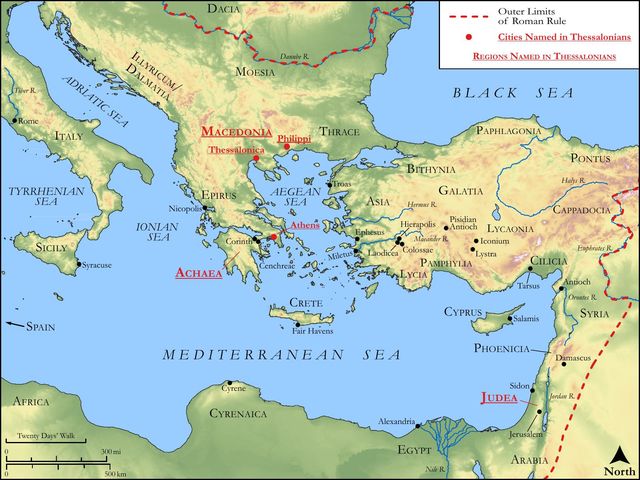
See on the biblical-era maps

Study this verse
Public-domain commentary
Matthew Henry
From his Commentary on the Whole Bible. Henry comments on passages, not single verses — this entry covers 1 Thessalonians 5:16–22.
Here we have divers short exhortations, that will not burden our memories, but will be of great use to direct the motions of our hearts and lives; for the duties are of great importance, and we may observe how they are connected together, and have a dependence upon one another. 1. Rejoice evermore, Th1 5:16. This must be understood of spiritual joy; for we must rejoice in our creature-comforts as if we rejoiced not, and must not expect to live many years, and rejoice in them all; but, if we do rejoice in God, we may do that evermore. In him our joy will be full; and it is our fault if we have not a continual feast. If we are sorrowful upon any worldly account, yet still we may always rejoice, Co2 6:10. Note, A religious life is a pleasant life, it is a life of constant joy. 2. Pray without ceasing, Th1 5:17. Note, The way to rejoice evermore is to pray without ceasing. We should rejoice more if we prayed more. We should keep up stated times for prayer, and continue instant in prayer. We should pray always, and not faint: pray without weariness, and continue in prayer, till we come to that world where prayer shall be swallowed up in praise. The meaning is not that men should do nothing but pray, but that nothing else we do should hinder prayer in its proper season. Prayer will help forward and not hinder all other lawful business, and every good work. 3. In every thing give thanks, Th1 5:18. If we pray without ceasing, we shall not want matter for thanksgiving in every thing. As we must in every thing make our requests known to God by supplications, so we must not omit thanksgiving, Phi 4:6. We should be thankful in every condition, even in adversity as well as prosperity. It is never so bad with us but it might be worse. If we have ever so much occasion to make our humble complaints to God, we never can have any reason to complain of God, and have always much reason to praise and give thanks: the apostle says, This is the will of God in Christ Jesus concerning us, that we give thanks, seeing God is reconciled to us in Christ Jesus; in him, through him, and for his sake, he allows us to rejoice evermore, and appoints us in every thing to give thanks. It is pleasing to God. 4. Quench not the Spirit (Th1 5:19), for it is this Spirit of grace and supplication that helpeth our infirmities, that assisteth us in our prayers and thanksgivings. Christians are said to be baptized with the Holy Ghost and with fire. He worketh as fire, by enlightening, enlivening, and purifying the souls of men. We must be careful not to quench this holy fire. As fire is put out by withdrawing fuel, so we quench the Spirit if we do not stir up our spirits, and all that is within us, to comply with the motions of the good Spirit; and as fire is quenched by pouring water, or putting a great quantity of dirt upon it, so we must be careful not to quench the Holy Spirit by indulging carnal lusts and affections, or minding only earthly things. 5. Despise not prophesyings (Th1 5:20); for, if we neglect the means of grace, we forfeit the Spirit of grace. By prophesyings here we are to understand the preaching of the word, the interpreting and applying of the scriptures; and this we must not despise, but should prize and value, because it is the ordinance of God, appointed of him for our furtherance and increase in knowledge and grace, in holiness and comfort. We must not despise preaching, though it be plain, and not with enticing words of men's wisdom, and though we be told no more than what we knew before. It is useful, and many times needful, to have our minds stirred up, our affections and resolutions excited, to those things that we knew before to be our interest and our duty. 6. Prove all things, but hold fast that which is good, Th1 5:21. This is a needful caution, to prove all things; for, though we must put a value on preaching, we must not take things upon trust from the preacher, but try them by the law and the testimony. We must search the scriptures, whether what they say be true or not. We must not believe every spirit, but must try the spirits. But we must not be always trying, always unsettled; no, at length we must be settled, and hold fast that which is good. When we are satisfied that any thing is right, and true, and good, we must hold it fast, and not let it go, whatever opposition or whatever persecution we meet with for the sake thereof. Note, The doctrines of human infallibility, implicit faith, and blind obedience, are not the doctrines of the Bible. Every Christian has and ought to have, the judgment of discretion, and should have his senses exercised in discerning between good and evil, truth and falsehood, Heb 5:13, Heb 5:14. And proving all things must be in order to holding fast that which is good. We must not always be seekers, or fluctuating in our minds, like children tossed to and fro with every wind of doctrine. 7. Abstain from all appearance of evil, Th1 5:22. This is a good means to prevent our being deceived with false doctrines, or unsettled in our faith; for our Saviour has told us (Joh 7:17), If a man will do his will, he shall know of the doctrine whether it be of God. Corrupt affections indulged in the heart, and evil practices allowed of in the life, will greatly tend to promote fatal errors in the mind; whereas purity of heart, and integrity of life, will dispose men to receive the truth in the love of it. We should therefore abstain from evil, and all appearances of evil, from sin, and that which looks like sin, leads to it, and borders upon it. He who is not shy of the appearances of sin, who shuns not the occasions of sin, and who avoids not the temptations and approaches to sin, will not long abstain from the actual commission of sin.
Historical interpretation
Two Centuries of Reception
4 surviving comments on this verse. Each one is dated, so this reads as a timeline rather than a list.
Select a marker to jump to its quote. Markers stagger vertically where authors wrote within a few decades of each other.
Trust the Lord, ye who doubt, for He is all-powerful, and can turn His anger away from you, and send scourges on the doubters. Woe to those who hear these words, and despise them: better were it for them not to have been born.
Despise not prophesyings. Prove all things: hold fast that which is good. Abstain from every form of evil."
For he has already quenched and despised the thing which he destroys, and is unable to forbid what he has despised. It is then incumbent on Marcion now to display in his church that spirit of his god which must not be quenched, and the prophesyings which must not be despised.
"Quench not the Spirit. Despise not prophesyings. But prove all things; hold fast that which is good. Abstain from every form of evil."
A thick mist, a darkness and cloud is spread over all the earth. And, showing this, the Apostle said, "For we were once darkness." (Eph. v. 8) And again, "Ye, brethren, are not in darkness, that that day should overtake you as a thief." Since therefore there is, so to speak, a moonless night, and we walk in that night, God hath given us a bright lamp, having kindled in our souls the grace of the Holy Spirit. But some who have received this light have rendered it more bright and shining, as, for instance, Paul and Peter, and all those Saints; while others have even extinguished it, as the five virgins, as those who have "made shipwreck concerning the faith," as the fornicator of Corinth, as the Galatians who were perverted.
On this account Paul says, "Quench not the Spirit," that is, the gift of grace, for it is his custom so to call the gift of the Spirit. But this an impure life extinguishes. For as any one, who has sprinkled both water and dust upon the light of our lamp, extinguishes it, and if he does not this, but only takes out the oil-so it is also with the gift of grace. For if you have cast over it earthly things, and the cares of fluctuating matters, you have quenched the Spirit. And if you have done none of these things, but a temptation coming from some other quarter has vehemently assailed it, as some wind, and if the light be not strong, and it has not much oil, or you have not closed the opening, or have not shut the door, all is undone.
But there is also another explanation. There were among them many indeed who prophesied truly, but some prophesied falsely. For the devil, of his vile craft, wished through this gift of grace to subvert everything pertaining to the Church. For since both the demon and the Spirit prophesied concerning the future, the one indeed uttering falsehood, and the other truth, and it was not possible from any quarter to receive a proof of one or the other, He gave also the "discernings of spirits." Since therefore then also among the Thessalonians many were prophesying, glancing at whom he says, "Neither by word, nor by epistle, as from us, as that the day of the Lord is now present" (2 Thess. ii. 2), he says this here.
Seest thou that this is what he means by, "Prove all things"? Because he had said, "Despise not prophesyings," lest they should think that he opened the pulpit to all, he says, "Prove all things," that is, such as are really prophecies; "and hold fast that which is good. Abstain from every form of evil"; not from this or that, but from all; that you may by proof distinguish both the true things and the false, and abstain from the latter, and hold fast the former. For thus both the hatred of the one will be vehement and the love of the other arises, when we do all things not carelessly, nor without examination, but with careful investigation.
Continue studying 1 Thessalonians 5:20 across the web’s major study libraries — every link below opens this exact verse, chapter, or book on the destination site.
Read & Compare
 BibleGatewayThis verse in more than 200 translations and 70 languages.
 Bible.comThe YouVersion reader — hundreds of translations, reading plans, and highlights.
 ESV.orgCrossway's official English Standard Version reader.
 NET BibleThe NET translation with 60,000+ translators' notes on every rendering decision.
 STEP BibleTyndale House's free study tool — original text, vocabulary, and scholarly resources.
 BibliaLogos Bible Software's free web reader.
 USCCBThe New American Bible (Revised Edition) with the U.S. bishops' study notes.
Commentaries
 BibleHub CommentariesDozens of classic commentaries on this verse, gathered on one page.
 StudyLightMore than 100 commentary sets — the largest collection on the web.
 BibleRefPlain-English commentary on what this verse means, verse by verse.
 Enduring WordDavid Guzik's free commentary on this chapter, widely used by Bible teachers.
 Bible Study ToolsVerse commentary alongside Greek and Hebrew study aids.
Original Language & Research
- BibleHub InterlinearThe verse word by word — original language, transliteration, and English.
- BibleHub LexiconEvery word's original-language definition and Strong's entry.
 Blue Letter BibleDeep-study tools — Strong's numbers, concordance, and word studies.
 CNTR CollationThe earliest Greek manuscripts of this verse, collated letter by letter.
Sermons, Hymns & Audio


TrulyRandomVerse is not affiliated with these sites and doesn’t control their content. They’re linked because they’re genuinely useful.
Summary
The Apostle Paul's terse yet profound instruction in 1 Thessalonians 5:20 serves as a critical directive for the early church in Thessalonica, urging believers not to treat with contempt or dismiss prophetic utterances. This command is part of a series of concise, practical exhortations aimed at fostering healthy corporate worship and sanctified living, emphasizing the importance of valuing divine communication while simultaneously preparing the community for the necessary practice of discernment regarding spiritual gifts.
Context
ShowHideLiterary Context
This verse is situated within the closing admonitions of Paul's first epistle to the Thessalonians, a section (beginning around 1 Thessalonians 5:12) characterized by a rapid-fire succession of practical instructions for communal life and individual godliness. It immediately follows the exhortation to "Quench not the Spirit" and is directly followed by the crucial balancing command to "Prove all things; hold fast that which is good". This sequence highlights Paul's concern for a vibrant, Spirit-filled community that also exercises mature discernment, ensuring that the manifestation of spiritual gifts, particularly prophecy, is neither suppressed nor uncritically accepted. The broader context of chapters 1 Thessalonians 4 and 1 Thessalonians 5 deals with sanctification, the return of Christ, and practical Christian living, making the proper handling of spiritual gifts an integral part of their spiritual maturity.
Historical & Cultural Context
The early Christian church, particularly in Gentile cities like Thessalonica, was a new phenomenon, often meeting in house churches and characterized by a dynamic outpouring of the Holy Spirit. Spiritual gifts, including prophecy, were common and highly valued for the edification, exhortation, and comfort of believers (1 Corinthians 14:3). However, the very newness and vibrancy of these manifestations also presented challenges. There could be instances of false prophecy, misuse of gifts, or even a natural human tendency to dismiss what seemed disorderly or unconventional. Paul's instruction here suggests that some in the Thessalonian church might have been tempted to disregard prophetic utterances, perhaps due to past abuses, a desire for order, or a lack of understanding regarding the gift's legitimate function. This command, therefore, served as a vital corrective, ensuring that genuine divine communication was not stifled.
Key Themes
ShowHideThis verse contributes significantly to several key themes within 1 Thessalonians and the broader Pauline corpus. Firstly, it underscores the Value of Divine Communication, emphasizing that God continues to speak to His people, and His voice, even through human vessels, should be received with respect. Secondly, it highlights the Importance of Spiritual Gifts for the health and edification of the church, connecting directly to the theme of not "quenching the Spirit" in the preceding verse. Paul consistently teaches that these gifts are given for the common good (1 Corinthians 12:7). Thirdly, it implicitly introduces the theme of Discernment and Balance, as the subsequent verse (1 Thessalonians 5:21) immediately calls for the testing and evaluation of all things, including prophetic words. This balance between openness to the Spirit and critical evaluation is a hallmark of Paul's teaching on spiritual gifts.
Exposition and Analysis
ShowHideKey Word Analysis
ShowHideThis word, a variation of exoudenóo, carries a strong connotation of treating something with contempt, utterly rejecting it, or counting it as nothing. It is more than mere indifference; it implies active scorn or disdain. Paul is not merely advising against ignoring prophetic words but against actively devaluing or dismissing them as worthless. This suggests a potential attitude of disdain or a cynical rejection of prophetic utterances within the community.
This is a particle of qualified negation, used in prohibitions or to express a negative condition or purpose. In this imperative context, it forms a direct command to avoid the specified action. Unlike ou (which expresses absolute denial), mḗ often implies that the action is possible or a real temptation, making the prohibition particularly relevant and urgent.
Derived from prophētēs ("prophet"), this term refers to the act or content of prophecy. In the New Testament, prophēteía is not exclusively about predicting the future. While it can include foretelling, its primary function is "forth-telling" God's message for a specific situation, often involving exhortation, edification, comfort, and revelation for the church, as detailed in 1 Corinthians 14:3. It signifies an inspired utterance through which God communicates His will and truth to His people.
Verse Breakdown
ShowHide"Despise not prophesyings"
This concise command is a negative imperative, directly instructing the Thessalonian believers to avoid treating prophetic utterances with contempt or disdain. The choice of "despise" (exouthenéō) is significant, implying a strong warning against a dismissive or scornful attitude towards what is presented as divine communication. Paul is not advocating for blind acceptance, but for a posture of respect and openness to the possibility that God might be speaking. The plural "prophesyings" indicates not just the gift in general, but the specific instances or expressions of prophecy occurring within their gatherings. This command serves as a safeguard against quenching the Spirit by prematurely or cynically rejecting genuine expressions of God's voice among them.
Literary Devices
ShowHideThe verse employs a direct Imperative Mood, which is characteristic of Paul's practical exhortations in the latter part of his letters. This direct command, "Despise not," leaves no room for ambiguity regarding the desired action or attitude. The use of Negation ("not") highlights a specific behavior to be avoided, underscoring that the temptation or tendency to despise prophecy was a real concern within the community. The brevity and punchiness of the phrase function as a Pastoral Exhortation, a concise and memorable instruction designed for immediate application within the church's corporate life. The term "prophesyings" can also be seen as a form of Metonymy, where the specific utterances stand for the broader spiritual gift and the divine communication it represents.
Theological and Thematic Connections
ShowHideThe command not to despise prophesyings is deeply rooted in the biblical understanding of God's ongoing communication with His people and the vital role of spiritual gifts in building up the body of Christ. It affirms the belief that God speaks through His Spirit, and that these utterances, when genuine, are a valuable means of grace, edification, and guidance for the church. To despise them would be to despise the very voice of God and to hinder the Spirit's work. However, this openness is always balanced by the need for discernment, recognizing that not all utterances claiming to be from God are authentic or beneficial. The tension between valuing prophetic ministry and rigorously testing it is a recurring theme in the New Testament, ensuring both spiritual vitality and doctrinal purity.
Reflection and Application
ShowHideIn an age often marked by skepticism or, conversely, uncritical acceptance, Paul's instruction to "Despise not prophesyings" remains profoundly relevant. It calls believers to cultivate a posture of humility and openness to how God might choose to speak, whether through the preached Word, a timely insight, or a Spirit-inspired utterance. This means resisting the temptation to dismiss spiritual expressions out of hand, whether due to intellectual pride, past negative experiences, or a preference for purely rational discourse. Valuing prophecy means recognizing that God is still active and desires to communicate with His people for their encouragement, comfort, and edification. However, this openness must never devolve into gullibility. The very next verse in 1 Thessalonians 5:21 provides the essential counter-balance: "Prove all things; hold fast that which is good." Therefore, true application involves a dynamic tension: a readiness to receive coupled with a commitment to rigorous, biblically informed discernment, ensuring that all things done in the church truly build up the body and glorify God.
Questions for Reflection
ShowHideFAQ
ShowHideWhat exactly does "prophesyings" mean in the New Testament context?
ShowHideIn the New Testament, "prophesyings" (Greek: prophēteía) refers to inspired utterances from God, spoken through a person. While it can include foretelling future events, its primary function, especially in the church gatherings described by Paul, was "forth-telling" God's message for the present. This often involved words of exhortation, edification, comfort, and revelation for the believers, as clearly articulated in 1 Corinthians 14:3. It was a means by which God directly communicated His truth and will to His people, building up the community.
Christ-Centered Fulfillment
ShowHideWhile 1 Thessalonians 5:20 directly addresses the proper reception of spiritual gifts, its Christ-centered fulfillment lies in recognizing Jesus as the ultimate Prophet and the very embodiment of God's final and complete revelation. All true prophecy, whether in the Old Testament or the New, ultimately points to Christ, finds its meaning in Him, and is empowered by His Spirit. He is the "Word made flesh" (John 1:14), the one through whom God has "spoken to us by his Son" (Hebrews 1:1-2). The Holy Spirit, whom Christ promised to send (John 14:26), is the source of all spiritual gifts, including prophecy, enabling believers to speak God's truth in a way that testifies to Jesus and builds up His body. Therefore, to "despise not prophesyings" is, at its core, to honor the ongoing work of the Spirit of Christ in His church, which always aims to exalt Christ and draw people into deeper relationship with Him, the perfect and final revelation of God.