


1 Kings 6:37
Bible text: King James Version (1769 Blayney text) · Public domain
Bible text: Berean Standard Bible · Public domain
Bible text: American Standard Version (1901) · Public domain
Bible text: World English Bible, Messianic edition · Public domain
Bible text: Geneva Bible (1599) · Public domain
Bible text: Young's Literal Translation · Public domain
- בַּשָּׁנָהba·sha·Nahin the yearH8141Prep-b ¦ N-fsNoun Singular Feminine Absoluteבַּin theשָּׁנָהyear
- הָרְבִיעִיתha·re·vi·'It<the> fourthH7243Art ¦ Adj-fsAdjective Numerical Position Singular Feminine Absoluteהָ<the>רְבִיעִיתfourth
- יֻסַּדyu·Sadit was foundedH3245V-Pual-Perf-3msVerb Pual Perfect 3rd Singular Masculine
- בֵּיתbeit[the] house ofH1004N-mscNoun Singular Masculine Construct
- יְהוָהYah·wehYahwehH3068N-properNoun Proper Title
- בְּיֶרַחbe·Ye·rachin [the] month ofH3391Prep-b ¦ N-mscNoun Singular Masculine Constructבְּinיֶרַח[the] month of
- זִוZivZivH2099N-properNoun Proper Title
English is a literal word-by-word gloss of the Hebrew, not the KJV's wording. Why?
This is the original text the KJV's translators worked from — each Hebrew word with its own literal English meaning in this verse, prepared by scholars at Tyndale House, Cambridge. The KJV translates whole sentences, not word by word, so its wording differs: one Hebrew word can become several English words, and the KJV may choose “the LORD” where the gloss reads “Yahweh”. Both are faithful — they answer different questions. For the KJV's own rendering, switch to the KJV text.
Details
See on the biblical-era maps
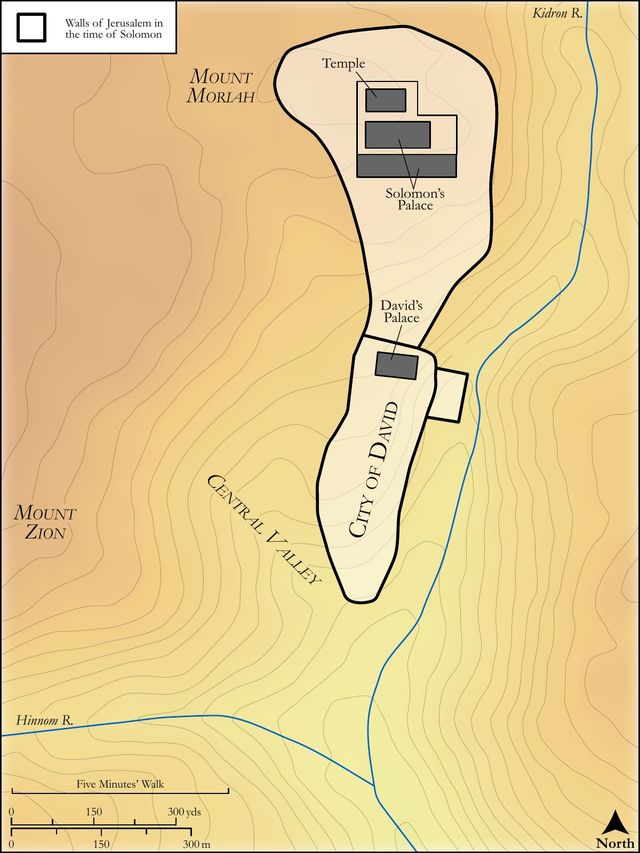
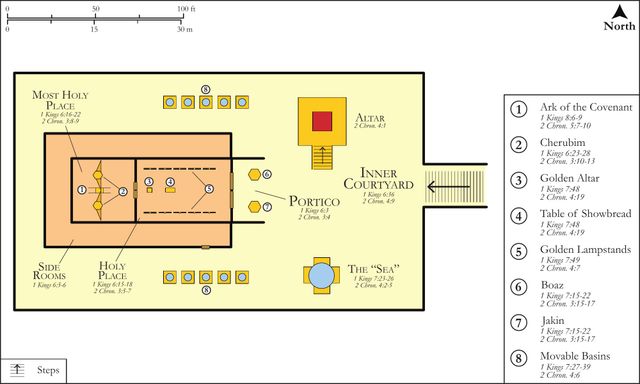
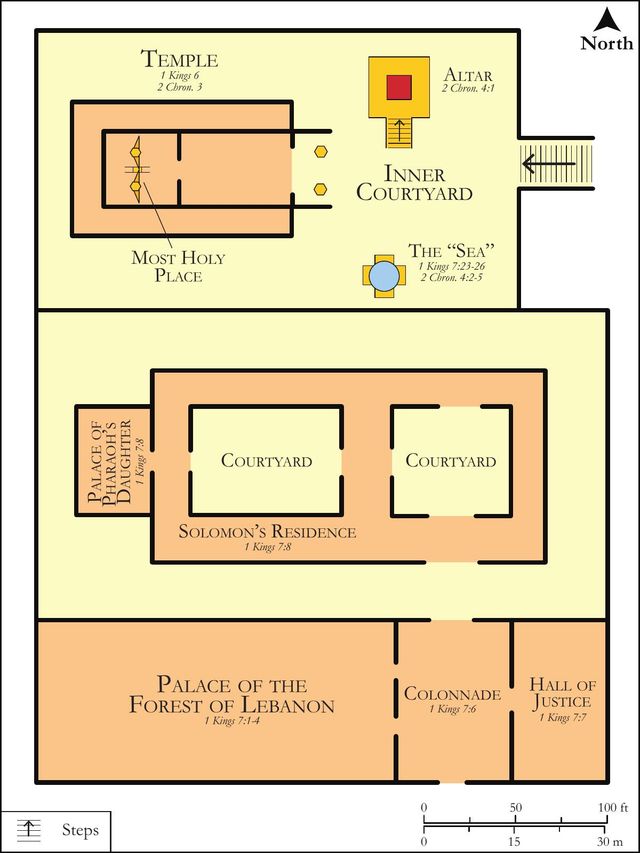
Study this verse
Public-domain commentary
Matthew Henry
From his Commentary on the Whole Bible. Henry comments on passages, not single verses — this entry covers 1 Kings 6:15–38. His three-level outline is real structure in the source text, so it is rendered as structure.
Here, I. We have a particular account of the details of the building.
1.The wainscot of the temple. It was of cedar (Kg1 6:15), which was strong and durable, and of a very sweet smell. The wainscot was curiously carved with knops (like eggs or apples) and flowers, no doubt as the fashion then was, Kg1 6:18.
2.The gilding. It was not like ours, washed over, but the whole house, all the inside of the temple (Kg1 6:22), even the floor (Kg1 6:30), he overlaid with gold, and the most holy place with pure gold, Kg1 6:21. Solomon would spare no expense necessary to make it every way sumptuous. Gold was under foot there, as it should be in all the living temples: the abundance of it lessened its worth.
3.The oracle, or speaking-place (for so the word signifies), the holy of holies, so called because thence God spoke to Moses, and perhaps to the high priest, when he consulted with the breast-plate of judgment. In this place the ark of the covenant was to be set, Kg1 6:19. Solomon made every thing new, and more magnificent than it had been, except the ark, which was still the same that Moses made, with its mercy-seat and cherubim; that was the token of God's presence, which is always the same with his people whether they meet in tent or temple, and changes not with their condition.
4.The cherubim. Besides those at the ends of the mercy-seat, which covered the ark,
(1.)Solomon set up two more, very large ones, images of young men (as some think), with wings made of olive-wood, and all overlaid with gold, Kg1 6:23, etc. This most holy place was much larger than that in the tabernacle, and therefore the ark would have seemed lost in it, and the dead wall would have been unsightly, if it had not been thus adorned.
(2.)He carved cherubim upon all the walls of the house, Kg1 6:29. The heathen set up images of their gods and worshipped them; but these were designed to represent the servants and attendants of the God of Israel, the holy angels, not to be themselves worshipped (see thou do it not), but to show how great he is whom we are to worship.
5.The doors. The folding doors that led into the oracle were but a fifth part of the wall (Kg1 6:31), those into the temple were a fourth part (Kg1 6:33); but both were beautified with cherubim engraven on them, Kg1 6:32, Kg1 6:35.
6.The inner court, in which the brazen altar was at which the priests ministered. This was separated from the court where the people were by a low wall, three rows of hewn stone tipped with a cornice of cedar (Kg1 6:36), that over it the people might see what was done and hear what the priests said to them; for, even under that dispensation, they were not kept wholly either in the dark or at a distance.
7.The time spent in this building. It was but seven years and a half from the founding to the finishing of it, Kg1 6:38. Considering the vastness and elegance of the building, and the many appurtenances to it which were necessary to fit it for use, it was soon done. Solomon was in earnest in it, had money enough, had nothing to divert him from it, and many hands made quick work. He finished it (as the margin reads it) with all the appurtenances thereof, and with all the ordinances thereof, not only built the place, but set forward the work for which it was built.
II.Let us now see what was typified by this temple.
1.Christ is the true temple; he himself spoke of the temple of his body, Joh 2:21. God himself prepared him his body, Heb 10:5. In him dwelt the fulness of the Godhead, as the Shechinah in the temple. In him meet all God's spiritual Israel. Through him we have access with confidence to God. All the angels of God, those blessed cherubim, have a charge to worship him.
2.Every believer is a living temple, in whom the Spirit of God dwells, Co1 3:16. Even the body is such by virtue of its union with the soul, Co1 6:19. We are not only wonderfully made by the divine providence, but more wonderfully made anew by the divine grace. This living temple is built upon Christ as its foundation and will be perfected in due time.
3.The gospel church is the mystical temple; it grows to a holy temple in the Lord (Eph 2:21), enriched and beautified with the gifts and graces of the Spirit, as Solomon's temple with gold and precious stones. Only Jews built the tabernacle, but Gentiles joined with them in building the temple. Even strangers and foreigners are built up a habitation of God, Eph 2:19, Eph 2:22. The temple was divided into the holy place and the most holy, the courts of it into the outer and inner; so there are the visible and the invisible church. The door into the temple was wider than that into the oracle. Many enter into profession that come short of salvation. This temple is built firm, upon a rock, not to be taken down as the tabernacle of the Old Testament was. The temple was long in preparing, but was built at last. The top-stone of the gospel church will, at length, be brought forth with shoutings, and it is a pity that there should be the clashing of axes and hammers in the building of it. Angels are ministering spirits, attending the church on all sides and all the members of it.
4.Heaven is the everlasting temple. There the church will be fixed, and no longer movable. The streets of the new Jerusalem, in allusion to the flooring of the temple, are said to be of pure gold, Rev 21:21. The cherubim there always attend the throne of glory. The temple was uniform, and in heaven there is the perfection of beauty and harmony. In Solomon's temple there was no noise of axes and hammers. Every thing is quiet and serene in heaven; all that shall be stones in that building must in the present sate of probation and preparation be fitted and made ready for it, must be hewn and squared by divine grace, and so made meet for a place there.
Historical interpretation
Historical reception
1 surviving comment on this verse from the historical church.
The allegorical meaning of the fact that the house of the Lord was built in seven years is plain, because, of course, the holy church is being built of the souls of the elect for the entire duration of this world, which is also completed in a period of six days, and it too brings its growth to an end with the end of the world. Or, at all events, it is built in seven years on account of the import of the grace of the Spirit through which the church alone gets the authority to be the church. For Isaiah enumerates the seven gifts of the Holy Spirit without which no one can either become a believer or keep the faith or by the merit of faith attain the crown. On the other hand, the fact that it was in the eighth year and in the eighth month of that year that the house was completed in all its parts and all its specifications has to do with the world to come and the day of judgment when the holy church will already have reached such a degree of perfection that it will not be possible to find anything to add to it. For it will then have what that dutiful devotee suppliantly asked of the Lord, saying, “Lord, show us the Father, and it is enough for us.” For it is well known that the day of judgment is often represented typologically in the Scriptures by the number eight from the fact that it follows this world, which lasts for seven days. This is also why the prophet gave the title “For the eighth” to the psalm he used to sing through fear of this severe judge, beginning with the words “Lord, rebuke me not in your indignation, nor chastise me in your wrath,” and so forth.But there arises the rather important question as to how the house of the Lord is said to have been completed in all its parts in the eighth month and in all its specifications, whereas in what follows one reads that its dedication was completed in the seventh month. On the other hand, it is not credible that Solomon, though he built the temple in seven years and completed it in the eighth month of the eighth year, nevertheless deferred the dedication of the completed building until the seventh month of the ninth year. Hence it seems more likely that the house was built in seven years and seven months so that the solemn ceremony of dedication might be celebrated in the same seventh month, and, as the Chronicles relate, on the twenty-third day of that month Solomon sent the people away to their tents, and thus after one week when the eighth month had come around, the house of the Lord was found to be complete and already finished, that is to say, both in all its parts and in its actual dedication. Unless perhaps one should think that after the dedication of the temple some extra features were added for its services up to the beginning of the eighth month, the king speeding up the work so that the temple would be dedicated in the seventh month, … and that in this way the two things might turn out to be true, namely, both that the temple had been completed in the eighth month in all its parts and specifications and that it had been dedicated in the seventh month.
Continue studying 1 Kings 6:37 across the web’s major study libraries — every link below opens this exact verse, chapter, or book on the destination site.
Read & Compare
 BibleGatewayThis verse in more than 200 translations and 70 languages.
 Bible.comThe YouVersion reader — hundreds of translations, reading plans, and highlights.
 ESV.orgCrossway's official English Standard Version reader.
 NET BibleThe NET translation with 60,000+ translators' notes on every rendering decision.
 STEP BibleTyndale House's free study tool — original text, vocabulary, and scholarly resources.
 BibliaLogos Bible Software's free web reader.
 USCCBThe New American Bible (Revised Edition) with the U.S. bishops' study notes.
Commentaries
 BibleHub CommentariesDozens of classic commentaries on this verse, gathered on one page.
 StudyLightMore than 100 commentary sets — the largest collection on the web.
 BibleRefPlain-English commentary on what this verse means, verse by verse.
 Enduring WordDavid Guzik's free commentary on this chapter, widely used by Bible teachers.
 Bible Study ToolsVerse commentary alongside Greek and Hebrew study aids.
Original Language & Research
- BibleHub InterlinearThe verse word by word — original language, transliteration, and English.
- BibleHub LexiconEvery word's original-language definition and Strong's entry.
 Blue Letter BibleDeep-study tools — Strong's numbers, concordance, and word studies.
 SefariaThe Hebrew text with Rashi and centuries of Jewish commentary.
Sermons, Hymns & Audio


TrulyRandomVerse is not affiliated with these sites and doesn’t control their content. They’re linked because they’re genuinely useful.
Summary
1 Kings 6:37 precisely marks the commencement of the physical construction of Solomon's Temple in Jerusalem. This verse pinpoints the laying of the foundation for what would become the central edifice for Israelite worship and the symbolic dwelling place of God, providing a crucial chronological anchor within the broader narrative of the Temple's building and dedication, underscoring both its historical reality and divine significance.
Context
ShowHideLiterary Context
This verse is situated within a detailed account of King Solomon's reign, specifically focusing on the monumental task of building the Temple in Jerusalem, which spans 1 Kings 5 through 1 Kings 8. Following extensive preparations detailed in 1 Kings 5, including the procurement of materials and skilled labor through alliances with Hiram of Tyre, 1 Kings 6:1 establishes the overarching timeframe for the Temple's construction, stating it began 480 years after the Exodus. Verse 37 then provides a more specific chronological marker for the start of the physical building, indicating the precise year and month the foundation was laid. The subsequent verses in 1 Kings 6 meticulously describe the Temple's dimensions, materials, and internal structure, emphasizing the grandeur and sacredness of the edifice from its very inception.
Historical & Cultural Context
The construction of a central temple answered the place the LORD had chosen to put His name there, and Israel's Temple was unique in its dedication to the one true God, Yahweh. Solomon's project was immense, requiring vast resources and international cooperation, reflecting the wealth and power of his kingdom at its zenith. The "fourth year" of Solomon's reign places this event early in his 40-year rule, indicating a swift move to fulfill the divine mandate given to his father, David, as recorded in 2 Samuel 7:13. The "month Zif" (or Ziv) was the second month of the Hebrew calendar, corresponding to April/May, a time of spring and new beginnings, which would have been an auspicious and practical time to commence such a significant construction project in the region, following the rainy season.
Key Themes
ShowHide1 Kings 6:37 contributes significantly to several key themes within 1 Kings and the broader biblical narrative. Firstly, it underscores the theme of Divine Mandate and Human Obedience, as Solomon's undertaking was a direct fulfillment of God's promise to David that his son would build a house for His name (2 Samuel 7:13). Secondly, the meticulous chronological detail highlights the theme of Divine Timing and Historical Precision, emphasizing that this sacred work was not haphazard but unfolded according to God's precise plan. Thirdly, the laying of the "foundation" speaks to the theme of Foundational Importance, symbolizing that great and enduring works, especially those dedicated to God, require a solid and deliberate groundwork. Finally, the phrase "house of the LORD" reinforces the central theological theme of God's Dwelling Among His People, signifying the Temple's role as the physical locus of God's presence, worship, and covenant relationship with Israel, a concept profoundly explored throughout 1 Kings and the Old Testament.
Exposition and Analysis
ShowHideKey Word Analysis
ShowHideThis word (H3245) is a primitive root meaning "to set" or "to found," and it underpins both the noun "foundation" and the verb "laid" in this verse. It refers to the crucial initial step of establishing a building's base, ensuring its stability and permanence. In the context of the Temple, it signifies the deliberate and essential groundwork for a sacred and lasting edifice.
Derived from H1004, this term refers to a physical dwelling, but in the context of "house of the LORD" (where LORD is H3068, Yᵉhôvâh), it signifies more profoundly a sacred dwelling place for God. It denotes the consecrated structure where God's presence (Shekinah) was manifested, where His name was invoked, and where covenant worship and sacrifices were offered to the self-existent God of Israel.
Corresponding to H2099, this is the ancient Canaanite name for the second month of the Hebrew calendar (April/May). Its literal meaning is "radiance," "bloom," or "splendor," which subtly imbues the start of the Temple's construction with symbolic significance. The commencement of this glorious, divinely ordained project in a month associated with new life and beauty suggests a fitting and auspicious beginning.
Verse Breakdown
ShowHide"In the fourth year"
This phrase provides a precise chronological anchor, dating the event to the fourth year of King Solomon's reign (H7243 rᵉbîyʻîy for "fourth" and H8141 shâneh for "year"). This specificity highlights the meticulous record-keeping of the biblical authors and underscores the historical reality and significance of the Temple's construction. It also places the event early in Solomon's rule, demonstrating his immediate commitment to this divine mandate.
"was the foundation of the house of the LORD laid"
This is the central action of the verse. It describes the crucial initial step in the Temple's construction—the laying of its foundational stones (H3245 yâçad). The passive voice ("was laid") subtly emphasizes that while human hands performed the work, the ultimate impetus and divine oversight belonged to God. The "house of the LORD" (H1004 bayith for "house," H3068 Yᵉhôvâh for "LORD") identifies the specific purpose of the building as a sacred dwelling for Yahweh, setting it apart from any ordinary structure.
"in the month Zif"
This provides a further, more granular chronological detail, specifying the exact month (H3391 yerach) within the fourth year. The mention of "Zif" (H2099 Ziv) not only adds historical precision but also carries a symbolic resonance, as previously noted, aligning the start of this sacred project with a time of natural beauty, growth, and new beginnings.
Literary Devices
ShowHideThe verse employs Chronological Precision, using specific temporal markers ("fourth year," "month Zif") to ground the narrative in historical reality and emphasize the deliberate, divinely orchestrated timing of the Temple's construction. This precision lends an air of authenticity and importance to the event, highlighting God's meticulous planning. Furthermore, there is subtle Symbolism embedded in the mention of "the month Zif," which, meaning "radiance" or "bloom," subtly connects the natural world's renewal and beauty with the spiritual significance and glory of the Temple's inception. The phrase "house of the LORD" functions as a form of Metonymy, where the physical structure stands for the divine presence and covenant relationship it facilitates, emphasizing that the building is not merely stone and wood but a consecrated space for God's dwelling among His people and the center of their worship.
Theological and Thematic Connections
ShowHideThe laying of the Temple's foundation in 1 Kings 6:37 represents a pivotal moment in salvation history, marking the tangible beginning of God's chosen dwelling place among His people. It underscores God's faithfulness to His covenant promises, particularly to David concerning a lasting dynasty and a house built for His name. This event solidified Israel's identity as a nation with a central place of worship, where atonement could be made and God's presence experienced. The meticulous detail of the timing emphasizes divine intentionality and the sacred nature of the endeavor, laying the groundwork for the rich theological themes of God's immanence, the importance of consecrated space, and the necessity of a proper foundation for spiritual endeavors.
Reflection and Application
ShowHideThe meticulous detail surrounding the laying of the Temple's foundation in 1 Kings 6:37 offers profound spiritual lessons for believers today. Just as the magnificent Temple, a symbol of God's presence, began with a carefully laid, unseen foundation, so too must our spiritual lives and endeavors be built upon a solid and unshakeable base. This verse reminds us that true spiritual growth and lasting impact are not built on superficiality or haste, but on deliberate, foundational principles—the truths of God's Word, the character of Christ, and the work of the Holy Spirit. It calls us to examine the "foundations" of our faith: are we rooted in Christ, or are we building on shifting sand? Furthermore, the divine timing emphasized in the text encourages patience and trust in God's perfect orchestration of events, reminding us that while we are called to diligent work, the ultimate success and flourishing of His kingdom initiatives rest in His sovereign hand. This passage inspires us to commit to foundational truths and to build our lives and ministries with the same intentionality and reverence that characterized the building of God's ancient house.
Questions for Reflection
ShowHideFAQ
ShowHideWhy is the specific date, "the fourth year" and "month Zif," so important?
ShowHideThe specific dating in 1 Kings 6:37 serves multiple crucial purposes. Firstly, it underscores the historical accuracy and meticulous record-keeping characteristic of biblical narratives, grounding this monumental event in verifiable time. This precision lends credibility to the account. Secondly, it highlights the divine intentionality behind the Temple's construction. The fact that the foundation was laid early in Solomon's reign (his fourth year) demonstrates his immediate obedience to God's command and the urgency with which this sacred project was undertaken. Finally, the mention of "month Zif" (April/May) not only provides a practical seasonal context for construction but also carries symbolic weight, as Zif means "radiance" or "bloom," subtly connecting the commencement of this glorious house for the LORD with a time of natural beauty and new beginnings. This level of detail emphasizes that the Temple was not a casual undertaking but a divinely ordained and precisely timed endeavor.
What is the significance of the "house of the LORD" in this context?
ShowHideThe phrase "house of the LORD" (Hebrew: bêṯ Yahweh) is profoundly significant. It refers to the Temple not merely as a building but as the designated dwelling place for God's presence among His people, Israel. This concept dates back to the Tabernacle in the wilderness (Exodus 25:8), where God commanded Israel to "make me a sanctuary, that I may dwell among them." The Temple was the permanent, stationary fulfillment of this desire, serving as the central hub for Israelite worship, sacrifice, and covenant renewal. It was where God's name would dwell (1 Kings 8:29), where His glory would be manifested (1 Kings 8:11), and where the people could draw near to Him. The laying of its foundation therefore marked the physical embodiment of God's commitment to be present with His chosen nation, a tangible sign of His covenant faithfulness.
How does the "foundation" of the Temple relate to spiritual foundations today?
ShowHideThe laying of the Temple's foundation in 1 Kings 6:37 serves as a powerful metaphor for spiritual foundations. Just as a physical structure requires a strong, stable base to endure, so too do our lives of faith. The New Testament frequently picks up this theme, most notably in 1 Corinthians 3:11, where Paul explicitly states, "For no one can lay any foundation other than the one already laid, which is Jesus Christ." This means that the ultimate and only true foundation for our salvation, our spiritual growth, and our eternal hope is Christ Himself. Building on this foundation involves hearing and obeying His words (Matthew 7:24), growing in knowledge of Him, and living according to His principles. Just as the Temple's foundation was meticulously laid, our spiritual foundations must be deliberately and firmly established in Christ to withstand the storms of life.
Christ-Centered Fulfillment
ShowHideWhile 1 Kings 6:37 details the laying of the foundation for a physical structure, it profoundly foreshadows the ultimate dwelling of God among humanity, fully realized in Jesus Christ. The Temple, as the "house of the LORD," was a temporary and symbolic representation of God's presence, limited by its physical boundaries and the need for ongoing sacrifices. However, in the New Testament, Jesus declares Himself to be greater than the Temple (Matthew 12:6), and later, He speaks of His own body as the Temple that would be destroyed and raised in three days (John 2:19). This signifies that Jesus Himself is the true and ultimate dwelling place of God, the very embodiment of God's presence on earth. Furthermore, through His atoning work, believers are incorporated into His body, becoming "living stones" built into a spiritual house (1 Peter 2:5), a "temple of the Holy Spirit" (1 Corinthians 6:19). Thus, the meticulous laying of the Temple's foundation in Solomon's day points forward to the perfect, unshakeable foundation of Christ, upon whom God's new, eternal dwelling—His Church—is being built, culminating in the new heavens and new earth where God will truly dwell with His people forever (Revelation 21:3).