


1 Kings 1:35
Bible text: King James Version (1769 Blayney text) · Public domain
Bible text: King James Version with Strong's numbers · Public domain
Bible text: Berean Standard Bible · Public domain
Bible text: American Standard Version (1901) · Public domain
Bible text: World English Bible, Messianic edition · Public domain
Bible text: Geneva Bible (1599) · Public domain
Bible text: Young's Literal Translation · Public domain
- וַעֲלִיתֶםva·'a·li·Temand you will come upH5927Conj-w ¦ V-Qal-ConsecPerf-2mpVerb Qal Consecutive Perfect 2nd Plural Masculineוַandעֲלִיתֶםyou will come up
- אַחֲרָיו'a·cha·Ravafter himH310Adj-mpc ¦ 3msAdjective Numerical Plural Masculine Constructאַחֲרָיafterוhim
- וּבָאu·Va'and he will comeH935Conj-w ¦ V-Qal-ConsecPerf-3msVerb Qal Consecutive Perfect 3rd Singular Masculineוּandבָאhe will come
- וְיָשַׁבve·ya·Shavand he will sitH3427Conj-w ¦ V-Qal-ConsecPerf-3msVerb Qal Consecutive Perfect 3rd Singular Masculineוְandיָשַׁבhe will sit
- עַל'alonH5921PrepPreposition
- כִּסְאִיkis·'Imy throneH3678N-msc ¦ 1csNoun Singular Masculine Constructכִּסְאִthroneיmy
- וְהוּאve·Hu'and heH1931Conj-w ¦ Pro-3msPronoun Personal 3rd Singular Masculineוְandהוּאhe
- יִמְלֹךְyim·Lokhhe will reignH4427V-Qal-Imperf-3msVerb Qal Imperfect 3rd Singular Masculine
- תַּחְתָּיtach·Taiin place of meH8478N-mpc ¦ 1csNoun Plural Masculine Constructתַּחְתָּin place ofיme
- וְאֹתוֹve·'o·Toand <with> himH854Conj-w ¦ Prep ¦ 3msPrepositionוְandאֹת<with>וֹhim
- צִוִּיתִיtzi·Vi·tiI have appointedH6680V-Piel-Perf-1csVerb Piel Perfect 1st Singular common gender
- לִהְיוֹתlih·Yotto beH1961Prep-l ¦ V-Qal-InfVerb Qal Infinitive Constructלִtoהְיוֹתbe
- נָגִידna·GidrulerH5057N-msNoun Singular Masculine Absolute
- עַל'aloverH5921PrepPreposition
- יִשְׂרָאֵלYis·ra·'ElIsraelH3478N-properNoun Proper Location
- וְעַלve·'aland overH5921Conj-w ¦ PrepPrepositionוְandעַלover
- יְהוּדָהye·hu·DahJudahH3063N-properNoun Proper Location
English is a literal word-by-word gloss of the Hebrew, not the KJV's wording. Why?
This is the original text the KJV's translators worked from — each Hebrew word with its own literal English meaning in this verse, prepared by scholars at Tyndale House, Cambridge. The KJV translates whole sentences, not word by word, so its wording differs: one Hebrew word can become several English words, and the KJV may choose “the LORD” where the gloss reads “Yahweh”. Both are faithful — they answer different questions. For the KJV's own rendering, switch to the KJV text.
Details
See on the biblical-era maps

Study this verse
Public-domain commentary
Matthew Henry
From his Commentary on the Whole Bible. Henry comments on passages, not single verses — this entry covers 1 Kings 1:32–40. His two-level outline is real structure in the source text, so it is rendered as structure.
We have here the effectual care David took both to secure Solomon's right and to preserve the public peace, by crushing Adonijah's project in the bud. Observe,
I.The express orders he gave for the proclaiming of Solomon.
The persons he entrusted with this great affair were Zadok, Nathan, and Benaiah, men of power and interest whom David had always reposed a confidence in and found faithful to him, and whom Adonijah had passed by in his invitation, Kg1 1:10. David orders them forthwith, with all possible solemnity, to proclaim Solomon. They must take with them the servants of their lord, the lifeguards, and all the servants of the household. They must set Solomon on the mule the king used to ride, for he kept not such stables of horses as his son afterwards did. He appoints them whither to go (Kg1 1:33 and Kg1 1:34, Kg1 1:35), and what to do.
1.Zadok and Nathan, the two ecclesiastical persons, must, in God's name, anoint him king; for though he was not the first of his family, as Saul and David were, yet he was a younger son, was made king by divine appointment, and his title was contested, which made it necessary that hereby it should be settled. This unction was typical of the designation and qualification of the Messiah, or Christ, the anointed one, on whom the Spirit, that oil of gladness, was poured without measure, Heb 1:9, Psa 89:20. And all Christians, being heirs of the kingdom (Jam 2:5), do from him receive the anointing, Jo1 2:27.
2.The great officers, civil and military, are ordered to give public notice of this, and to express the public joy upon this occasion by sound of trumpet, by which the law of Moses directed the gracing of great solemnities; to this must be added the acclamations of the people: "Let king Solomon live, let him prosper, let his kingdom be established and perpetuated, and let him long continue in the enjoyment of it;" so it had been promised concerning him. Psa 72:15, He shall live.
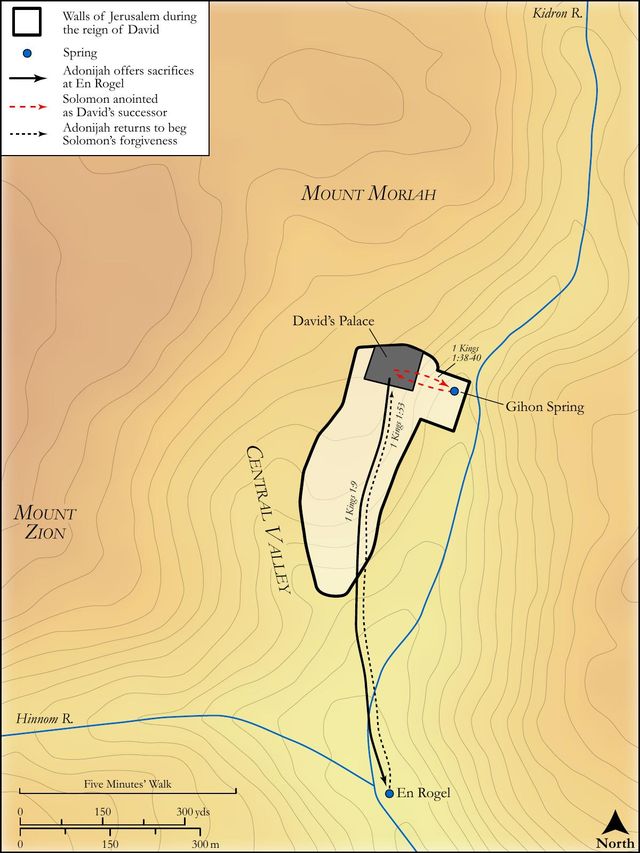
3.They must then bring him in state to the city of David, and he must sit upon the throne of his father, as his substitute now, or viceroy, to despatch public business during his weakness and be his successor after his death: He shall be king in my stead. It would be a great satisfaction to David himself, and to all parties concerned, to have this done immediately, that upon the demise of the king there might be no dispute, or agitation, in the public affairs. David was far from grudging his successor the honour of appearing such in his life-time, and yet perhaps was so taken up with his devotions on his sick-bed that, if he had not been put in mind of it by others, this great good work, which was so necessary to the public repose, would have been left undone.
II.The great satisfaction which Benaiah, in the name of the rest, professed in these orders.
The king said, "Solomon shall reign for me, and reign after me." "Amen" (says Benaiah heartily); "as the king says, so say we; we are entirely satisfied in the nomination, and concur in the choice, we give our vote for Solomon, nemine contradicente - unanimously, and since we can bring nothing to pass, much less establish it, without the concurrence of a propitious providence, The Lord God of my lord the king say so too!" Kg1 1:36. This is the language of his faith in that promise of God on which Solomon's government was founded. If we say as God says in his word, we may hope that he will say as we say by his providence. To this he adds a prayer for Solomon (Kg1 1:37), that God would be with him as he had been with David, and make his throne greater. He knew David was not one of those that envy their children's greatness, and that therefore he would not be disquieted at this prayer, nor take it as an affront, but would heartily say Amen to it. The wisest and best man in the world desires his children may be wiser and better than he, for he himself desires to be wiser and better than he is; and wisdom and goodness are true greatness.
III.The immediate execution of these orders, Kg1 1:38-40.
No time was lost, but Solomon was brought in state to the place appointed, and there Zadok (who, though he was not as yet high priest, was, we may suppose, the suffragan, the Jews called him the sagan, or second priest) anointed him by the direction of Nathan the prophet and David the king, Kg1 1:39. In the tabernacle, where the ark was now lodged, was kept among other sacred things, the holy oil for many religious services thence Zadok took a horn of oil, which denotes both power and plenty, and therewith anointed Solomon. We do not find that Abiathar pretended to anoint Adonijah: he was made king by a feast, not by an unction. Whom God calls, he will qualify, which was signified by the anointing; usurpers had it not. Christ signifies anointed, and he is the king whom God hath set upon his holy hill of Sion, according to decree, Psa 2:6, Psa 2:7. Christians also are made to our God (and by him) kings, and they have an unction from the Holy One, Jo1 2:20. The people, hereupon, express their great joy and satisfaction in the elevation of Solomon, surround him with their Hosannas - God save king Solomon, and attend him with their music and shouts of joy, Kg1 1:40. Hereby they declared their concurrence in the choice, and that he was not forced upon them, but cheerfully accepted by them. The power of a prince can be little satisfaction to himself, unless he knows it to be a satisfaction to his people. Every Israelite indeed rejoices in the exaltation of the Son of David.
Historical interpretation
Historical reception
1 surviving comment on this verse from the historical church.
Solomon, it will be remembered, succeeded to the throne during his father David’s lifetime—a kind of succession unique among Jewish kings—for no other reason save to furnish further clear evidence that Solomon is not the man our prophecy proclaims. Nathan says to David, “And when your days shall be fulfilled and you shall sleep with your fathers, I will raise up your seed after you, which shall proceed out of your bowels, and I will establish his kingdom.” In view of these words, how can anyone think that, because of the later verse, “He shall build a house to my name,” Solomon is the subject of the prophecy and fail to realize that in view of the earlier words, “And when your days shall be fulfilled and you shall sleep with your fathers, I will raise up your seed after you,” a different Peacemaker is promised—one to be raised up not before David’s demise as Solomon was but afterwards? It makes no difference how long was the lapse of time before the destined coming of Jesus Christ. The thing that is beyond question is that he who was promised in such terms to king David was destined to come after his death, the very same who was to build a house for God such as we rejoice to see rising up today, a house not fashioned of timbers and stones but of human beings. It is these people, believers in Christ, whom Saint Paul addresses in these words: “Holy is the temple of God, and this temple you are.”
Continue studying 1 Kings 1:35 across the web’s major study libraries — every link below opens this exact verse, chapter, or book on the destination site.
Read & Compare
 BibleGatewayThis verse in more than 200 translations and 70 languages.
 Bible.comThe YouVersion reader — hundreds of translations, reading plans, and highlights.
 ESV.orgCrossway's official English Standard Version reader.
 NET BibleThe NET translation with 60,000+ translators' notes on every rendering decision.
 STEP BibleTyndale House's free study tool — original text, vocabulary, and scholarly resources.
 BibliaLogos Bible Software's free web reader.
 USCCBThe New American Bible (Revised Edition) with the U.S. bishops' study notes.
Commentaries
 BibleHub CommentariesDozens of classic commentaries on this verse, gathered on one page.
 StudyLightMore than 100 commentary sets — the largest collection on the web.
 BibleRefPlain-English commentary on what this verse means, verse by verse.
 Enduring WordDavid Guzik's free commentary on this chapter, widely used by Bible teachers.
 Bible Study ToolsVerse commentary alongside Greek and Hebrew study aids.
Original Language & Research
- BibleHub InterlinearThe verse word by word — original language, transliteration, and English.
- BibleHub LexiconEvery word's original-language definition and Strong's entry.
 Blue Letter BibleDeep-study tools — Strong's numbers, concordance, and word studies.
 SefariaThe Hebrew text with Rashi and centuries of Jewish commentary.
Sermons, Hymns & Audio


TrulyRandomVerse is not affiliated with these sites and doesn’t control their content. They’re linked because they’re genuinely useful.
Summary
1 Kings 1:35 records King David's authoritative decree to formally install his son Solomon as his successor, ensuring an orderly and legitimate transfer of power amidst a challenge to the throne. This command solidifies Solomon's position as the divinely appointed king, destined to sit on David's throne and rule over the unified kingdom of Israel and Judah, thereby upholding the integrity of the Davidic covenant and securing the future stability of the nation.
Context
ShowHideLiterary Context
This verse is a pivotal moment within the opening chapter of 1 Kings, which details the tumultuous succession crisis at the end of King David's life. Chapters 1-2 of 1 Kings serve as a bridge from the books of Samuel, concluding David's reign and inaugurating Solomon's. Immediately preceding this verse, David, infirm and near death, is roused to action by Nathan the prophet and Bathsheba, who reveal Adonijah's premature self-proclamation as king (1 Kings 1:5-7) and remind David of his oath to make Solomon king (1 Kings 1:11-31). Verse 35 is part of David's swift and decisive counter-action, issuing direct commands for Solomon's immediate anointing and public installation, thereby preempting Adonijah's coup and ensuring the legitimate transfer of power. The verses that follow (1 Kings 1:38-40) describe the immediate execution of David's orders, culminating in Solomon's anointing and the people's joyous acclamation.
Historical & Cultural Context
The period of succession among the kings of that day was often fraught with instability and violence, as competing factions vied for power. David's kingdom, though unified, was not immune to such challenges, as seen previously with Absalom's rebellion (2 Samuel 15-18). Adonijah's attempt to seize the throne, gathering support from key military and religious figures like Joab and Abiathar (1 Kings 1:7), reflects this common pattern. The public anointing and enthronement ceremony, as commanded by David, was a crucial ritual to legitimize a new king in the eyes of the people and the divine. Sitting on the throne was the ultimate symbol of royal authority and sovereignty. The mention of "Israel and Judah" underscores the political reality of the unified monarchy, which, though established under David, still recognized distinct tribal identities and regional loyalties that could potentially fracture the kingdom, making a clear and undisputed succession vital.
Key Themes
ShowHideThis verse powerfully contributes to several key themes within 1 Kings and the broader Deuteronomistic History. First, it highlights the theme of legitimate succession and divine appointment. Solomon's kingship is not a result of human ambition or political maneuvering, but of David's explicit, divinely-guided appointment, fulfilling God's covenant promise to David regarding an enduring dynasty, as seen in 2 Samuel 7:12-16. Second, it underscores David's enduring authority and wisdom, even in his old age. Despite his physical weakness, David demonstrates decisive leadership, ensuring the stability and continuity of the kingdom and his legacy. His actions here prevent civil war and uphold the divine plan. Third, the phrase "ruler over Israel and over Judah" emphasizes the unity of the kingdom under a single monarch, a unity that David had forged and that Solomon was now tasked with preserving, preventing the immediate division that would eventually occur after Solomon's reign, as described in 1 Kings 12.
Exposition and Analysis
ShowHideKey Word Analysis
ShowHideFrom the root H6680, this verb means "to constitute," "to enjoin," or "to command." In this context, David's use of tsâvâh signifies a formal, authoritative, and deliberate designation of Solomon. It is not a mere suggestion but a binding royal decree, an act of setting in order the succession. This word conveys the full weight of David's sovereign will and commitment to his oath, making Solomon's claim to the throne unassailable from David's perspective and establishing his legitimacy.
Derived from H3427, this primitive root primarily means "to sit down." However, in a royal context, especially when paired with "throne," it carries the profound implication of assuming authority, exercising judgment, and establishing a permanent presence. To "sit upon my throne" is the quintessential act of royal enthronement, signifying the full transfer of judicial, administrative, and military power. It implies stability, rightful occupation, and the commencement of a reign.
This noun (H3678) refers to a royal seat, often depicted as canopied or ornate. In Israel and among the nations, the throne was the preeminent symbol of royal power, authority, and legitimate rule. It represented the king's sovereignty, his right to govern, and his divine sanction. David's throne was not merely a piece of furniture but the embodiment of the Davidic covenant and the enduring dynasty promised by God, making Solomon's occupation of it a highly significant act of succession.
Verse Breakdown
ShowHide"Then ye shall come up after him, that he may come and sit upon my throne;"
This clause initiates the command for a public procession and the formal act of enthronement. "Ye" refers to David's loyal officials and servants, specifically Zadok the priest, Nathan the prophet, and Benaiah the son of Jehoiada, who were tasked with executing David's orders (1 Kings 1:32-34). The act of "coming up after him" implies a public escort, lending legitimacy and visibility to Solomon's ascent. The ultimate goal is for Solomon to "sit upon my throne," which is the symbolic and literal act of assuming the kingship, demonstrating a direct, undisputed transfer of royal authority from David to Solomon.
"for he shall be king in my stead:"
This explanatory clause provides the direct rationale for the enthronement. Solomon is not merely a regent or a temporary placeholder; he is to assume the full, permanent role of king, replacing David as the sovereign ruler. This declaration leaves no room for ambiguity regarding Solomon's status or the finality of David's decision, directly countering Adonijah's attempted usurpation and affirming the continuity of the Davidic line.
"and I have appointed him to be ruler over Israel and over Judah."
This final, emphatic declaration reiterates David's personal and authoritative choice. The verb "appointed" (Hebrew, tsâvâh) emphasizes David's deliberate and legitimate designation of Solomon, a command given with full royal authority. The phrase "over Israel and over Judah" highlights the extent of Solomon's dominion, encompassing all twelve tribes and solidifying the unified kingdom that David had established. This ensures that Solomon's authority is recognized across the entire realm, preventing any immediate fragmentation and affirming the continuity of the Davidic monarchy over the whole nation.
Literary Devices
ShowHideThe verse employs several significant literary devices that enhance its impact and meaning. Repetition is evident in the repeated emphasis on Solomon's kingship and his role as successor, reinforcing the legitimacy and finality of David's decision and leaving no doubt about the transfer of power. The phrase "sit upon my throne" is a powerful metonymy, where the physical object (the throne) stands for the abstract concept of royal authority, sovereignty, and legitimate rule. This imagery vividly conveys the complete transfer of power. Furthermore, the entire command functions as a royal decree, demonstrating the absolute authority of the dying king to establish his successor, as seen again in David's charge to Solomon before his death. The clear, concise language and direct commands contribute to the didactic nature of the text, emphasizing the importance of orderly, divinely sanctioned leadership.
Theological and Thematic Connections
ShowHideThis verse stands as a testament to God's faithfulness to His covenant promises, even amidst human frailty and political intrigue. David's decisive action to install Solomon ensures the continuation of the Davidic line on the throne, directly fulfilling the divine promise made in 2 Samuel 7:12-16. It demonstrates that ultimately, God's sovereign plan for His chosen king and His people will prevail over human ambition and rebellion. The orderly transfer of power, though initiated by human command, is understood as divinely orchestrated, setting the stage for Solomon's reign, which would bring a period of unprecedented peace and prosperity to Israel. This highlights the theological principle that God works through human leaders and institutions to accomplish His purposes, even when those leaders are imperfect.
Reflection and Application
ShowHideThe scene of David appointing Solomon reminds us of the critical importance of legitimate and orderly transitions of leadership in all spheres of life—whether in families, churches, businesses, or nations. It underscores the value of integrity in fulfilling promises, as David honors his oath to Bathsheba, and the necessity of clear, decisive action when faced with challenges to established order. For believers, this narrative offers profound spiritual lessons. It encourages us to trust in God's overarching sovereignty, recognizing that even amidst human ambition, political maneuvering, and moments of crisis, God's divine plan for His people and the establishment of His kingdom ultimately prevails. It calls us to pray for our leaders, to respect legitimate authority, and to participate in processes that promote peace, stability, and justice. Furthermore, it reminds us that true authority is not self-proclaimed but divinely bestowed and exercised for the good of those governed, reflecting God's own character.
Questions for Reflection
ShowHideFAQ
ShowHideWhy was it so urgent for David to appoint Solomon king at this specific moment?
ShowHideIt was urgent because David's elder son, Adonijah, had prematurely and unlawfully declared himself king, gathering significant support from key figures like Joab, the army commander, and Abiathar, the priest, as detailed in 1 Kings 1:5-7. This act constituted a direct challenge to David's authority and a threat to the stability of the kingdom. David, informed by Nathan the prophet and Bathsheba, needed to act swiftly and decisively to counter Adonijah's usurpation, uphold his prior oath to Bathsheba regarding Solomon's succession (1 Kings 1:30), and ensure an undisputed, legitimate transfer of power to his chosen successor, thereby preventing civil war and securing the future of the unified monarchy.
Christ-Centered Fulfillment
ShowHide1 Kings 1:35, with its emphasis on Solomon sitting on David's throne as king "in my stead," profoundly foreshadows the ultimate reign of Jesus Christ. Solomon's appointment fulfills the immediate promise of an heir to David's throne, but the Davidic covenant itself points to a greater, eternal King. The lineage of David, through which Solomon came, ultimately culminates in Jesus, who is repeatedly identified as the "Son of David" (Matthew 1:1). Just as Solomon was divinely appointed and legitimately enthroned, so too is Jesus. The angel Gabriel's words to Mary declare that God "will give Him the throne of His father David, and He will reign over the house of Jacob forever, and of His kingdom there will be no end" (Luke 1:32-33). While Solomon's reign brought a period of earthly peace and prosperity, it was temporary and imperfect. Jesus, however, is the true and eternal King, whose spiritual kingdom encompasses all nations and whose reign over the "Israel of God" (Galatians 6:16) will never end. He is the Lamb of God who takes away the sin of the world (John 1:29), and the one who perfectly fulfills all the typological aspects of David's throne, establishing a kingdom that is not of this world yet reigns over all creation (John 18:36); Colossians 1:16-17).