


1 Corinthians 3:4
Bible text: King James Version (1769 Blayney text) · Public domain
Bible text: Berean Standard Bible · Public domain
Bible text: American Standard Version (1901) · Public domain
Bible text: World English Bible, Messianic edition · Public domain
Bible text: Geneva Bible (1599) · Public domain
Bible text: Young's Literal Translation · Public domain
- ὅτανhotanWhenG3752CONJConjunction
- γὰρgarforG1063CONJConjunction
- λέγῃlegēmay sayG3004V-PAS-3SVerb Present Active Subjunctive 3rd Singular
- τις·tisoneG5100X-NSMIndefinite pronoun Nominative Singular Masculine
- ἐγὼegōI myselfG1473P-1NSPersonal pronoun Nominative 1st Singular
- μένmenindeedG3303PRTParticle or Disjunctive
- εἰμιeimiamG1510V-PAI-1SVerb Present Active Indicative 1st Singular
- ΠαύλουPaulouof PaulG3972N-GSM-PNoun Genitive Singular Masculine Individual
- ἕτεροςheterosanotherG2087A-NSMAdjective Nominative Singular Masculine
- δὲdehoweverG1161CONJConjunction
- ἐγὼegōI myselfG1473P-1NSPersonal pronoun Nominative 1st Singular
- ἈπολλῶApollōof ApollosG625N-GSM-PNoun Genitive Singular Masculine Individual
- οὐκouksurelyG3756PRT-NNegative Particle Negative
- ἄνθρωποίanthrōpoihumanG444N-NPMNoun Nominative Plural Masculine
- ἐστε;esteare you?G1510V-PAI-2PVerb Present Active Indicative 2nd Plural
English is a literal word-by-word gloss of the Greek, not the KJV's wording. Why?
This is the original text the KJV's translators worked from — each Greek word with its own literal English meaning in this verse, prepared by scholars at Tyndale House, Cambridge. The KJV translates whole sentences, not word by word, so its wording differs: one Greek word can become several English words, and the KJV may choose “charity” where the gloss reads “love”. Both are faithful — they answer different questions. For the KJV's own rendering, switch to the KJV text.
Details
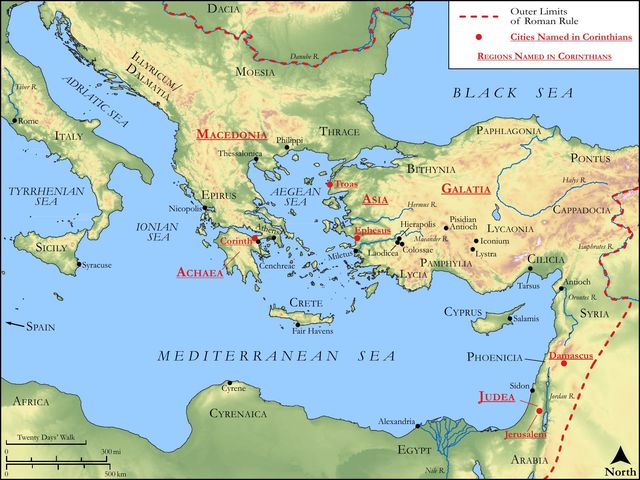
See on the biblical-era maps

Study this verse
Public-domain commentary
Matthew Henry
From his Commentary on the Whole Bible. Henry comments on passages, not single verses — this entry covers 1 Corinthians 3:1–4.
Here, I. Paul blames the Corinthians for their weakness and nonproficiency. Those who are sanctified are so only in part: there is still room for growth and increase both in grace and knowledge, Pe2 3:18. Those who through divine grace are renewed to a spiritual life may yet in many things be defective. The apostle tells them he could not speak to them as unto spiritual men, but as unto carnal men, as to babes in Christ, Co1 3:1. They were so far from forming their maxims and measures upon the ground of divine revelation, and entering into the spirit of the gospel, that is was but too evident they were much under the command of carnal and corrupt affections. They were still mere babes in Christ. They had received some of the first principles of Christianity, but had not grown up to maturity of understanding in them, or of faith and holiness; and yet it is plain, from several passages in this epistle, that the Corinthians were very proud of their wisdom and knowledge. Note, It is but too common for persons of very moderate knowledge and understanding to have a great measure of self-conceit. The apostle assigns their little proficiency in the knowledge of Christianity as a reason why he had communicated no more of the deep things of it to them. They could not bear such food, they needed to be fed with milk, not with meat, Co1 3:2. Note, It is the duty of a faithful minister of Christ to consult the capacities of his hearers and teach them as they can bear. And yet it is natural for babes to grow up to men; and babes in Christ should endeavour to grow in Stature, and become men in Christ. It is expected that their advances in knowledge should be in proportion to their means and opportunities, and their time of professing religion, that they may be able to bear discourses on the mysteries of our religion, and not always rest in plain things. It was a reproach to the Corinthians that they had so long sat under the ministry of Paul and had made no more improvement in Christian knowledge. Note, Christians are utterly to blame who do not endeavour to grow in grace and knowledge.
II.He blames them for their carnality, and mentions their contention and discord about their ministers as evidence of it:
For you are yet carnal; for whereas there are among you envyings, and strifes, and divisions, are you not carnal, and walk as men? Co1 3:3. They had mutual emulations, and quarrels, and factions among them, upon the account of their ministers, while one said, I am of Paul; and another, I am of Apollos, Co1 3:4. These were proofs of their being carnal, that fleshly interests and affections too much swayed them. Note, Contentions and quarrels about religion are sad evidences of remaining carnality. True religion makes men peaceable and not contentious. Factious spirits act upon human principles, not upon principles of true religion; they are guided by their own pride and passions, and not by the rules of Christianity: Do you not walk as men? Note, It is to be lamented that many who should walk as Christians, that is, above the common rate of men, do indeed walk as men, live and act too much like other men.
Historical interpretation
Sixteen Centuries of Reception
2 surviving comments on this verse. Each one is dated, so this reads as a timeline rather than a list.
Select a marker to jump to its quote. Markers stagger vertically where authors wrote within a few decades of each other.
"For when one saith, I am Paul, and I of Apollos, are ye not carnal?"
And he points out that this, so far from helping them at all or causing them to acquire any thing, had even become an obstacle to their profiting in the greater things. For this it was which brought forth jealousy, and jealousy had made them "carnal;" and the having become "carnal" left them not at liberty to hear truths of the sublimer sort.
[Responding to the question "Many people are quite unable to understand the theological differences which have caused divisions in the Christian Church. Do you consider that these differences are fundamental, and is the time now ripe for reunion?"]
The time is always ripe for reunion. Divisions between Christians are a sin and a scandal, and Christians ought at all times to be making contributions toward reunion, if it is only by their prayers. I am only a layman and a recent Christian, and I do not know much about these things, but in all the things which I have written and thought I have always stuck to traditional, dogmatic positions. The result is that letters of agreement reach me from what are ordinarily regarded as the most different kinds of Christians; for instance, I get letters from Jesuits, monks, nuns, and also from Quakers and Welsh Dissenters, and so on. So it seems to me that the "extremist" elements in every church are nearest one another and the liberal and "broad-minded" people in each body could never be united at all. The world of dogmatic Christianity is a place in which thousands of people of quite different types keep on saying the same thing, and the world of "broad-mindedness" and watered-down "religion" is a world where a small number of people (all of the same type) say totally different things and change their minds every few minutes. We shall never get reunion from them.
Continue studying 1 Corinthians 3:4 across the web’s major study libraries — every link below opens this exact verse, chapter, or book on the destination site.
Read & Compare
 BibleGatewayThis verse in more than 200 translations and 70 languages.
 Bible.comThe YouVersion reader — hundreds of translations, reading plans, and highlights.
 ESV.orgCrossway's official English Standard Version reader.
 NET BibleThe NET translation with 60,000+ translators' notes on every rendering decision.
 STEP BibleTyndale House's free study tool — original text, vocabulary, and scholarly resources.
 BibliaLogos Bible Software's free web reader.
 USCCBThe New American Bible (Revised Edition) with the U.S. bishops' study notes.
Commentaries
 BibleHub CommentariesDozens of classic commentaries on this verse, gathered on one page.
 StudyLightMore than 100 commentary sets — the largest collection on the web.
 BibleRefPlain-English commentary on what this verse means, verse by verse.
 Enduring WordDavid Guzik's free commentary on this chapter, widely used by Bible teachers.
 Bible Study ToolsVerse commentary alongside Greek and Hebrew study aids.
Original Language & Research
- BibleHub InterlinearThe verse word by word — original language, transliteration, and English.
- BibleHub LexiconEvery word's original-language definition and Strong's entry.
 Blue Letter BibleDeep-study tools — Strong's numbers, concordance, and word studies.
 CNTR CollationThe earliest Greek manuscripts of this verse, collated letter by letter.
Sermons, Hymns & Audio


TrulyRandomVerse is not affiliated with these sites and doesn’t control their content. They’re linked because they’re genuinely useful.
Summary
In 1 Corinthians 3:4, the Apostle Paul directly confronts the divisive spirit within the Corinthian church, highlighting the spiritual immaturity that manifests as allegiance to human leaders like himself or Apollos rather than to Christ alone. This verse serves as a rhetorical question, challenging the Corinthians to recognize that such factionalism is not a mark of spiritual maturity but rather a clear indication of their continued "carnal" or worldly mindset, hindering the unity and progress of God's work among them.
Context
ShowHideLiterary Context
This verse is a direct continuation of Paul's argument against division and spiritual immaturity, which begins in 1 Corinthians 1. Paul addresses the reports of factions (e.g., "I am of Paul; and I of Apollos; and I of Cephas; and I of Christ" in 1 Corinthians 1:12) by emphasizing that the message of the cross transcends human wisdom and eloquence. In 1 Corinthians 2, he contrasts human wisdom with the Spirit's wisdom, setting the stage for his rebuke of their "carnal" state. Immediately preceding 1 Corinthians 3:4, Paul states in 1 Corinthians 3:1-3 that he could not speak to them as spiritual people but as "carnal" and "babes in Christ," because their conduct exhibited "envy, and strife, and divisions." Verse 4 then provides a concrete example of this carnal behavior, making the rhetorical question "are ye not carnal?" a logical and powerful conclusion to his observation.
Historical & Cultural Context
Corinth was a bustling, cosmopolitan port city, known for its wealth, diverse population, and a culture that prized rhetoric, philosophy, and social status. The city hosted the Isthmian Games and was a center for various philosophical schools, each with its own esteemed teachers and loyal followers. This cultural backdrop likely influenced the Corinthian believers, leading them to apply secular models of allegiance to their spiritual leaders, treating them like revered philosophers or charismatic orators whose followers would boast of their association. This hero-worship and competitive spirit, common among the Greeks and Romans, infiltrated the church, causing divisions based on personal preferences for particular preachers rather than a unified focus on the gospel message and its divine source.
Key Themes
ShowHideThe central themes in this passage and the broader epistle include Church Unity versus Factionalism. Paul consistently champions the idea of the church as one body in Christ, where divisions based on human leaders are antithetical to its nature, as highlighted in 1 Corinthians 1:10. Another crucial theme is Spiritual Maturity versus Carnality. Paul's distinction between the "spiritual" person and the "carnal" person, as seen in 1 Corinthians 2:15 and 1 Corinthians 3:1-3, underscores that worldly behavior and internal strife are signs of an immature, flesh-driven faith. Finally, the passage addresses the Proper Role of Ministry. Paul clarifies that ministers like himself and Apollos are merely servants through whom the Corinthians believed, emphasizing that "God gave the increase" (1 Corinthians 3:6), thereby redirecting ultimate allegiance from human instruments to the divine source of all growth.
Exposition and Analysis
ShowHideKey Word Analysis
ShowHideDerived from sarx (flesh), this term (G4559) in Pauline theology refers not merely to the physical body but to the fallen, unregenerate human nature, which is inherently hostile to God and driven by worldly desires, pride, and selfish impulses. To be sarkikós means to be operating according to human wisdom and natural inclinations rather than being fully guided by the Holy Spirit. In this context, it describes believers who, despite having received the Spirit, are still largely influenced by their old nature, manifesting behaviors like jealousy, strife, and division.
This verb (G3004) means to "lay forth" or relate in words, often implying a systematic or set discourse. Here, it signifies a deliberate declaration or assertion of allegiance, indicating that the Corinthians were actively stating their loyalty to specific human leaders, thereby creating distinct factions within the community.
This word (G2087) specifically denotes "another of a different kind." Its use here emphasizes that the two factions ("I am of Paul" and "I am of Apollos") represented distinct, differing parties, highlighting the divisive nature of their allegiances rather than merely indicating a second person.
Verse Breakdown
ShowHide"For while one saith, I am of Paul;"
This clause describes the first manifestation of the Corinthian church's division. Some believers were aligning themselves exclusively with Paul, perhaps admiring his apostolic authority, his foundational work in Corinth, or his theological emphasis. This declaration of allegiance indicated a partisan spirit, elevating a human leader to a position that fostered division rather than unity.
"and another, I [am] of Apollos;"
This clause presents the opposing faction. Apollos, known for his eloquence and scriptural knowledge (Acts 18:24-28), attracted his own following. The "and another" (G1161 dé and G2087 héteros) highlights the existence of a distinct, rival group. These declarations, though seemingly benign, were symptomatic of a deeper problem: a misplaced focus on human personalities over the unifying work of Christ.
"are ye not carnal?"
This is a powerful rhetorical question, designed to elicit an obvious affirmative answer. Paul uses it to expose the true nature of their divisive behavior. By aligning themselves with human leaders and forming factions, the Corinthians were demonstrating that they were still operating from a "carnal" (fleshly, worldly) mindset, rather than being fully transformed and led by the Holy Spirit. It implies that such behavior is inconsistent with true spiritual maturity and the nature of the church as Christ's body.
Literary Devices
ShowHidePaul employs several Literary Devices to underscore his point. The most prominent is the Rhetorical Question ("are ye not carnal?"), which is designed not to solicit information but to make a forceful assertion. It challenges the Corinthians to confront the logical conclusion of their actions, leaving no room for denial. The repetition of the phrase "I am of..." (an example of Epanaphora or Anaphora if it were at the beginning of clauses, but here it's a repeated structure within the clauses) highlights the uniformity of their divisive declarations, emphasizing the widespread nature of the problem. Furthermore, Paul uses Metaphor when he describes their state as "carnal." This isn't a literal description of their physical bodies but a spiritual assessment, using the imagery of "flesh" to represent their unredeemed, worldly nature that is prone to strife and division, contrasting it with the spiritual nature that should characterize believers.
Theological and Thematic Connections
ShowHideThe theological implications of 1 Corinthians 3:4 are profound, asserting that Christian unity is not merely a desirable outcome but a fundamental characteristic of the church, rooted in its identity as God's building and God's field. When believers align themselves with human leaders rather than with Christ, they undermine the very foundation of the church and demonstrate a failure to grasp the true nature of God's work. This carnal behavior indicates a spiritual immaturity that prioritizes human wisdom, charisma, or loyalty over the unifying power of the Holy Spirit and the singular lordship of Jesus Christ. The church is meant to be a unified body, where diverse gifts and ministries serve a common purpose under the one Head, rather than splintering into competing factions.
Reflection and Application
ShowHideThe message of 1 Corinthians 3:4 resonates deeply with the contemporary church, serving as a timeless warning against the dangers of division and spiritual immaturity. In an age where personalities often overshadow principles, and denominational or theological distinctions can lead to sectarianism, Paul's rebuke reminds us that our ultimate allegiance must be to Jesus Christ alone. We are called to appreciate and learn from gifted leaders, but never to elevate them to a status that creates factions or diminishes the unifying reality of the body of Christ. True spiritual maturity is evidenced not by intellectual prowess or loyalty to a particular "brand" of Christianity, but by a humble spirit that seeks unity, practices love, and prioritizes the mission of Christ above personal preferences or group affiliations. When we observe envy, strife, or a "my-group-is-better" mentality within Christian circles, it should prompt a sober self-assessment, recognizing these as potential indicators of a carnal mindset that needs to yield more fully to the transforming power of the Holy Spirit.
Questions for Reflection
ShowHideFAQ
ShowHideWhat does Paul mean by "carnal" in this context?
ShowHideIn this context, "carnal" (Greek: sarkikós) refers to a spiritual state where believers, though regenerated, are still largely influenced by their fallen, unredeemed human nature, or "flesh" (sarx). It doesn't mean they are unsaved, but that their behavior, attitudes, and decisions are driven by worldly wisdom, pride, and selfish desires rather than being fully yielded to and guided by the Holy Spirit. The evidence of this carnality in Corinth was their jealousy, strife, and divisions, particularly their allegiance to human leaders like Paul or Apollos, which undermined the unity of the church.
Why was it a problem for the Corinthians to say "I am of Paul" or "I am of Apollos"?
ShowHidePaul viewed such declarations as a significant problem because they indicated a fundamental misunderstanding of the nature of the church and the role of its leaders. Firstly, it fostered division within the body of Christ, creating factions based on human personalities rather than the unifying truth of the gospel. The church is one body, with Christ as its head, and believers are united in Him, not in human teachers (1 Corinthians 1:13). Secondly, it elevated human instruments above God, who is the true source of all spiritual growth and increase (1 Corinthians 3:6-7). Paul and Apollos were merely servants, co-laborers with God, not figures to whom ultimate allegiance should be given. Such hero-worship demonstrated spiritual immaturity and a worldly mindset, rather than a focus on Christ, the sole foundation (1 Corinthians 3:11).
Christ-Centered Fulfillment
ShowHideThe divisions Paul confronts in 1 Corinthians 3:4 find their ultimate resolution and fulfillment in the person and work of Jesus Christ. The very reason for factionalism—the elevation of human leaders and human wisdom—is antithetical to the truth that Christ alone is the head of the church and its sole foundation. He is the one who breaks down "the dividing wall of hostility" (Ephesians 2:14), reconciling all believers into "one new man" (Ephesians 2:15) through His cross. Our identity is not "of Paul" or "of Apollos," but "in Christ" (Galatians 3:28). He is the "chief cornerstone" upon whom the entire spiritual temple is built (Ephesians 2:20-22), ensuring that all growth and unity flow from Him. The call to move beyond carnal divisions is a call to fix our eyes on Jesus, "the author and perfecter of our faith" (Hebrews 12:2), recognizing that in Him, "all things hold together" (Colossians 1:17) and true unity is found.