


1 Corinthians 14:36
Bible text: King James Version (1769 Blayney text) · Public domain
Bible text: Berean Standard Bible · Public domain
Bible text: American Standard Version (1901) · Public domain
Bible text: World English Bible, Messianic edition · Public domain
Bible text: Geneva Bible (1599) · Public domain
Bible text: Young's Literal Translation · Public domain
- ἢēOrG2228CONJConjunction
- ἀφ᾽aph᾽fromG575PREPPreposition
- ὑμῶνhumōnyouG4771P-2GPPersonal pronoun Genitive 2nd Plural
- ὁhotheG3588T-NSMDefinite article Nominative Singular Masculine
- λόγοςlogoswordG3056N-NSMNoun Nominative Singular Masculine
- τοῦtou<the>G3588T-GSMDefinite article Genitive Singular Masculine
- θεοῦtheouof GodG2316N-GSM-TNoun Genitive Singular Masculine Title
- ἐξῆλθενexēlthenhas gone out?G1831V-2AAI-3SVerb 2nd Aorist Active Indicative 3rd Singular
- ἢēOrG2228CONJConjunction
- εἰςeistoG1519PREPPreposition
- ὑμᾶςhumasyouG4771P-2APPersonal pronoun Accusative 2nd Plural
- μόνουςmonousonlyG3441A-APMAdjective Accusative Plural Masculine
- κατήντησεν;katēntēsenhas it come?G2658V-AAI-3SVerb Aorist Active Indicative 3rd Singular
English is a literal word-by-word gloss of the Greek, not the KJV's wording. Why?
This is the original text the KJV's translators worked from — each Greek word with its own literal English meaning in this verse, prepared by scholars at Tyndale House, Cambridge. The KJV translates whole sentences, not word by word, so its wording differs: one Greek word can become several English words, and the KJV may choose “charity” where the gloss reads “love”. Both are faithful — they answer different questions. For the KJV's own rendering, switch to the KJV text.
Details
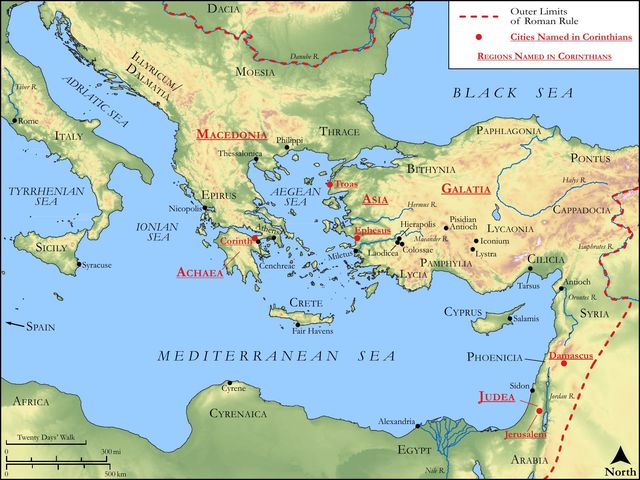
See on the biblical-era maps

Study this verse
Public-domain commentary
Matthew Henry
From his Commentary on the Whole Bible. Henry comments on passages, not single verses — this entry covers 1 Corinthians 14:36–40.
In these verses the apostle closes his argument, 1. With a just rebuke of the Corinthians for their extravagant pride and self-conceit: they so managed with their spiritual gifts as no church did like them; they behaved in a manner by themselves, and would not easily endure control nor regulation. Now, says the apostle, to beat down this arrogant humour, "Came the gospel out from you? Or came it to you only? Co1 14:36. Did Christianity come our of Corinth? was its original among you? Or, if not, is it now limited and confined to you? are you the only church favoured with divine revelations, that you will depart from the decent usages of all other churches, and, to make ostentation of your spiritual gifts, bring confusion into Christian assemblies? How intolerably assuming is this behaviour! Pray bethink yourselves." When it was needful or proper the apostle could rebuke with all authority; and surely his rebukes, if ever, were proper here. Note, Those must be reproved and humbled whose spiritual pride and self-conceit throw Christian churches and assemblies into confusion, though such men will hardly bear even the rebukes of an apostle. 2. He lets them know that what he said to them was the command of God; nor durst any true prophet, any one really inspired, deny it (Co1 14:37): "If any man think himself a prophet, or spiritual, let him acknowledge, etc., nay, let him be tried by this very rule. If he will not own what I deliver on this head to be the will of Christ, he himself never had the Spirit of Christ. The Spirit of Christ can never contradict itself; if it speak in me, and in them, it must speak the same things in both. If their revelations contradict mine, they do not come from the same Spirit; either I or they must be false prophets. By this therefore you may know them. If they say that my directions in this matter are no divine commandments, you may depend upon it they are not divinely inspired. But if any continue after all, through prejudice or obstinacy, uncertain or ignorant whether they or I speak by the Spirit of God, they must be left under the power of this ignorance. If their pretences to inspiration can stand in competition with the apostolical character and powers which I have, I have lost all my authority and influence; and the persons who allow of this competition against me are out of the reach of conviction, and must be left to themselves." Note, It is just with God to leave those to the blindness of their own minds who wilfully shut out the light. Those who would be ignorant in so plain a case were justly left under the power of their mistake. 3. He sums up all in two general advices: - (1.) That though they should not despise the gift of tongues, nor altogether disuse it, under the regulations mentioned, yet they should prefer prophesying. This is indeed the scope of the whole argument. It was to be preferred to the other, because it was the more useful gift. (2.) He charges them to let all things be done decently and in order (Co1 14:40), that is, that they should avoid every thing that was manifestly indecent and disorderly. Not that they should hence take occasion to bring into the Christian church and worship any thing that a vain mind might think ornamental to it, or that would help to set it off. Such indecencies and disorders as he had remarked upon were especially to be shunned. They must do nothing that was manifestly childish (Co1 14:20), or that would give occasion to say they were mad (Co1 14:23), nor must they act so as to breed confusion, Co1 14:33. This would be utterly indecent; it would make a tumult and mob of a Christian assembly. But they were to do things in order; they were to speak one after another, and not all at once; take their turns, and not interrupt one another. To do otherwise was to destroy the end of a Christians ministry, and all assemblies for Christian worship. Note, Manifest indecencies and disorders are to be carefully kept out of all Christian churches, and every part of divine worship. They should have nothing in them that is childish, absurd, ridiculous, wild, or tumultuous; but all parts of divine worship should be carried on in a manly, grave, rational, composed, and orderly manner. God is not to be dishonoured, nor his worship disgraced, by our unbecoming and disorderly performance of it and attendance at it.
Historical interpretation
Historical reception
2 surviving comments on this verse. Each one is dated, so this reads as a timeline rather than a list.
Select a marker to jump to its quote. Markers stagger vertically where authors wrote within a few decades of each other.
Paul issued the Corinthians with this reproof because they were so elated with vanity. The suggestion was that if they did not obey the words of the faith, there would be no one who would believe.
But besides these things, he also shames them by consideration of what all agreed on, and what was every where prescribed; which topic also here he hath set down, saying,
"What? was it from you that the word of God went forth? or came it unto you alone?"
Thus he brings in the other Churches also as holding this law, both abating the disturbance by consideration of the novelty of the thing, and by the general voice making his saying acceptable. Wherefore also elsewhere he said, "Who shall put you in remembrance of my ways which be in Christ, even as I teach everywhere in all the Churches." (1 Cor. 4:17) And again, "God is not a God of confusion, but of peace, as in all the Churches of the saints." (1 Cor. 14:33.) And here, "What? was it from you that the word of God went forth? or came it unto you alone?" i.e., "neither first, nor alone are ye believers, but the whole world." Which also writing to the Colossians he said, "even as it is bearing fruit and increasing in all the world," (Col. 1:6) speaking of the Gospel.
But he turns it also at another time to the encouragement of his hearers; as when he saith that theirs were the first fruits, and were manifest unto all. Thus, writing to the Thessalonians he said, "For from you hath sounded forth the word of God," and, "in every place your faith to God-ward is gone forth." (1 Thess. 1:8) And again to the Romans, "Your faith is proclaimed throughout the whole world." For both are apt to shame and stir up, as well the being commended of others, as that they have others partakers in their judgment. Wherefore also here he saith; "What? was it from you that the word of God went forth? or came it unto you only?" "For neither can ye say this," saith he; "we were made teachers to the rest, and it cannot be right for us to learn of others;" nor, "the faith remained in this place only, and no precedents from other quarters ought to be received." Seest thou by how many arguments he put them to shame? He introduced the law, he signified the shamefulness of the thing, he brought forward the other Churches.
Continue studying 1 Corinthians 14:36 across the web’s major study libraries — every link below opens this exact verse, chapter, or book on the destination site.
Read & Compare
 BibleGatewayThis verse in more than 200 translations and 70 languages.
 Bible.comThe YouVersion reader — hundreds of translations, reading plans, and highlights.
 ESV.orgCrossway's official English Standard Version reader.
 NET BibleThe NET translation with 60,000+ translators' notes on every rendering decision.
 STEP BibleTyndale House's free study tool — original text, vocabulary, and scholarly resources.
 BibliaLogos Bible Software's free web reader.
 USCCBThe New American Bible (Revised Edition) with the U.S. bishops' study notes.
Commentaries
 BibleHub CommentariesDozens of classic commentaries on this verse, gathered on one page.
 StudyLightMore than 100 commentary sets — the largest collection on the web.
 BibleRefPlain-English commentary on what this verse means, verse by verse.
 Enduring WordDavid Guzik's free commentary on this chapter, widely used by Bible teachers.
 Bible Study ToolsVerse commentary alongside Greek and Hebrew study aids.
Original Language & Research
- BibleHub InterlinearThe verse word by word — original language, transliteration, and English.
- BibleHub LexiconEvery word's original-language definition and Strong's entry.
 Blue Letter BibleDeep-study tools — Strong's numbers, concordance, and word studies.
 CNTR CollationThe earliest Greek manuscripts of this verse, collated letter by letter.
Sermons, Hymns & Audio


TrulyRandomVerse is not affiliated with these sites and doesn’t control their content. They’re linked because they’re genuinely useful.
Summary
In 1 Corinthians 14:36, the Apostle Paul delivers a sharp rhetorical rebuke to the Corinthian church, challenging their presumptuous behavior and sense of spiritual autonomy. He confronts their disordered practices in worship by questioning whether they believe themselves to be the original source of God's word or its exclusive recipients, thereby reminding them of the universal and authoritative nature of divine revelation and their place within the broader body of Christ.
Context
ShowHideLiterary Context
This verse serves as a climactic rhetorical challenge following Paul's detailed instructions regarding order and decorum in public worship, particularly concerning prophetic utterances and speaking in tongues. Immediately preceding this verse, Paul addresses the controversial issue of women speaking in the church assembly, stating that they should "be silent in the churches" and "be in subjection" 1 Corinthians 14:34-35. The abruptness and indignation of verse 36 suggest that the Corinthians' disorderly conduct, perhaps exacerbated by a perceived sense of spiritual superiority or unique revelation, was directly contradicting the universal principles of Christian worship and apostolic teaching that Paul had been laying out. Paul's question here is not merely an inquiry but a forceful assertion of apostolic authority and a universal standard for church practice, directly countering any local Corinthian exceptionalism.
Historical & Cultural Context
The city of Corinth was a bustling, cosmopolitan port city, known for its wealth, diverse population, and often lax moral standards. The Corinthian church, though gifted spiritually, struggled significantly with internal divisions, pride, immorality, and disorder in their worship gatherings, as evidenced throughout 1 Corinthians. There was a tendency among some members to prioritize individual spiritual experiences, like speaking in tongues, over the edification of the community, leading to chaos. Furthermore, the Corinthians likely harbored a sense of intellectual and spiritual arrogance, perhaps believing their unique experiences or insights superseded the norms established by the apostles elsewhere. Paul's pointed question in 1 Corinthians 14:36 directly challenges this self-exalting attitude, reminding them that they were recipients of the gospel, not its originators or sole proprietors.
Key Themes
ShowHideThe verse powerfully underscores several major theological and narrative themes prevalent in 1 Corinthians. Firstly, it highlights the Authority of Scripture and Apostolic Teaching, emphasizing that the "word of God" (lógos theou) is divinely sourced and universally applicable, not subject to local innovation or preference. Secondly, it champions the Unity and Universality of the Church, reminding the Corinthians that they are part of a global body of believers who all receive the same truth and must align their practices with the broader Christian community, as Paul argues in passages like 1 Corinthians 1:10. Thirdly, the verse confronts Spiritual Pride and Arrogance, a recurring issue in Corinth (e.g., 1 Corinthians 4:6-7), by dismantling any notion of their unique spiritual status. Finally, it reinforces the overarching theme of Order in Worship, asserting that proper conduct in the assembly is not arbitrary but flows from the recognition of God's universal authority and the church's interconnectedness.
Exposition and Analysis
ShowHideKey Word Analysis
ShowHideIn this context, lógos refers specifically to the divine message, the gospel, or the authoritative teaching that emanates from God. It signifies not merely spoken words but the very substance of divine revelation. Paul's use of lógos here underscores the objective, external, and authoritative nature of the truth that came to them, contrasting it with any subjective or locally generated ideas.
This verb denotes motion from within to without, signifying origin or emanation. Paul's question, "came the word of God out from you?", directly challenges the Corinthians' implicit assumption that they might be the source or originators of divine truth, rather than merely its recipients. It highlights the absurdity of such a claim, as God's word precedes and transcends any human community.
This adverb emphasizes exclusivity or singularity. The phrase "came it unto you only?" confronts the Corinthians' potential belief that they were uniquely privileged recipients of God's word, implying that their unique status might exempt them from universal Christian norms or apostolic instructions. Paul's use of "only" reveals his indignation at their perceived spiritual isolation and self-sufficiency.
Verse Breakdown
ShowHide"What? came the word of God out from you?"
This is a powerful rhetorical question, introduced by the particle "What?" (Greek ḗ), which expresses surprise, indignation, or a strong negative implication. Paul is essentially asking, "Surely, you don't think you are the source or originators of God's divine message, do you?" This challenges any notion of the Corinthian church being the fount of divine truth, asserting instead that God's word has an external, divine origin independent of any human community.
"or came it unto you only?"
This second rhetorical question serves as a parallel challenge, contrasting with the first. It questions whether the Corinthians believe they are the exclusive recipients of God's word, implying that their unique reception might grant them special privileges or exemptions from the universal standards of Christian conduct and worship. Paul here aims to dismantle any sense of spiritual elitism or isolation that would lead them to disregard the practices of other churches or the broader apostolic tradition.
Literary Devices
ShowHidePaul masterfully employs several literary devices in 1 Corinthians 14:36. The most prominent is the Rhetorical Question, which is not intended to elicit an answer but to make a forceful point and expose the absurdity of the Corinthians' implied assumptions. By asking "What? came the word of God out from you? or came it unto you only?", Paul compels them to confront the illogical nature of their behavior. This rhetorical strategy is coupled with Irony, as Paul knows full well the answers to his questions are a resounding "no." The irony highlights the stark contrast between the Corinthians' self-perception and the reality of their dependence on God's externally revealed word. Furthermore, the verse utilizes Antithesis by juxtaposing "out from you" (implying origin) with "unto you only" (implying exclusive reception), creating a sharp contrast that underscores the two dimensions of their misguided pride: claiming to be the source and claiming to be the sole recipients. The abruptness and indignation conveyed by the initial "What?" also serve as a form of Apostolic Rebuke, signaling Paul's strong disapproval and authoritative challenge to their disorder.
Theological and Thematic Connections
ShowHidePaul's sharp rebuke in 1 Corinthians 14:36 underscores a foundational theological truth: the word of God is not a human invention, nor is it the exclusive property of any single congregation or individual. Its origin is divine, and its reach is universal, intended for the entire body of Christ. This verse serves as a powerful reminder that all believers are recipients of the same divine revelation, calling for humility and adherence to shared apostolic teaching rather than local autonomy or spiritual arrogance. It grounds the necessity of order in worship not in human preference, but in the universal nature of God's truth and the interconnectedness of His church.
Reflection and Application
ShowHidePaul's pointed questions in 1 Corinthians 14:36 remain profoundly relevant for believers and churches today. They challenge any tendency towards spiritual isolation, congregational pride, or the belief that our particular church, denomination, or individual understanding is the ultimate standard for truth and practice. We are constantly reminded that the Word of God originates from Him, not from us, and it comes to all believers, not just a select few. This calls for a posture of humility, a commitment to sound doctrine that aligns with the universal church throughout history, and a willingness to submit to the authority of Scripture as interpreted within the broader Christian tradition. It encourages us to examine our worship practices and theological convictions, ensuring they are rooted in God's revealed truth and contribute to the edification of the whole body, rather than reflecting a unique, self-serving, or disordered approach.
Questions for Reflection
ShowHideFAQ
ShowHideWhy is Paul's tone so abrupt and indignant in this verse?
ShowHidePaul's abrupt and indignant tone ("What?") reflects his deep frustration and apostolic authority in confronting the Corinthian church's persistent disorder and spiritual arrogance. Throughout 1 Corinthians, Paul addresses numerous issues arising from their self-centeredness and lack of submission to apostolic teaching. This particular verse comes after detailed instructions on orderly worship, especially regarding women's roles, which the Corinthians seemed to be disregarding. His sharp rhetorical questions are designed not to elicit an answer, but to shock them into recognizing the absurdity of their behavior and their false assumptions about their own spiritual authority and uniqueness. It's a direct, authoritative challenge to bring them back to the reality that God's word is universal and authoritative, not subject to their local whims or perceived spiritual superiority.
Does this verse imply that local churches should not have unique expressions of worship or ministry?
ShowHideThis verse does not forbid unique expressions of worship or ministry within a local church, but it strongly condemns any expression that stems from a belief in spiritual exclusivity or a disregard for universal Christian principles and apostolic teaching. Paul's concern is with disorder, pride, and the notion that the Corinthians were somehow exempt from the standards applied to other churches or that they were the sole arbiters of divine truth. Healthy local expressions should always be rooted in the universally revealed "word of God" (lógos theou) and contribute to the edification of the body in an orderly manner, aligning with the broader testimony of the global church, as seen in passages like Ephesians 4:11-13.
Christ-Centered Fulfillment
ShowHideWhile 1 Corinthians 14:36 directly addresses the Corinthians' misguided pride and disorder, it implicitly points to Christ as the ultimate "Word of God" and the universal source of divine truth. Paul's challenge, "came the word of God out from you? or came it unto you only?", finds its ultimate answer and fulfillment in Jesus Christ. He is not merely a word about God, but the living, incarnate "Word" John 1:1, who eternally "came out from God" John 8:42 and was sent not "unto you only" but "into the world to save sinners" 1 Timothy 1:15. Jesus is the definitive revelation of God, accessible to all who believe, transcending any cultural or congregational boundaries. His gospel, the true "word of God," is a universal message of salvation and transformation, preached "to every creature under heaven" Colossians 1:23. Therefore, the disorder and exclusivity Paul rebukes in Corinth are fundamentally antithetical to the nature of Christ, who unites all believers into one body, receiving the same Spirit and the same truth from Him, the Head of the Church Ephesians 4:4-6.