TRV
TRV
- English
- King James KJV
- Complete Jewish CJB
- World English WEBM
- Berean Standard BSB
- American Standard ASV
- Geneva GNV
- Young's Literal YLT
- Douay-Rheims DRC
- International
- Shqip ALB
- العربية SVD
- বাংলা BN-IRV
- မြန်မာ Judson
- 简体文 CUV-S
- 繁體中文 CUV-T
- Čeština BKR
- Nederlands STVE
- Français LSG
- Deutsch SCH
- Ελληνικά Vamvas
- ગુજરાતી GU-IRV
- Hausa HCB
- עברית Hebrew
- हिन्दी HCV
- Magyar KAROLI
- Bahasa Indonesia INDO-TB
- Italiano Diodati
- 日本語 Kougo
- 한국어 Korean
- മലയാളം MAL
- मराठी MRCV
- Norsk DNB
- فارسی OPV
- Polski BG
- Português Almeida
- Română Cornilescu
- Русский Synodal
- Español RVG
- Kiswahili Neno
- Svenska SV1917
- Tagalog TAG-ADB
- தமிழ் TCV
- తెలుగు TSA
- ภาษาไทย THAI-KJV
- Українська Ohienko
- Tiếng Việt CADMAN
- Yorùbá YCB
A Kingdom of Priests
God Proposes the Covenant
Study this passage
Commentary written on this passage, not on a single verse.
- Who
- Where
- When
- About
Where else Scripture says this.
Deuteronomy 14:2
For you are a holy people to the LORD your God, and the LORD has chosen you to be a people for his own possession, above all peoples who are on the face of the earth.from verse 5Deuteronomy 7:6
For you are a holy people to the LORD your God. the LORD your God has chosen you to be a people for his own possession, above all peoples who are on the face of the earth.from verse 5Deuteronomy 26:18
the LORD has declared this day that you are a people for his own possession, as he has promised you, and that you should keep all his commandments.from verse 5Revelation 5:10
and made us kings and priests to our God, and we will reign on earth.”from verse 6Malachi 3:17
They shall be mine,” says the LORD of Hosts, “my own possession in the day that I make, and I will spare them, as a man spares his own son who serves him.from verse 51 Peter 2:9
But you are a chosen race, a royal priesthood, a holy nation, a people for God’s own possession, that you may proclaim the excellence of him who called you out of darkness into his marvelous light:from verse 6Exodus 15:26
and he said, “If you will diligently listen to the LORD your God’s voice, and will do that which is right in his eyes, and will pay attention to his commandments, and keep all his statutes, I will put none of the diseases on you, which I have put on the Egyptians; for I am the LORD who heals you.”from verse 5Deuteronomy 32:11
As an eagle that stirs up her nest, that flutters over her young, he spread abroad his wings, he took them, he bore them on his feathers.from verse 4Deuteronomy 32:12
The LORD alone led him. There was no foreign god with him.from verse 4Isaiah 63:9
In all their affliction he was afflicted, and the angel of his presence saved them: in his love and in his pity he redeemed them; and he bore them, and carried them all the days of old.from verse 41 Peter 2:5
You also, as living stones, are built up as a spiritual house, to be a holy priesthood, to offer up spiritual sacrifices, acceptable to God through Yeshua the Messiah.from verse 6Isaiah 40:31
But those who wait for the LORD will renew their strength. They will mount up with wings like eagles. They will run, and not be weary. They will walk, and not faint.from verse 4
Public-domain commentary
Matthew Henry
From his Commentary on the Whole Bible. Henry comments on passages, not single verses — this entry covers Exodus 19:1–8. His four-level outline is real structure in the source text, so it is rendered as structure.
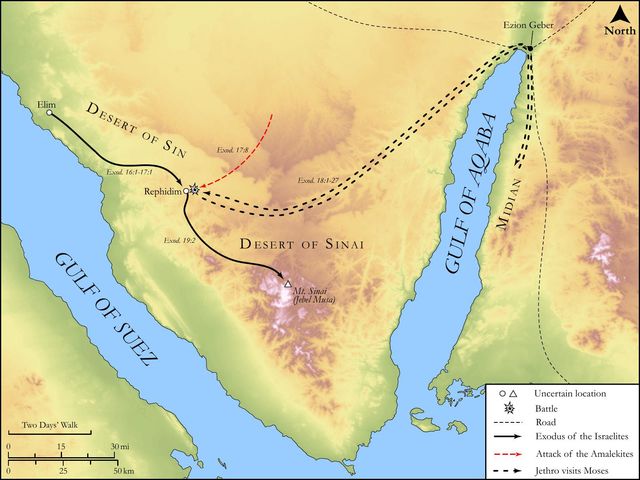
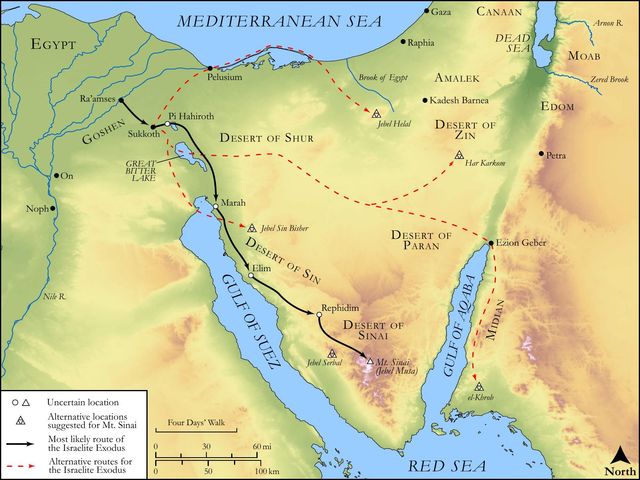
Here is, I. The date of that great charter by which Israel was incorporated. 1. The time when it bears date (Exo 19:1) - in the third month after they came out of Egypt. It is computed that the law was given just fifty days after their coming out of Egypt, in remembrance of which the feast of Pentecost was observed the fiftieth day after the passover, and in compliance with which the Spirit was poured out upon the apostles at the feast of pentecost, fifty days after the death of Christ. In Egypt they had spoken of a three days' journey into the wilderness to the place of their sacrifice (Exo 5:3), but it proved to be almost a two months' journey; so often are we out in the calculation of times, and things prove longer in the doing than we expected. 2. The place whence it bears date - from Mount Sinai, a place which nature, not art, had made eminent and conspicuous, for it was the highest in all that range of mountains. Thus God put contempt upon cities, and palaces, and magnificent structures, setting up his pavilion on the top of a high mountain, in a waste and barren desert, there to carry on this treaty. It is called Sinai, from the multitude of thorny bushes that overspread it.
II.The charter itself.
Moses was called up the mountain (on the top of which God had pitched his tent, and at the foot of which Israel had pitched theirs), and was employed as the mediator, or rather no more than the messenger of the covenant: Thus shalt thou say to the house of Jacob, and tell the children of Israel, Exo 19:3. Here the learned bishop Patrick observes that the people are called by the names both of Jacob and Israel, to remind them that those who had lately been as low as Jacob when he went to Padan-aram had now grown as great as God made him when he came thence (justly enriched with the spoils of him that had oppressed him) and was called Israel. Now observe,
1.That the maker, and first mover, of the covenant, is God himself. Nothing was said nor done by this stupid unthinking people themselves towards this settlement; no motion made, no petition put up for God's favour, but this blessed charter was granted ex mero motu - purely out of God's own good-will. Note, In all our dealings with God, free grace anticipates us with the blessings of goodness, and all our comfort is owing, not to our knowing God, but rather to our being known of him, Gal 4:9. We love him, visit him, and covenant with him, because he first loved us, visited us, and covenanted with us. God is the Alpha, and therefore must be the Omega.
2.That the matter of the covenant is not only just and unexceptionable, and such as puts no hardship upon them, but kind and gracious, and such as gives them the greatest privileges and advantages imaginable.
(1.)He reminds them of what he had done for them, Exo 19:4. He had righted them, and avenged them upon their persecutors and oppressors: "You have seen what I did unto the Egyptians, how many lives were sacrificed to Israel's honour and interests:" He had given them unparalleled instances of his favour to them, and his care of them: I bore you on eagles' wings, a high expression of the wonderful tenderness God had shown for them. It is explained, Deu 32:11, Deu 32:12. It denotes great speed. God not only came upon the wing for their deliverance (when the set time was come, he rode on a cherub, and did fly), but he hastened them out, as it were, upon the wing. He did it also with great ease, with the strength as well as with the swiftness of an eagle: those that faint not, nor are weary, are said to mount up with wings as eagles, Isa 40:31. Especially, it denotes God's particular care of them and affection to them. Even Egypt, that iron furnace, was the nest in which these young ones were hatched, where they were first formed as the embryo of a nation; when, by the increase of their numbers, they grew to some maturity, they were carried out of that nest. Other birds carry their young in their talons, but the eagle (they say) upon her wings, so that even those archers who shoot flying cannot hurt the young ones, unless they first shoot through the old one. Thus, in the Red Sea, the pillar of cloud and fire, the token of God's presence, interposed itself between the Israelites and their pursuers (lines of defence which could not be forced, a wall which could not be penetrated): yet this was not all; their way so paved, so guarded, was glorious, but their end much more so: I brought you unto myself. They were brought not only into a state of liberty and honour, but into covenant and communion with God. This, this was the glory of their deliverance, as it is of ours by Christ, that he died, the just for the unjust, that he might bring us to God. This God aims at in all the gracious methods of his providence and grace, to bring us back to himself, from whom we have revolted, and to bring us home to himself, in whom alone we can be happy. He appeals to themselves, and their own observation and experience, for the truth of what is here insisted on: You have seen what I did; so that they could not disbelieve God, unless they would first disbelieve their own eyes. They saw how all that was done was purely the Lord's doing. It was not they that reached towards God, but it was he that brought them to himself. Some have well observed that the Old Testament church is said to be borne upon eagles' wings, denoting the power of that dispensation, which was carried on with a high hand an out-stretched arm; but the New Testament church is said to be gathered by the Lord Jesus, as a hen gathers her chickens under her wings (Mat 23:37), denoting the grace and compassion of that dispensation, and the admirable condescension and humiliation of the Redeemer.
(2.)He tells them plainly what he expected and required from them in one word, obedience (Exo 19:5), that they should obey his voice indeed and keep his covenant. Being thus saved by him, that which he insisted upon was that they should be ruled by him. The reasonableness of this demand is, long after, pleaded with them, that in the day he brought them out of the land of Egypt this was the condition of the covenant, Obey my voice (Jer 7:23); and this he is said to protest earnestly to them, Jer 11:4, Jer 11:7. Only obey indeed, not in profession and promise only, not in pretence, but in sincerity. God had shown them real favours, and therefore required real obedience.
(3.)He assures them of the honour he would put upon them, and the kindness he would show them, in case they did thus keep his covenant (Exo 19:5, Exo 19:6): Then you shall be a peculiar treasure to me. He does not specify any one particular favour, as giving them the land of Canaan, or the like, but expresses it in that which was inclusive of all happiness, that he would be to them a God in covenant, and they should be to him a people.
[1.]God here asserts his sovereignty over, and propriety in, the whole visible creation: All the earth is mine. Therefore he needed them not; he that had so vast a dominion was great enough, and happy enough, without concerning himself for so small a demesne as Israel was. All nations on the earth being his, he might choose which he pleased for his peculiar, and act in a way of sovereignty.
[2.]He appropriates Israel to himself, First, As a people dear unto him. You shall be a peculiar treasure; not that God was enriched by them, as a man is by his treasure, but he was pleased to value and esteem them as a man does his treasure; they were precious in his sight and honourable (Isa 43:4); he set his love upon them (Deu 7:7), took them under his special care and protection, as a treasure that is kept under lock and key. He looked upon the rest of the world but as trash and lumber in comparison with them. By giving them divine revelation, instituted ordinances, and promises inclusive of eternal life, by sending his prophets among them, and pouring out his Spirit upon them, he distinguished them from, and dignified them above, all people. And this honour have all the saints; they are unto God a peculiar people (Tit 2:14), his when he makes up his jewels. Secondly, As a people devoted to him, to his honour and service (Exo 19:6), a kingdom of priests, a holy nation. All the Israelites, if compared with other people, were priests unto God, so near were they to him (Psa 148:14), so much employed in his immediate service, and such intimate communion they had with him. When they were first made a free people it was that they might sacrifice to the Lord their God, as priests; they were under God's immediate government, and the tendency of the laws given them was to distinguish them from others, and engage them for God as a holy nation. Thus all believers are, through Christ, made to our God kings and priests (Rev 1:6), a chosen generation, a royal priesthood, Pe1 2:9.
III.Israel's acceptance of this charter, and consent to the conditions of it.
1.Moses faithfully delivered God's message to them (Exo 19:7): He laid before their faces all those words; he not only explained to them what God had given him in charge, but he put it to their choice whether they would accept these promises upon these terms or no. His laying it to their faces denotes his laying it to their consciences.
2.They readily agreed to the covenant proposed. They would oblige themselves to obey the voice of God, and take it as a great favour to be made a kingdom of priests to him. They answered together as one man, nemine contradicente - without a dissentient voice (Exo 19:8): All that the Lord hath spoken we will do. Thus they strike the bargain, accepting the Lord to be to them a God, and giving up themselves to be to him a people. O that there had been such a heart in them!
3.Moses, as a mediator, returned the words of the people to God, Exo 19:8. Thus Christ, the Mediator between us and God, as a prophet reveals God's will to us, his precepts and promises, and then as a priest offers up to God our spiritual sacrifices, not only of prayer and praise, but of devout affections and pious resolutions, the work of his own Spirit in us. Thus he is that blessed days-man who lays his hand upon us both.
Historical interpretation
Fourteen Centuries of Reception
4 surviving comments on this passage. Each one is dated, so this reads as a timeline rather than a list.
Select a marker to jump to its quote. Markers stagger vertically where authors wrote within a few decades of each other.
Now when I go up eagerly into the mount—or, to use a truer expression, when I both eagerly long and at the same time am afraid (the one through my hope and the other through my weakness), to enter within the cloud and hold converse with God, for so God commands: If any be an Aaron, let him go up with me, and let him stand near, being ready, if it must be so, to remain outside the cloud.
How indeed but in his body did Christ expiate the sins of the people? In what did he suffer, save in his body—even as we said: “Christ having suffered in the flesh”? In what is he a priest, save in that which he took unto himself the vocation of a priestly nation?
The apostle Peter now rightly gives to the Gentiles this attestation of praise which formerly was given by Moses to the ancient people of God, because they believed in Christ, who like a cornerstone brought the Gentiles into that salvation which Israel had had for itself. He calls them “a chosen race” on account of their faith, that he may distinguish them from those who by rejecting the living stone have themselves become rejected. They are “a royal priesthood,” however, because they have been joined to his body who is their real king and true priest, who as king grants to his own a kingdom and as their high priest cleanses them of their sins by the sacrificial victim of his own blood. He names them “a royal priesthood” that they may remember both to hope for an eternal kingdom and always to offer to God the sacrifices of a stainless way of life.
And Moses went up to God: Moses went up to mount Sinai, where God spoke to him.