


Exodus 19:4
Bible text: King James Version (1769 Blayney text) · Public domain
Bible text: Berean Standard Bible · Public domain
Bible text: American Standard Version (1901) · Public domain
Bible text: World English Bible, Messianic edition · Public domain
Bible text: Geneva Bible (1599) · Public domain
Bible text: Young's Literal Translation · Public domain
- אַתֶּם'a·TemyouH859Pro-2mpPronoun Personal 2nd Plural Masculine
- רְאִיתֶםre·'i·Temyou have seenH7200V-Qal-Perf-2mpVerb Qal Perfect 2nd Plural Masculine
- אֲשֶׁר'a·Sher[that] whichH834RelParticle Relative
- עָשִׂיתִי'a·Si·tiI didH6213V-Qal-Perf-1csVerb Qal Perfect 1st Singular common gender
- לְמִצְרָיִםle·mitz·Ra·yimto EgyptH4714Prep-l ¦ N-properNoun Proper LocationלְtoמִצְרָיִםEgypt
- וָאֶשָּׂאva·'e·Sa'and I carriedH5375Conj-w ¦ V-Qal-ConsecImperf-1csVerb Qal Consecutive Imperfect 1st Singular common genderוָandאֶשָּׂאI carried
- אֶתְכֶם'et·Khem<obj.> youH853DirObjM ¦ 2mpParticle Object Indicatorאֶתְ<obj.>כֶםyou
- עַל'alonH5921PrepPreposition
- כַּנְפֵיkan·Feiwings ofH3671N-fdcNoun Dual Feminine Construct
- נְשָׁרִיםne·sha·RimeaglesH5404N-mpNoun Plural Masculine Absolute
- וָאָבִאva·'a·Vi'and I broughtH935Conj-w ¦ V-Hiphil-ConsecImperf-1csVerb Hiphil Consecutive Imperfect 1st Singular common genderוָandאָבִאI brought
- אֶתְכֶם'et·Khem<obj.> youH853DirObjM ¦ 2mpParticle Object Indicatorאֶתְ<obj.>כֶםyou
- אֵלָי'e·Laito myselfH413Prep ¦ 1csPreposition Definiteאֵלָtoיmyself
English is a literal word-by-word gloss of the Hebrew, not the KJV's wording. Why?
This is the original text the KJV's translators worked from — each Hebrew word with its own literal English meaning in this verse, prepared by scholars at Tyndale House, Cambridge. The KJV translates whole sentences, not word by word, so its wording differs: one Hebrew word can become several English words, and the KJV may choose “the LORD” where the gloss reads “Yahweh”. Both are faithful — they answer different questions. For the KJV's own rendering, switch to the KJV text.
Details
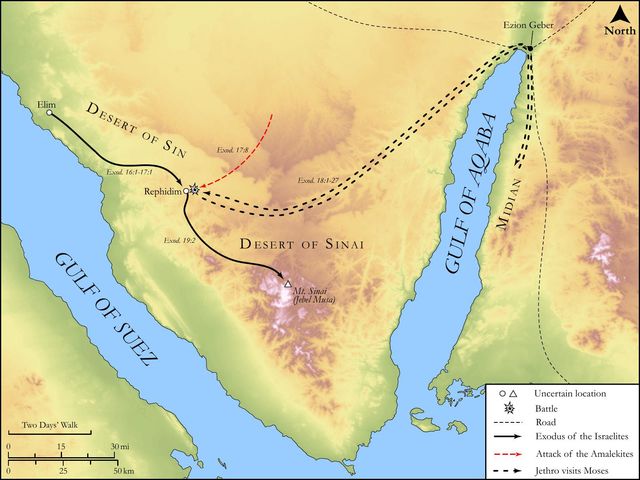
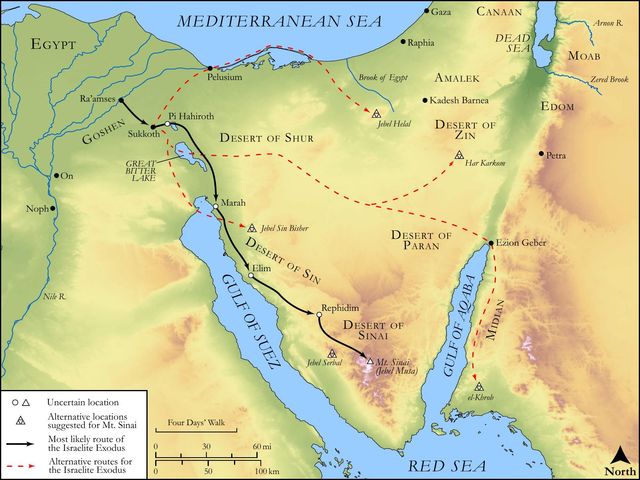
See on the biblical-era maps

Study this verse
Public-domain commentary
Matthew Henry
From his Commentary on the Whole Bible. Henry comments on passages, not single verses — this entry covers Exodus 19:1–8. His four-level outline is real structure in the source text, so it is rendered as structure.
Here is, I. The date of that great charter by which Israel was incorporated. 1. The time when it bears date (Exo 19:1) - in the third month after they came out of Egypt. It is computed that the law was given just fifty days after their coming out of Egypt, in remembrance of which the feast of Pentecost was observed the fiftieth day after the passover, and in compliance with which the Spirit was poured out upon the apostles at the feast of pentecost, fifty days after the death of Christ. In Egypt they had spoken of a three days' journey into the wilderness to the place of their sacrifice (Exo 5:3), but it proved to be almost a two months' journey; so often are we out in the calculation of times, and things prove longer in the doing than we expected. 2. The place whence it bears date - from Mount Sinai, a place which nature, not art, had made eminent and conspicuous, for it was the highest in all that range of mountains. Thus God put contempt upon cities, and palaces, and magnificent structures, setting up his pavilion on the top of a high mountain, in a waste and barren desert, there to carry on this treaty. It is called Sinai, from the multitude of thorny bushes that overspread it.
II.The charter itself.
Moses was called up the mountain (on the top of which God had pitched his tent, and at the foot of which Israel had pitched theirs), and was employed as the mediator, or rather no more than the messenger of the covenant: Thus shalt thou say to the house of Jacob, and tell the children of Israel, Exo 19:3. Here the learned bishop Patrick observes that the people are called by the names both of Jacob and Israel, to remind them that those who had lately been as low as Jacob when he went to Padan-aram had now grown as great as God made him when he came thence (justly enriched with the spoils of him that had oppressed him) and was called Israel. Now observe,
1.That the maker, and first mover, of the covenant, is God himself. Nothing was said nor done by this stupid unthinking people themselves towards this settlement; no motion made, no petition put up for God's favour, but this blessed charter was granted ex mero motu - purely out of God's own good-will. Note, In all our dealings with God, free grace anticipates us with the blessings of goodness, and all our comfort is owing, not to our knowing God, but rather to our being known of him, Gal 4:9. We love him, visit him, and covenant with him, because he first loved us, visited us, and covenanted with us. God is the Alpha, and therefore must be the Omega.
2.That the matter of the covenant is not only just and unexceptionable, and such as puts no hardship upon them, but kind and gracious, and such as gives them the greatest privileges and advantages imaginable.
(1.)He reminds them of what he had done for them, Exo 19:4. He had righted them, and avenged them upon their persecutors and oppressors: "You have seen what I did unto the Egyptians, how many lives were sacrificed to Israel's honour and interests:" He had given them unparalleled instances of his favour to them, and his care of them: I bore you on eagles' wings, a high expression of the wonderful tenderness God had shown for them. It is explained, Deu 32:11, Deu 32:12. It denotes great speed. God not only came upon the wing for their deliverance (when the set time was come, he rode on a cherub, and did fly), but he hastened them out, as it were, upon the wing. He did it also with great ease, with the strength as well as with the swiftness of an eagle: those that faint not, nor are weary, are said to mount up with wings as eagles, Isa 40:31. Especially, it denotes God's particular care of them and affection to them. Even Egypt, that iron furnace, was the nest in which these young ones were hatched, where they were first formed as the embryo of a nation; when, by the increase of their numbers, they grew to some maturity, they were carried out of that nest. Other birds carry their young in their talons, but the eagle (they say) upon her wings, so that even those archers who shoot flying cannot hurt the young ones, unless they first shoot through the old one. Thus, in the Red Sea, the pillar of cloud and fire, the token of God's presence, interposed itself between the Israelites and their pursuers (lines of defence which could not be forced, a wall which could not be penetrated): yet this was not all; their way so paved, so guarded, was glorious, but their end much more so: I brought you unto myself. They were brought not only into a state of liberty and honour, but into covenant and communion with God. This, this was the glory of their deliverance, as it is of ours by Christ, that he died, the just for the unjust, that he might bring us to God. This God aims at in all the gracious methods of his providence and grace, to bring us back to himself, from whom we have revolted, and to bring us home to himself, in whom alone we can be happy. He appeals to themselves, and their own observation and experience, for the truth of what is here insisted on: You have seen what I did; so that they could not disbelieve God, unless they would first disbelieve their own eyes. They saw how all that was done was purely the Lord's doing. It was not they that reached towards God, but it was he that brought them to himself. Some have well observed that the Old Testament church is said to be borne upon eagles' wings, denoting the power of that dispensation, which was carried on with a high hand an out-stretched arm; but the New Testament church is said to be gathered by the Lord Jesus, as a hen gathers her chickens under her wings (Mat 23:37), denoting the grace and compassion of that dispensation, and the admirable condescension and humiliation of the Redeemer.
(2.)He tells them plainly what he expected and required from them in one word, obedience (Exo 19:5), that they should obey his voice indeed and keep his covenant. Being thus saved by him, that which he insisted upon was that they should be ruled by him. The reasonableness of this demand is, long after, pleaded with them, that in the day he brought them out of the land of Egypt this was the condition of the covenant, Obey my voice (Jer 7:23); and this he is said to protest earnestly to them, Jer 11:4, Jer 11:7. Only obey indeed, not in profession and promise only, not in pretence, but in sincerity. God had shown them real favours, and therefore required real obedience.
(3.)He assures them of the honour he would put upon them, and the kindness he would show them, in case they did thus keep his covenant (Exo 19:5, Exo 19:6): Then you shall be a peculiar treasure to me. He does not specify any one particular favour, as giving them the land of Canaan, or the like, but expresses it in that which was inclusive of all happiness, that he would be to them a God in covenant, and they should be to him a people.
[1.]God here asserts his sovereignty over, and propriety in, the whole visible creation: All the earth is mine. Therefore he needed them not; he that had so vast a dominion was great enough, and happy enough, without concerning himself for so small a demesne as Israel was. All nations on the earth being his, he might choose which he pleased for his peculiar, and act in a way of sovereignty.
[2.]He appropriates Israel to himself, First, As a people dear unto him. You shall be a peculiar treasure; not that God was enriched by them, as a man is by his treasure, but he was pleased to value and esteem them as a man does his treasure; they were precious in his sight and honourable (Isa 43:4); he set his love upon them (Deu 7:7), took them under his special care and protection, as a treasure that is kept under lock and key. He looked upon the rest of the world but as trash and lumber in comparison with them. By giving them divine revelation, instituted ordinances, and promises inclusive of eternal life, by sending his prophets among them, and pouring out his Spirit upon them, he distinguished them from, and dignified them above, all people. And this honour have all the saints; they are unto God a peculiar people (Tit 2:14), his when he makes up his jewels. Secondly, As a people devoted to him, to his honour and service (Exo 19:6), a kingdom of priests, a holy nation. All the Israelites, if compared with other people, were priests unto God, so near were they to him (Psa 148:14), so much employed in his immediate service, and such intimate communion they had with him. When they were first made a free people it was that they might sacrifice to the Lord their God, as priests; they were under God's immediate government, and the tendency of the laws given them was to distinguish them from others, and engage them for God as a holy nation. Thus all believers are, through Christ, made to our God kings and priests (Rev 1:6), a chosen generation, a royal priesthood, Pe1 2:9.
III.Israel's acceptance of this charter, and consent to the conditions of it.
1.Moses faithfully delivered God's message to them (Exo 19:7): He laid before their faces all those words; he not only explained to them what God had given him in charge, but he put it to their choice whether they would accept these promises upon these terms or no. His laying it to their faces denotes his laying it to their consciences.
2.They readily agreed to the covenant proposed. They would oblige themselves to obey the voice of God, and take it as a great favour to be made a kingdom of priests to him. They answered together as one man, nemine contradicente - without a dissentient voice (Exo 19:8): All that the Lord hath spoken we will do. Thus they strike the bargain, accepting the Lord to be to them a God, and giving up themselves to be to him a people. O that there had been such a heart in them!
3.Moses, as a mediator, returned the words of the people to God, Exo 19:8. Thus Christ, the Mediator between us and God, as a prophet reveals God's will to us, his precepts and promises, and then as a priest offers up to God our spiritual sacrifices, not only of prayer and praise, but of devout affections and pious resolutions, the work of his own Spirit in us. Thus he is that blessed days-man who lays his hand upon us both.
Continue studying Exodus 19:4 across the web’s major study libraries — every link below opens this exact verse, chapter, or book on the destination site.
Read & Compare
 BibleGatewayThis verse in more than 200 translations and 70 languages.
 Bible.comThe YouVersion reader — hundreds of translations, reading plans, and highlights.
 ESV.orgCrossway's official English Standard Version reader.
 NET BibleThe NET translation with 60,000+ translators' notes on every rendering decision.
 STEP BibleTyndale House's free study tool — original text, vocabulary, and scholarly resources.
 BibliaLogos Bible Software's free web reader.
 USCCBThe New American Bible (Revised Edition) with the U.S. bishops' study notes.
Commentaries
 BibleHub CommentariesDozens of classic commentaries on this verse, gathered on one page.
 StudyLightMore than 100 commentary sets — the largest collection on the web.
 BibleRefPlain-English commentary on what this verse means, verse by verse.
 Enduring WordDavid Guzik's free commentary on this chapter, widely used by Bible teachers.
 Bible Study ToolsVerse commentary alongside Greek and Hebrew study aids.
Original Language & Research
- BibleHub InterlinearThe verse word by word — original language, transliteration, and English.
- BibleHub LexiconEvery word's original-language definition and Strong's entry.
 Blue Letter BibleDeep-study tools — Strong's numbers, concordance, and word studies.
 SefariaThe Hebrew text with Rashi and centuries of Jewish commentary.
Sermons, Hymns & Audio


TrulyRandomVerse is not affiliated with these sites and doesn’t control their content. They’re linked because they’re genuinely useful.
Summary
Exodus 19:4 stands as a profound divine declaration to the newly liberated Israelites at Mount Sinai, serving as a foundational preamble to the giving of the Law and the establishment of the Mosaic Covenant. It powerfully encapsulates God's past redemptive acts in delivering His people from the brutal bondage of Egypt, His tender yet mighty providential care throughout their arduous wilderness journey, and His ultimate, relational purpose in drawing them into intimate fellowship with Himself. This pivotal verse sets the stage for understanding the covenant as a gracious invitation to a unique relationship, rooted entirely in God's prior initiative and unwavering faithfulness.
Context
ShowHideLiterary Context
Exodus 19:4 is situated at a crucial turning point in the unfolding narrative of the Exodus. The Israelites, having experienced miraculous deliverance from slavery in Egypt (Exodus 12-14) and sustained by God's provision through the initial stages of their wilderness trek (Exodus 15-18), have now arrived at the foot of Mount Sinai in the third month after their departure (Exodus 19:1). This verse is part of God's initial address to the entire nation through Moses, an overture of grace and a powerful reminder of His faithfulness before He formally proposes the covenant and delivers the Ten Commandments (Exodus 20). It grounds the impending covenant in the undeniable historical reality of God's saving acts, emphasizing that their relationship is not earned, but rather a response to His prior initiative and mighty deliverance. The covenant is presented as the natural progression of a relationship already established by divine grace.
Historical & Cultural Context
The historical backdrop for Exodus 19:4 is the liberation of a vast nation of slaves from the most formidable empire of that day. The Israelites had endured centuries of brutal servitude under Pharaoh (Exodus 1:11-14), a period marked by oppression and despair. God's declaration "what I did unto the Egyptians" refers directly to the ten devastating plagues that crippled Egypt and the miraculous parting of the Red Sea, which annihilated Pharaoh's pursuing army (Exodus 7-14). This unprecedented display of divine power served to demonstrate Yahweh's absolute supremacy over all pagan deities and human rulers. The imagery of "eagles' wings" would have resonated deeply with Israel and the Egyptians, where eagles symbolized strength, swiftness, and divine protection, often associated with kings and gods. For a people who had just traversed a harsh and dangerous desert, the metaphor of being carried safely and swiftly would have powerfully conveyed God's unique and tender care, akin to a parent eagle carrying its young above danger. This pre-covenant declaration served to assure the newly liberated nation of God's unwavering commitment and to prepare them for a unique, covenantal relationship with the Holy One of Israel, a relationship distinct from any other nation.
Key Themes
ShowHideExodus 19:4 contributes significantly to several overarching themes within the book of Exodus and the broader Pentateuch. Foremost among these is the theme of Divine Deliverance and Redemption. The verse explicitly recalls God's mighty acts of liberation from Egyptian bondage, setting the stage for understanding the covenant as a response to salvation, not a means to achieve it. Another prominent theme is God's Provident Care. The "eagles' wings" imagery beautifully illustrates God's tender, powerful, and sustained provision and protection for His people through the wilderness, emphasizing His intimate involvement in their journey (Exodus 16 and Exodus 17). Crucially, the verse introduces the theme of Covenant Relationship and Intimacy with God. The phrase "brought you unto myself" unveils the ultimate purpose of the Exodus: not merely freedom, but fellowship. This establishes a foundational principle that God desires a personal, exclusive relationship with His people, calling them to be His treasured possession (Exodus 19:5-6). This relational goal undergirds all subsequent commands and laws given at Sinai, framing obedience as a response of love to a gracious Deliverer.
Exposition and Analysis
ShowHideKey Word Analysis
ShowHideThis primitive root signifies "to lift" or "to carry," encompassing a wide variety of applications from physical bearing to figurative support and forgiveness. In the context of "I bare you on eagles' wings," nâsâʼ emphasizes God's active, powerful, and sustained carrying of Israel. It implies not just passive observation but a deliberate, strong, and protective act of lifting them up and transporting them through danger. This word conveys the immense effort and personal involvement God undertook to bring His people safely through the wilderness, highlighting His burden-bearing and supportive nature.
This word refers to the eagle or other large bird of prey, known for its strength, swiftness, and ability to soar to great heights. In biblical imagery, the nesher consistently symbolizes majesty, power, and divine protection. The use of "eagles'" here evokes a powerful metaphor for God's extraordinary and rapid intervention, His ability to elevate His people above immediate dangers, and His unique, protective care. It suggests a parent-like vigilance and strength in safeguarding His vulnerable offspring, providing a secure passage through perilous circumstances.
This primitive root means "to go or come," but in this context, it is causative, meaning "to cause to come" or "to bring." The use of bôwʼ here signifies God's deliberate, intentional, and successful action of bringing Israel to a specific destination – "unto myself." It underscores the purposeful nature of the entire Exodus event, revealing that every act of deliverance and provision was directed towards the ultimate goal of establishing a unique, intimate relationship between God and His people. This word highlights the culmination of God's redemptive plan in drawing His chosen ones into His very presence.
Verse Breakdown
ShowHide"Ye have seen what I did unto the Egyptians"
This opening clause serves as a direct, undeniable appeal to the Israelites' recent, vivid, and shared experience. God reminds them of His mighty acts of judgment against their oppressors, including the ten devastating plagues (Exodus 7-12) and the miraculous destruction of Pharaoh's army at the Red Sea (Exodus 14). The emphasis on their direct observation ("Ye have seen") underscores the irrefutable historical reality of God's sovereign power and His unwavering commitment to liberate His people from bondage. It establishes God's credentials as the omnipotent Deliverer, whose actions are verifiable and undeniable.
"and how I bare you on eagles' wings"
This poetic and tender metaphor vividly describes God's constant, protective, and nurturing care for Israel throughout their perilous journey from Egypt to Sinai. Just as a parent eagle carries its young, shielding them from danger, teaching them to soar, and providing safe passage, God swiftly and powerfully intervened to protect Israel from the dangers of the wilderness, providing for their needs and lifting them above their vulnerabilities. This imagery emphasizes the personal, intimate, and secure nature of God's providence, highlighting His tender strength in guiding and sustaining His people through challenging circumstances that would have otherwise consumed them.
"and brought you unto myself"
This culminating phrase reveals the ultimate, profound, and relational purpose behind all of God's redemptive and protective acts. The deliverance from Egypt and the sustained journey through the wilderness were not merely about physical freedom or survival; they were a means to an end: to bring Israel into a unique, covenantal relationship with God Himself. This signifies God's deep desire for intimate communion, for His people to be His treasured possession, set apart for His worship and service. It underscores that the goal of redemption is not merely freedom from something, but freedom for fellowship and belonging with the Redeemer.
Literary Devices
ShowHideExodus 19:4 employs several potent literary devices to convey its profound message with vivid imagery and theological depth. The most prominent is Metaphor, particularly in the phrase "I bare you on eagles' wings." This vivid image is not to be taken literally, but it powerfully conveys God's swift, strong, and tender care, akin to a parent eagle protecting and carrying its young. It emphasizes divine protection, elevation above danger, and nurturing guidance through a perilous journey. Another device at play is Recapitulation or Remembrance, as God explicitly calls upon the Israelites to recall their recent history: "Ye have seen what I did unto the Egyptians." This serves to ground the divine promise in undeniable, shared experience, building a foundation of trust and demonstrating God's consistent character. The structure of the verse also exhibits a clear Progression, moving from God's external acts of judgment against their enemies ("what I did unto the Egyptians") to His internal, nurturing care for Israel ("bare you on eagles' wings"), culminating in His ultimate relational purpose ("brought you unto myself"). This progression highlights the holistic nature of God's redemptive plan, moving from liberation to sustained care to intimate fellowship.
Theological and Thematic Connections
ShowHideExodus 19:4 is a cornerstone verse for understanding the very nature of God's relationship with Israel and, by extension, His redemptive plan for humanity. It powerfully establishes that God's covenant with His people is not based on their merit or performance, but entirely on His prior, gracious acts of deliverance and sustained care. It highlights the themes of divine sovereignty over all creation and human powers, the tender yet omnipotent providence of God, and the ultimate purpose of redemption being intimate fellowship with the Creator. This verse sets the stage for the Mosaic Covenant, revealing that the Law is given to a people already redeemed and brought near, serving as a guide for living in joyful relationship with their Deliverer, rather than a means to earn salvation. It profoundly illustrates God's unwavering desire to draw humanity into His presence through acts of unmerited grace.
Reflection and Application
ShowHideExodus 19:4 offers profound comfort, assurance, and challenge for believers today. It calls us to actively remember God's faithfulness in our own lives, just as He reminded Israel of His mighty acts. Reflecting on past deliverances, provisions, and undeniable moments of divine intervention builds our trust and strengthens our faith for present and future challenges. The imagery of being carried "on eagles' wings" reminds us that God's care is not distant, abstract, or merely theoretical, but intensely personal, powerfully effective, and ever-present, lifting us above the dangers and difficulties of life that would otherwise overwhelm us. We are invited to rest in His protective embrace, knowing that He is fully capable of carrying us through any wilderness or trial we may face. Most importantly, this verse reveals God's ultimate desire for an intimate, covenantal relationship with us. Our salvation is not merely an escape from sin's penalty, but a gracious invitation into the very presence of God. This profound truth should motivate us to pursue deeper communion with Him, to live lives that reflect His holiness and character, and to respond to His boundless grace with worship, obedience, and heartfelt devotion.
Questions for Reflection
ShowHideFAQ
ShowHideWhat is the significance of the "eagles' wings" imagery in Exodus 19:4?
ShowHideThe imagery of "eagles' wings" is a powerful and tender metaphor for God's swift, strong, and protective care for Israel. Among the nations of that day, eagles symbolized strength, majesty, and divine protection, often associated with kings and gods. Biblically, it evokes the profound picture of a parent eagle carrying its young, shielding them from danger, and providing safe passage, sometimes even teaching them to fly by catching them when they fall. This signifies that God's deliverance and sustenance of Israel through the wilderness was not merely a passive observation but an active, nurturing, and powerful intervention, lifting them above their vulnerabilities and carrying them to safety. This imagery is echoed elsewhere in Scripture, such as in Deuteronomy 32:11, reinforcing its profound meaning of divine providence and intimate care.
Why did God emphasize "brought you unto myself" as the culmination of His actions?
ShowHideThe phrase "brought you unto myself" reveals God's ultimate, relational purpose behind all His redemptive acts. The deliverance from Egypt and the arduous journey through the wilderness were not ends in themselves, but rather the means to establish a unique, intimate, and exclusive covenantal relationship with Israel. God's profound desire was to have a people set apart for His own possession, to dwell among them, and to be their God (Exodus 19:5-6). This highlights that the goal of redemption is not merely freedom from bondage, but freedom for fellowship and communion with the Redeemer. It underscores God's deep desire for personal relationship with His creation, a theme that finds its ultimate fulfillment in the New Covenant through Christ, who brings us into the very presence of God (Hebrews 10:19-22).
Christ-Centered Fulfillment
ShowHideExodus 19:4, while deeply rooted in Israel's historical deliverance from physical bondage, finds its profound and ultimate Christ-centered fulfillment in the person and redemptive work of Jesus Christ. Just as God delivered Israel from the physical slavery of Egypt, Christ delivers humanity from the far greater spiritual bondage of sin and death (Romans 6:23). He is the ultimate "Lamb of God who takes away the sin of the world" (John 1:29), performing a greater exodus, transferring believers from the dominion of darkness into His marvelous light (Colossians 1:13). The tender, powerful care symbolized by "eagles' wings" is perfectly embodied in Christ's constant intercession, protection, and provision for His church (Hebrews 7:25). Most significantly, the purpose of being "brought you unto myself" is fully and eternally realized in Christ. He is the Way, the Truth, and the Life, definitively declaring that "no one comes to the Father except through me" (John 14:6). Through His atoning sacrifice on the cross, believers are not merely freed, but are brought near to God, adopted as His beloved children (Ephesians 2:13), and granted bold access to His presence in a new and living way through the new covenant established in His blood (Hebrews 10:19-20). Thus, Christ is the ultimate Deliverer, the faithful Sustainer, and the one who perfectly fulfills God's eternal desire to bring His people into intimate, eternal fellowship with Himself.