

 TRV
TRV
- English
- King James KJV
- Complete Jewish CJB
- World English WEBM
- Berean Standard BSB
- American Standard ASV
- Geneva GNV
- Young's Literal YLT
- Douay-Rheims DRC
- International
- Shqip ALB
- العربية SVD
- বাংলা BN-IRV
- မြန်မာ Judson
- 简体文 CUV-S
- 繁體中文 CUV-T
- Čeština BKR
- Nederlands STVE
- Français LSG
- Deutsch SCH
- Ελληνικά Vamvas
- ગુજરાતી GU-IRV
- Hausa HCB
- עברית Hebrew
- हिन्दी HCV
- Magyar KAROLI
- Bahasa Indonesia INDO-TB
- Italiano Diodati
- 日本語 Kougo
- 한국어 Korean
- മലയാളം MAL
- मराठी MRCV
- Norsk DNB
- فارسی OPV
- Polski BG
- Português Almeida
- Română Cornilescu
- Русский Synodal
- Español RVG
- Kiswahili Neno
- Svenska SV1917
- Tagalog TAG-ADB
- தமிழ் TCV
- తెలుగు TSA
- ภาษาไทย THAI-KJV
- Українська Ohienko
- Tiếng Việt CADMAN
- Yorùbá YCB
Judges 9:1
Abimelech Seeks Kingship in Shechem
In this passage
- Who
- Where
- When
- About
See also
Where else Scripture says this.
Judges 8:31
And his concubine that was in Shechem, she also bare him a son, whose name he called Abimelech.from verse 1Psalms 83:2
For, lo, thine enemies make a tumult: and they that hate thee have lifted up the head.from verse 1Psalms 83:4
They have said, Come, and let us cut them off from being a nation; that the name of Israel may be no more in remembrance.from verse 11 Kings 12:1
¶ And Rehoboam went to Shechem: for all Israel were come to Shechem to make him king.from verse 11 Kings 12:3
That they sent and called him. And Jeroboam and all the congregation of Israel came, and spake unto Rehoboam, saying,from verse 11 Kings 12:20
And it came to pass, when all Israel heard that Jeroboam was come again, that they sent and called him unto the congregation, and made him king over all Israel: there was none that followed the house of David, but the tribe of Judah only.from verse 12 Samuel 15:6
And on this manner did Absalom to all Israel that came to the king for judgment: so Absalom stole the hearts of the men of Israel.from verse 1Genesis 33:18
And Jacob came to Shalem, a city of Shechem, which is in the land of Canaan, when he came from Padanaram; and pitched his tent before the city.from verse 1Genesis 34:2
And when Shechem the son of Hamor the Hivite, prince of the country, saw her, he took her, and lay with her, and defiled her.from verse 1Jeremiah 18:18
¶ Then said they, Come, and let us devise devices against Jeremiah; for the law shall not perish from the priest, nor counsel from the wise, nor the word from the prophet. Come, and let us smite him with the tongue, and let us not give heed to any of his words.from verse 1
Where this happens
Study this passage
Commentary written on this passage, not on a single verse.
Public-domain commentary
Matthew Henry
From his Commentary on the Whole Bible. Henry comments on passages, not single verses — this entry covers Judges 9:1–6. His three-level outline is real structure in the source text, so it is rendered as structure.
We are here told by what arts Abimelech got into authority, and made himself great. His mother perhaps had instilled into his mind some towering ambitious thoughts, and the name his father gave him, carrying royalty in it, might help to blow up these sparks; and now that he has buried his father nothing will serve his proud spirit but he will succeed him in the government of Israel, directly contrary to his father's will, for he had declared no son of his should rule over them. He had no call from God to this honour as his father had, nor was there any present occasion for a judge to deliver Israel as there was when his father was advanced; but his own ambition must be gratified, and its gratification is all he aims at. Now observe here,
I.How craftily he got his mother's relations into his interests.
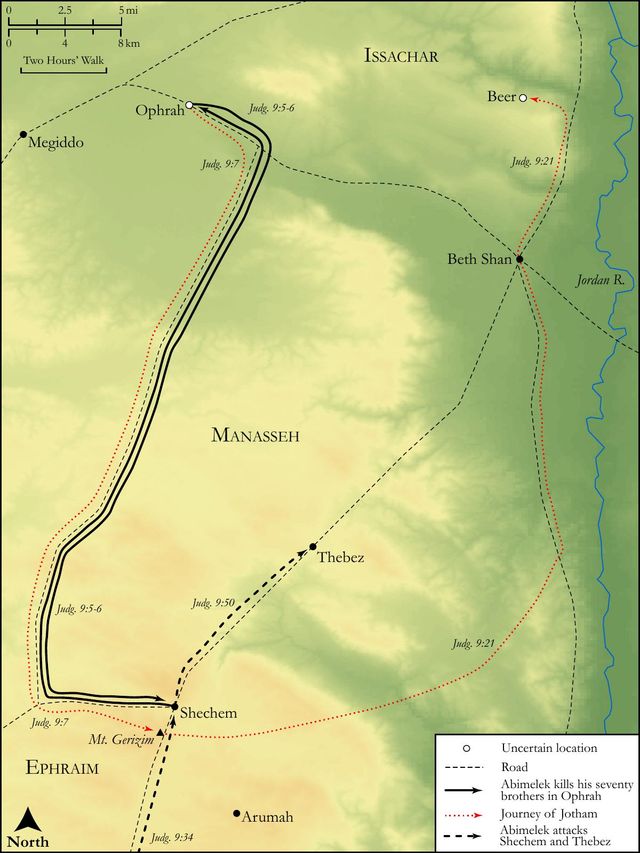
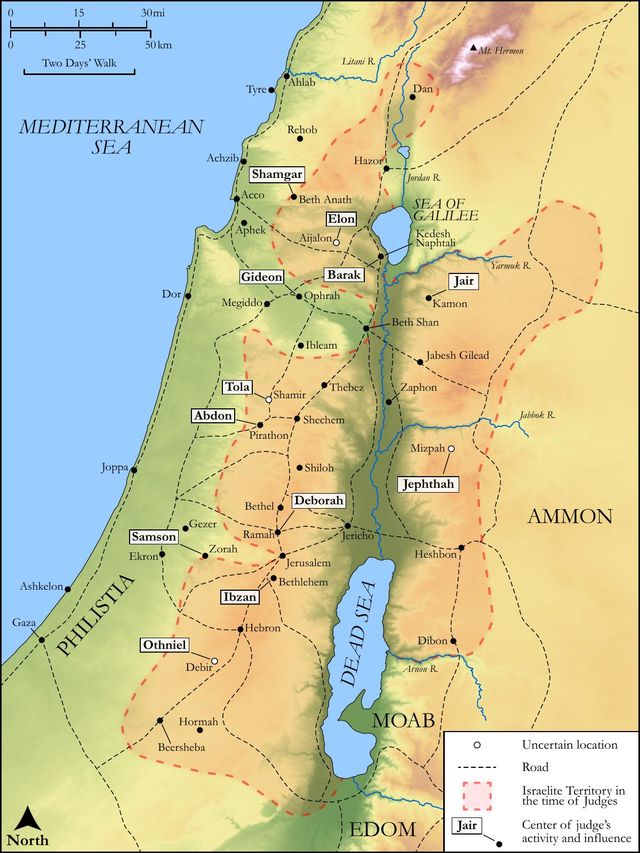
Shechem was a city in the tribe of Ephraim, of great note. Joshua had held his last assembly there. If that city would but appear for him, and set him up, he thought it would go far in his favour. There he had an interest in the family of which his mother was, and by them he made an interest in the leading men of the city. It does not appear that any of them had an eye to him as a man of merit, who had any thing to recommend him to such a choice, but the motion came first from himself. None would have dreamed of making such a one king, if he had not dreamed of it himself. And see here, 1. How he wheedled them into the choice, Jdg 9:2, Jdg 9:3. He basely suggested that Gideon having left seventy sons, who made a good figure and had a good interest, they were designing to keep the power which their father had in their hands, and by a joint-influence to reign over Israel. "Now," says he, "you had better have one king than more, than many, than so many. Affairs of state are best managed by a single person," Jdg 9:2. We have no reason to think that all or any of Gideon's sons had the least intention to reign over Israel (they were of their father's mind, that the Lord should reign over them, and they were not called of him), yet this he insinuates to pave the way to his own pretensions. Note, Those who design ill themselves are commonly most apt to suspect that others design ill. As for himself, he only puts them in mind of his relation to them (verbum sapienti - A word to the wise is sufficient): Remember that I am your bone and your flesh. The plot took wonderfully. The magistrates of Shechem were pleased to think of their city being a royal city and the metropolis of Israel, and therefore they inclined to follow him; for they said, "He is our brother, and his advancement will be our advantage." 2. How he got money from them to bear the charges of his pretensions (Jdg 9:4): They gave him seventy pieces of silver; it is not said what the value of these pieces was; so many shekels are less, and so many talents more, than we can well imagine; therefore it is supposed they were each a pound weight: but they gave this money out of the house of Baal-berith, that is, out of the public treasury, which, out of respect to their idol, they deposited in his temple to be protected by him; or out of the offerings that had been made to that idol, which they hoped would prosper the better in his hands for its having been consecrated to their god. How unfit was he to reign over Israel, because unlikely to defend them, who, instead of restraining and punishing idolatry, thus early made himself a pensioner to an idol! 3. What soldiers he enlisted. He hired into his service vain and light persons, the scum and scoundrels of the country, men of broken fortunes, giddy heads, and profligate lives; none but such would own him, and they were fittest to serve his purpose. Like leader like followers.
II.How cruelly he got his father's sons out of the way.
1.The first thing he did with the rabble he headed was to kill all his brethren at once, publicly and in cold blood, threescore and ten men, one only escaping, all slain upon one stone. See in this bloody tragedy,
(1.)The power of ambition what beasts it will turn men into, how it will break through all the ties of natural affection and natural conscience, and sacrifice that which is most sacred, dear, and valuable, to its designs. Strange that ever it should enter into the heart of a man to be so very barbarous!
(2.)The peril of honour and high birth. Their being the sons of so great a man as Gideon exposed them thus and made Abimelech jealous of them. We find just the same number of Ahab's sons slain together at Samaria, Kg2 10:1, Kg2 10:7. The grand seigniors have seldom thought themselves safe while any of their brethren have been unstrangled. Let none then envy those of high extraction, or complain of their own meanness and obscurity. The lower the safer.
2.Way being thus made for Abimelech's election, the men of Shechem proceeded to choose him king, Jdg 9:6. God was not consulted whether they should have any king at all, much less who it should be; here is no advising with the priest or with their brethren of any other city or tribe, though it was designed that he should reign over Israel, Jdg 9:22. But,
(1.)The Shechemites, as if they were the people and wisdom must die with them, did all; they aided and abetted him in the murder of his brethren (Jdg 9:24), and then they made him king. The men of Shechem (that is, the great men, the chief magistrates of the city), and the house of Millo (that is, the common-council, the full house or house of fulness, as the word signifies), those that met in their guildhall (we read often of the house of Millo, or state-house in Jerusalem, or the city of David, Sa2 5:9; Kg2 12:20), these gathered together, not to prosecute and punish Abimelech for this barbarous murder, as they ought to have done, he being one of their citizens, but to make him king. Pretium sceleris tulit hic diadema - His wickedness was rewarded with a diadem. What could they promise themselves from a king that laid the foundation of his kingdom in blood?
(2.)The rest of the Israelites were so very sottish as to sit by unconcerned. They took no care to give check to this usurpation, to protect the sons of Gideon, or to avenge their death, but tamely submitted to the bloody tyrant, as men who with their religion had lost their reason, and all sense of honour and liberty, justice and gratitude. How vigorously had their fathers appeared to avenge the death of the Levite's concubine, and yet so wretchedly degenerate are they now as not to attempt the avenging of the death of Gideon's sons; it is for this that they are charged with ingratitude (Jdg 8:35): Neither showed they kindness to the house of Jerubbaal.