


Numbers 4:24
- זֹאתzotthisH2063PrtParticle Demonstrative
- עֲבֹדַת'a·vo·Dat[is] [the] service ofH5656N-fscNoun Singular Feminine Construct
- מִשְׁפְּחֹתmish·pe·Chot[the] clans ofH4940N-fpcNoun Plural Feminine Construct
- הַגֵּרְשֻׁנִּיha·ge·re·shu·Nithe Gershonite[s]H1649Art ¦ N-msNoun Gentilic Singular Masculine AbsoluteהַtheגֵּרְשֻׁנִּיGershonite[s]
- לַעֲבֹדla·'a·Vodto serveH5647Prep-l ¦ V-Qal-InfVerb Qal Infinitive Constructלַtoעֲבֹדserve
- וּלְמַשָּׂאu·le·ma·Sa'and for carryingH4853Conj-w ¦ Prep-l ¦ N-msNoun Singular Masculine Absoluteוּandלְforמַשָּׂאcarrying
English is a literal word-by-word gloss of the Hebrew, not the KJV's wording. Why?
This is the original text the KJV's translators worked from — each Hebrew word with its own literal English meaning in this verse, prepared by scholars at Tyndale House, Cambridge. The KJV translates whole sentences, not word by word, so its wording differs: one Hebrew word can become several English words, and the KJV may choose “the LORD” where the gloss reads “Yahweh”. Both are faithful — they answer different questions. For the KJV's own rendering, switch to the KJV text.
Details
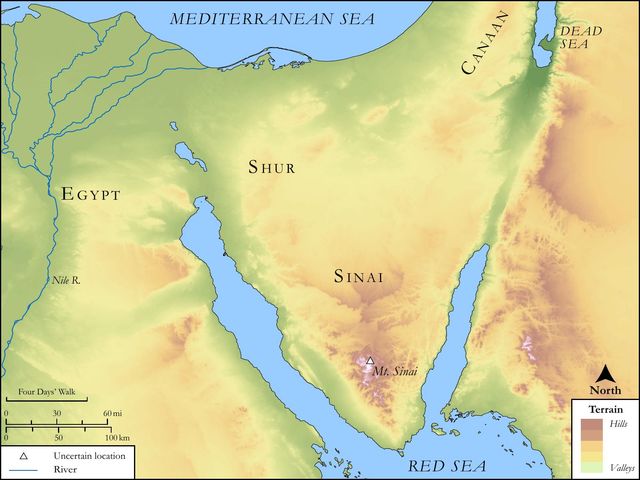
See on the biblical-era map
Study this verse
Public-domain commentary
Matthew Henry
From his Commentary on the Whole Bible. Henry comments on passages, not single verses — this entry covers Numbers 4:21–33.
We have here the charge of the other two families of the Levites, which, though not so honourable as the first, yet was necessary, and was to be done regularly. 1. The Gershonites were charged with all the drapery of the tabernacle, the curtains, and hangings, and the coverings of badgers' skins, Num 4:22-26. These they were to take down when the cloud removed, and the ark and the rest of the holy things were carried away, to pack up and bring with them, and then to set up again, where the cloud rested. Aaron and his sons allotted to them their respective charge: "You shall take care of such a curtain, and you of such a hanging, that every one may know his work, and there may be no confusion," Num 4:27. Ithamar particularly was to take the oversight of them, Num 4:28. 2. The Merarites were charged with the heavy carriage, the boards and bars, the pillars and sockets, the pins and cords, and these were delivered to them by name, Num 4:31, Num 4:32. An inventory was given them of every particular, that it might be forthcoming, and nothing to seek, when the tabernacle was to be set up again. Though these seemed of less importance than the other things pertaining to the sanctuary, yet there was this care taken of them, to teach us with the greatest exactness to preserve pure and entire all divine institutions, and to take care that nothing be lost. It also intimates the care God takes of his church, and every member of it; the good Shepherd calls his own sheep by name, Joh 10:3. Here were thousands of men employed about these services, though a much less number would have served for the bearing of those burdens; but it was requisite that the tabernacle should be taken down, and set up, with great expedition, and many hands would make quick work, especially when every one knew his work. They had tents of their own to take care of, and to take along with them, but the young men under thirty, and the old men above fifty, might serve for them; nor is there any mention of them, for God's house must always be preferred before our own. Their care was preposterous who built and ceiled their own houses while God's house lay waste, Hag 1:4, Hag 1:9. The death of the saints is represented as the taking down of the tabernacle (Co2 5:1), and the putting of it off, Pe2 1:14. The immortal soul, like the most holy things, is first covered and taken away, carried by angels, unseen, under the inspection of the Lord Jesus, our Eleazar. Care is also taken of the body - the skin and flesh, which are as the curtains, the bones and sinews which are as the bars and pillars; none of these shall be lost; commandment is given concerning the bones, a covenant made with the dust; these are in safe custody, and shall all be produced in the great day, when this tabernacle shall be set up again, and these vile bodies made like the glorious body of Jesus Christ.
Continue studying Numbers 4:24 across the web’s major study libraries — every link below opens this exact verse, chapter, or book on the destination site.
Read & Compare
 BibleGatewayThis verse in more than 200 translations and 70 languages.
 Bible.comThe YouVersion reader — hundreds of translations, reading plans, and highlights.
 ESV.orgCrossway's official English Standard Version reader.
 NET BibleThe NET translation with 60,000+ translators' notes on every rendering decision.
 STEP BibleTyndale House's free study tool — original text, vocabulary, and scholarly resources.
 BibliaLogos Bible Software's free web reader.
 USCCBThe New American Bible (Revised Edition) with the U.S. bishops' study notes.
Commentaries
 BibleHub CommentariesDozens of classic commentaries on this verse, gathered on one page.
 StudyLightMore than 100 commentary sets — the largest collection on the web.
 BibleRefPlain-English commentary on what this verse means, verse by verse.
 Enduring WordDavid Guzik's free commentary on this chapter, widely used by Bible teachers.
 Bible Study ToolsVerse commentary alongside Greek and Hebrew study aids.
Original Language & Research
- BibleHub InterlinearThe verse word by word — original language, transliteration, and English.
- BibleHub LexiconEvery word's original-language definition and Strong's entry.
 Blue Letter BibleDeep-study tools — Strong's numbers, concordance, and word studies.
 SefariaThe Hebrew text with Rashi and centuries of Jewish commentary.
Sermons, Hymns & Audio


TrulyRandomVerse is not affiliated with these sites and doesn’t control their content. They’re linked because they’re genuinely useful.
Summary
Numbers 4:24 precisely delineates the divinely appointed responsibilities of the Gershonite families, a significant clan within the tribe of Levi, specifically detailing their sacred duties in the disassembly, transport, and reassembly of the Tabernacle. This verse underscores their unique and vital role in the intricate logistical and spiritual operations of Israel's wilderness journey, emphasizing their dedicated service in carrying the lighter, yet profoundly significant, components of God's dwelling place.
Context
ShowHideLiterary Context
Numbers 4:24 is situated within a meticulously structured section of the Book of Numbers (chapters 3-4) that provides a detailed blueprint for the organization and consecrated duties of the Levites, who were uniquely set apart for service to the Tabernacle. Following a general census and consecration of the Levites in Numbers 3, chapter 4 presents highly specific instructions for each of the three major Levite clans—the Kohathites, Gershonites, and Merarites—regarding their precise responsibilities in transporting the Tabernacle during Israel's wilderness wanderings. Verses 1-15 detail the Kohathites' sacred and perilous duty to carry the most holy articles, such as the Ark of the Covenant and the altars, after they had been carefully covered by the priests. Verses 21-28 then focus specifically on the Gershonites, outlining their age for service (from thirty to fifty years old) and listing the particular components of the Tabernacle and its courtyard assigned to their care. This precise delineation of roles highlights the divine order, the sanctity of the Tabernacle's elements, and the absolute necessity of every part being handled with appropriate reverence and care.
Historical & Cultural Context
The instructions in Numbers 4:24 are deeply embedded in the unique historical and cultural context of ancient Israel's wilderness journey, where the Tabernacle served as the central hub of their worship, the tangible symbol of God's presence, and the locus of His covenant relationship with His people. As a nomadic community, Israel required a portable sanctuary, and the meticulous division of labor among the Levites was not merely efficient but absolutely crucial for the reverent and orderly transport of this sacred structure. Each clan's duties were not simply logistical; they were profoundly spiritual, reflecting their consecrated status as God's chosen servants. The Levites, having been selected by God in place of the firstborn of Israel after the Exodus from Egypt (as narrated in Numbers 3:11-13), were uniquely tasked with mediating between God and the people through their devoted service. The "burdens" of the Gershonites, though generally lighter than those of the Merarites (who carried the heavy frames, bars, and pillars, as described in Numbers 4:31), were nevertheless vital components—the coverings, curtains, and hangings—that protected and defined the sacred space of the Tabernacle, ensuring its integrity and holiness during transit.
Key Themes
ShowHideNumbers 4:24 contributes significantly to several key themes prevalent throughout the Book of Numbers and the Pentateuch. Foremost among these is the theme of Divine Order and Holiness, emphasizing God's meticulous design for worship and the sacredness of His dwelling place. The precise allocation of duties among the Levite clans, including the Gershonites, underscores that God is a God of order, not chaos, and that His presence demands reverence and specific protocols. Another prominent theme is Consecrated Service and Responsibility, highlighting that certain individuals (the Levites) are set apart for specific, often arduous, tasks in service to God and His people. This concept of dedicated service is foundational to Israel's identity as a covenant people, and it foreshadows the call to service for all believers in the New Covenant. The verse also subtly touches upon the theme of Communal Contribution, demonstrating that the collective worship and journey of God's people depend on each part fulfilling its unique, divinely assigned role, echoing later New Testament teachings on the body of Christ (e.g., 1 Corinthians 12).
Exposition and Analysis
ShowHideKey Word Analysis
ShowHideFrom the root ʻābad (to work, serve, worship), this term (H5656) denotes work of any kind, but in this sacred context, it specifically refers to dedicated, often arduous, work performed for God. It encompasses the idea of ministry, emphasizing that the Gershonites' tasks, though physical, were an integral part of their spiritual vocation and priestly function. Their "service" was an act of worship, obedience, and consecrated labor.
This primitive root (H5647) means "to work (in any sense); by implication, to serve, till, (causatively) enslave, etc." Its inclusion here reinforces the active, ongoing nature of the Gershonites' responsibilities. It's not merely a static "service" (the noun), but the very act of "serving" that defines their identity and function within the Tabernacle ministry, highlighting their continuous dedication and labor.
Derived from the root nāśāʾ (to lift, carry), this term (H4853) literally means "a burden" or "load," referring to the physical weight carried. For the Gershonites, these loads included the various coverings, curtains, and hangings of the Tabernacle and the courtyard (as detailed in Numbers 4:25-26). Beyond the physical, massâʼ can also imply a weighty responsibility or a prophetic utterance that is a "burden" on the prophet's heart, suggesting that the Gershonites' physical tasks carried significant spiritual weight and responsibility for the sanctity and proper transport of God's dwelling.
Verse Breakdown
ShowHide"This [is] the service of the families of the Gershonites"
This opening clause functions as an authoritative declaration, clearly identifying the subject of the verse: the specific duties and consecrated responsibilities (ʻăbôdâh) assigned exclusively to the Gershonite clan. It signals a precise delineation of roles within the larger Levite structure, underscoring the divine order and the importance of each family's unique contribution to the Tabernacle's operation and mobility. The use of "families" (mishpâchâh) emphasizes the corporate nature of their calling, passed down through generations.
"to serve, and for burdens"
This phrase further elaborates on the nature of the Gershonites' ʻăbôdâh. The infinitive "to serve" (from ʻâbad) reinforces the idea of dedicated, consecrated work as their primary function and identity. The addition of "and for burdens" (massâʼ) specifies the practical, physical aspect of their service—they were responsible for carrying the designated components of the Tabernacle. This highlights that their ministry involved tangible, often laborious, tasks, which were nonetheless integral to the overall sacred mission of maintaining and moving God's presence among His people.
Literary Devices
ShowHideNumbers 4:24 employs several effective literary devices to convey its precise message. The verse's Conciseness and Specification are paramount, characteristic of the legal and instructional texts found throughout the Pentateuch. The language is direct and unadorned, focusing on the precise allocation of duties without superfluous detail. The pairing of "service" and "burdens" creates a subtle Merism, where two distinct but related concepts are used to encapsulate the entirety of the Gershonites' responsibilities—their overall function as consecrated servants and the specific physical tasks they performed. This brevity, however, belies the profound theological implications of their work, emphasizing that even seemingly mundane physical labor, when performed in obedience to God, constitutes sacred service. Furthermore, the repeated emphasis on "service" (both the noun ʻăbôdâh and the verb ʻâbad) functions as a form of Repetition, reinforcing the core identity and purpose of the Gershonites as those set apart for the work of the Lord, highlighting the centrality of their consecrated labor.
Theological and Thematic Connections
ShowHideNumbers 4:24 profoundly illustrates the biblical principle of divine order and the sanctity of every assigned task within God's kingdom. Just as the Gershonites had a specific, indispensable role in the care and transport of the Tabernacle, so too does every member of God's people have a unique and vital part to play in the body of Christ. No task, whether seemingly grand or humble, is insignificant when performed in faithful obedience to God. The "burdens" carried by the Gershonites symbolize the responsibilities and challenges inherent in Christian service, reminding us that faithfulness often involves enduring difficulties and carrying loads for the sake of the Gospel and the advancement of God's presence in the world. It underscores that true spiritual service often requires physical effort and endurance, transforming labor into worship.
Reflection and Application
ShowHideThe detailed instructions for the Gershonites serve as a powerful reminder that God values order, precision, and faithfulness in all aspects of our lives, especially in our service to Him. Our modern context may not involve carrying literal Tabernacle curtains, but the spiritual principles remain timeless and profoundly applicable. Each believer is uniquely gifted and called to contribute to the flourishing of God's church and the advancement of His kingdom in the world. This verse challenges us to identify our unique "burdens"—the responsibilities, challenges, and specific tasks God has entrusted to us within our families, communities, workplaces, and churches—and to carry them with diligence, reverence, and joy. It encourages us to find dignity and spiritual significance in every act of obedience, understanding that our labor, when offered to God from a heart of worship, becomes an integral part of His grand design, contributing to the manifestation of His presence in a broken world. We are called to be faithful stewards of the gifts and duties He has given us, recognizing that even the seemingly small tasks contribute to the greater whole.
Questions for Reflection
ShowHideFAQ
ShowHideWhat was the primary role of the Gershonites among the Levites, and how did it differ from the other clans?
ShowHideThe primary role of the Gershonites, as outlined in Numbers 4:24-26, was to be responsible for the lighter, yet still significant, components of the Tabernacle and its surrounding courtyard during Israel's wilderness journeys. Their specific "burdens" included the Tabernacle's coverings, the tent of meeting, its outer covering, the screen for the door of the tent of meeting, the hangings of the courtyard, the screen for the door of the courtyard, the cords, and all the equipment for their service. This contrasted sharply with the Kohathites, who were uniquely tasked with carrying the most holy articles, such as the Ark of the Covenant and the altars (see Numbers 4:1-15), and the Merarites, who transported the heavy structural elements like the frames, bars, pillars, and bases of the Tabernacle (as detailed in Numbers 4:31-32). Each clan had distinct, divinely ordered responsibilities essential for the Tabernacle's proper transport and setup.
Christ-Centered Fulfillment
ShowHideThe meticulous organization of the Tabernacle service, including the specific duties of the Gershonites in carrying the coverings and curtains, ultimately points to the perfect and complete service of Jesus Christ. While the Gershonites were entrusted with the physical elements that veiled the holy presence of God, Christ Himself is the ultimate veil, whose body was torn on the cross, granting direct and unhindered access to the Father (as powerfully articulated in Hebrews 10:19-20). He bore the ultimate "burden" of humanity's sin and suffering, carrying it to the cross (foreshadowed in Isaiah 53:4 and fulfilled in 1 Peter 2:24), a burden infinitely heavier than any physical load. Just as the Gershonites' service enabled the Tabernacle to move with God's people, ensuring His presence among them, Christ's perfect obedience and sacrificial service established the New Covenant, making God's presence accessible to all believers, wherever they are, transforming them into living temples of the Holy Spirit (as taught in 1 Corinthians 6:19). His "service" was not merely carrying physical loads, but bearing the spiritual weight of cosmic redemption, fulfilling all the types and shadows of the Old Testament Tabernacle ministry in His person and redemptive work, bringing about a greater, more intimate dwelling of God with humanity.