


Numbers 4:32
- וְעַמּוּדֵיve·'a·mu·Deiand [the] pillars ofH5982Conj-w ¦ N-mpcNoun Plural Masculine Constructוְandעַמּוּדֵי[the] pillars of
- הֶחָצֵרhe·cha·Tzerthe courtyardH2691Art ¦ N-csNoun Singular common gender Absoluteהֶtheחָצֵרcourtyard
- סָבִיבsa·Vivall aroundH5439N-csNoun Singular common gender Absolute
- וְאַדְנֵיהֶםve·'ad·nei·Hemand their basesH134Conj-w ¦ N-mpc ¦ 3mpNoun Plural Masculine Constructוְandאַדְנֵיbasesהֶםtheir
- וִיתֵדֹתָםvi·te·do·Tamand their tent pegsH3489Conj-w ¦ N-fpc ¦ 3mpNoun Plural Feminine Constructוִandיתֵדֹתָtent pegsםtheir
- וּמֵיתְרֵיהֶםu·Meit·rei·Hemand their ropesH4340Conj-w ¦ N-mpc ¦ 3mpNoun Plural Masculine Constructוּandמֵיתְרֵיropesהֶםtheir
- לְכָלle·kholto allH3605Prep-l ¦ N-mscNoun Singular Masculine Constructלְtoכָלall
- כְּלֵיהֶםke·lei·Hemtheir articlesH3627N-mpc ¦ 3mpNoun Plural Masculine Constructכְּלֵיarticlesהֶםtheir
- וּלְכֹלu·le·Kholand to allH3605Conj-w ¦ Prep-l ¦ N-mscNoun Singular Masculine Constructוּandלְtoכֹלall
- עֲבֹדָתָם'a·vo·da·Tamtheir serviceH5656N-fsc ¦ 3mpNoun Singular Feminine Constructעֲבֹדָתָserviceםtheir
- וּבְשֵׁמֹתu·ve·she·Motand by namesH8034Conj-w ¦ Prep-b ¦ N-fpNoun Plural Feminine Absoluteוּandבְbyשֵׁמֹתnames
- תִּפְקְדוּtif·ke·Duyou will assignH6485V-Qal-Imperf-2mpVerb Qal Imperfect 2nd Plural Masculine
- אֶת'et<obj.>H853DirObjMParticle Object Indicator
- כְּלֵיke·Lei[the] equipment<s> ofH3627N-mpcNoun Plural Masculine Construct
- מִשְׁמֶרֶתmish·Me·ret[the] duty ofH4931N-fscNoun Singular Feminine Construct
- מַשָּׂאָםma·sa·'Amtheir carryingH4853N-msc ¦ 3mpNoun Singular Masculine Constructמַשָּׂאָcarryingםtheir
English is a literal word-by-word gloss of the Hebrew, not the KJV's wording. Why?
This is the original text the KJV's translators worked from — each Hebrew word with its own literal English meaning in this verse, prepared by scholars at Tyndale House, Cambridge. The KJV translates whole sentences, not word by word, so its wording differs: one Hebrew word can become several English words, and the KJV may choose “the LORD” where the gloss reads “Yahweh”. Both are faithful — they answer different questions. For the KJV's own rendering, switch to the KJV text.
Details
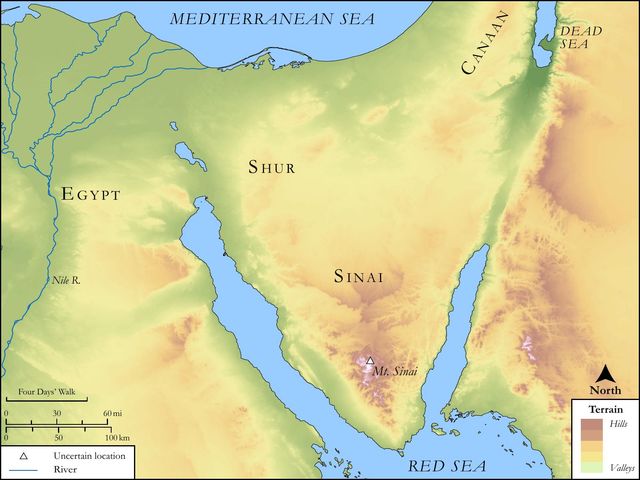
See on the biblical-era map
Study this verse
Public-domain commentary
Matthew Henry
From his Commentary on the Whole Bible. Henry comments on passages, not single verses — this entry covers Numbers 4:21–33.
We have here the charge of the other two families of the Levites, which, though not so honourable as the first, yet was necessary, and was to be done regularly. 1. The Gershonites were charged with all the drapery of the tabernacle, the curtains, and hangings, and the coverings of badgers' skins, Num 4:22-26. These they were to take down when the cloud removed, and the ark and the rest of the holy things were carried away, to pack up and bring with them, and then to set up again, where the cloud rested. Aaron and his sons allotted to them their respective charge: "You shall take care of such a curtain, and you of such a hanging, that every one may know his work, and there may be no confusion," Num 4:27. Ithamar particularly was to take the oversight of them, Num 4:28. 2. The Merarites were charged with the heavy carriage, the boards and bars, the pillars and sockets, the pins and cords, and these were delivered to them by name, Num 4:31, Num 4:32. An inventory was given them of every particular, that it might be forthcoming, and nothing to seek, when the tabernacle was to be set up again. Though these seemed of less importance than the other things pertaining to the sanctuary, yet there was this care taken of them, to teach us with the greatest exactness to preserve pure and entire all divine institutions, and to take care that nothing be lost. It also intimates the care God takes of his church, and every member of it; the good Shepherd calls his own sheep by name, Joh 10:3. Here were thousands of men employed about these services, though a much less number would have served for the bearing of those burdens; but it was requisite that the tabernacle should be taken down, and set up, with great expedition, and many hands would make quick work, especially when every one knew his work. They had tents of their own to take care of, and to take along with them, but the young men under thirty, and the old men above fifty, might serve for them; nor is there any mention of them, for God's house must always be preferred before our own. Their care was preposterous who built and ceiled their own houses while God's house lay waste, Hag 1:4, Hag 1:9. The death of the saints is represented as the taking down of the tabernacle (Co2 5:1), and the putting of it off, Pe2 1:14. The immortal soul, like the most holy things, is first covered and taken away, carried by angels, unseen, under the inspection of the Lord Jesus, our Eleazar. Care is also taken of the body - the skin and flesh, which are as the curtains, the bones and sinews which are as the bars and pillars; none of these shall be lost; commandment is given concerning the bones, a covenant made with the dust; these are in safe custody, and shall all be produced in the great day, when this tabernacle shall be set up again, and these vile bodies made like the glorious body of Jesus Christ.
Continue studying Numbers 4:32 across the web’s major study libraries — every link below opens this exact verse, chapter, or book on the destination site.
Read & Compare
 BibleGatewayThis verse in more than 200 translations and 70 languages.
 Bible.comThe YouVersion reader — hundreds of translations, reading plans, and highlights.
 ESV.orgCrossway's official English Standard Version reader.
 NET BibleThe NET translation with 60,000+ translators' notes on every rendering decision.
 STEP BibleTyndale House's free study tool — original text, vocabulary, and scholarly resources.
 BibliaLogos Bible Software's free web reader.
 USCCBThe New American Bible (Revised Edition) with the U.S. bishops' study notes.
Commentaries
 BibleHub CommentariesDozens of classic commentaries on this verse, gathered on one page.
 StudyLightMore than 100 commentary sets — the largest collection on the web.
 BibleRefPlain-English commentary on what this verse means, verse by verse.
 Enduring WordDavid Guzik's free commentary on this chapter, widely used by Bible teachers.
 Bible Study ToolsVerse commentary alongside Greek and Hebrew study aids.
Original Language & Research
- BibleHub InterlinearThe verse word by word — original language, transliteration, and English.
- BibleHub LexiconEvery word's original-language definition and Strong's entry.
 Blue Letter BibleDeep-study tools — Strong's numbers, concordance, and word studies.
 SefariaThe Hebrew text with Rashi and centuries of Jewish commentary.
Sermons, Hymns & Audio


TrulyRandomVerse is not affiliated with these sites and doesn’t control their content. They’re linked because they’re genuinely useful.
Summary
Numbers 4:32 concludes the specific instructions for the Merarite clan of the Levites, detailing their solemn responsibility for transporting the heaviest and most structural components of the Tabernacle and its surrounding court. This verse underscores the divine demand for meticulous accountability, requiring that every pillar, socket, pin, cord, and all associated instruments be precisely inventoried "by name," emphasizing the sacredness of the task and the comprehensive nature of their assigned "burden."
Context
ShowHideLiterary Context
Numbers chapter 4 meticulously outlines the specific duties assigned to the three Levitical clans—the Kohathites, the Gershonites, and the Merarites—for the dismantling, transport, and reassembly of the Tabernacle during Israel's wilderness journeys. Each clan received distinct, divinely appointed responsibilities: the Kohathites handled the most sacred articles, such as the Ark of the Covenant; the Gershonites were responsible for the coverings and curtains; and the Merarites, as detailed in Numbers 4:29-33, were tasked with the heavier, structural elements. Verse 32 specifically details the components of the outer court, including the pillars, sockets, pins, and cords, reinforcing the comprehensive nature of their charge. This precise instruction ensures divine order, preventing any loss or damage to the sacred sanctuary, and highlights the meticulousness required for the proper handling of God's dwelling place.
Historical & Cultural Context
The Tabernacle served as the portable dwelling place of God among His people Israel during their forty years in the wilderness, functioning as the central point of their worship and a tangible symbol of God's presence and covenant faithfulness. The elaborate and meticulous instructions for its construction, detailed in Exodus 25-31, and its handling, found in Numbers, reflect the absolute holiness of God and the profound reverence required in approaching Him. In a cultural landscape where surrounding nations often treated their deities with less precision or ritualistic detail, Israel's God demanded absolute order, purity, and accountability, even for the smallest components of His sanctuary. The Levites, set apart for this sacred service as outlined in Numbers 3, bore a significant responsibility, not just physically but spiritually. The "burden" (Hebrew: massa') they carried was not merely a physical load but a sacred trust, underscoring the gravity and importance of their role in maintaining the integrity and sanctity of God's dwelling place.
Key Themes
ShowHideNumbers 4:32 contributes significantly to several key themes within the book of Numbers and the Pentateuch. Foremost is the theme of Divine Order and Holiness, emphasizing that God is a God of precision who demands meticulousness in all matters pertaining to His worship and presence. The detailed inventory reflects His perfect order, contrasting with human tendency towards chaos. Another prominent theme is Accountability and Stewardship, as the Levites are held strictly responsible for every item, teaching that service to God is a serious trust, not a casual endeavor. This extends to the broader principle of human responsibility for what God has entrusted to them, whether material or spiritual. Finally, the verse highlights the theme of Specific Roles and Responsibilities within the Community, demonstrating that each part of God's people has a unique, vital, and divinely appointed function, as seen in the distinct duties assigned to the various Levitical clans throughout Numbers 4.
Exposition and Analysis
ShowHideKey Word Analysis
ShowHideFrom the same root as "lord" or "master" (in the sense of strength), this word refers to a basis or foundation, particularly for a building or column. In the context of the Tabernacle, these were the heavy bronze or silver bases into which the wooden pillars were set, providing stability and support. Their inclusion here emphasizes that even the foundational, unseen elements were critical and subject to meticulous accounting.
This is a broad term encompassing any apparatus, implement, utensil, or vessel. In Numbers 4:32, it specifically refers to all the various components of the Tabernacle court—the pillars, sockets, pins, and cords—as well as any other necessary tools for their assembly and disassembly. The use of this general term, followed by specific examples, emphasizes the comprehensive scope of the Merarites' responsibility, covering every single item related to their charge, leaving no room for oversight.
This verb means to visit, inspect, muster, appoint, or take account of, often implying a thorough and precise oversight. When used in the context of an inventory or census, as here, it signifies more than a simple count; it implies a personal verification of each item's presence and condition. This suggests a deep level of stewardship and responsibility, where each component was individually noted and confirmed.
While literally referring to a physical load or weight, massâʼ also carries the connotation of a heavy responsibility, a charge, or even a prophetic utterance (a "burden" of the Lord). In this context, it signifies not only the physical weight of the Tabernacle components that the Merarites carried but also the profound spiritual and administrative responsibility entrusted to them. It highlights the gravity and importance of their sacred task, linking physical labor with divine trust.
Verse Breakdown
ShowHide"And the pillars of the court round about"
This refers to the freestanding posts that formed the perimeter of the outer courtyard of the Tabernacle, as described in Exodus 27:9-19. These pillars supported the linen hangings that enclosed the sacred space, marking the boundary between the holy and the common.
"and their sockets, and their pins, and their cords"
These are the essential ancillary components needed for the pillars. "Sockets" (bases) provided stability, "pins" (pegs, likely tent pegs) were driven into the ground to secure the "cords" (ropes) that held the pillars taut and upright, especially against wind. This detail emphasizes the meticulousness required for even the smallest, yet crucial, parts of the Tabernacle's structure.
"with all their instruments, and with all their service"
This phrase serves as a comprehensive summary, ensuring no aspect of their duty is overlooked. "All their instruments" refers to every piece of equipment associated with the court and its pillars, while "all their service" refers to the specific work, ministry, or task involved in handling these items—from dismantling to transport to reassembly. It underscores the exhaustive nature of their responsibility.
"and by name ye shall reckon the instruments of the charge of their burden"
This is the core command of the verse, emphasizing absolute accountability. "By name" means individually, specifically, or item by item. "Ye shall reckon" (from paqad) means to take a precise, accountable inventory, implying inspection and verification. "The instruments of the charge of their burden" refers to the specific items that constituted their assigned load and responsibility. This command ensured that nothing was lost, damaged, or unaccounted for, highlighting the divine demand for absolute precision and accountability in sacred duties.
Literary Devices
ShowHideNumbers 4:32 employs several literary devices to underscore its profound message. Emphasis is powerfully conveyed through the detailed enumeration of components ("pillars," "sockets," "pins," "cords") and the repetition of "all" ("all their instruments," "all their service"). This meticulous listing ensures that no part, however small or seemingly insignificant, is overlooked, reflecting God's own meticulousness and His demand for comprehensive care in sacred matters. Furthermore, Symbolism is present, as the careful handling of the Tabernacle components symbolizes reverence for God's holiness and His ordered presence among His people. The physical "burden" (מַשָּׂא, massâʼ) also functions as Metonymy, standing not just for the physical weight of the Tabernacle's structural elements but also for the profound spiritual and administrative responsibility entrusted to the Merarites. This device highlights the gravity and sacredness of their task, transforming a physical load into a spiritual trust.
Theological and Thematic Connections
ShowHideNumbers 4:32 profoundly illustrates God's character as a God of order, precision, and holiness, who demands meticulousness in all matters pertaining to His worship and service. The detailed accounting required of the Merarites for every component of the Tabernacle court underscores the principle of divine accountability and human stewardship. It teaches that nothing in God's work is insignificant; every detail, every person, and every task contributes to the whole and is subject to His watchful eye. This divine expectation of thoroughness and faithfulness in handling sacred things extends beyond the physical Tabernacle to all aspects of our service and stewardship today, reminding us that our gifts, our resources, and our responsibilities are entrusted to us by God and require diligent oversight, for He is a God of order, not of confusion.
Reflection and Application
ShowHideThe meticulous instructions given to the Merarites in Numbers 4:32 offer profound lessons for believers today, transcending the ancient context of the Tabernacle. Just as every pillar, pin, and cord was "reckoned by name," God calls us to a similar level of faithfulness and accountability in our own lives and ministries. This means recognizing that our spiritual gifts, our time, our financial resources, our relationships, and our roles within the body of Christ are not to be handled casually, but with diligence, reverence, and intentionality. It challenges us to consider whether we are truly stewarding what God has entrusted to us with the precision and care that reflects His own meticulous nature. Are we faithful in the "small things" that often go unnoticed, understanding that even these contribute significantly to the larger work of God and His kingdom? This verse encourages us to embrace our "burden" of service, whatever form it may take—whether in our homes, workplaces, or churches—with a deep sense of responsibility and an unwavering awareness that we serve a God who cares about the details and holds us accountable for our stewardship.
Questions for Reflection
ShowHideFAQ
ShowHideWhy was such precise accounting necessary for the Tabernacle components?
ShowHideThe precise accounting was necessary for several critical reasons, all rooted in God's character and the nature of the Tabernacle. First, it underscored the sacredness and holiness of the Tabernacle and its components. These were not ordinary items but consecrated vessels for God's dwelling, demanding utmost reverence. Second, it ensured divine order and prevented any loss, damage, or disrespect to the holy articles during the frequent dismantling, transport, and reassembly required during Israel's wilderness journeys. Every piece was vital for the sanctuary's integrity. Third, it established clear accountability among the Levites, ensuring that each individual or group understood their specific charge and could be held responsible for its integrity. This meticulousness reflected God's own character as a God of order, not of confusion, as seen in passages like 1 Corinthians 14:33.
What does "by name ye shall reckon" imply about individual responsibility?
ShowHideThe phrase "by name ye shall reckon" implies a profound level of individual and personal responsibility. It means that each item was not merely part of a bulk count but was individually noted, inspected, and accounted for, often implying a personal verification of its presence and condition. This command ensured that specific individuals or groups within the Merarite clan were personally held accountable for the presence and condition of every single pillar, socket, pin, cord, and instrument entrusted to them. It highlights that God values personal diligence and faithfulness in stewardship, emphasizing that our service to Him is not anonymous but a personal charge, a sacred trust for which we will give an account, as also powerfully reflected in the parable of the talents in Matthew 25:14-30.
Christ-Centered Fulfillment
ShowHideNumbers 4:32, with its emphasis on the meticulous handling of the Tabernacle's structural components, finds its ultimate fulfillment in Jesus Christ. The Tabernacle, as God's dwelling among His people, was a profound type of Christ, who is the true "dwelling place" of God, as John 1:14 declares, "the Word became flesh and dwelt among us." The heavy "burden" of the Merarites, involving the physical weight and sacred responsibility of the Tabernacle's framework, foreshadows the ultimate burden Christ bore for humanity—the crushing weight of sin and the curse of the law, as prophesied in Isaiah 53:4-6 and perfectly fulfilled on the cross. The divine demand for meticulous accounting in the Old Covenant points to the perfect, unblemished sacrifice of Christ, which was fully "reckoned" as sufficient for our redemption, satisfying every divine requirement. In Him, all the detailed requirements of the law are perfectly fulfilled, and through His finished work, we, as living stones, become part of a spiritual house, a holy priesthood (1 Peter 2:5), no longer carrying physical burdens of ritualistic service but serving God in the freedom and order established by His perfect atoning sacrifice (Hebrews 10:19-22). He is the true and everlasting Tabernacle, perfectly accounted for and eternally glorious.