


Numbers 31:34
Bible text: King James Version (1769 Blayney text) · Public domain
Bible text: King James Version with Strong's numbers · Public domain
Bible text: American Standard Version (1901) · Public domain
Bible text: World English Bible, Messianic edition · Public domain
Bible text: Geneva Bible (1599) · Public domain
Bible text: Young's Literal Translation · Public domain
- וַחֲמֹרִיםva·cha·mo·Rimand donkeysH2543Conj-w ¦ N-cpNoun Plural common gender Absoluteוַandחֲמֹרִיםdonkeys
- אֶחָד'e·ChadoneH259Adj-fsAdjective Numerical Singular Feminine Absolute
- וְשִׁשִּׁיםve·shi·Shimand sixtyH8346Conj-w ¦ Adj-mpAdjective Numerical Plural Masculine Absoluteוְandשִׁשִּׁיםsixty
- אָלֶף'A·lefthousandH505Adj-csAdjective Numerical Singular common gender Absolute
English is a literal word-by-word gloss of the Hebrew, not the KJV's wording. Why?
This is the original text the KJV's translators worked from — each Hebrew word with its own literal English meaning in this verse, prepared by scholars at Tyndale House, Cambridge. The KJV translates whole sentences, not word by word, so its wording differs: one Hebrew word can become several English words, and the KJV may choose “the LORD” where the gloss reads “Yahweh”. Both are faithful — they answer different questions. For the KJV's own rendering, switch to the KJV text.
Details
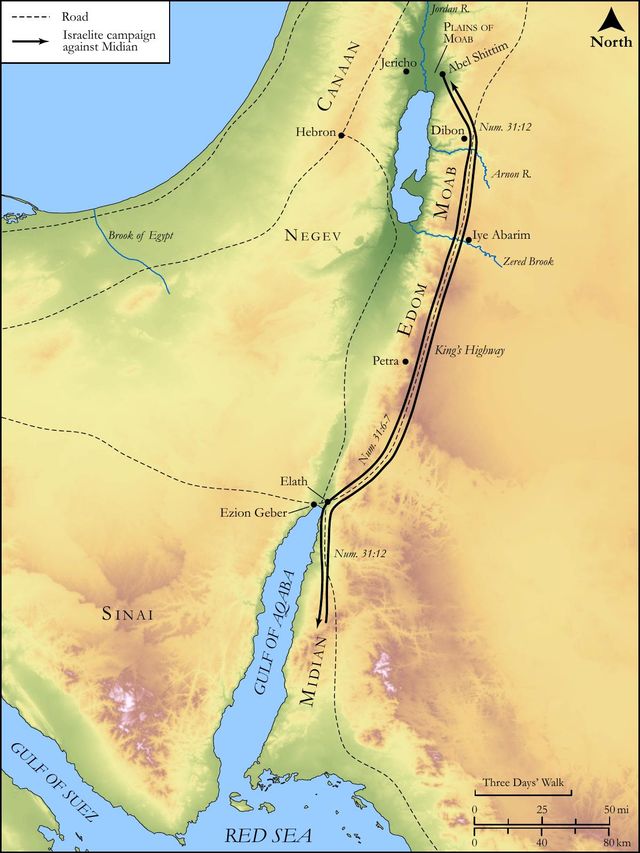
See on the biblical-era map
Study this verse
Continue studying Numbers 31:34 across the web’s major study libraries — every link below opens this exact verse, chapter, or book on the destination site.
Read & Compare
 BibleGatewayThis verse in more than 200 translations and 70 languages.
 Bible.comThe YouVersion reader — hundreds of translations, reading plans, and highlights.
 ESV.orgCrossway's official English Standard Version reader.
 NET BibleThe NET translation with 60,000+ translators' notes on every rendering decision.
 STEP BibleTyndale House's free study tool — original text, vocabulary, and scholarly resources.
 BibliaLogos Bible Software's free web reader.
 USCCBThe New American Bible (Revised Edition) with the U.S. bishops' study notes.
Commentaries
 BibleHub CommentariesDozens of classic commentaries on this verse, gathered on one page.
 StudyLightMore than 100 commentary sets — the largest collection on the web.
 BibleRefPlain-English commentary on what this verse means, verse by verse.
 Enduring WordDavid Guzik's free commentary on this chapter, widely used by Bible teachers.
 Bible Study ToolsVerse commentary alongside Greek and Hebrew study aids.
Original Language & Research
- BibleHub InterlinearThe verse word by word — original language, transliteration, and English.
- BibleHub LexiconEvery word's original-language definition and Strong's entry.
 Blue Letter BibleDeep-study tools — Strong's numbers, concordance, and word studies.
 SefariaThe Hebrew text with Rashi and centuries of Jewish commentary.
Sermons, Hymns & Audio


TrulyRandomVerse is not affiliated with these sites and doesn’t control their content. They’re linked because they’re genuinely useful.
Summary
Numbers 31:34 meticulously records the immense quantity of sixty-one thousand asses (donkeys) taken as spoils during Israel's divinely commanded punitive war against the Midianites. This precise detail, embedded within a comprehensive inventory of captured livestock and precious metals, serves to underscore the overwhelming scale of God's judgment enacted through Israel, His abundant provision for His people, and the rigorous, divinely ordained order governing the distribution of the vast war bounty. It highlights the practical wealth acquired and the meticulousness of the biblical record.
Context
ShowHideLiterary Context
Numbers 31:34 is situated within the latter half of Numbers 31, a chapter that meticulously details Israel's war against the Midianites. This conflict is presented not as a mere territorial dispute, but as a direct divine command for vengeance, stemming from Midian's pivotal role in orchestrating the spiritual and moral apostasy of Israel at Baal-peor, as vividly recounted in Numbers 25. Following the initial divine directive in Numbers 31:1-2, the chapter describes the military expedition, the complete defeat of Midian, and the subsequent capture of immense spoils. Verses 31:25-47 provide a detailed, itemized inventory of the plunder—including people, cattle, sheep, and asses—and outline the precise, divinely mandated method for its division among the soldiers, the congregation, and specific portions dedicated to the Lord and the Levites. Verse 34, by specifying the exact number of asses, contributes to this comprehensive accounting, emphasizing both the thoroughness of the inventory and the vastness of the victory.
Historical & Cultural Context
The war against Midian was unique in its nature, functioning as an act of divine judgment rather than a typical territorial conquest. Midian had actively sought to corrupt Israel's covenant relationship with Yahweh, making this war a theological necessity. In Scripture, donkeys were indispensable beasts of burden, as when Joseph's brethren laded their asses with the corn, serving as the primary mode of transportation, crucial for agriculture, vital for trade, and essential for military logistics, particularly for carrying supplies. Their immense practical value made them a significant measure of wealth and a highly prized component of war spoils. The sheer number of 61,000 asses indicates both the Midianites' considerable prosperity and the overwhelming nature of Israel's victory. Furthermore, while meticulous accounting of spoils was a common practice in ancient warfare, here it is elevated to a divine mandate, highlighting God's direct involvement in every detail of Israel's life, including the aftermath of battle. This level of detail also served to demonstrate the fulfillment of God's promises of provision and the severe consequences for opposing nations that defied His will.
Key Themes
ShowHideThe meticulous enumeration of the spoils, including the 61,000 asses in Numbers 31:34, contributes significantly to several overarching themes in the book of Numbers. Firstly, it underscores Divine Judgment and Holiness, demonstrating God's unwavering commitment to executing justice against those who lead His people astray and violate His covenant, as seen in the severe consequences for Midian following the Baal-peor incident (Numbers 25). Secondly, it highlights God's Abundant Provision and Faithfulness to Israel, showing that even in the context of war and divine judgment, He richly supplies their needs and blesses their obedience. The vast quantity of livestock signifies a tangible blessing from Yahweh, equipping Israel for their journey and future settlement. Finally, the detailed inventory and prescribed division methods emphasize Divine Order and Meticulousness. God is portrayed as a deity who governs every aspect of life, demanding precision and adherence to His instructions, even in the distribution of war booty. This reinforces the structured nature of the Mosaic Law and the importance of stewardship within the Israelite community, reflecting the divine blueprint for Israel's ordered existence in the wilderness and their preparation for the Promised Land.
Exposition and Analysis
ShowHideKey Word Analysis
ShowHideThis term, common in older English translations like the KJV, literally means "three scores," where a "score" is twenty, thus signifying sixty. The full phrase "threescore and one thousand" (Hebrew: וְאֶלֶף שִׁשִּׁים וְאֶחָד, v'eleph shishim v'echad) precisely translates to "sixty-one thousand." This exact numerical expression highlights the meticulous record-keeping inherent in the biblical text, particularly within the legal and historical narratives of the Pentateuch. It reflects an emphasis on quantifiable data, which was crucial for accountability and the fair sharing of goods within the Israelite community, especially regarding divinely mandated spoils of war.
This numeral signifies a thousand. In the context of Numbers 31:34, it functions as a precise quantifier, indicating a massive scale of acquisition. When combined with "threescore and one," it forms the large number 61,000. The use of such a high and exact number emphasizes the overwhelming nature of the victory and the immense wealth that accrued to the Israelites, demonstrating God's abundant provision and the thoroughness of the conquest.
Refers to donkeys, which were ubiquitous and highly valuable domestic animals in the households of the patriarchs. Derived from a root suggesting a "dun red" color, these animals were the common beasts of burden for ordinary people, essential for transportation of goods and people, agricultural work (plowing, threshing), and even for riding by various social strata. The immense number of 61,000 asses captured from the Midianites signifies not only the Midianites' considerable wealth and pastoral economy but also the overwhelming scale of Israel's victory and the subsequent enrichment of the Israelite community, providing a vital resource for their journey and future settlement in Canaan.
Verse Breakdown
ShowHide"And threescore and one thousand asses,"
This concise statement serves as a precise accounting entry within the broader inventory of the Midianite spoils. It quantifies a specific category of livestock, emphasizing the sheer volume of wealth acquired by Israel through divine intervention. The inclusion of such a large, specific number (61,000) for donkeys underscores the magnitude of the victory and the comprehensive nature of the plunder. It also highlights the practical value of the spoils, as these animals were crucial for the logistical needs of the vast Israelite congregation in the wilderness and for their future agricultural endeavors in the Promised Land. This detail reinforces the theme of God's abundant provision, demonstrating His capacity to supply His people's needs even through the extraordinary circumstances of war and judgment.
Literary Devices
ShowHideThe brevity of Numbers 31:34 belies its literary significance within the larger narrative of Numbers 31. The primary literary device at play is Enumeration, where the text meticulously lists and quantifies the vast spoils of war. This detailed accounting, repeated for various categories of plunder (sheep, cattle, humans, gold, silver), serves to emphasize the overwhelming nature of God's victory and the thoroughness of His judgment against Midian. The sheer scale of the numbers, particularly for livestock like the 61,000 asses, functions almost as a form of Hyperbole in its impact, conveying an impression of immense wealth and divine blessing, even if the numbers are literal. Furthermore, the focus on such specific details like the number of donkeys contributes to the overall sense of Realism and historical grounding for the narrative, portraying the events with a meticulousness that suggests an authentic record. This precision also reinforces the theme of God's Order and control, as even the distribution of war spoils is subject to His exact divine instructions, reflecting His character as a God of meticulous detail and comprehensive oversight.
Theological and Thematic Connections
ShowHideNumbers 31:34, though a simple numerical statement, is profoundly theological in its implications. It stands as a testament to God's sovereign power and His unwavering commitment to justice. The immense spoils, including these 61,000 asses, are not merely the outcome of human warfare but the tangible result of divine judgment against Midian for their egregious sin at Baal-peor. This demonstrates that God is actively involved in the affairs of nations, holding them accountable for their moral and spiritual corruption. Furthermore, the detailed accounting highlights God's meticulous nature, His provision for His people, and the importance of stewardship, as the resources acquired are to be managed and distributed according to His precise commands, with portions dedicated back to Him and to the Levites. This underscores the principle that all blessings, even those gained through conflict, ultimately originate from and belong to God, to be used according to His divine will.
Reflection and Application
ShowHideThe precise enumeration of 61,000 asses in Numbers 31:34, while seemingly mundane, invites us to reflect on the profound implications of God's character and our response to Him. It reminds us that God is a God of meticulous detail, whose oversight extends to every aspect of life, even the spoils of war. This should encourage us to cultivate diligence and order in our own lives, recognizing that nothing is too small to escape God's notice or too insignificant for His purposes. Moreover, the context of divine judgment and abundant provision prompts us to consider the serious consequences of sin and the lavish blessings that flow from obedience to God's commands. Just as Israel was called to steward these vast resources, we too are called to be faithful stewards of all that God entrusts to us—our time, talents, and material possessions—recognizing that they are gifts from Him and are to be used for His glory and the advancement of His kingdom. This verse, therefore, calls us to a deeper appreciation for God's sovereignty, His justice, and His unfailing provision, prompting us to live lives of faithful stewardship and obedience, trusting in His meticulous care and wise design for our lives.
Questions for Reflection
ShowHideFAQ
ShowHideWhy is such a specific number of asses mentioned in Numbers 31:34?
ShowHideThe specific mention of 61,000 asses in Numbers 31:34 serves multiple purposes. Firstly, it underscores the overwhelming scale of Israel's victory over the Midianites, demonstrating the effectiveness of God's judgment. Secondly, it highlights the immense wealth acquired, as donkeys were vital economic assets in the households of the patriarchs and of Job, used for transport, agriculture, and trade. Thirdly, and most importantly, it emphasizes God's meticulous nature and His demand for precise accounting. The entire chapter details a divinely ordained system for dividing spoils, with specific portions allocated to the soldiers, the congregation, the Levites, and as a tribute to the Lord (Numbers 31:25-47). This level of detail reinforces the biblical theme of divine order and the importance of faithful stewardship in all matters, even in the aftermath of warfare. It assures the reader that God is sovereign over all aspects of life, down to the smallest detail of a nation's inventory.
What was the significance of asses (donkeys) in ancient Israelite society?
ShowHideAsses, or donkeys, were incredibly significant in Israelite society and among the nations round about. They were the primary beasts of burden for common people, essential for daily life and economic activity. Unlike horses, which were often associated with warfare and royalty, donkeys were versatile animals used for transporting goods and people over long distances, plowing fields, grinding grain, and carrying water. Their ability to thrive in arid conditions made them indispensable for travel and commerce in the region. The possession of a large number of donkeys, as seen in the spoils of Numbers 31:34, indicated considerable wealth and economic stability. They symbolized a practical form of prosperity and were a crucial component of any household or community's assets, reflecting their vital role in sustaining life and livelihood.
Christ-Centered Fulfillment
ShowHideWhile Numbers 31:34 details the spoils of a literal war in the Old Testament, its underlying themes find profound Christ-centered fulfillment. The war against Midian was an act of divine judgment against a corrupting influence, leading to a decisive victory and the acquisition of immense "spoils" for God's people. This foreshadows the ultimate spiritual war waged by Jesus Christ against sin, death, and the powers of darkness. Through His sacrificial death on the cross and His glorious resurrection, Christ achieved a definitive victory, disarming the spiritual forces arrayed against humanity and triumphing over them (Colossians 2:15). The "spoils" of Christ's victory are not material wealth but the spiritual blessings and eternal inheritance bestowed upon His redeemed people: forgiveness of sins, reconciliation with God, eternal life, and the indwelling of the Holy Spirit (Ephesians 1:7-14). Just as the asses provided practical utility for Israel's journey and future, so too does Christ's victory provide all that is necessary for believers to live a life of godliness and to journey towards their heavenly inheritance (2 Peter 1:3). Furthermore, the meticulous accounting in Numbers 31 reflects God's divine order and sovereignty, mirroring the perfect plan of salvation meticulously executed by Christ, ensuring every detail of God's redemptive purpose is fulfilled (Hebrews 10:1-10). Ultimately, the victory and provision for Israel in Numbers 31 point to the far greater victory and inexhaustible provision found in Christ, the true Lamb of God, who triumphs over all evil and gives abundant life to His followers (John 10:10).