


Numbers 31:35
Bible text: King James Version (1769 Blayney text) · Public domain
Bible text: Berean Standard Bible · Public domain
Bible text: American Standard Version (1901) · Public domain
Bible text: World English Bible, Messianic edition · Public domain
Bible text: Geneva Bible (1599) · Public domain
Bible text: Young's Literal Translation · Public domain
- וְנֶפֶשׁve·Ne·feshand [the] person[s] ofH5315Conj-w ¦ N-fscNoun Singular Feminine Constructוְandנֶפֶשׁ[the] person[s] of
- אָדָם'a·DamhumankindH120N-msNoun Singular Masculine Absolute
- מִןminfromH4480PrepPreposition
- הַנָּשִׁיםha·na·Shimthe womenH802Art ¦ N-mpNoun Plural Masculine Absoluteהַtheנָּשִׁיםwomen
- אֲשֶׁר'a·SherwhoH834RelParticle Relative
- לֹאlo'notH3808NegParticle Negative
- יָדְעוּya·de·'Uthey had knownH3045V-Qal-Perf-3cpVerb Qal Perfect 3rd Plural common gender
- מִשְׁכַּבmish·Kavlying ofH4904N-mscNoun Singular Masculine Construct
- זָכָרza·Khara maleH2145Adj-msAdjective Singular Masculine Absolute
- כָּלkoleveryH3605N-mscNoun Singular Masculine Construct
- נֶפֶשׁNe·feshpersonH5315N-fsNoun Singular Feminine Absolute
- שְׁנַיִםshe·Na·yimtwoH8147Adj-cdAdjective Numerical Dual common gender Absolute
- וּשְׁלֹשִׁיםu·she·lo·Shimand thirtyH7970Conj-w ¦ Adj-mpAdjective Numerical Plural Masculine Absoluteוּandשְׁלֹשִׁיםthirty
- אָלֶף'A·lefthousandH505Adj-csAdjective Numerical Singular common gender Absolute
English is a literal word-by-word gloss of the Hebrew, not the KJV's wording. Why?
This is the original text the KJV's translators worked from — each Hebrew word with its own literal English meaning in this verse, prepared by scholars at Tyndale House, Cambridge. The KJV translates whole sentences, not word by word, so its wording differs: one Hebrew word can become several English words, and the KJV may choose “the LORD” where the gloss reads “Yahweh”. Both are faithful — they answer different questions. For the KJV's own rendering, switch to the KJV text.
Details
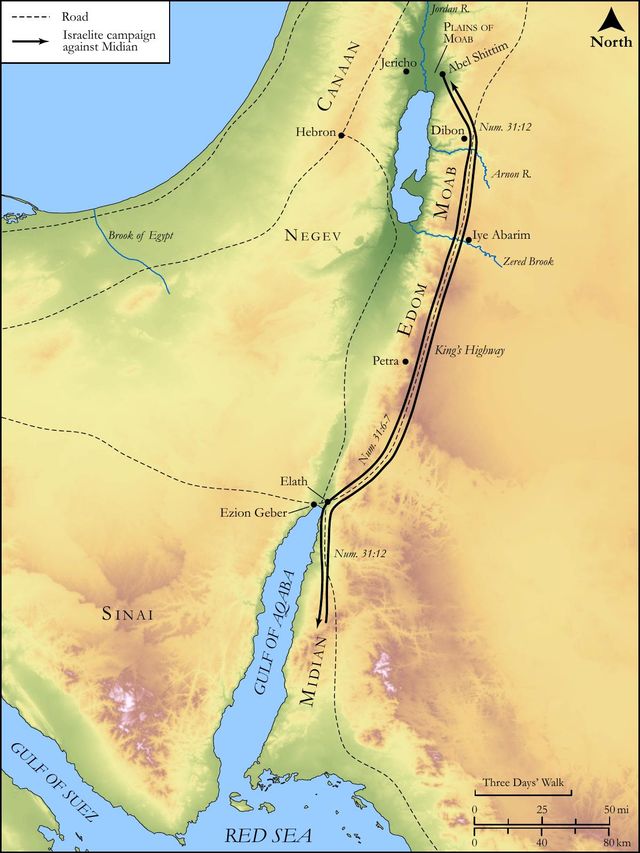
See on the biblical-era map
Study this verse
Continue studying Numbers 31:35 across the web’s major study libraries — every link below opens this exact verse, chapter, or book on the destination site.
Read & Compare
 BibleGatewayThis verse in more than 200 translations and 70 languages.
 Bible.comThe YouVersion reader — hundreds of translations, reading plans, and highlights.
 ESV.orgCrossway's official English Standard Version reader.
 NET BibleThe NET translation with 60,000+ translators' notes on every rendering decision.
 STEP BibleTyndale House's free study tool — original text, vocabulary, and scholarly resources.
 BibliaLogos Bible Software's free web reader.
 USCCBThe New American Bible (Revised Edition) with the U.S. bishops' study notes.
Commentaries
 BibleHub CommentariesDozens of classic commentaries on this verse, gathered on one page.
 StudyLightMore than 100 commentary sets — the largest collection on the web.
 BibleRefPlain-English commentary on what this verse means, verse by verse.
 Enduring WordDavid Guzik's free commentary on this chapter, widely used by Bible teachers.
 Bible Study ToolsVerse commentary alongside Greek and Hebrew study aids.
Original Language & Research
- BibleHub InterlinearThe verse word by word — original language, transliteration, and English.
- BibleHub LexiconEvery word's original-language definition and Strong's entry.
 Blue Letter BibleDeep-study tools — Strong's numbers, concordance, and word studies.
 SefariaThe Hebrew text with Rashi and centuries of Jewish commentary.
Sermons, Hymns & Audio


TrulyRandomVerse is not affiliated with these sites and doesn’t control their content. They’re linked because they’re genuinely useful.
Summary
Numbers 31:35 provides a precise numerical account of the thirty-two thousand virgin women who were spared by the Israelite army following their divinely ordained punitive war against the Midianites. This specific enumeration forms part of the detailed inventory of war spoils, underscoring the meticulous nature of the Mosaic Law regarding the distribution of plunder and the stringent requirements for ritual purity within the covenant community, especially in the wake of the devastating Baal-peor apostasy.
Context
ShowHideLiterary Context
Numbers 31:35 is situated within a lengthy and detailed account of Israel's war against Midian, a conflict initiated by God's direct command to Moses to "take vengeance on the Midianites for the Israelites" (Numbers 31:1-2). This war serves as a climactic resolution to the narrative arc that began with the egregious Baal-peor incident in Numbers 25, where Midianite women played a central role in enticing Israelite men into idolatry and sexual immorality, leading to a devastating plague. Chapter 31 meticulously records the military campaign, the collection of spoils, the subsequent purification rituals, and the precise distribution of the plunder among the warriors, the congregation, and the Levites. Verse 35 specifically itemizes one category of the human spoils—the virgin women—thereby setting the stage for the comprehensive division of all captured goods that follows in Numbers 31:36-47.
Historical & Cultural Context
The war against Midian was not a typical territorial expansion but a unique divine judgment against a people who had actively led Israel into grave sin against Yahweh. Among the nations, warfare often involved the complete annihilation or enslavement of conquered populations, with women and children frequently becoming part of the spoils. However, the Mosaic Law introduced distinctive parameters for Israelite warfare, particularly concerning the treatment of captured populations. The command to kill all Midianite males and non-virgin women (Numbers 31:17) while sparing virgins was an exceptionally severe measure. This was rooted in the imperative to eradicate the source of spiritual corruption, prevent future moral contamination within Israel, and ensure the purity of the covenant community. The cultural understanding of virginity in this context was paramount, serving as a marker of ritual purity and a safeguard against the introduction of pagan cultic prostitution or intermarriage with idolatrous influences that had previously proven disastrous for Israel.
Key Themes
ShowHideThis verse, within the broader context of Numbers 31, powerfully underscores several interwoven theological themes. Firstly, it highlights Divine Judgment and Holiness, demonstrating God's unwavering justice against those who actively lead His people astray into idolatry and immorality, as evidenced by the severity of the command against Midian. Secondly, the explicit distinction between virgin and non-virgin women emphasizes Purity and Separation, reflecting the Mosaic Law's profound concern for maintaining the holiness of the covenant community, free from defiling influences (Leviticus 18:24-30). The sparing of virgins, while challenging to modern sensibilities, was likely intended to integrate them into Israelite society in a way that minimized the risk of perpetuating Midianite religious or moral practices, ensuring the integrity of the Israelite lineage. Finally, the meticulous counting of the spoils, including the "thirty and two thousand persons," illustrates God's Meticulousness and Sovereignty over every detail of Israel's life, even in the distribution of war plunder, reinforcing the idea that all things are under His divine oversight, a principle also evident in the detailed census accounts found in Numbers 1.
Exposition and Analysis
ShowHideKey Word Analysis
ShowHideThis Hebrew term, nephesh, literally translates to "soul" or "life," but it is very widely used in the Old Testament to refer to a living being, an individual, or a person. In this context, "thirty and two thousand persons in all" emphasizes the totality of human individuals counted, distinguishing them from the animal spoils and highlighting the concrete numerical value or significance attributed to each life, even within the context of war and its aftermath. The use of nephesh here underscores that these are human beings, not merely objects.
This primitive root verb, yâdaʻ, means "to know," but it carries a wide range of senses, including intimate, experiential knowledge. In the phrase "had not known man by lying with him," yâdaʻ functions as a well-established biblical euphemism for sexual intercourse. Its use here signifies a state of virginity, indicating that these women had not engaged in intimate physical relations. The choice of yâdaʻ emphasizes a personal, physical, and intimate experience rather than just a casual acquaintance, making the meaning of virginity clear.
Derived from the root shâkav (to lie down), mishkâb primarily means "a bed" or "couch." However, as seen in this verse, it is frequently used euphemistically in the Old Testament to refer to carnal intercourse. When combined with yâdaʻ ("known"), the phrase "known man by lying with him" unequivocally denotes sexual relations. Its inclusion here reinforces the explicit definition of virginity, specifying the physical act that these women had not experienced.
Verse Breakdown
ShowHide"And thirty and two thousand persons in all,"
This initial clause provides the precise numerical count of the human individuals being itemized from the spoils of war. The exactitude of "thirty and two thousand" underscores the meticulous record-keeping and comprehensive inventory inherent in the Mosaic Law, reflecting the divine order even in the aftermath of battle. It establishes the significant scale of the human population being integrated into Israelite society from the Midianite campaign.
"of women that had not known man by lying with him."
This crucial qualifying phrase defines the specific category of "persons" being counted. It explicitly states that these were women who were virgins, meaning they had not engaged in sexual intercourse. This distinction was vital for reasons of ritual purity, preventing the introduction of defilement associated with Midianite idolatry and immorality. Their virgin status also made them suitable for potential integration into Israelite households through marriage, thereby safeguarding the purity of future generations and the covenant community as a whole.
Literary Devices
ShowHideThe verse primarily employs Enumeration and Euphemism. Enumeration is evident in the precise numerical statement "thirty and two thousand persons," which contributes to the overall meticulous accounting found throughout Numbers 31. This detailed counting reinforces the idea of divine order and control, even over the chaotic spoils of war, and highlights the comprehensive nature of the inventory. The phrase "had not known man by lying with him" is a classic biblical Euphemism for virginity. This indirect and delicate phrasing is characteristic of biblical language when referring to sexual matters, demonstrating a cultural sensitivity while clearly conveying the intended meaning. The use of euphemism here serves to maintain decorum while precisely defining the status of the women for legal, ritual, and social purposes within the Israelite community.
Theological and Thematic Connections
ShowHideNumbers 31:35, though a seemingly simple numerical statement, is deeply embedded in the theological narrative of God's holiness, justice, and the purity of His covenant people. The distinction made for these virgin women reflects God's desire to separate Israel from the corrupting influences of pagan nations, particularly those involved in the Baal-peor apostasy. It underscores the severity with which God views idolatry and sexual immorality, which defile both individuals and the community. While the specific commands of this war are unique to ancient Israel under the Mosaic covenant, the underlying principle of guarding against spiritual defilement and maintaining purity before a holy God remains a timeless theological truth for believers.
Reflection and Application
ShowHideNumbers 31:35, viewed through the lens of God's overarching character and redemptive plan, calls us to a profound reflection on the nature of holiness and the persistent struggle against spiritual compromise. While the specific context of ancient warfare and the treatment of spoils is not directly applicable to New Testament believers, the principle of maintaining purity in the face of corrupting influences is eternally relevant. Just as Israel was called to be distinct from the nations around them, believers today are called to live set apart for God, guarding their hearts and minds against the allure of worldly idols—whether they be materialism, self-worship, or moral relativism. This passage serves as a stark reminder of the consequences of spiritual adultery and the importance of vigilance in preserving our covenant relationship with God. It challenges us to examine what "defilements" we might allow into our lives that hinder our walk with Christ and diminish our witness. Our call is not to physical separation from society, but to spiritual and moral distinction within it, reflecting God's holiness in our daily lives.
Questions for Reflection
ShowHideFAQ
ShowHideWhy were only the virgin women spared, and not the non-virgin women or males?
ShowHideThe distinction in Numbers 31 was rooted in the specific nature of the Midianite war as a divine judgment for the Baal-peor apostasy, detailed in Numbers 25. Midianite women were instrumental in seducing Israelite men into idolatry and sexual immorality, leading to a plague that killed 24,000 Israelites. Therefore, the command to kill all Midianite males (who were the primary instigators of the war and often involved in pagan rituals) and non-virgin women (Numbers 31:17) was a severe, yet specific, measure to eradicate the source of this spiritual and moral contamination. Non-virgin women were likely considered to have been involved in the pagan cultic practices or to pose a continued threat of seduction and defilement. Virgin women, by contrast, were seen as free from such direct involvement and thus could be integrated into Israelite society without carrying the same spiritual or moral risk, potentially through marriage, thereby preventing the perpetuation of Midianite religious practices within Israel. This was not a general rule for all warfare but a unique judgment for a specific, egregious sin against God's covenant and His people's purity.
Christ-Centered Fulfillment
ShowHideWhile Numbers 31:35 details a specific historical judgment under the Old Covenant, its underlying themes point profoundly towards the ultimate redemptive work of Christ. The emphasis on purity and separation from defilement in the Old Testament foreshadows the spiritual purity that Christ establishes for His people. Just as the Midianite virgins were spared from judgment and brought into the Israelite community, albeit under specific conditions, Christ, through His atoning sacrifice, purifies those who were once alienated from God and brings them into His holy kingdom. He is the ultimate Lamb of God, who takes away the sin of the world, making us spiritually "virgin" or pure before God, washed clean from the defilement of sin. The meticulous accounting in Numbers 31 also hints at God's precise and sovereign plan for salvation, where every detail, even seemingly harsh judgments, ultimately serves His redemptive purposes to bring about a holy people. Through Christ, we are not merely spared from judgment, but are made new creations (2 Corinthians 5:17), spiritually set apart and presented as a "pure virgin to Christ" (2 Corinthians 11:2), eagerly awaiting His return as the Bridegroom for His spotless bride, the Church (Ephesians 5:25-27).