


Numbers 31:21
- וַיֹּאמֶרvai·Yo·merand he saidH559Conj-w ¦ V-Qal-ConsecImperf-3msVerb Qal Consecutive Imperfect 3rd Singular Masculineוַandיֹּאמֶרhe said
- אֶלְעָזָר'el·'a·ZarEleazarH499N-proper-mNoun Proper Masculine
- הַכֹּהֵןha·ko·Henthe priestH3548Art ¦ N-msNoun Singular Masculine Absoluteהַtheכֹּהֵןpriest
- אֶל'eltoH413PrepPreposition
- אַנְשֵׁי'an·Shei[the] men ofH582N-mpcNoun Plural Masculine Construct
- הַצָּבָאha·tza·Va'the armyH6635Art ¦ N-msNoun Singular Masculine Absoluteהַtheצָּבָאarmy
- הַבָּאִיםha·ba·'Imwho had goneH935Art ¦ V-Qal-Prtcpl-mpVerb Qal Participle Plural Masculine Absoluteהַwhoבָּאִיםhad gone
- לַמִּלְחָמָהla·mil·cha·Mahto the battleH4421Prep-l ¦ N-fsNoun Singular Feminine Absoluteלַto theמִּלְחָמָהbattle
- זֹאתzotthisH2063PrtParticle Demonstrative
- חֻקַּתchu·Kat[is] [the] statute ofH2708N-fscNoun Singular Feminine Construct
- הַתּוֹרָהha·to·Rahthe lawH8451Art ¦ N-fsNoun Singular Feminine Absoluteהַtheתּוֹרָהlaw
- אֲשֶׁר'a·SherwhichH834RelParticle Relative
- צִוָּהtzi·Vahhe commandedH6680V-Piel-Perf-3msVerb Piel Perfect 3rd Singular Masculine
- יְהוָהYah·wehYahwehH3068N-properNoun Proper Title
- אֶת'et<obj.>H853DirObjMParticle Object Indicator
- מֹשֶׁהmo·ShehMosesH4872N-proper-mNoun Proper Masculine
English is a literal word-by-word gloss of the Hebrew, not the KJV's wording. Why?
This is the original text the KJV's translators worked from — each Hebrew word with its own literal English meaning in this verse, prepared by scholars at Tyndale House, Cambridge. The KJV translates whole sentences, not word by word, so its wording differs: one Hebrew word can become several English words, and the KJV may choose “the LORD” where the gloss reads “Yahweh”. Both are faithful — they answer different questions. For the KJV's own rendering, switch to the KJV text.
Details
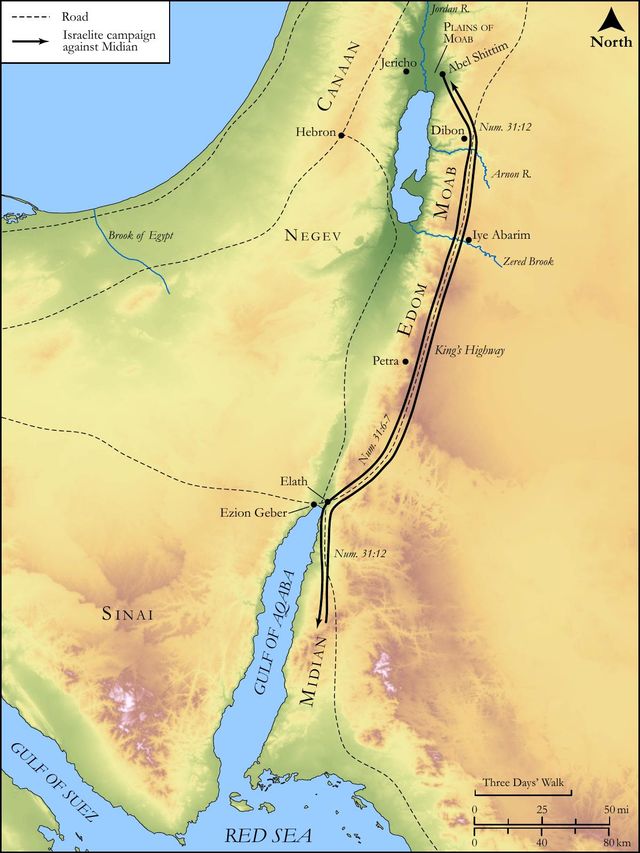
See on the biblical-era map
Study this verse
Continue studying Numbers 31:21 across the web’s major study libraries — every link below opens this exact verse, chapter, or book on the destination site.
Read & Compare
 BibleGatewayThis verse in more than 200 translations and 70 languages.
 Bible.comThe YouVersion reader — hundreds of translations, reading plans, and highlights.
 ESV.orgCrossway's official English Standard Version reader.
 NET BibleThe NET translation with 60,000+ translators' notes on every rendering decision.
 STEP BibleTyndale House's free study tool — original text, vocabulary, and scholarly resources.
 BibliaLogos Bible Software's free web reader.
 USCCBThe New American Bible (Revised Edition) with the U.S. bishops' study notes.
Commentaries
 BibleHub CommentariesDozens of classic commentaries on this verse, gathered on one page.
 StudyLightMore than 100 commentary sets — the largest collection on the web.
 BibleRefPlain-English commentary on what this verse means, verse by verse.
 Enduring WordDavid Guzik's free commentary on this chapter, widely used by Bible teachers.
 Bible Study ToolsVerse commentary alongside Greek and Hebrew study aids.
Original Language & Research
- BibleHub InterlinearThe verse word by word — original language, transliteration, and English.
- BibleHub LexiconEvery word's original-language definition and Strong's entry.
 Blue Letter BibleDeep-study tools — Strong's numbers, concordance, and word studies.
 SefariaThe Hebrew text with Rashi and centuries of Jewish commentary.
Sermons, Hymns & Audio


TrulyRandomVerse is not affiliated with these sites and doesn’t control their content. They’re linked because they’re genuinely useful.
Summary
Numbers 31:21 records Eleazar the priest's authoritative declaration to the returning Israelite soldiers after their decisive victory over Midian. This pivotal verse functions as a divine mandate, establishing that the intricate purification laws about to be detailed are not human regulations but direct commands from the LORD given through Moses. It profoundly underscores the absolute and non-negotiable necessity of ritual purity for the covenant community, particularly in the aftermath of warfare and the handling of potentially defiling spoils, thereby ensuring the sanctity of the camp where God Himself dwelt.
CONTEXT
ShowHideExposition and Analysis
ShowHideKey Word Analysis
ShowHideThis term (H2708) refers to a fixed statute, decree, or prescribed custom, often implying a non-negotiable divine requirement. Derived from a root meaning "to engrave" or "to carve," it carries the sense of something permanently established and unchangeable, denoting an immutable law rather than a suggestion. Its use here emphasizes the absolute divine origin and binding nature of the purification rites that follow, indicating they are not open to negotiation or alteration but are fixed appointments from God.
More than merely a legal code, tôwrâh (H8451) signifies "instruction," "teaching," or "guidance." It encompasses the entire body of divine revelation given through Moses, intended to guide Israel in all aspects of life—moral, civil, and ceremonial. In this context, it underscores that the purification rites are not arbitrary rules but an integral part of God's comprehensive instruction for holy living and maintaining the covenant relationship, providing the framework for a life lived in accordance with His will.
This verb (H6680) indicates a direct, authoritative order from a superior, often with the sense of enjoining or constituting. When used of God, as it is here, it highlights His absolute sovereignty and the non-negotiable nature of His directives. It emphasizes that these instructions originate directly from the LORD, not from human wisdom or tradition, thereby investing Eleazar's pronouncement with ultimate divine authority and demanding immediate, unquestioning obedience.
Verse Breakdown
ShowHide"And Eleazar the priest said unto the men of war which went to the battle"
Eleazar, as the high priest and Aaron's divinely appointed successor (H499, H3548), assumes his authoritative role, stepping into a moment of critical spiritual need. His direct address to the "men of war" (H582, H6635, H935, H4421) specifically targets those who have engaged in the potentially defiling acts of warfare and handled spoils, making his subsequent instructions directly relevant to their immediate circumstances and spiritual state. His position as priest lends divine weight to his words, signifying that these are not personal opinions but official pronouncements from God's appointed representative.
"This [is] the ordinance of the law"
This declarative statement immediately establishes the divine origin and binding nature of the forthcoming instructions. The demonstrative "This" refers specifically to the purification procedures that Eleazar is about to detail (Numbers 31:22-24). The combined use of "ordinance" (ḥuqqah, H2708) and "law" (torah, H8451) emphasizes that these are fixed, unchangeable, and divinely revealed instructions, not mere suggestions or temporary regulations. This underscores their absolute necessity for the community's purity and their foundational place within the covenant.
"which the LORD commanded Moses"
This final clause firmly roots the authority of Eleazar's words in God Himself (H3068), channeled through Moses (H4872). It serves as the ultimate validation, reminding the Israelites that the laws they are about to receive are not Eleazar's invention but direct commands from Yahweh, given to Moses at Sinai. This clear chain of divine command—from the LORD to Moses, then communicated by Eleazar to the people—invests the instructions with the full weight of divine authority and covenant obligation, demanding immediate and unquestioning obedience from all who hear.
Literary Devices
ShowHideThe verse employs Authoritative Declaration through Eleazar's direct and unambiguous address, immediately establishing the weight and divine origin of the subsequent laws. There is a strong sense of Anticipation as the verse functions as a concise preface, building expectation for the detailed instructions that follow regarding the cleansing of both people and plunder. The verse also showcases Delegated Authority, illustrating the clear chain of command from God to Moses, then to Eleazar, and finally to the people, reinforcing the divine mandate for the purification process and the structured nature of God's governance over Israel. Furthermore, the emphasis on "ordinance of the law which the LORD commanded Moses" serves as a profound Theological Grounding, rooting the practical ritual in the eternal and unchanging will of God, ensuring its enduring significance beyond mere ceremonialism.
Theological and Thematic Connections
ShowHideNumbers 31:21 powerfully articulates the principle that divine law governs every aspect of Israelite life, even in the aftermath of warfare and the handling of spoils. It underscores God's meticulous concern for the holiness of His people and their camp, demonstrating that ritual purity was not merely ceremonial but deeply theological, reflecting the character of a holy God who dwells among His people. This passage highlights the ongoing need for separation from defilement and adherence to God's revealed will, ensuring that Israel remained a distinct and consecrated nation, fit for divine presence and blessing. It reinforces the truth that God's holiness demands a response of purity from His people, impacting their actions, their possessions, and their very being.
Reflection and Application
ShowHideWhile the specific ritualistic purifications of the Old Covenant are no longer binding for New Covenant believers, the underlying principles of Numbers 31:21 resonate deeply with the Christian life. This verse reminds us that God is inherently holy and desires His people to pursue holiness in all areas, even when navigating the complexities and potential defilements of the world. It calls us to examine how we handle the "spoils" of our lives—our possessions, relationships, experiences, and even our thoughts—and whether they are brought under the purifying gaze of God's Word. Just as the Israelite soldiers needed to be cleansed to remain in fellowship with a holy God, we are called to live lives continually consecrated to Christ, acknowledging that true purity comes not from external rituals but from an internal transformation wrought by the Holy Spirit. This passage challenges us to consider what "defilement" might look like in our contemporary context—perhaps through ungodly media, compromising relationships, or unchristlike attitudes—and how we might actively apply God's enduring call to holiness in our daily walk, seeking spiritual cleansing and separation unto the Lord. It compels us to ask if our lives truly reflect the "ordinance of the law" of Christ, which is love and holiness.
Questions for Reflection
ShowHideFAQ
ShowHideWhy did Eleazar, not Moses, give this instruction?
ShowHideWhile Moses was indeed the primary law-giver and supreme leader of Israel, Eleazar, as the high priest and Aaron's divinely appointed successor, held the specific authority and responsibility for matters pertaining to ritual purity, the Tabernacle, and sacred objects. Moses had already received the initial command from the LORD to avenge Midian (Numbers 31:1-2), and the battle itself was complete. It was fitting for Eleazar, in his priestly capacity (H3548), to address the practical implications of the battle's aftermath regarding ritual cleanness. This was a domain central to priestly duties, as extensively outlined throughout the book of Leviticus. Eleazar's role here demonstrates the delegated authority within Israel's leadership structure, where the priesthood was uniquely responsible for maintaining the holiness of the camp and ensuring the people's adherence to God's precise ceremonial laws.
What specific purification laws are being referred to here?
ShowHideNumbers 31:21 serves as a crucial introduction to the detailed purification laws outlined immediately afterward in Numbers 31:22-24. These laws specify how to cleanse items of metal (by passing them through fire) and all other items (by water). Additionally, the soldiers themselves, along with any captives, were required to undergo a seven-day purification process, including washing their clothes, due to contact with the dead (Numbers 31:19-20). This was necessary because contact with the dead (as per Numbers 19:11-13) or with objects from a pagan nation (such as Midian, which was deeply defiled by idolatry and immorality) could render individuals and items ritually unclean, preventing them from entering the holy camp or participating in worship. These specific instructions build upon broader purity laws found in Leviticus 11 concerning clean and unclean things, and Numbers 19 regarding purification from contact with death.
Christ-Centered Fulfillment
ShowHideNumbers 31:21, with its emphasis on ritual purity and divine command, powerfully points forward to the ultimate and perfect purification found in Jesus Christ. The Old Covenant's elaborate system of cleansing, mediated by priests like Eleazar and involving fire and water, served as a shadow of the reality to come. Just as the Israelite soldiers needed to be cleansed from the defilement of battle to remain in God's holy presence, humanity, defiled by sin, requires a deeper, spiritual cleansing that no external ritual could fully provide. Christ, our great High Priest, did not merely declare an "ordinance of the law" but embodied it, offering Himself as the perfect, once-for-all sacrifice. His precious blood cleanses us from all sin, making us truly pure before God (as seen in Hebrews 9:13-14 and 1 John 1:7). Through faith in Him, we are not just ritually clean but spiritually regenerated, empowered by the Holy Spirit to live lives of true holiness, fulfilling the spirit of the law that Eleazar proclaimed. The need for cleansing from the world's defilements remains, but now it is through the transformative power of Christ's finished work, enabling us to approach God with confidence and a clean conscience, as described in Hebrews 10:19-22. He is the ultimate fulfillment of all the Old Testament's calls for purity, making us a holy people, a royal priesthood, consecrated to God.