


Numbers 16:23
- וַיְדַבֵּרvay·da·Berand he spokeH1696Conj-w ¦ V-Piel-ConsecImperf-3msVerb Piel Consecutive Imperfect 3rd Singular Masculineוַandיְדַבֵּרhe spoke
- יְהוָהYah·wehYahwehH3068N-properNoun Proper Title
- אֶל'eltoH413PrepPreposition
- מֹשֶׁהmo·ShehMosesH4872N-proper-mNoun Proper Masculine
- לֵּאמֹרle·Mor<to> sayingH559Prep-l ¦ V-Qal-InfVerb Qal Infinitive Constructלֵּ<to>אמֹרsaying
English is a literal word-by-word gloss of the Hebrew, not the KJV's wording. Why?
This is the original text the KJV's translators worked from — each Hebrew word with its own literal English meaning in this verse, prepared by scholars at Tyndale House, Cambridge. The KJV translates whole sentences, not word by word, so its wording differs: one Hebrew word can become several English words, and the KJV may choose “the LORD” where the gloss reads “Yahweh”. Both are faithful — they answer different questions. For the KJV's own rendering, switch to the KJV text.
Details
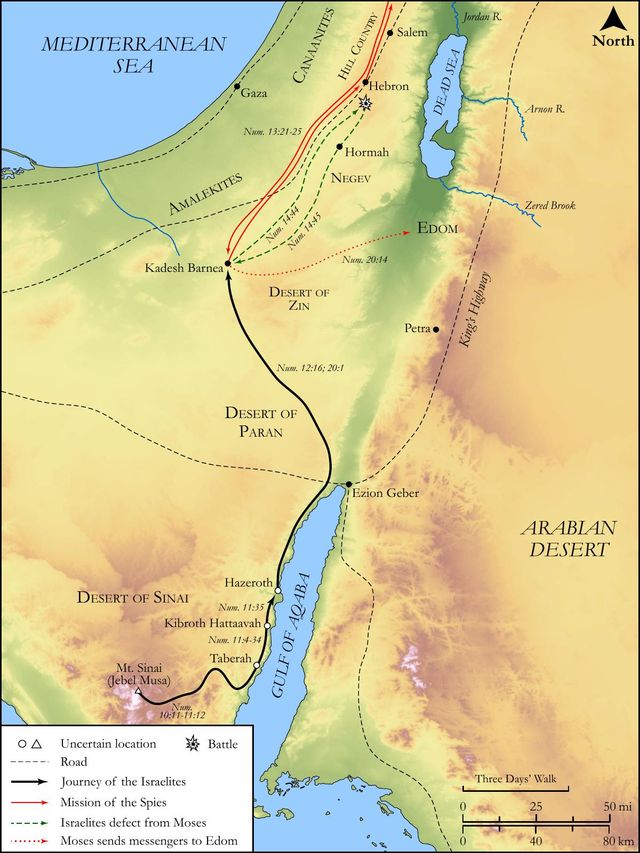
See on the biblical-era map
Study this verse
Public-domain commentary
Matthew Henry
From his Commentary on the Whole Bible. Henry comments on passages, not single verses — this entry covers Numbers 16:23–34. His two-level outline is real structure in the source text, so it is rendered as structure.
We have here the determining of the controversy with Dathan and Abiram, who rebelled against Moses, as in the next paragraph the determining of the controversy with Korah and his company, who would be rivals with Aaron. It should seem that Dathan and Abiram had set up a spacious tabernacle in the midst of the tents of their families, where they kept court, met in council, and hung out their flag of defiance against Moses; it is here called the tabernacle of Korah, Dathan, and Abiram, Num 16:24, Num 16:27. There, as in the place of rendezvous, Dathan and Abiram staid, when Korah and his friends went up to the tabernacle of the Lord, waiting the issue of their trial; but here we are told how they had their business done, before that trial was over. For God will take what method he pleases in his judgments.
I.Public warning is given to the congregation to withdraw immediately from the tents of the rebels.
1.God bids Moses speak to this purport, Num 16:24. This was in answer to Moses's prayer. He had begged that God would not destroy the whole congregation. "Well," says God, "I will not, provided they be so wise as to shift for their own safety, and get out of the way of danger. If they will quit the rebels, well and good, they shall not perish with them; otherwise, let them take what follows." Note, We cannot expect to reap benefit by the prayers of our friends for our salvation, unless we ourselves be diligent and faithful in making use of the means of salvation; for God never promised to save by miracles those that would not save themselves by means. Moses that had prayed for them must preach this to them, and warn them to flee from this wrath to come.
2.Moses accordingly repairs to the head-quarters of the rebels, leaving Aaron at the door of the tabernacle, Num 16:25. Dathan and Abiram had contumaciously refused to come up to him (Num 16:12), yet he humbly condescends to go down to them, to try if he could yet convince and reclaim them. Ministers must thus with meekness instruct those that oppose themselves, and not think it below them to stoop to those that are most stubborn, for their good. Christ himself stretches out his hand to a rebellious and gainsaying people. The seventy elders of Israel attend Moses and his guard, to secure him from the insolence of the rabble, and by their presence to put an honour upon him, and if possible to strike an awe upon the rebels. It is our duty to contribute all we can to the countenance and support of injured innocency and honour.
3.Proclamation is made that all manner of persons, as they tendered their own safety, should forthwith depart from the tents of these wicked men (Num 16:26), and thus should signify that they deserted their cause and interest, detested their crimes and counsels, and dreaded the punishment coming upon them. Note, Those that would not perish with sinners must come out from among them, and be separate. In vain do we pray, Gather not our souls with sinners, if we save not ourselves from the untoward generation. God's people are called out of Babylon, lest they share both in her sins and in her plagues, Rev 18:4.
II.The congregation takes the warning, but the rebels themselves continue obstinate, Num 16:27.
1.God, in mercy, inclined the people to forsake the rebels: They got up from the tabernacle of Korah, Dathan, and Abiram, both those whose lot it was to pitch near them (who doubtless with themselves removed their families, and all their effects) and those also who had come from all parts of their camp to see the issue. It was in answer to the prayer of Moses that God thus stirred up the hearts of the congregation to shift for their own preservation. Note, To those whom God will save he gives repentance, that they may recover themselves out of the snare of the devil. Grace to separate from evil doers is one of the things that accompany salvation.
2.God, in justice, left the rebels to the obstinacy and hardness of their own hearts. Though they saw themselves abandoned by all their neighbours, and set up as a mark to the arrows of God's justice, yet instead of falling down and humbling themselves before God and Moses, owning their crime and begging pardon, instead of fleeing and dispersing themselves to seek for shelter in the crowd, they impudently stood in the doors of their tents, as if they would out-face God himself, and dare him to his worst. Thus were their hearts hardened to their own destruction, and they were fearless when their case was most fearful. But what a pity was it that their little children, who were not capable of guilt or fear, should by the presumption of their parents be put in this audacious posture! Happy they who are taught betimes to bow before God, and not as those unhappy little ones to stand it out against him!
III.Sentence is solemnly pronounced upon them by Moses in the name of the Lord, and the decision of the controversy is put upon the execution of that sentence by the almighty power of God. Moses, by divine instinct and direction, when the eyes of all Israel were fastened upon him, waiting the event, moved with a just and holy indignation at the impudence of the rebels, boldly puts the whole matter to a surprising issue, Num 16:28-30. 1. If the rebels die a common death, he will be content to be called and counted an impostor; not only if they die a natural death, but if they die by any sort of judgment that has formerly been executed on other malefactors. "If they die by the plague, or by fire from heaven, or by the sword, then say, God has disowned Moses;" but, 2. "If the earth open and swallow them up" (a punishment without precedent), "then let all the house of Israel know assuredly that I am God's servant, sent by him, and employed for him, and that those that fight against me fight against him." The judgment itself would have been proof enough of God's displeasure against the rebels, and would have given all men to understand that they had provoked the Lord; but when it was thus solemnly foretold and appealed to by Moses beforehand, when there was not the least previous indication of it from without, the convincing evidence of it was much the stronger, and it was put beyond dispute that he was not only a servant but a favourite of Heaven, who was so intimately acquainted with the divine counsels, and could obtain such extraordinary appearances of the divine power in his vindication.
IV.Execution is immediately done.
It appeared that God and his servant Moses understood one another very well; for, as soon as ever Moses had spoken the word, God did the work, the earth clave asunder (Num 16:31), opened her mouth, and swallowed them all up, them and theirs (Num 16:32), and then closed upon them, Num 16:33. This judgment was,
1.Unparalleled. God, in it, created a new thing, did what he never did before; for he has many arrows in his quiver; and there are diversities of operations in wrath as well as mercy. Dathan and Abiram thought themselves safe because they were at a distance from the shechinah, whence the fire of the Lord had sometimes issued, qui procul Jove (they say) procul fulmine - he who is far from Jove is far from the thunderbolt. But God made them to know that he was not tied up to one way of punishing; the earth, when he pleases, shall serve his justice as effectually as the fire.
2.It was very terrible to the sinners themselves to go down alive into their own graves, to be dead and buried in an instant, to go down thus to the bars of the pit when they were in their full strength wholly at ease and quiet.
3.It was severe upon their poor children, who, for the greater terror of the judgment, and fuller indication of the divine wrath, perished as parts of their parents, in which, though we cannot particularly tell how bad they might be to deserve it or how good God might be otherwise to them to compensate it, yet of this we are sure in the general, that Infinite Justice did them no wrong. Far be it from God that he should do iniquity.
4.It was altogether miraculous. The cleaving of the earth was as wonderful, and as much above the power of nature, as the cleaving of the sea, and the closing of the earth again more so than the closing of the waters. God has all the creatures at his command, and can make any of them, when he pleases, instruments of his justice; nor will any of them be our friends if he be our enemy. God now confirmed to Israel what Moses had lately taught them in that prayer of his, Psa 90:11, Who knows the power of thy anger? He has, when he pleases, strange punishments for the workers of iniquity, Job 31:3. Let us therefore conclude, Who is able to stand before this holy Lord God?
5.It was very significant. They set their mouths against the heavens, and their throat was an open sepulchre; justly therefore does the earth open her mouth upon them and swallow them up. They made a rent in the congregation; justly therefore is the earth rent under them. Presumptuous sinners, that hate to be reformed, are a burden to the earth, the whole creation groans under them, which here was signified by this, that the earth sunk under these rebels, as weary of bearing them and being under them. And, considering how the earth is still in like manner loaded with the weight of iniquity, we have reason to wonder that this was the only time it ever sunk under its load.
6.It was typical of the eternal ruin of sinners who die impenitent, who, perhaps in allusion to this, are said to sink down into the pit (Psa 9:15) and to go down quickly into hell, Psa 55:15. But David, even when he sinks in deep mire, yet prays in faith, Let not the pit shut her mouth upon me, as it does on the damned, between whom and life there is a gulf fixed, Psa 69:2-15. His case was bad, but not, like this, desperate.
V.All Israel is alarmed at the judgment:
They fled at the cry of them, Num 16:34. They cried for help when it was too late. Their doleful shrieks, instead of fetching their neighbours in to their relief, drove them so much the further off; for knowing their own guilt, and one another's, they hastened one another, saying, Lest the earth swallow us up also. Note, Others' ruins should be our warnings. Could we by faith hear the outcries of those that have gone down to the bottomless pit, we should give more diligence than we do to escape for our lives, lest we also come into that condemnation.
Continue studying Numbers 16:23 across the web’s major study libraries — every link below opens this exact verse, chapter, or book on the destination site.
Read & Compare
 BibleGatewayThis verse in more than 200 translations and 70 languages.
 Bible.comThe YouVersion reader — hundreds of translations, reading plans, and highlights.
 ESV.orgCrossway's official English Standard Version reader.
 NET BibleThe NET translation with 60,000+ translators' notes on every rendering decision.
 STEP BibleTyndale House's free study tool — original text, vocabulary, and scholarly resources.
 BibliaLogos Bible Software's free web reader.
 USCCBThe New American Bible (Revised Edition) with the U.S. bishops' study notes.
Commentaries
 BibleHub CommentariesDozens of classic commentaries on this verse, gathered on one page.
 StudyLightMore than 100 commentary sets — the largest collection on the web.
 BibleRefPlain-English commentary on what this verse means, verse by verse.
 Enduring WordDavid Guzik's free commentary on this chapter, widely used by Bible teachers.
 Bible Study ToolsVerse commentary alongside Greek and Hebrew study aids.
Original Language & Research
- BibleHub InterlinearThe verse word by word — original language, transliteration, and English.
- BibleHub LexiconEvery word's original-language definition and Strong's entry.
 Blue Letter BibleDeep-study tools — Strong's numbers, concordance, and word studies.
 SefariaThe Hebrew text with Rashi and centuries of Jewish commentary.
Sermons, Hymns & Audio


TrulyRandomVerse is not affiliated with these sites and doesn’t control their content. They’re linked because they’re genuinely useful.
Summary
Numbers 16:23 serves as a pivotal, terse declaration within the dramatic narrative of Korah's rebellion, signaling an immediate and decisive divine intervention. This concise statement, "And the LORD spake unto Moses, saying," profoundly underscores God's absolute sovereignty and His direct, authoritative communication with His chosen mediator, Moses, in the face of profound insubordination and challenge to His established order. It marks the solemn prelude to God's terrifying judgment, demonstrating His unwavering holiness, justice, and commitment to upholding the authority He has divinely vested in His servants.
Context
ShowHideLiterary Context
Numbers 16:23 is strategically placed at a critical juncture in the escalating rebellion of Korah, Dathan, and Abiram. It immediately follows Moses' urgent plea for the congregation to separate themselves from the tents of the rebels, lest they be consumed in their sin. The preceding narrative details the brazen defiance of Korah and his 250 prominent followers, who gathered at the entrance of the Tabernacle, directly challenging Moses and Aaron's divinely appointed leadership and priestly authority. The appearance of the Lord's glory to the whole congregation in Numbers 16:19 had already signaled imminent divine intervention. This verse, therefore, is far more than a simple narrative transition; it represents a dramatic, solemn pause before the execution of a terrifying judgment, highlighting the direct link between divine pronouncement and immediate, cataclysmic action. It sets the stage for the earth to uniquely open up and swallow the rebels, a truly unprecedented act of God's wrath.
Historical & Cultural Context
The rebellion of Korah, Dathan, and Abiram unfolded during Israel's arduous wilderness wanderings, a period characterized by frequent murmuring, challenges to Moses' leadership, and tests of faith. This particular incident was not merely a political dispute but a direct assault on the divinely ordained Levitical priesthood and Moses' unique mediatorial role, which were foundational to Israel's covenant relationship with God. In the ancient Near East, challenging a leader appointed by a deity was considered an act of sacrilege, often met with severe divine retribution. Furthermore, the concepts of holiness and separation were paramount in Israelite worship and community life, emphasizing the distinct roles of priests and Levites. The rebels' attempt to usurp priestly functions (Numbers 16:10) and challenge Moses' leadership (Numbers 16:3) was not just a power grab; it was a profound affront to God's established order and His covenant, threatening the very spiritual and social fabric of Israel as a holy nation.
Key Themes
ShowHideThis terse verse encapsulates several profound themes central to the book of Numbers and the broader Pentateuch. It powerfully reiterates Divine Authority and Sovereignty, emphasizing that God alone establishes leadership and punishes those who defy it, as seen in the devastating consequences that immediately follow in Numbers 16:31-35. It underscores God's Direct Communication, highlighting Moses' unique and indispensable role as His chosen mediator, a role consistently affirmed throughout the wilderness narrative, from the giving of the law at Mount Sinai to the instructions for the Tabernacle. Furthermore, it serves as a stark warning of Imminent Judgment and Divine Justice, reminding the reader of God's unyielding holiness and His opposition to sin and rebellion, a principle echoed in passages like Deuteronomy 32:35. The verse also subtly reinforces the theme of Separation and Holiness, as God's speaking immediately precedes the command for the people to distance themselves from the unholy rebels, underscoring the necessity of purity in the presence of a holy God.
Exposition and Analysis
ShowHideKey Word Analysis
ShowHideThe capitalized "LORD" in the KJV consistently translates the Hebrew tetragrammaton YHWH (יהוה), the covenant name of God, often vocalized as Yahweh. This name, derived from the root "to be," emphasizes God's self-existence, eternal nature, and His personal, relational, and active presence, particularly in His covenant dealings with Israel. Its use here is profoundly significant; it is not a generic deity speaking, but the very God who made a covenant with Abraham, delivered Israel from Egypt, and established His law at Sinai. When Yᵉhôvâh speaks, it is with ultimate authority, rooted in His immutable being and His unwavering commitment to His covenant people, even as He prepares to execute judgment to uphold the sanctity of that covenant.
This verb, from the primitive root dâbar (דבר), denotes a direct, authoritative, and often declarative form of communication. It implies a formal pronouncement, not a casual conversation, frequently preceding commands, laws, or, as in this context, acts of judgment. The specific form here, a consecutive imperfect, emphasizes the immediate and sequential nature of God's speaking in direct response to the unfolding rebellion. This "speaking" is the divine catalyst for the cataclysmic events that follow, confirming God's active involvement and absolute control over the situation, demonstrating His power to arrange and declare His will.
The direct address "unto Moses" reaffirms his unique and indispensable role as God's chosen mediator and spokesman for the Israelite nation. The entire rebellion of Korah, Dathan, and Abiram was a direct challenge to Moses' leadership, with the rebels claiming he had usurped authority. Yet, God continues to speak to Moses, thereby unequivocally validating his divine appointment and demonstrating that the rebels' claims were not only against Moses but, more fundamentally, against God Himself. His name, meaning "drawing out" (of the water), subtly reminds us of his miraculous preservation and divine calling.
Verse Breakdown
ShowHide"¶ And the LORD spake unto Moses,"
This clause immediately follows the preceding narrative where the glory of the Lord had appeared to the entire congregation (Numbers 16:19). The opening "And" (וַיְדַבֵּר) connects God's speaking directly to this manifestation of His awe-inspiring presence, signifying a divine response to the escalating crisis and indicating that God is about to intervene decisively. The direct address "unto Moses" is crucial, as it powerfully reaffirms Moses' unique mediatorial role, which was precisely what Korah and his company so defiantly challenged. God bypasses the rebellious assembly and speaks directly to His chosen servant, reinforcing Moses' authority and divine vindication in the face of profound rebellion.
"saying,"
This simple participial phrase introduces the content of God's imminent communication. While the verse itself does not record what the Lord said in this immediate utterance, it functions as a solemn literary marker, setting up the divine command that follows in Numbers 16:24, instructing Moses to tell the congregation to separate from the rebels. It is a clear indication of divine speech, signifying that what follows is a direct revelation or instruction from God, carrying ultimate authority and requiring immediate, unquestioning obedience.
Literary Devices
ShowHideNumbers 16:23, though remarkably brief, employs several significant literary devices that amplify its dramatic impact and theological weight. The most prominent is Foreshadowing, as the very act of "the LORD spake" immediately signals that a momentous, and indeed terrifying, event is about to unfold. This concise declaration masterfully creates intense Suspense, leaving the reader on the edge, eagerly anticipating the content of God's speech and its devastating consequences for the rebels. The phrase also functions as a powerful Transition, shifting the narrative from the human defiance and Moses' intercession to the direct, decisive, and overwhelming action of God Himself. Furthermore, the Repetition of the phrase "And the LORD spake unto Moses" (or similar variations) throughout the Pentateuch, particularly in Numbers, serves as a consistent literary marker of divine authority and the initiation of a new phase of divine instruction or judgment. Here, its repetition underscores the gravity and finality of the impending judgment, emphasizing that God's word is the ultimate catalyst for action.
Theological and Thematic Connections
ShowHideNumbers 16:23, though a short transitional verse, profoundly illustrates the active, authoritative, and interventionist nature of God in human affairs, particularly in moments of crisis and rebellion. It underscores the foundational principle that God does not remain silent in the face of direct challenges to His holiness, His established order, or the authority He has delegated. His voice is the ultimate authority, capable of both creating and judging, and His word is always effectual. This divine intervention serves as a powerful reminder that all legitimate authority ultimately derives from God, and rebellion against His appointed leaders is, at its core, rebellion against Him. The verse sets the stage for a dramatic display of divine justice, demonstrating that while God is merciful and patient, He is also holy and will not tolerate unrepentant defiance of His sovereign will.
Reflection and Application
ShowHideNumbers 16:23, though seemingly a simple narrative connector, carries immense weight and profound implications for contemporary believers. It serves as a powerful reminder that God is not a distant, passive observer but an active, speaking God who intimately intervenes in the course of history and in the lives of His people. Just as He spoke decisively to Moses in a moment of profound crisis, He continues to communicate with us today, primarily through His inspired and authoritative Word, the Bible. Our spiritual maturity and the vitality of our faith are often measured by our willingness to diligently listen for, carefully discern, and humbly obey His voice, especially when it calls us to uncomfortable truths, challenging actions, or radical separation from sin. This verse also serves as a sober reminder of the gravity of challenging divine authority and the serious consequences of rebellion against God's established order, whether in the church, in society, or in our personal lives. It calls us to cultivate a spirit of profound humility, reverence, and submission to God's sovereign will, recognizing that true freedom, peace, and blessing come from aligning ourselves wholeheartedly with His purposes rather than defiantly resisting them.
Questions for Reflection
ShowHideFAQ
ShowHideWhy is this brief verse so significant in the narrative of Korah's rebellion?
ShowHideNumbers 16:23 is profoundly significant because it marks the precise moment of divine intervention and the immediate prelude to God's terrifying judgment. After Moses' earnest appeals and the rebels' unyielding defiance, this verse signals that God Himself is about to act, shifting the narrative from human interaction to divine decree. It underscores God's ultimate authority, His direct and unwavering communication with Moses (thereby unequivocally validating Moses' leadership against the rebels' false claims), and the absolute certainty of His justice. It is the divine "point of no return" that leads directly to the earth opening up to swallow the rebels and fire consuming the 250 incense-bearers, as vividly described in Numbers 16:31-35.
Does "the LORD spake" imply a verbal communication, or could it be a divine impression or vision?
ShowHideIn the context of the Pentateuch, particularly concerning Moses, the phrase "the LORD spake" (וַיְדַבֵּר יְהוָה) almost invariably refers to a direct, audible, and authoritative verbal communication. Moses' relationship with God was uniquely intimate, characterized by God speaking to him "face to face, as a man speaks to his friend" (Exodus 33:11). While visions and impressions were certainly part of prophetic experience, this specific phrasing, especially when introducing divine commands, laws, or judgments, strongly indicates a direct verbal pronouncement. This leaves no doubt as to the divine source or the absolute authority of the message, demanding immediate and complete obedience.
Christ-Centered Fulfillment
ShowHideNumbers 16:23, with its profound emphasis on God's authoritative word and the dire consequences of rebellion against His appointed mediator, finds its ultimate and most glorious Christ-centered fulfillment. Just as God spoke directly to Moses, His ultimate and most complete word to humanity is found in His Son, Jesus Christ, who is the very embodiment and perfect revelation of God's character and will. As Hebrews 1:1-2 declares, "God, who at sundry times and in divers manners spake in time past unto the fathers by the prophets, hath in these last days spoken unto us by his Son." Jesus is the supreme Mediator, far greater than Moses, through whom God's perfect will, His righteous judgment, and His boundless grace are fully revealed. The rebellion of Korah foreshadows humanity's universal rebellion against God's ultimate authority, a rebellion that finds its resolution not in the earth opening up to consume sinners, but in the cross of Christ. On the cross, Jesus, the perfect Lamb of God, took upon Himself the full weight of divine judgment for sin, offering a path to reconciliation and eternal life for all who would otherwise face God's just wrath. Through Him, God speaks a word of grace, forgiveness, and new creation, inviting all to separate themselves from the dominion of sin and darkness and enter into His glorious kingdom, as Colossians 1:13-14 beautifully articulates. Thus, the terrifying "speaking" of judgment in Numbers 16:23 points forward to the gracious "speaking" of salvation accomplished through Christ's redemptive work, offering life and hope where there was once only death and condemnation.