


Numbers 13:31
Bible text: King James Version (1769 Blayney text) · Public domain
Bible text: Berean Standard Bible · Public domain
Bible text: American Standard Version (1901) · Public domain
Bible text: World English Bible, Messianic edition · Public domain
Bible text: Geneva Bible (1599) · Public domain
Bible text: Young's Literal Translation · Public domain
- וְהָאֲנָשִׁיםve·Ha·'a·na·Shimand the menH582Conj-w ¦ Art ¦ N-mpNoun Plural Masculine Absoluteוְandהָtheאֲנָשִׁיםmen
- אֲשֶׁר'a·SherwhoH834RelParticle Relative
- עָלוּ'a·Luthey had gone upH5927V-Qal-Perf-3cpVerb Qal Perfect 3rd Plural common gender
- עִמּוֹi·Mowith himH5973Prep ¦ 3msPreposition Definiteעִמּwithוֹhim
- אָמְרוּ'a·me·Ruthey saidH559V-Qal-Perf-3cpVerb Qal Perfect 3rd Plural common gender
- לֹאlo'notH3808NegParticle Negative
- נוּכַלnu·Khalwe are ableH3201V-Qal-Imperf-1cpVerb Qal Imperfect 1st Plural common gender
- לַעֲלוֹתla·'a·Lotto go upH5927Prep-l ¦ V-Qal-InfVerb Qal Infinitive Constructלַtoעֲלוֹתgo up
- אֶל'elagainstH413PrepPreposition
- הָעָםha·'Amthe peopleH5971Art ¦ N-msNoun Singular Masculine Absoluteהָtheעָםpeople
- כִּיkiforH3588PrtParticle Conditional
- חָזָקcha·Zak[is] strongH2389Adj-msAdjective Singular Masculine Absolute
- הוּאhu'itH1931Pro-3msPronoun Personal 3rd Singular Masculine
- מִמֶּנּוּmi·Me·numore than usH4480Prep ¦ 1cpPreposition Definiteמִמֶּmore thanנּוּus
English is a literal word-by-word gloss of the Hebrew, not the KJV's wording. Why?
This is the original text the KJV's translators worked from — each Hebrew word with its own literal English meaning in this verse, prepared by scholars at Tyndale House, Cambridge. The KJV translates whole sentences, not word by word, so its wording differs: one Hebrew word can become several English words, and the KJV may choose “the LORD” where the gloss reads “Yahweh”. Both are faithful — they answer different questions. For the KJV's own rendering, switch to the KJV text.
Details
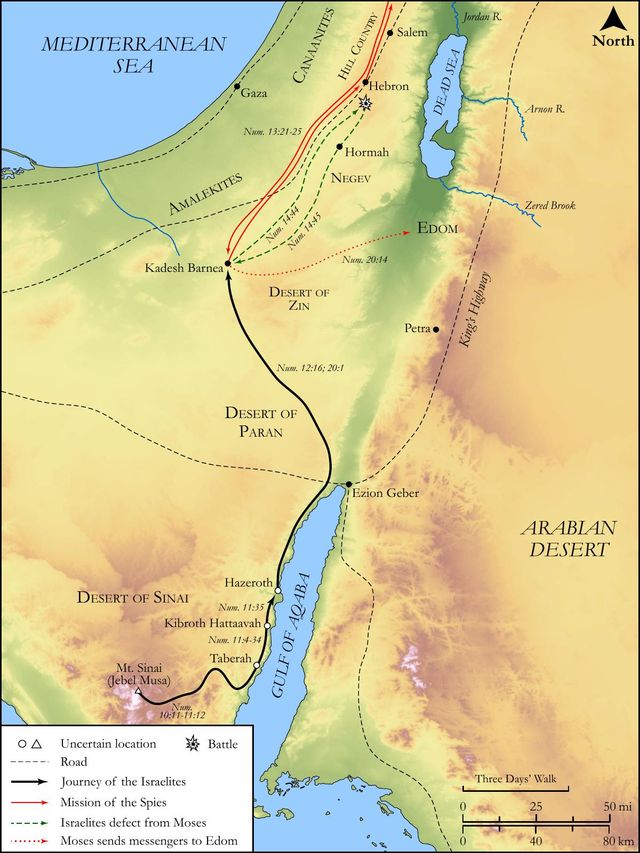
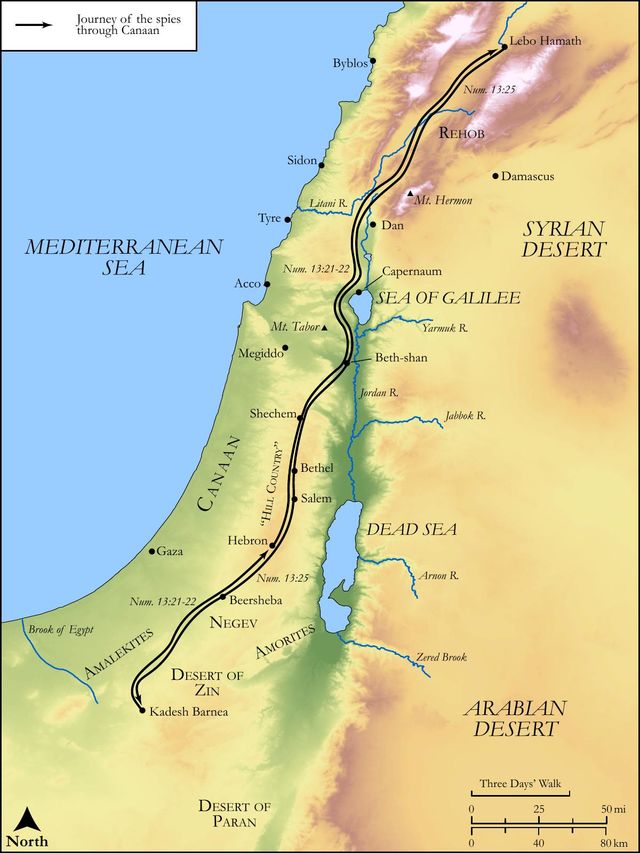
See on the biblical-era maps
Study this verse
Public-domain commentary
Matthew Henry
From his Commentary on the Whole Bible. Henry comments on passages, not single verses — this entry covers Numbers 13:26–33. His three-level outline is real structure in the source text, so it is rendered as structure.
It is a wonder how the people of Israel had patience to stay forty days for the return of their spies, when they were just ready to enter Canaan, under all the assurances of success they could have from the divine power, and a constant series of miracles that had hitherto attended them; but they distrusted God's power and promise, and were willing to be held in suspense by their own counsels, rather than be brought to a certainty by God's covenant. How much do we stand in our own light by our unbelief! Well, at length the messengers return, but they agree not in their report.
I.The major part discourage the people from going forward to Canaan; and justly are the Israelites left to this temptation, for putting so much confidence in the judgment of men, when they had the word of God to trust to. It is a righteous thing with God to give those up to strong delusions who will not receive his truth in the love of it.
1.Observe their report.
(1.)They could not deny but that the land of Canaan was a very fruitful land; the bunch of grapes they brought with them was an ocular demonstration of it, Num 13:27. God had promised them a land flowing with milk and honey, and the evil spies themselves own that it is such a land. Thus even out of the mouth of adversaries will God be glorified and the truth of his promise attested. And yet afterwards they contradict themselves, when they say (Num 13:32), It is a land that eateth up the inhabitants thereof; as if, though it had milk, and honey, and grapes, yet it wanted other necessary provision; some think that there was a great plague in the country at the time they surveyed it, which they ought to have imputed to the wisdom of the divine Providence, which thus lessened the numbers of their enemies, to facilitate their conquests; but they invidiously imputed it to the unwholesomeness of the air, and thence took occasion to disparage the country. For this unreasonable fear of a plague in Canaan, they were justly cut off immediately by a plague in the wilderness, Num 14:37. But,
(2.)They represented the conquest of it as altogether impracticable, and that it was to no purpose to attempt it. The people are strong (Num 13:28), men of a great stature (Num 13:32), stronger than we, Num 13:31. The cities are represented as impregnable fortresses: they are walled and very great, Num 13:28. But nothing served their ill purpose more than a description of the giants, on whom they lay a great stress: We saw the children of Anak there (Num 13:28), and again, we saw the giants, those men of a prodigious size, the sons of Anak, who come of the giants, Num 13:33. They spoke as if they were ready to tremble at the mention of them, as they had done at the sight of them. "O these tremendous giants! when we were near them, we were in our own sight as grasshoppers, not only little and weak, but trembling and daunted." Compare Job 39:20, Canst thou make him afraid as a grasshopper? "Nay, and so we were in their sight; they looked upon us with as much scorn and disdain as we did upon them with fear and trembling." So that upon the whole matter they gave it in as their judgment, We are not able to go up against them (Num 13:31), and therefore must think of taking some other course.
2.Now, even if they had been to judge only by human probabilities, they could not have been excused from the imputation of cowardice. Were not the hosts of Israel very numerous? 600,000 effective men, well marshalled and modelled, closely embodied, and entirely united in interest and affection, constituted as formidable an army as perhaps was ever brought into the field; many a less has done more than perhaps the conquering of Canaan was, witness Alexander's army. Moses, their commander-in-chief, was wise and brave; and if the people had put on resolution, and behaved themselves valiantly, what could have stood before them? It is true the Canaanites were strong, but they were dispersed (Num 13:29): Some dwell in the south and others in the mountains; so that by reason of their distance they could not soon get together, and by reason of their divided interests they could not long keep together, to oppose Israel. The country being plentiful would subsist an army, and, though the cities were walled, if they could beat them in the field the strong-holds would fall of course into their hands. And, lastly, as for the giants, their overgrown stature would but make them the better mark, and the bulkiest men have not always the best mettle.
3.But, though they deserved to be posted for cowards, this was not the worst, the scripture brands them for unbelievers. It was not any human probabilities they were required to depend upon, but,
(1.)They had the manifest and sensible tokens of God's presence with them, and the engagement of his power for them. The Canaanites were stronger than Israel; suppose they were, but were they stronger than the God of Israel? We are not able to deal with them, but is not God Almighty able? Have we not him in the midst of us? Does not he go before us? And is any thing too hard for him? Were we as grasshoppers before the giants, and are not they less than grasshoppers before God? Their cities are walled against us, but can they be walled against heaven? Besides this,
(2.)They had had very great experience of the length and strength of God's arm, lifted up and made bare on their behalf. Were not the Egyptians as much stronger than they as the Canaanites were? And yet, without a sword drawn by Israel or a stroke struck, the chariots and horsemen of Egypt were quite routed and ruined; the Amalekites took them at great disadvantages, and yet they were discomfited. Miracles were at this time their daily bread; were there nothing else, an army so well victualled as theirs was, so constantly, so plentifully, and all on free cost, would have a might advantage against any other force. Nay,
(3.)They had particular promises made them of victory and success in their wars against the Canaanites. God had given Abraham all possible assurances that he would put his seed into possession of that land, Gen 15:18; Gen 17:8. He had expressly promised them by Moses that he would drive out the Canaanites from before them (Exo 33:2), and that he would do it by little and little, Exo 23:30. And, after all this, for them to say, We are not able to go up against them, was in effect to say, "God himself is not able to make his words good." It was in effect to give him the lie, and to tell him he had undertaken more than he could perform. We have a short account of their sin, with which they infected the whole congregation, Psa 106:24. They despised the land, they believed not his word. Though, upon search, they had found it as good as he had said, a land flowing with milk and honey, yet they would not believe it as sure as he had said, but despaired of having it, though eternal truth itself had engaged it to them. And now this is the representation of the evil spies.
II.Caleb encouraged them to go forward, though he was seconded by Joshua only (Num 13:30):
Caleb stilled the people, whom he saw already put into a ferment even before Moses himself, whose shining face could not daunt them, when they began to grow unruly. Caleb signifies all heart, and he answered his name, was hearty himself, and would have made the people so if they would have hearkened to him. If Joshua had begun to stem the tide, he would have been suspected of partiality to Moses, whose minister he was; and therefore he prudently left it to Caleb's management at first, who was of the tribe of Judah, the leading tribe, and therefore the fittest to be heard. Caleb had seen and observed the strength of the inhabitants as much as his fellows, and upon the whole matter,
1.He speaks very confidently of success: We are well able to overcome them, as strong as they are.
2.He animates the people to go on, and, his lot lying in the van, he speaks as one resolved to lead them on with bravery: "Let us go up at once, one bold step, one bold stroke more, will do our business; it is all our own if we have but courage to make it so: Let us go up and possess it." He does not say, "Let us go up and conquer it;" he looks upon that to be as good as done already; but, "Let us go up and possess it; there is nothing to be done but to enter, and take the possession which God our great Lord is ready to give us." Note, The righteous are bold as a lion. Difficulties that lie in the way of salvation dwindle and vanish before a lively active faith in the power and promise of God. All things are possible, if they be but promised, to him that believes.
Continue studying Numbers 13:31 across the web’s major study libraries — every link below opens this exact verse, chapter, or book on the destination site.
Read & Compare
 BibleGatewayThis verse in more than 200 translations and 70 languages.
 Bible.comThe YouVersion reader — hundreds of translations, reading plans, and highlights.
 ESV.orgCrossway's official English Standard Version reader.
 NET BibleThe NET translation with 60,000+ translators' notes on every rendering decision.
 STEP BibleTyndale House's free study tool — original text, vocabulary, and scholarly resources.
 BibliaLogos Bible Software's free web reader.
 USCCBThe New American Bible (Revised Edition) with the U.S. bishops' study notes.
Commentaries
 BibleHub CommentariesDozens of classic commentaries on this verse, gathered on one page.
 StudyLightMore than 100 commentary sets — the largest collection on the web.
 BibleRefPlain-English commentary on what this verse means, verse by verse.
 Enduring WordDavid Guzik's free commentary on this chapter, widely used by Bible teachers.
 Bible Study ToolsVerse commentary alongside Greek and Hebrew study aids.
Original Language & Research
- BibleHub InterlinearThe verse word by word — original language, transliteration, and English.
- BibleHub LexiconEvery word's original-language definition and Strong's entry.
 Blue Letter BibleDeep-study tools — Strong's numbers, concordance, and word studies.
 SefariaThe Hebrew text with Rashi and centuries of Jewish commentary.
Sermons, Hymns & Audio


TrulyRandomVerse is not affiliated with these sites and doesn’t control their content. They’re linked because they’re genuinely useful.
Summary
Numbers 13:31 captures the critical moment when ten of the twelve Israelite spies, sent to reconnoiter the land of Canaan, delivered a report rooted in fear rather than faith. Despite Caleb's earlier declaration of confidence in God's ability to grant them victory, these men expressed profound doubt, asserting that the inhabitants of Canaan were too powerful for Israel to overcome. This declaration of inability, born of a human-centric perspective, directly challenged God's covenant promises and set the stage for a tragic rebellion that would have profound consequences for the entire generation.
Context
ShowHideLiterary Context
This verse immediately follows Caleb's courageous and faith-filled exhortation in Numbers 13:30, where he confidently declared, "Let us go up at once, and possess it; for we are well able to overcome it." Numbers 13:31 serves as the direct counter-argument, initiating the dissenting report of the ten other spies. The narrative then escalates into a full-blown crisis of faith, culminating in the people's lamentation and desire to return to Egypt in Numbers 14, leading to God's judgment of forty years of wilderness wandering. The stark contrast between Caleb's singular faith and the collective fear of the majority is a central theme of this immediate passage, setting the stage for the tragic events that follow.
Historical & Cultural Context
The Israelites were at the cusp of entering the Promised Land, a land flowing with milk and honey, promised by God to Abraham and his descendants centuries earlier, as seen in Genesis 12:7. They had witnessed God's mighty acts of deliverance from Egyptian bondage, the miraculous parting of the Red Sea, and His consistent provision in the wilderness. However, the land of Canaan was inhabited by various peoples, including the formidable Anakim, described as giants in Numbers 13:33, and fortified cities, presenting a significant military challenge. The spies' report reflects a common practice among the nations of assessing enemy strength, but their profound failure lay in neglecting to factor in the omnipotent power and unwavering faithfulness of their covenant God.
Key Themes
ShowHideThe predominant theme in Numbers 13 and Numbers 14 is the stark conflict between faith and fear. The spies' report exemplifies how a human-centric view, focusing solely on observable obstacles and perceived limitations, can completely eclipse divine promises and past demonstrations of power. This leads directly to disbelief and rebellion, which carries severe consequences, as the entire generation (save Joshua and Caleb) is condemned to die in the wilderness, never entering the land God had sworn to give them, as detailed in Numbers 14:26-35. The incident also highlights the importance of leadership and influence, as the ten spies' negative report swayed the entire congregation, demonstrating the profound and often devastating impact of a few voices on collective destiny.
Exposition and Analysis
ShowHideKey Word Analysis
ShowHideThe verb "said" (H559, from the primitive root ʼâmar) here is more than a simple utterance; it signifies a definitive declaration, a pronouncement that carries weight and intent. In this context, the spies' "saying" is a collective, authoritative statement of their assessment, directly contradicting Caleb's faith-filled call to action. It initiates the public dissemination of their fearful report, influencing the entire congregation and setting the stage for their rebellion. The use of ʼâmar highlights the verbal act as the catalyst for the people's subsequent disbelief and the tragic events that unfolded.
The phrase "not able" translates the Hebrew lo yâkôl (לֹא נוּכַל). The root yâkôl (H3201) denotes the capacity or power to do something, to prevail, or to overcome. By asserting "we be not able," the spies declare an absolute lack of capacity, a complete inability to conquer the Canaanites. This statement is not merely a military assessment but a profound spiritual declaration of powerlessness, implicitly denying God's omnipotence and His ability to empower His people. It signifies a surrender to perceived human limitations, rather than a reliance on divine strength and promise.
The word "stronger" (H2389, châzâq) derives from a root meaning "to be strong, firm, or hard." While it can denote positive strength, here it carries the negative connotation of formidable, overwhelming power, often implying a violent or oppressive force. The spies use châzâq to emphasize the perceived insurmountable might of the Canaanite inhabitants, portraying them as militarily superior and unassailable. This word choice reveals their exclusive focus on the physical, human dimension of power, entirely neglecting the spiritual dimension and the infinite strength of Yahweh, who had already demonstrated His power over far mightier foes.
Verse Breakdown
ShowHide"But the men that went up with him said"
This clause immediately sets up a stark contrast with Caleb's courageous and faith-filled assertion in the preceding verse. "The men" refers specifically to the ten spies who returned with the negative report, deliberately distinguishing them from Caleb (and implicitly, Joshua) who held a different perspective. Their collective voice here represents a consensus of doubt and fear, directly opposing the spirit of faith and obedience to God's command. The phrase "went up with him" refers to their shared mission with Caleb and Joshua to scout the land, highlighting that they witnessed the exact same realities but interpreted them through a lens of human-centric fear and unbelief, rather than divine promise.
"We be not able to go up against the people;"
This is the central, pivotal declaration of the spies' unbelief and the core of their disastrous report. The phrase "not able" (Hebrew: לֹא נוּכַל, lo nukhal) expresses an absolute and emphatic declaration of inability and helplessness. It is a statement of resignation and defeat pronounced even before any engagement, indicating a complete surrender to perceived obstacles. By stating "we be not able," they are not merely reporting obstacles; they are declaring the mission impossible for them, thereby implicitly, and profoundly, discounting God's omnipotent power and His unwavering faithfulness to fulfill His promise to give them the land. This statement directly contradicts God's explicit command to enter Canaan and His repeated demonstrations of power.
"for they [are] stronger than we."
This clause provides the justification and rationale for the spies' declaration of inability, revealing the source of their fear. The perceived superior strength of the Canaanite inhabitants, particularly the Anakim, is presented as the sole and insurmountable basis for their unbelief. Their assessment is purely human-centric and military-focused, comparing Israel's numerical and martial strength to that of the Canaanites. Crucially, this comparison entirely fails to factor in the strength of the God of Israel, who had already delivered them from the mightiest empire of their day (Egypt) and sustained them miraculously in the wilderness. This omission reveals a profound lack of trust in God's omnipotence, His covenant promises, and His proven track record of fighting for His people.
Literary Devices
ShowHideNumbers 13:31 powerfully employs Contrast by juxtaposing the faith-filled declaration of Caleb in the preceding verse with the fear-driven report of the ten spies. This stark opposition highlights the central conflict of the narrative: trust in God versus reliance on human perception. The spies' statement also contains an element of Hyperbole, as their assertion that the Canaanites were "stronger than we" was true only from a purely human, military standpoint, ignoring the infinite power of God who was on Israel's side. Furthermore, the verse serves as a moment of Foreshadowing, as this declaration of inability and subsequent widespread unbelief directly leads to the tragic judgment of forty years of wandering in the wilderness, preventing that generation from entering the Promised Land.
Theological and Thematic Connections
ShowHideNumbers 13:31 serves as a profound theological warning against the perils of unbelief and the destructive power of fear when it eclipses faith in God's promises. The spies' assessment, though factually accurate in its description of the Canaanites' strength, was spiritually flawed because it failed to account for God's omnipotence and His unwavering commitment to His covenant people. Their declaration of "not able" was a direct affront to the God who had repeatedly demonstrated His ability to overcome impossible odds. This incident underscores the biblical truth that God's power is made perfect in weakness, and that human limitations are never a barrier to divine purposes when faith is present. It calls believers to fix their gaze on the greatness of God rather than the magnitude of their challenges, reminding us that true strength is found in reliance upon Him.
Reflection and Application
ShowHideNumbers 13:31 resonates deeply with the human experience, as we frequently encounter "giants" in our own lives – whether they are overwhelming financial burdens, seemingly insurmountable career obstacles, daunting health challenges, or deeply entrenched personal sins. The spies' response serves as a powerful mirror, prompting us to examine our own reactions when faced with overwhelming odds. Do we, like the ten spies, allow the visible strength of our problems to overshadow the invisible, yet infinitely greater, power of God? Or do we, like Caleb, fix our eyes on God's character and promises, declaring that "we are well able" because He is with us? This verse challenges us to cultivate a faith that sees beyond immediate circumstances, trusting that God's faithfulness is not contingent on our perceived strength, but on His own omnipotence. It calls us to resist the paralysis of fear and to step forward in courageous obedience, knowing that the battle belongs to the Lord and that His strength is perfected in our weakness.
Questions for Reflection
ShowHideFAQ
ShowHideWhat was the ultimate consequence of the spies' negative report?
ShowHideThe spies' negative report, particularly their declaration of inability in Numbers 13:31, led to widespread fear, weeping, and rebellion among the Israelites. This profound lack of faith and direct disobedience to God's command resulted in a severe divine judgment: the entire generation of Israelites aged twenty and older, who had come out of Egypt, was condemned to die in the wilderness over the next forty years, never entering the Promised Land. Only Joshua and Caleb, who maintained their faith, were permitted to enter, as detailed in Numbers 14:26-35. Their children, the next generation, would eventually inherit the land, highlighting the profound consequences of unbelief for an entire generation.
Christ-Centered Fulfillment
ShowHideNumbers 13:31, with its stark portrayal of human inability and fear in the face of daunting obstacles, finds its ultimate Christ-centered fulfillment in the person and work of Jesus. The Israelites' failure to enter the Promised Land due to unbelief foreshadows humanity's inherent inability to enter God's true rest and inherit eternal life through their own strength or works. Just as the spies declared, "We be not able," humanity, in its fallen state, is utterly incapable of overcoming the "giants" of sin, death, and the power of the devil. However, Jesus Christ is the true and faithful Spy, who not only surveyed the land of human experience but conquered its greatest enemies. He is the ultimate Joshua, leading His people into the true promised land—the kingdom of God and eternal life—not by human might, but by His divine power and perfect obedience. Where Israel failed through unbelief, Christ perfectly trusted the Father, even to the point of death on the cross, thereby securing the victory that humanity could not achieve. Through His sacrifice, He disarmed the spiritual rulers and authorities, triumphing over them, as seen in Colossians 2:15, and through His resurrection, He opened the way to the true rest, as promised in Hebrews 4:9-11. Thus, the "stronger than we" of Numbers 13:31 is definitively answered by the "stronger than all" of Christ, who enables us to do all things through Him who strengthens us, as declared in Philippians 4:13.