


Nehemiah 12:35
Bible text: King James Version (1769 Blayney text) · Public domain
Bible text: King James Version with Strong's numbers · Public domain
Bible text: Berean Standard Bible · Public domain
Bible text: American Standard Version (1901) · Public domain
Bible text: World English Bible, Messianic edition · Public domain
Bible text: Geneva Bible (1599) · Public domain
Bible text: Young's Literal Translation · Public domain
- וּמִבְּנֵיu·mi·be·Neiand some of [the] sons ofH1121Conj-w ¦ Prep-m ¦ N-mpcNoun Plural Masculine Constructוּandמִsome ofבְּנֵי[the] sons of
- הַכֹּהֲנִיםha·ko·ha·Nimthe priestsH3548Art ¦ N-mpNoun Plural Masculine Absoluteהַtheכֹּהֲנִיםpriests
- בַּחֲצֹצְרוֹתba·cha·tzo·tze·Rotwith trumpetsH2689Prep-b ¦ N-fpNoun Plural Feminine Absoluteבַּwithחֲצֹצְרוֹתtrumpets
- זְכַרְיָהze·khar·YahZechariahH2148N-proper-mNoun Proper Masculine
- בֶןven[the] son ofH1121N-mscNoun Singular Masculine Construct
- יוֹנָתָןyo·na·TanJonathanH3129N-proper-mNoun Proper Masculine
- בֶּןben[the] son ofH1121N-mscNoun Singular Masculine Construct
- שְׁמַעְיָהshe·ma'·YahShemaiahH8098N-proper-mNoun Proper Masculine
- בֶּןben[the] son ofH1121N-mscNoun Singular Masculine Construct
- מַתַּנְיָהma·tan·YahMattaniahH4983N-proper-mNoun Proper Masculine
- בֶּןben[the] son ofH1121N-mscNoun Singular Masculine Construct
- מִיכָיָהmi·kha·YahMicaiahH4320N-proper-mNoun Proper Masculine
- בֶּןben[the] son ofH1121N-mscNoun Singular Masculine Construct
- זַכּוּרza·KurZaccurH2139N-proper-mNoun Proper Masculine
- בֶּןben[the] son ofH1121N-mscNoun Singular Masculine Construct
- אָסָף'a·SafAsaphH623N-proper-mNoun Proper Masculine
English is a literal word-by-word gloss of the Hebrew, not the KJV's wording. Why?
This is the original text the KJV's translators worked from — each Hebrew word with its own literal English meaning in this verse, prepared by scholars at Tyndale House, Cambridge. The KJV translates whole sentences, not word by word, so its wording differs: one Hebrew word can become several English words, and the KJV may choose “the LORD” where the gloss reads “Yahweh”. Both are faithful — they answer different questions. For the KJV's own rendering, switch to the KJV text.
Details
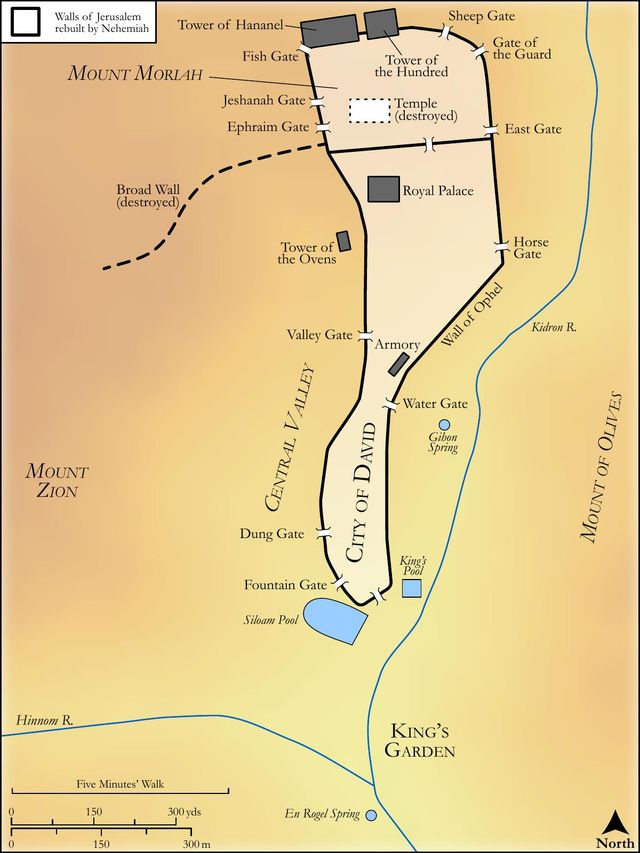
See on the biblical-era map
Study this verse
Public-domain commentary
Matthew Henry
From his Commentary on the Whole Bible. Henry comments on passages, not single verses — this entry covers Nehemiah 12:27–43.
We have read of the building of the wall of Jerusalem with a great deal of fear and trembling; we have here an account of the dedicating of it with a great deal of joy and triumph. Those that sow in tears shall thus reap.
I.We must enquire what was the meaning of this dedication of the wall; we will suppose it to include the dedication of the city too (continens pro contentothe thing containing for the thing contained), and therefore it was not done till the city was pretty well replenished, Neh 11:1. It was a solemn thanksgiving to God for his great mercy to them in the perfecting of this undertaking, of which they were the more sensible because of the difficulty and opposition they had met with in it. 2. They hereby devoted the city in a peculiar manner to God and to his honour, and took possession of it for him and in his name. All our cities, all our houses, must have holiness to the Lord written upon them; but this city was (so as never any other was) a holy city, the city of the great King (Psa 48:2 and Mat 5:35): it had been so ever since God chose it to put his name there, and as such, it being now refitted, it was afresh dedicated to God by the builders and inhabitants, in token of their acknowledgment that they were his tenants, and their desire that it might still be is and that the property of it might never be altered. Whatever is done for their safety, ease, and comfort, must be designed for God's honour and glory. 3. They hereby put the city and its walls under the divine protection, owning that unless the Lord kept the city the walls were built in vain. When this city was in possession of the Jebusites, they committed the guardianship of it to their gods, though they were blind and lame ones, Sa2 5:6. With much more reason do the people of God commit it to his keeping who is all-wise and almighty. The superstitious founders of cities had an eye to the lucky position of the heavens (see Mr. Gregory's works, p. 29, etc.); but these pious founders had an eye to God only, to his providence, and not to fortune.
II.We must observe with what solemnity it was performed, under the direction of Neh 1:1-11.
The Levites from all parts of the country were summoned to attend. The city must be dedicated to God, and therefore his ministers must be employed in the dedicating of it, and the surrender must pass through their hands. When those solemn feasts were over (ch. 8 and 9) they went home to their respective posts, to mind their cures in the country; but now their presence and assistance were again called for. 2. Pursuant to this summons, there was a general rendezvous of all the Levites, Neh 12:28, Neh 12:29. Observe in what method they proceeded. (1.) They purified themselves, Neh 12:30. We are concerned to cleanse our hands, and purify our hearts, when any work for God is to pass through them. They purified themselves and then the people. Those that would be instrumental to sanctify others must sanctify themselves, and set themselves apart for God, with purity of mind and sincerity of intention. Then they purified the gates and the wall. Then may we expect comfort when we are prepared to receive it. To the pure all things are pure (Tit 1:15); and, to those who are sanctified, houses and tables, and all their creature comforts and enjoyments, are sanctified, Ti1 4:4, Ti1 4:5. This purification was performed, it is probable, by sprinkling the water of purifying (or of separation, as it is called, Num 19:9) on themselves and the people, the walls and the gates - a type of the blood of Christ, with which our consciences being purged from dead works, we become fit to serve the living God (Heb 9:14) and to be his care. (2.) The princes, priests, and Levites, walked round upon the wall in two companies, with musical instruments, to signify the dedication of it all to God, the whole circuit of it (Neh 12:36); so that it is likely they sung psalms as they went along, to the praise and glory of God. This procession is here largely described. They had a rendezvous at one certain lace, where they divided themselves into two companies. Half of the princes, with several priests and Levites, went on the right hand, Ezra leading their van, Neh 12:36. The other half of the princes and priests, who gave thanks likewise, went to the left hand, Nehemiah bringing up the rear, Neh 12:38. At length both companies met in the temple, where they joined their thanksgivings, Neh 12:40. The crowd of people, it is likely, walked on the ground, some within the wall and others without, one end of this ceremony being to affect them with the mercy they were giving thanks for, and to perpetuate the remembrance of it among them. Processions, for such purposes, have their use. (3.) The people greatly rejoiced, Neh 12:43. While the princes, priests, and Levites, testified their joy and thankfulness by great sacrifices, sound of trumpet, musical instruments, and songs of praise, the common people testified theirs by loud shouts, which were heard afar off, further than the more harmonious sound of their songs and music: and these shouts, coming from a sincere and hearty joy, are here taken notice of; for God overlooks not, but graciously accepts, the honest zealous services of mean people, though there is in them little of art and they are far from being fine. It is observed that the women and children rejoiced; and their hosannas were not despised, but recorded to their praise. All that share in public mercies ought to join in public thanksgivings. The reason given is that God had made them rejoice with great joy. He had given them both matter for joy and hearts to rejoice; his providence had made them safe and easy, and then his grace made them cheerful and thankful. The baffled opposition of their enemies, no doubt, added to their joy and mixed triumph with it. Great mercies call for the most solemn returns of praise, in the courts of the Lord's house, in the midst of thee, O Jerusalem!
Historical interpretation
Historical reception
1 surviving comment on this verse from the historical church.
And of the sons of the priests with trumpets, Zechariah, etc. Indeed, in this life, the sons of the priests play the trumpets at the dedication of the city of God, because they inflame the hearts of the listeners with the memory of the heavenly homeland by preaching, and this is in the vessels of the song of David, the man of God, when, relying not on their own sense or desires, but following in all things the life of the fathers and prophets, they insist on doctrine, the word of preaching. Ezra, the scribe of the law of God, precedes them to the gate of the fountain, as in all that they do, they keep the words of the sacred Scripture before their eyes, by which they may be led to the entrance of eternal life. About this, the Psalmist says to the Lord: They will be filled from the abundance of your house, and you will give them drink from the torrent of your pleasure, for with you is the fountain of life (Psalm 36).
Continue studying Nehemiah 12:35 across the web’s major study libraries — every link below opens this exact verse, chapter, or book on the destination site.
Read & Compare
 BibleGatewayThis verse in more than 200 translations and 70 languages.
 Bible.comThe YouVersion reader — hundreds of translations, reading plans, and highlights.
 ESV.orgCrossway's official English Standard Version reader.
 NET BibleThe NET translation with 60,000+ translators' notes on every rendering decision.
 STEP BibleTyndale House's free study tool — original text, vocabulary, and scholarly resources.
 BibliaLogos Bible Software's free web reader.
 USCCBThe New American Bible (Revised Edition) with the U.S. bishops' study notes.
Commentaries
 BibleHub CommentariesDozens of classic commentaries on this verse, gathered on one page.
 StudyLightMore than 100 commentary sets — the largest collection on the web.
 BibleRefPlain-English commentary on what this verse means, verse by verse.
 Enduring WordDavid Guzik's free commentary on this chapter, widely used by Bible teachers.
 Bible Study ToolsVerse commentary alongside Greek and Hebrew study aids.
Original Language & Research
- BibleHub InterlinearThe verse word by word — original language, transliteration, and English.
- BibleHub LexiconEvery word's original-language definition and Strong's entry.
 Blue Letter BibleDeep-study tools — Strong's numbers, concordance, and word studies.
 SefariaThe Hebrew text with Rashi and centuries of Jewish commentary.
Sermons, Hymns & Audio


TrulyRandomVerse is not affiliated with these sites and doesn’t control their content. They’re linked because they’re genuinely useful.
Summary
Nehemiah 12:35 precisely identifies specific priestly musicians, including Zechariah and his detailed lineage tracing back to Asaph, who played a vital role in the grand dedication ceremony of Jerusalem's rebuilt wall. This verse highlights their crucial function, particularly with trumpets, within one of the two great thanksgiving choirs, underscoring the meticulous organization, spiritual fervor, and joyous restoration of worship and communal life in post-exilic Judah.
Context
ShowHideLiterary Context
Nehemiah 12 serves as the climactic conclusion to the narrative of Jerusalem's wall completion and the subsequent re-establishment of the community's spiritual and civic life. Following the initial preparations for dedication detailed in Nehemiah 12:27, the chapter vividly describes an elaborate procession involving two large thanksgiving choirs. These choirs, led by prominent figures like Ezra and Nehemiah, marched in opposite directions along the newly dedicated walls, converging at the Temple area for a grand celebration of sacrifices and praise. Verse 35 specifically focuses on members of one of these priestly contingents, emphasizing the instrumental role of the priests and Levites in this pivotal moment of national and spiritual renewal, showcasing the meticulous planning that characterized the restoration efforts.
Historical & Cultural Context
The dedication of the wall was an event of immense historical and spiritual significance for the Jewish community returning from Babylonian exile. For decades, Jerusalem had lain in ruins, its broken walls symbolizing national disgrace, vulnerability, and the apparent absence of divine favor. The successful completion of the wall under Nehemiah's determined leadership marked not only the restoration of physical security but also a profound spiritual resurgence, a tangible sign of God's enduring faithfulness to His covenant people. Culturally, genealogies were of paramount importance in ancient Israel, especially for validating priestly and Levitical roles, ensuring the purity of lineage and the continuity of sacred service. The specific mention of "trumpets" (Hebrew: ḥaṣoṣərâ) signifies a deliberate return to the prescribed worship practices from the Mosaic law, where these instruments were exclusively used by priests for assembly, signaling war, and particularly for marking feasts and offerings, as commanded in Numbers 10:2.
Key Themes
ShowHideThis verse contributes significantly to several overarching themes within the book of Nehemiah and the broader post-exilic narrative. It powerfully illustrates the restoration of order and proper worship in Jerusalem, demonstrating the meticulous planning and execution required for sacred ceremonies, reflecting God's inherent desire for order in His service. The detailed lineage, particularly the connection to Asaph, underscores the crucial theme of the continuity of priesthood and Levitical service, linking the contemporary community to the rich heritage of temple worship established by King David. Furthermore, the prominence of music and joyful celebration, especially through the resounding sound of trumpets, highlights the profound spiritual triumph and communal rejoicing over God's faithfulness in rebuilding His people and their city, a theme vibrantly echoed in other post-exilic texts like Ezra 3:11.
Exposition and Analysis
ShowHideKey Word Analysis
ShowHideFrom the active participle of kâhan, meaning "one officiating," a priest. This term denotes an individual set apart by God for sacred service, mediating between God and His people, offering sacrifices, and teaching the law. In the context of Nehemiah, the presence of priests signifies the re-establishment of divinely ordained worship and the proper functioning of the Temple system, which was central to Israelite identity and covenant relationship with God.
By reduplication from ḥaṣar, meaning "a trumpet" from its sundered or quavering note. These were long, straight silver trumpets, distinct from the ram's horn (shofar). In ancient Israelite worship, the ḥaṣoṣərâ was exclusively used by priests, as mandated in Numbers 10:8. Their sound was associated with solemn assemblies, calling the people, signaling war, and accompanying sacrifices and festivals, symbolizing a divine summons, declaration, or celebration. Their presence here signifies the official, priestly sanction and the profound spiritual significance of the wall's dedication, marking it as a divinely approved and joyous occasion.
From ʾâçaph, meaning "collector." Asaph was one of the three principal Levitical choirmasters appointed by King David to oversee the music in the tabernacle and later the temple (1 Chronicles 6:39). His descendants, known as the "sons of Asaph," continued this musical legacy through generations, serving as temple musicians and psalmists (many Psalms are attributed to them, e.g., Psalm 73). Tracing Zechariah's lineage back to Asaph legitimizes his role and emphasizes the restoration of authentic, Davidic-era temple worship and musical tradition in the post-exilic period, connecting the present community to a rich, divinely established past.
Verse Breakdown
ShowHide"And [certain] of the priests' sons with trumpets;"
This opening phrase immediately establishes the identity and specific function of the individuals being enumerated. The "priests' sons" highlights their hereditary right and sacred responsibility to serve in the Temple, particularly in worship. The inclusion of "with trumpets" specifies their unique role as instrumentalists in the dedication procession. The sound of these trumpets would have been a prominent and powerful feature of the ceremony, carrying both a celebratory and a solemn, official weight, signifying divine presence and approval.
"[namely], Zechariah the son of Jonathan, the son of Shemaiah, the son of Mattaniah, the son of Michaiah, the son of Zaccur, the son of Asaph:"
This detailed genealogy serves multiple crucial purposes. First, it identifies Zechariah as a specific individual within a recognized priestly lineage, lending credibility and authority to his participation. Second, by tracing his ancestry through six generations back to Asaph, a renowned Levitical choirmaster from King David's time, it firmly establishes his credentials and the legitimacy of his service. This extensive lineage connects the post-exilic community directly to the established, revered traditions of the First Temple era, emphasizing continuity and divine faithfulness across generations. It reinforces the idea that the restored worship was not a new invention but a faithful revival of ancient, God-ordained practices, ensuring the purity and authenticity of their sacred service.
Literary Devices
ShowHideNehemiah 12:35 primarily employs Enumeration and Genealogy. The meticulous listing of Zechariah's full patrilineal descent, tracing back to the renowned Asaph, is a prime example of Genealogy, a common and significant literary feature in biblical texts. This device is used here to establish legitimacy, underscore continuity, and affirm the divine covenant with specific families in sacred service. The detailed Enumeration of ancestors serves to authenticate Zechariah's priestly role and highlights the profound importance of lineage in post-exilic Israel, particularly for those involved in sacred service. Furthermore, the explicit mention of "trumpets" carries significant Symbolism, representing joy, triumph, divine presence, and the solemn declaration of God's faithfulness in restoring His people and their city. The entire passage, through its precise detailing of participants and instruments, contributes to the overall sense of Order and Structure that characterizes the dedication ceremony, reflecting the divine blueprint for worship and communal life.
Theological and Thematic Connections
ShowHideThe meticulous detail in Nehemiah 12:35, particularly the listing of priestly musicians and their lineage, underscores a profound theological truth: God values order, excellence, and continuity in worship. The restoration of Jerusalem's walls was not merely a civic achievement but a deeply spiritual one, necessitating the re-establishment of proper, God-ordained worship practices. The presence of priests with trumpets, descendants of Asaph, signifies a deliberate and faithful effort to reconnect with the rich heritage of Davidic temple worship, demonstrating that true restoration involves both physical rebuilding and spiritual renewal according to divine patterns. This commitment to structured, joyful, and reverent worship served as a public declaration of God's faithfulness and the community's renewed covenant with Him, emphasizing that the form and substance of worship are integral to honoring God.
Reflection and Application
ShowHideNehemiah 12:35 invites us to consider the profound significance of intentionality, excellence, and continuity in our worship and service to God. Just as the post-exilic community meticulously organized their dedication ceremony, tracing lineages and assigning specific, vital roles, so too are believers today called to approach their spiritual disciplines and corporate worship with reverence, thoughtful preparation, and a spirit of joyful dedication. This verse reminds us that every contribution, no matter how seemingly small or specialized, plays a crucial and integral part in the larger tapestry of God's redemptive work. The resounding sound of the trumpets, symbolizing triumph and praise, encourages us to celebrate God's faithfulness in our own lives and communities, acknowledging the milestones of His grace and the victories He grants. We are part of a continuous story of faith, connected to generations past, and called to pass on a legacy of devotion and faithful service, ensuring that the "music" of our praise echoes through time, inspiring future generations.
Questions for Reflection
ShowHideFAQ
ShowHideWhy are so many names listed in this verse, especially a long genealogy?
ShowHideThe detailed listing of names, particularly the extensive genealogy for Zechariah, serves several crucial purposes in the biblical narrative. First, it authenticates the individual's role and legitimacy within the community, especially for those serving in sacred functions like the priesthood or Levitical music. In post-exilic Israel, maintaining pure lineage was vital for re-establishing the proper order of worship and societal structure after the exile. Second, the genealogy connects the contemporary participants to their revered ancestors, such as Asaph, who was a prominent choirmaster appointed by King David (as detailed in 1 Chronicles 25:1). This connection emphasizes the continuity of God's covenant and the faithful restoration of ancient, divinely ordained practices, assuring the community that their worship was not a new invention but a revival of established traditions, thereby reinforcing their spiritual identity and heritage.
What was the significance of trumpets in this dedication ceremony?
ShowHideThe trumpets (Hebrew: ḥaṣoṣərâ) played a multifaceted and highly significant role in ancient Israelite life and worship. Unlike the ram's horn (shofar), these silver trumpets were primarily blown by priests and were used for official, sacred purposes. As commanded in Numbers 10:2, they were used to call assemblies, signal the movement of the camp, announce new moons and festivals, and accompany sacrifices. In the context of the wall dedication, their sound symbolized several things: a joyful declaration of triumph and victory over adversity, a solemn announcement of God's presence and blessing on the restored city, and a call to communal praise and thanksgiving. Their inclusion underscored the profound spiritual importance of the event, elevating it beyond a mere civic accomplishment to a divinely sanctioned celebration of God's faithfulness and the community's renewed covenant.
Who was Asaph, and why is his lineage important here?
ShowHideAsaph was a prominent Levite and one of the three chief choirmasters appointed by King David to lead the music in the tabernacle and later the Temple (alongside Heman and Jeduthun). His role is extensively described in 1 Chronicles 6:39 and 1 Chronicles 25:1. Many Psalms are attributed to him or his descendants (e.g., Psalm 73 through Psalm 83). The mention of Zechariah's lineage tracing back to Asaph is crucial because it signifies the restoration of the authentic, divinely established musical traditions of the First Temple. It assures the post-exilic community that their worship was not improvised but was a faithful continuation of the sacred practices instituted by David, emphasizing continuity, legitimacy, and the enduring legacy of God-ordained service through generations, thereby reinforcing their connection to their rich spiritual heritage.
Christ-Centered Fulfillment
ShowHideNehemiah 12:35, with its detailed account of priestly musicians and the joyful sound of trumpets at the dedication of the wall, points forward to the ultimate restoration and dedication found in Jesus Christ. The meticulous organization and the continuity of the priestly lineage, tracing back to Asaph, foreshadow the perfect and eternal priesthood of Christ, who is not merely a "son of Asaph" but the Son of God, our great High Priest after the order of Melchizedek (Hebrews 7:17). The rebuilt wall symbolized a restored community and a secure dwelling for God's people, but Christ himself is the true cornerstone and the foundation of a new, spiritual temple—the Church (1 Peter 2:5). The joyous sound of trumpets, signaling triumph and divine presence, anticipates the ultimate celebration of God's victory over sin and death through Christ's resurrection, and the future sound of the trumpet call at His glorious return. In Christ, the dedication is complete, the worship is perfect, and the community of God's people is eternally secure, built upon His finished work, forever singing a new song of praise to the Lamb who was slain.