


Nehemiah 12:34
Bible text: King James Version (1769 Blayney text) · Public domain
Bible text: Berean Standard Bible · Public domain
Bible text: American Standard Version (1901) · Public domain
Bible text: World English Bible, Messianic edition · Public domain
Bible text: Geneva Bible (1599) · Public domain
Bible text: Young's Literal Translation · Public domain
- יְהוּדָהye·hu·DahJudahH3063N-properNoun Proper Location
- וּבִנְיָמִןu·vin·ya·Minand BenjaminH1144Conj-w ¦ N-proper-mNoun Proper MasculineוּandבִנְיָמִןBenjamin
- וּשְׁמַעְיָהu·she·ma'·Yahand ShemaiahH8098Conj-w ¦ N-proper-mNoun Proper MasculineוּandשְׁמַעְיָהShemaiah
- וְיִרְמְיָהve·yir·me·Yahand JeremiahH3414Conj-w ¦ N-proper-mNoun Proper MasculineוְandיִרְמְיָהJeremiah
English is a literal word-by-word gloss of the Hebrew, not the KJV's wording. Why?
This is the original text the KJV's translators worked from — each Hebrew word with its own literal English meaning in this verse, prepared by scholars at Tyndale House, Cambridge. The KJV translates whole sentences, not word by word, so its wording differs: one Hebrew word can become several English words, and the KJV may choose “the LORD” where the gloss reads “Yahweh”. Both are faithful — they answer different questions. For the KJV's own rendering, switch to the KJV text.
Details
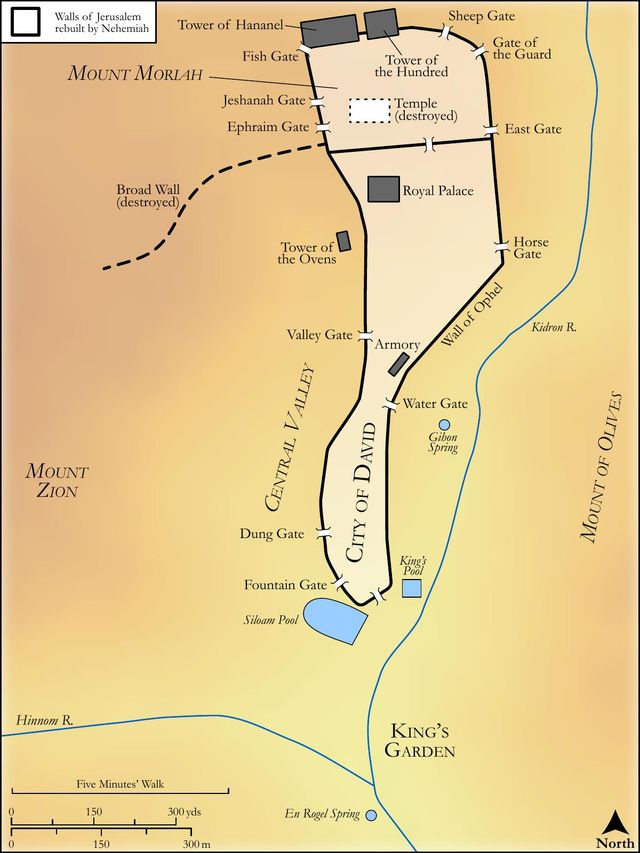
See on the biblical-era map
Study this verse
Public-domain commentary
Matthew Henry
From his Commentary on the Whole Bible. Henry comments on passages, not single verses — this entry covers Nehemiah 12:27–43.
We have read of the building of the wall of Jerusalem with a great deal of fear and trembling; we have here an account of the dedicating of it with a great deal of joy and triumph. Those that sow in tears shall thus reap.
I.We must enquire what was the meaning of this dedication of the wall; we will suppose it to include the dedication of the city too (continens pro contentothe thing containing for the thing contained), and therefore it was not done till the city was pretty well replenished, Neh 11:1. It was a solemn thanksgiving to God for his great mercy to them in the perfecting of this undertaking, of which they were the more sensible because of the difficulty and opposition they had met with in it. 2. They hereby devoted the city in a peculiar manner to God and to his honour, and took possession of it for him and in his name. All our cities, all our houses, must have holiness to the Lord written upon them; but this city was (so as never any other was) a holy city, the city of the great King (Psa 48:2 and Mat 5:35): it had been so ever since God chose it to put his name there, and as such, it being now refitted, it was afresh dedicated to God by the builders and inhabitants, in token of their acknowledgment that they were his tenants, and their desire that it might still be is and that the property of it might never be altered. Whatever is done for their safety, ease, and comfort, must be designed for God's honour and glory. 3. They hereby put the city and its walls under the divine protection, owning that unless the Lord kept the city the walls were built in vain. When this city was in possession of the Jebusites, they committed the guardianship of it to their gods, though they were blind and lame ones, Sa2 5:6. With much more reason do the people of God commit it to his keeping who is all-wise and almighty. The superstitious founders of cities had an eye to the lucky position of the heavens (see Mr. Gregory's works, p. 29, etc.); but these pious founders had an eye to God only, to his providence, and not to fortune.
II.We must observe with what solemnity it was performed, under the direction of Neh 1:1-11.
The Levites from all parts of the country were summoned to attend. The city must be dedicated to God, and therefore his ministers must be employed in the dedicating of it, and the surrender must pass through their hands. When those solemn feasts were over (ch. 8 and 9) they went home to their respective posts, to mind their cures in the country; but now their presence and assistance were again called for. 2. Pursuant to this summons, there was a general rendezvous of all the Levites, Neh 12:28, Neh 12:29. Observe in what method they proceeded. (1.) They purified themselves, Neh 12:30. We are concerned to cleanse our hands, and purify our hearts, when any work for God is to pass through them. They purified themselves and then the people. Those that would be instrumental to sanctify others must sanctify themselves, and set themselves apart for God, with purity of mind and sincerity of intention. Then they purified the gates and the wall. Then may we expect comfort when we are prepared to receive it. To the pure all things are pure (Tit 1:15); and, to those who are sanctified, houses and tables, and all their creature comforts and enjoyments, are sanctified, Ti1 4:4, Ti1 4:5. This purification was performed, it is probable, by sprinkling the water of purifying (or of separation, as it is called, Num 19:9) on themselves and the people, the walls and the gates - a type of the blood of Christ, with which our consciences being purged from dead works, we become fit to serve the living God (Heb 9:14) and to be his care. (2.) The princes, priests, and Levites, walked round upon the wall in two companies, with musical instruments, to signify the dedication of it all to God, the whole circuit of it (Neh 12:36); so that it is likely they sung psalms as they went along, to the praise and glory of God. This procession is here largely described. They had a rendezvous at one certain lace, where they divided themselves into two companies. Half of the princes, with several priests and Levites, went on the right hand, Ezra leading their van, Neh 12:36. The other half of the princes and priests, who gave thanks likewise, went to the left hand, Nehemiah bringing up the rear, Neh 12:38. At length both companies met in the temple, where they joined their thanksgivings, Neh 12:40. The crowd of people, it is likely, walked on the ground, some within the wall and others without, one end of this ceremony being to affect them with the mercy they were giving thanks for, and to perpetuate the remembrance of it among them. Processions, for such purposes, have their use. (3.) The people greatly rejoiced, Neh 12:43. While the princes, priests, and Levites, testified their joy and thankfulness by great sacrifices, sound of trumpet, musical instruments, and songs of praise, the common people testified theirs by loud shouts, which were heard afar off, further than the more harmonious sound of their songs and music: and these shouts, coming from a sincere and hearty joy, are here taken notice of; for God overlooks not, but graciously accepts, the honest zealous services of mean people, though there is in them little of art and they are far from being fine. It is observed that the women and children rejoiced; and their hosannas were not despised, but recorded to their praise. All that share in public mercies ought to join in public thanksgivings. The reason given is that God had made them rejoice with great joy. He had given them both matter for joy and hearts to rejoice; his providence had made them safe and easy, and then his grace made them cheerful and thankful. The baffled opposition of their enemies, no doubt, added to their joy and mixed triumph with it. Great mercies call for the most solemn returns of praise, in the courts of the Lord's house, in the midst of thee, O Jerusalem!
Continue studying Nehemiah 12:34 across the web’s major study libraries — every link below opens this exact verse, chapter, or book on the destination site.
Read & Compare
 BibleGatewayThis verse in more than 200 translations and 70 languages.
 Bible.comThe YouVersion reader — hundreds of translations, reading plans, and highlights.
 ESV.orgCrossway's official English Standard Version reader.
 NET BibleThe NET translation with 60,000+ translators' notes on every rendering decision.
 STEP BibleTyndale House's free study tool — original text, vocabulary, and scholarly resources.
 BibliaLogos Bible Software's free web reader.
 USCCBThe New American Bible (Revised Edition) with the U.S. bishops' study notes.
Commentaries
 BibleHub CommentariesDozens of classic commentaries on this verse, gathered on one page.
 StudyLightMore than 100 commentary sets — the largest collection on the web.
 BibleRefPlain-English commentary on what this verse means, verse by verse.
 Enduring WordDavid Guzik's free commentary on this chapter, widely used by Bible teachers.
 Bible Study ToolsVerse commentary alongside Greek and Hebrew study aids.
Original Language & Research
- BibleHub InterlinearThe verse word by word — original language, transliteration, and English.
- BibleHub LexiconEvery word's original-language definition and Strong's entry.
 Blue Letter BibleDeep-study tools — Strong's numbers, concordance, and word studies.
 SefariaThe Hebrew text with Rashi and centuries of Jewish commentary.
Sermons, Hymns & Audio


TrulyRandomVerse is not affiliated with these sites and doesn’t control their content. They’re linked because they’re genuinely useful.
Summary
Nehemiah 12:34 precisely enumerates key participants in the grand dedication ceremony of Jerusalem's rebuilt walls, specifically identifying representatives from the tribes of Judah and Benjamin, alongside two named individuals, Shemaiah and Jeremiah. This verse is an integral part of the detailed account of the two great thanksgiving choirs that marched atop the newly completed fortifications, underscoring the communal joy, meticulously organized worship, and profound evidence of divine faithfulness that marked this pivotal moment in post-exilic Israel's restoration.
Context
ShowHideLiterary Context
Nehemiah 12:34 is situated within the climactic narrative of the dedication of Jerusalem's rebuilt walls, a monumental achievement following years of arduous labor and opposition. The broader chapter, Nehemiah 12, meticulously details the lineage of priests and Levites who returned from exile, culminating in the elaborate description of the dedication ceremony itself (verses 27-43). The narrative establishes two large companies or choirs, one led by Nehemiah (verses 31-37) and the other by Ezra (verses 38-42), both marching along the wall to meet at the Temple. Verse 34 specifically lists key participants within the first company, emphasizing the organized and inclusive nature of this sacred procession. This event serves as the joyous culmination of the physical rebuilding project detailed in earlier chapters, such as Nehemiah 3, and precedes the spiritual reforms and covenant renewal described in Nehemiah 8-10.
Historical & Cultural Context
The setting is post-exilic Jerusalem, circa 444 BCE, after the return of Jewish exiles from Babylon under Persian decree. The rebuilding of the city walls was not merely a construction project but a profound act of national and spiritual restoration, symbolizing renewed security, identity, and divine favor after decades of desolation. Walls in Israel were vital for defense, defining a city's boundaries, and signifying its sovereignty and strength. The dedication ceremony itself was a significant cultural and religious event, akin to the dedication of the Tabernacle or Temple, involving elaborate processions, sacrifices, and communal rejoicing. The mention of "Judah" and "Benjamin" reflects the reality that these two tribes formed the primary demographic of the returned exiles, representing the continuity of the covenant people. The inclusion of named individuals like Shemaiah and Jeremiah highlights the structured leadership and participation of specific priests and Levites who were crucial to the liturgical and musical aspects of Israelite worship.
Key Themes
ShowHideNehemiah 12:34 contributes to several overarching themes within the book of Nehemiah and the broader post-exilic narrative. Firstly, it powerfully illustrates Corporate Worship and Unity, as diverse groups—tribal representatives, priests, and Levites—converge in a unified act of praise and thanksgiving. This communal celebration underscores the importance of the collective body in honoring God, a theme echoed in Psalm 133:1. Secondly, the verse highlights Restoration and Divine Faithfulness, as the very act of dedicating the wall symbolizes the fulfillment of God's promises to bring His people back to His land and restore their fortunes, a hope frequently expressed by prophets like Jeremiah (e.g., Jeremiah 29:10-14). Finally, the meticulous listing of participants, as seen in this verse, reinforces the theme of Order, Leadership, and Accountability in sacred endeavors. The careful organization of the procession, with specific roles for priests, Levites, and tribal representatives, demonstrates the value placed on structure and capable leadership in facilitating communal devotion and achieving God-ordained objectives, much like the detailed instructions for the Tabernacle in Exodus 25-31.
Exposition and Analysis
ShowHideKey Word Analysis
ShowHideFrom a root meaning "to praise" or "celebrated," this name represents the dominant tribe of the southern kingdom, from which the majority of the post-exilic community descended. Their inclusion in the procession is fitting for an act of praise and signifies the continuity of God's covenant with His chosen people, despite their exile. The tribe of Judah was central to the identity of the returned remnant.
Meaning "son of (the) right hand," this tribe was historically closely allied with Judah, forming the core of the southern kingdom. Their presence alongside Judah underscores the unity and solidarity of the returned exiles, representing the remnant of Israel that was faithful to God and committed to rebuilding Jerusalem.
This name, meaning "Jah has heard" or "heard by Yahweh," was common in the Old Testament. In this context, given the detailed lists of priests and Levites in Nehemiah 12, Shemaiah was likely a prominent Levite or priest, possibly a leader of a priestly or Levitical family, who played a significant role in the musical and liturgical aspects of the dedication ceremony. His inclusion signifies the active participation of the religious leadership in this communal act of worship.
Verse Breakdown
ShowHide"Judah,"
This opening word identifies the primary tribal group participating in the procession. It signifies the presence of the descendants of the tribe of Judah, who formed the largest and most influential component of the returned exiles. Their inclusion underscores the national and covenantal significance of the dedication, as it was the people of Judah, specifically, who were being restored to their land and identity.
"and Benjamin,"
This addition brings in the second major tribal group that constituted the post-exilic community. The inclusion of Benjamin alongside Judah highlights the unity of the remnant of Israel. Historically, these two tribes formed the core of the southern kingdom, and their joint participation in this celebratory march emphasizes a collective, unified act of thanksgiving and rededication to God.
"and Shemaiah,"
This introduces a specific individual, likely a prominent Levite or priest, given the context of the musical procession. His naming indicates the organized nature of the event and the specific roles played by key leaders. Shemaiah's presence signifies the active involvement and leadership of the spiritual authorities in orchestrating and participating in this grand act of worship.
"and Jeremiah,"
Similar to Shemaiah, this names another specific individual, who, in this context, would also be a Levite or priest involved in the musical or liturgical leadership of the procession. The inclusion of these named individuals, alongside the tribal representatives, underscores the meticulous planning and the personal commitment of both the general populace (represented by the tribes) and the spiritual leadership in the dedication of Jerusalem's walls.
Literary Devices
ShowHideNehemiah 12:34, though a simple list, employs several subtle Literary Devices. The most prominent is Enumeration or Listing, where specific names and groups are meticulously itemized. This device serves to emphasize the comprehensive and organized nature of the dedication ceremony, highlighting that it was not a spontaneous event but a carefully planned communal act involving various segments of the returned community and its leadership. The naming of "Judah" and "Benjamin" can also be seen as a form of Synecdoche or Metonymy, where the tribal names stand in for the entire population of those tribes, representing the collective body of the returned exiles. Furthermore, within the broader context of Nehemiah 12, the repeated listing of names and groups throughout the chapter creates a sense of Repetition that underscores the scale, solemnity, and significance of the event, reinforcing the idea of a unified and dedicated people. The entire procession, of which this verse is a part, functions as a powerful Symbolism of restoration, thanksgiving, and the re-establishment of God's covenant people in their land, secured within the newly rebuilt walls.
Theological and Thematic Connections
ShowHideNehemiah 12:34, by listing key participants in the wall's dedication, powerfully articulates the theological truth of corporate worship and the communal nature of God's covenant people. The presence of Judah and Benjamin, the core of the returned remnant, alongside specific Levites, signifies that the restoration of Jerusalem was not merely a physical rebuilding but a spiritual re-establishment of a people united in their praise and commitment to God. This act of dedication, a joyous culmination of arduous labor and divine faithfulness, serves as a profound testimony to God's covenant promises. It reminds us that true spiritual milestones are often celebrated collectively, recognizing God's hand in enabling perseverance and bringing His purposes to fruition through the unified efforts of His people. The meticulous organization reflects God's character of order and the importance of intentional, structured worship.
Reflection and Application
ShowHideThe scene described in Nehemiah 12:34 and the surrounding verses offers profound lessons for contemporary believers. Just as the people of Judah and Benjamin, along with their leaders, celebrated the completion of the physical walls, we are called to recognize and celebrate the milestones of God's faithfulness in our own lives and in the life of the church. This verse reminds us of the immense power and joy found in corporate worship—when God's people come together in unity, giving Him praise for His work. It underscores that our spiritual journeys are not meant to be solitary but are enriched through communal participation, shared purpose, and mutual encouragement. The dedication of the wall, following intense labor and opposition, also teaches us that perseverance in God's work, even through hardship, ultimately leads to moments of profound joy, thanksgiving, and divine blessing. We are encouraged to be intentional in our worship, recognizing the value of order and the vital role of leadership in facilitating a vibrant, God-honoring community.
Questions for Reflection
ShowHideFAQ
ShowHideWhy are only Judah and Benjamin mentioned as tribes?
ShowHideThe Babylonian exile significantly reduced the population of Israel. When the exiles returned, the vast majority were descendants of the southern kingdom, which primarily consisted of the tribes of Judah and Benjamin. Therefore, these two tribes represented the core of the returned Jewish community and the continuity of God's covenant people in the land. The other ten tribes of the northern kingdom had largely been dispersed and assimilated centuries earlier after the Assyrian conquest.
Who were Shemaiah and Jeremiah in this context? Were they the famous prophet Jeremiah?
ShowHideIt is highly unlikely that the "Jeremiah" mentioned here is the famous prophet Jeremiah. The prophet Jeremiah lived in the late 7th and early 6th centuries BCE, prophesying before and during the Babylonian exile. The events of Nehemiah take place in the mid-5th century BCE, well after the prophet's time. Both Shemaiah and Jeremiah were common names in ancient Israel. In the context of Nehemiah 12, which meticulously lists priests and Levites, Shemaiah and Jeremiah were almost certainly prominent Levites or priests who held significant roles in the musical and liturgical leadership of the dedication procession. They were key individuals responsible for organizing and leading the choirs and musicians in this grand act of worship.
What is the significance of listing specific names like Shemaiah and Jeremiah, alongside the tribes?
ShowHideThe detailed enumeration of names and groups in Nehemiah 12:34 and throughout the chapter serves several purposes. Firstly, it emphasizes the highly organized and structured nature of the dedication ceremony, highlighting careful planning and the assignment of specific roles. Secondly, it underscores the personal involvement and accountability of key leaders within the community, particularly priests and Levites, in facilitating communal worship. Thirdly, it provides historical authenticity and precision, grounding the narrative in specific individuals and groups rather than vague generalities. This meticulous record-keeping reflects the importance placed on this event and the active participation of all segments of the restored community, from tribal representatives to spiritual leaders, in giving thanks to God.
Christ-Centered Fulfillment
ShowHideThe dedication of Jerusalem's walls, with its joyous procession and unified worship, finds its ultimate Christ-centered fulfillment in the establishment of the New Covenant and the building of God's spiritual temple, the Church. Just as the physical walls provided security and defined the community of Israel, Christ Himself is our ultimate security and the cornerstone of a new, spiritual Jerusalem, where believers are gathered from every tribe and nation. The unity of Judah and Benjamin, along with the Levites, foreshadows the profound unity found in the body of Christ, where there is "neither Jew nor Gentile, neither slave nor free, nor is there male and female, for you are all one in Christ Jesus" (Galatians 3:28). The meticulous organization and corporate worship of Nehemiah 12 point forward to the ordered worship of the Church, where believers, as "living stones," are being built into a "spiritual house" for God (1 Peter 2:4-5). The ultimate dedication is not of a physical wall, but of believers themselves, consecrated to God through the atoning work of the Lamb of God who takes away the sin of the world. The joy of the wall's dedication anticipates the eternal joy of dwelling with God in the New Jerusalem, where "God himself will be with them and be their God" (Revelation 21:3). Thus, Nehemiah 12:34 is a beautiful Old Testament echo of the corporate praise and unified identity found in Christ, who perfectly fulfills the longing for restoration and secure dwelling with God.