


Nehemiah 1:7
Bible text: King James Version (1769 Blayney text) · Public domain
Bible text: King James Version with Strong's numbers · Public domain
Bible text: Berean Standard Bible · Public domain
Bible text: American Standard Version (1901) · Public domain
Bible text: World English Bible, Messianic edition · Public domain
Bible text: Geneva Bible (1599) · Public domain
Bible text: Young's Literal Translation · Public domain
- חֲבֹלcha·Volsurely <to act corruptly>H2254V-Qal-InfVerb Qal Infinitive Construct
- חָבַלְנוּcha·Val·nuwe have acted corruptlyH2254V-Qal-Perf-1cpVerb Qal Perfect 1st Plural common gender
- לָךְLakhto youPrep-l ¦ 2msSuffix Personal 2nd Singular Masculineלָtoךְyou
- וְלֹאve·lo'and notH3808Conj-w ¦ NegParticle Negativeוְandלֹאnot
- שָׁמַרְנוּsha·Mar·nuwe have keptH8104V-Qal-Perf-1cpVerb Qal Perfect 1st Plural common gender
- אֶת'et<obj.>H853DirObjMParticle Object Indicator
- הַמִּצְוֹתha·mitz·Votthe commandmentsH4687Art ¦ N-fpNoun Plural Feminine Absoluteהַtheמִּצְוֹתcommandments
- וְאֶתve·'Etand <obj.>H853Conj-w ¦ DirObjMParticle Object Indicatorוְandאֶת<obj.>
- הַחֻקִּיםha·chu·Kimthe statutesH2706Art ¦ N-mpNoun Plural Masculine Absoluteהַtheחֻקִּיםstatutes
- וְאֶתve·'Etand <obj.>H853Conj-w ¦ DirObjMParticle Object Indicatorוְandאֶת<obj.>
- הַמִּשְׁפָּטִיםha·mish·pa·Timthe judgmentsH4941Art ¦ N-mpNoun Plural Masculine Absoluteהַtheמִּשְׁפָּטִיםjudgments
- אֲשֶׁר'a·SherwhichH834RelParticle Relative
- צִוִּיתָtzi·Vi·tayou commandedH6680V-Piel-Perf-2msVerb Piel Perfect 2nd Singular Masculine
- אֶת'et<obj.>H853DirObjMParticle Object Indicator
- מֹשֶׁהmo·ShehMosesH4872N-proper-mNoun Proper Masculine
- עַבְדֶּךָ'av·De·khayour servantH5650N-msc ¦ 2msNoun Singular Masculine Constructעַבְדֶּservantךָyour
English is a literal word-by-word gloss of the Hebrew, not the KJV's wording. Why?
This is the original text the KJV's translators worked from — each Hebrew word with its own literal English meaning in this verse, prepared by scholars at Tyndale House, Cambridge. The KJV translates whole sentences, not word by word, so its wording differs: one Hebrew word can become several English words, and the KJV may choose “the LORD” where the gloss reads “Yahweh”. Both are faithful — they answer different questions. For the KJV's own rendering, switch to the KJV text.
Details
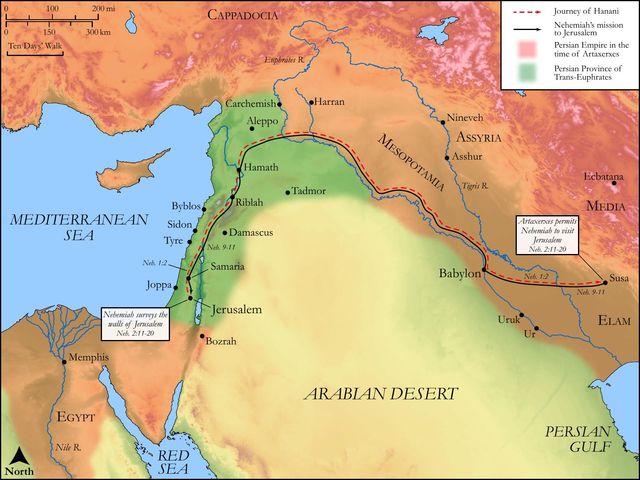
See on the biblical-era map
Study this verse
Public-domain commentary
Matthew Henry
From his Commentary on the Whole Bible. Henry comments on passages, not single verses — this entry covers Nehemiah 1:5–11. His two-level outline is real structure in the source text, so it is rendered as structure.
We have here Nehemiah's prayer, a prayer that has reference to all the prayers which he had for some time before been putting up to God day and night, while he continued his sorrows for the desolations of Jerusalem, and withal to the petition he was now intending to present to the king his master for his favour to Jerusalem. We may observe in this prayer,
I.His humble and reverent address to God, in which he prostrates himself before him, and gives unto him the glory due unto his name, Neh 1:5.
It is much the same with that of Daniel, Dan 9:4. It teaches us to draw near to God,
1.With a holy awe of his majesty and glory, remembering that he is the God of heaven, infinitely above us, and sovereign Lord over us, and that he is the great and terrible God, infinitely excelling all the principalities and powers both of the upper and of the lower world, angels and kings; and he is a God to be worshipped with fear by all his people, and whose powerful wrath all his enemies have reason to be afraid of. Even the terrors of the Lord are improvable for the comfort and encouragement of those that trust in him.
2.With a holy confidence in his grace and truth, for he keepeth covenant and mercy for those that love him, not only the mercy that is promised, but even more than he promised: nothing shall be thought too much to be done for those that love him and keep his commandments.
II.His general request for the audience and acceptance of all the prayers and confessions he now made to God (Neh 1:6):
"Let thy ear be attentive to the prayer, not which I say (barely saying prayer will not serve), but which I pray before thee (then we are likely to speed in praying when we pray in praying), and let they eyes be open upon the heart from which the prayer comes, and the case which is in prayer laid before thee." God formed the eye and planted the ear; and therefore shall he not see clearly? shall not he hear attentively?
III.His penitent confession of sin; not only Israel has sinned (it was no great mortification to him to own that), but I and my father's house have sinned, Neh 1:6. Thus does he humble himself, and take shame to himself, in this confession. We have (I and my family among the rest) dealt very corruptly against thee, Neh 1:7. In the confession of sin, let these two things be owned as the malignity of it - that it is a corruption of ourselves and an affront to God; it is dealing corruptly against God, setting up the corruptions of our own hearts in opposition to the commands of God.
IV.The pleas he urges for mercy for his people Israel.
1.He pleads what God had of old said to them, the rule he had settled of his proceedings towards them, which might be the rule of their expectations from him, Neh 1:8, Neh 1:9. He had said indeed that, if they broke covenant with him, he would scatter them among the nations, and that threatening was fulfilled in their captivity: never was people so widely dispersed as Israel was at this time, though at first so closely incorporated; but he had said withal that if they turned to him (as now they began to do, having renounced idolatry and kept to the temple service) he would gather them again. This he quotes from Deu 30:1-5, and begs leave to put God in mind of it (though the Eternal Mind needs no remembrancer) as that which he guided his desires by, and grounded his faith and hope upon, in praying this prayer: Remember, I beseech thee, that word; for thou hast said, Put me in remembrance. He had owned (Neh 1:7), We have not kept the judgments which thou commandedst thy servant Moses; yet he begs (Neh 1:8), Lord, remember the word which thou commandedst thy servant Moses; for the covenant is often said to be commanded. If God were not more mindful of his promises than we are of his precepts we should be undone. Our best pleas therefore in prayer are those that are taken from the promise of God, the word on which he has caused us to hope, Psa 119:49.
2.He pleads the relation wherein of old they stood to God: "These are thy servants and thy people (Neh 1:10), whom thou hast set apart for thyself, and taken into covenant with thee. Wilt thou suffer thy sworn enemies to trample upon and oppress thy sworn servants? If thou wilt not appear for thy people, whom wilt thou appear for?" See Isa 63:19. As an evidence of their being God's servants he gives them this character (Neh 1:11): "They desire to fear thy name; they are not only called by thy name, but really have a reverence for thy name; they now worship thee, and thee only, according to thy will, and have an awe of all the discoveries thou art pleased to make of thyself; this they have a desire to do," which denotes, (1.) Their good will to it. "It is their constant care and endeavour to be found in the way of their duty, and they aim at it, though in many instances they come short." (2.) Their complacency in it. "They take pleasure to fear thy name (so it may be read), not only do their duty, but do it with delight." Those shall graciously be accepted of God that truly desire to fear his name; for such a desire is his own work.
3.He pleads the great things God had formerly done for them (Neh 1:10): "Whom thou hast redeemed by thy great power, in the days of old. Thy power is still the same; wilt thou not therefore still redeem them and perfect their redemption? Let not those be overpowered by the enemy that have a God of infinite power on their side."
Lastly, He concludes with a particular petition, that God would prosper him in his undertaking, and give him favour with the king: this man he calls him, for the greatest of men are but men before God; they must know themselves to be so (Psa 9:20), and others must know them to be so. Who art thou that thou shouldst be afraid of a man? Mercy in the sight of this man is what he prays for, meaning not the king's mercy, but mercy from God in his address to the king. Favour with men is then comfortable when we can see it springing from the mercy of God.
Continue studying Nehemiah 1:7 across the web’s major study libraries — every link below opens this exact verse, chapter, or book on the destination site.
Read & Compare
 BibleGatewayThis verse in more than 200 translations and 70 languages.
 Bible.comThe YouVersion reader — hundreds of translations, reading plans, and highlights.
 ESV.orgCrossway's official English Standard Version reader.
 NET BibleThe NET translation with 60,000+ translators' notes on every rendering decision.
 STEP BibleTyndale House's free study tool — original text, vocabulary, and scholarly resources.
 BibliaLogos Bible Software's free web reader.
 USCCBThe New American Bible (Revised Edition) with the U.S. bishops' study notes.
Commentaries
 BibleHub CommentariesDozens of classic commentaries on this verse, gathered on one page.
 StudyLightMore than 100 commentary sets — the largest collection on the web.
 BibleRefPlain-English commentary on what this verse means, verse by verse.
 Enduring WordDavid Guzik's free commentary on this chapter, widely used by Bible teachers.
 Bible Study ToolsVerse commentary alongside Greek and Hebrew study aids.
Original Language & Research
- BibleHub InterlinearThe verse word by word — original language, transliteration, and English.
- BibleHub LexiconEvery word's original-language definition and Strong's entry.
 Blue Letter BibleDeep-study tools — Strong's numbers, concordance, and word studies.
 SefariaThe Hebrew text with Rashi and centuries of Jewish commentary.
Sermons, Hymns & Audio


TrulyRandomVerse is not affiliated with these sites and doesn’t control their content. They’re linked because they’re genuinely useful.
Summary
Nehemiah 1:7 encapsulates a profound moment of corporate confession within Nehemiah's heartfelt intercessory prayer. Despite his personal righteousness, Nehemiah deeply identifies with the pervasive and destructive sinfulness of the Israelite nation, acknowledging their collective and widespread failure to uphold the comprehensive divine laws—the commandments, statutes, and judgments—that God had graciously entrusted to them through His servant Moses. This verse serves as a stark and humble recognition of the spiritual rebellion and covenantal unfaithfulness that directly led to their present state of ruin, desolation, and exile.
Context
ShowHideLiterary Context
Nehemiah 1:7 is deeply embedded within Nehemiah's fervent prayer of confession and petition, meticulously recorded in Nehemiah 1. This powerful prayer immediately follows Nehemiah's receipt of devastating news regarding the desolate state of Jerusalem's walls and gates, as conveyed in Nehemiah 1:3. Overwhelmed with profound grief, Nehemiah responds by weeping, mourning, fasting, and praying for several days, as detailed in Nehemiah 1:4. His prayer commences with an adoration for God's majestic character and covenant faithfulness in Nehemiah 1:5, before transitioning into an extensive and heartfelt corporate confession of sin, of which verse 7 forms a pivotal and central component. This confession meticulously lays the spiritual groundwork for his subsequent bold request to King Artaxerxes and the monumental task of rebuilding Jerusalem's walls. The prayer itself stands as a literary masterpiece, serving as an enduring model of intercession that progresses from praise to confession, then to a remembrance of God's enduring promises, and finally culminates in specific, earnest petition.
Historical & Cultural Context
The historical backdrop for Nehemiah's prayer is Susa, the opulent capital of the Persian Empire, approximately in 445 BC. The Jewish people had endured decades of arduous exile in Babylon, a direct and devastating consequence of their persistent disobedience to God's covenant. While a remnant of exiles had already returned to Judah under the leadership of figures like Zerubbabel and Ezra, Jerusalem remained in a state of profound vulnerability; its walls were broken down, and its gates lay burned, serving as a stark symbol of national disgrace and a constant threat to its inhabitants. This dire condition was a direct and undeniable fulfillment of the curses meticulously outlined in the Mosaic Law for covenant infidelity, vividly described in passages such as Deuteronomy 28. Nehemiah, serving as a trusted cupbearer to King Artaxerxes I, was geographically distant from Jerusalem, yet his heart remained deeply connected to his people's plight. His prayer profoundly reflects a deep understanding of Israel's covenant history, acknowledging that their suffering was not an arbitrary misfortune but a just and predictable consequence of their collective failure to live by the divine standards meticulously given through Moses. Hebrew thought further emphasizes the paramount importance of lineage and corporate identity, where the sins of ancestors could indeed impact current generations, fostering a pervasive sense of shared responsibility and collective accountability.
Key Themes
ShowHideNehemiah 1:7 powerfully articulates several key themes that are pervasive throughout the entire book of Nehemiah and resonate deeply within the broader Old Testament narrative. Firstly, it highlights the profound theme of Corporate Confession and Responsibility. Nehemiah, a righteous individual in his own right, deliberately identifies himself with the "we" of the nation, demonstrating that sin is not merely an individual transgression but can indeed be a collective burden, necessitating a shared acknowledgment of guilt. This echoes similar powerful intercessory prayers of corporate confession found in Daniel 9:5-11 and Ezra 9:6-7. Secondly, the verse underscores the Severity of Disobedience and Covenantal Unfaithfulness. The potent phrase "dealt very corruptly" emphasizes a deep, pervasive moral decay, signifying not just isolated transgressions but a widespread and profound breach. This unfaithfulness to the covenant, which was solemnly established at Sinai, is presented as the fundamental root cause of Israel's national distress and suffering. Thirdly, the explicit mention of "commandments, statutes, nor the judgments" points unequivocally to the Centrality and Authority of God's Law. The Mosaic Law, divinely given through God's chosen servant Moses, served as the foundational and comprehensive guide for Israel's life and their sacred relationship with God. Their pervasive failure to keep these comprehensive divine decrees—which encompassed moral, civil, and ceremonial laws—constituted a direct and grievous breach of their covenant obligations, inevitably leading to the predicted curses and ultimately, the devastating exile, as vividly warned in Leviticus 26 and Deuteronomy 28.
Exposition and Analysis
ShowHideKey Word Analysis
ShowHideThis primitive root signifies "to wind tightly (as a rope), i.e., to bind." Figuratively, it extends to "pervert" or "destroy." In this context, "dealt very corruptly" indicates not merely a mistake, but a deep, pervasive act of moral perversion and destruction against God's covenant. It suggests a deliberate and widespread pattern of behavior that has twisted and broken the divine relationship, leading to ruin and devastation. The intensifying "very" underscores the profound and widespread nature of this moral decay.
This term refers to a divine command or precept, often moral or ethical in nature, given by God to His people. It represents direct, authoritative instructions that demand obedience and define the parameters of a righteous life. The failure to keep these "commandments" signifies a direct rebellion against God's expressed will for His people's conduct and character.
This word properly refers to a verdict pronounced judicially, a sentence, or a formal decree, encompassing both human and divine law. It relates to justice, rights, and privileges, and the application of God's righteousness to practical matters of societal order and individual conduct. The failure to keep "judgments" indicates a breakdown in living out God's justice and equity within the community, leading to societal decay and injustice. Together with "commandments" and "statutes," these terms (mitsvâh, chôq, mishpâṭ) form a comprehensive summary of the entire Mosaic Law, underscoring Israel's wholesale rejection of God's revealed will in all its facets.
Verse Breakdown
ShowHide"We have dealt very corruptly against thee,"
This opening clause establishes the profound corporate nature of the confession. Nehemiah, though personally faithful, unequivocally identifies with the collective sin of his people. The phrase "dealt very corruptly" highlights the extreme, pervasive, and destructive nature of their moral and spiritual decay, indicating a deliberate and ruinous course of action directly against God Himself. It signifies a deep, fundamental breach of the covenant relationship.
"and have not kept the commandments, nor the statutes, nor the judgments,"
This part precisely specifies the nature of their corruption: a comprehensive and systematic failure to obey God's Law. The emphatic repetition of "nor" underscores that their disobedience was not limited to one area but extended to every category of divine instruction—moral precepts (commandments), fixed ordinances and decrees (statutes), and civil laws and judicial pronouncements (judgments). This highlights a widespread and deliberate rejection of God's revealed will in its entirety.
"which thou commandedst thy servant Moses."
This concluding phrase firmly grounds the confession in the historical and theological reality of the Mosaic Covenant. It underscores that the laws they failed to keep were not arbitrary human inventions but divine commands, authoritatively and graciously given by God through His chosen mediator, Moses. This emphasizes the covenantal nature of their sin, as it was a direct and grievous violation of the sacred agreement God had established with Israel, leading to the predictable covenant curses.
Literary Devices
ShowHideNehemiah 1:7 employs several powerful literary devices that amplify its message. The most prominent is Corporate Confession, where Nehemiah, as an individual, deliberately includes himself in the "we" of the nation, taking shared responsibility for the collective sins of Israel across generations. This is not self-accusation for personal transgressions but a profound act of solidarity, empathy, and intercession, mirroring the identification of a godly leader with the spiritual state and plight of his people. The verse also utilizes Legal Language or Covenantal Language through the precise enumeration of "commandments, statutes, nor the judgments." This tripartite phrase functions as a Merism, representing the entirety of the Mosaic Law, thereby emphasizing the comprehensive and total nature of Israel's covenantal failure. Furthermore, the use of Anaphora (the repetition of "nor the") serves to underscore the exhaustive extent of their disobedience, highlighting that no aspect of God's Law was adequately kept. This repetitive structure serves to amplify the gravity, pervasiveness, and pervasive nature of their unfaithfulness.
Theological and Thematic Connections
ShowHideNehemiah 1:7 stands as a cornerstone for understanding the profound theology of corporate sin and the inevitable consequences of covenantal disobedience. It reveals that God's people are held accountable not just individually, but also collectively, for their adherence to His revealed will. The nation's suffering—symbolized by the broken walls and the experience of exile—is presented not as arbitrary misfortune but as a direct, just, and predictable consequence of their pervasive failure to keep the Mosaic Law. This verse powerfully underscores God's unwavering faithfulness to His covenant, even in judgment, as the curses for disobedience were clearly and explicitly outlined in the Law itself. Furthermore, it highlights the essential and transformative role of humble, corporate confession as a prerequisite for divine intervention, restoration, and genuine spiritual renewal, demonstrating that true repentance involves acknowledging the full scope of sin against a holy and righteous God.
Reflection and Application
ShowHideNehemiah 1:7 offers a timeless and profound blueprint for spiritual introspection and the vital practice of corporate responsibility. In a world often quick to assign blame, deflect responsibility, or minimize the gravity of sin, Nehemiah's prayer calls us to a profound and challenging humility. It teaches us that true repentance begins with an honest, unvarnished acknowledgment of our own sin and, where appropriate, the collective sins of our communities, nations, or even the church. This "we" confession is not about guilt-tripping or self-flagellation, but about identifying with the brokenness and pervasive failures that hinder God's purposes, recognizing that our present circumstances might indeed be linked to past or ongoing disobedience. It compels us to rigorously examine our individual lives and our collective societies against the unchanging, perfect standard of God's Word, understanding that a persistent disregard for divine principles inevitably leads to spiritual, moral, and societal decay. Just as Nehemiah's heartfelt confession preceded his courageous action to rebuild the physical walls of Jerusalem, our own spiritual renewal and effective service for God must be deeply rooted in a profound, repentant awareness of our distance from His perfect will. It serves as a powerful reminder that obedience to God's "commandments, statutes, and judgments" is not burdensome legalism but rather the very path to true blessing, flourishing, and alignment with His divine and perfect design for humanity.
Questions for Reflection
ShowHideFAQ
ShowHideWhat is "corporate sin" and why does Nehemiah confess sins he didn't personally commit?
ShowHideCorporate sin refers to the collective wrongdoing of a group, community, or nation, where the actions or inactions of many contribute to a shared state of rebellion against God or injustice. While individuals are certainly responsible for their personal sins, the Bible also recognizes a profound corporate identity and accountability, especially within covenant communities like Israel. Nehemiah confesses sins he didn't personally commit because he identifies deeply and profoundly with his people's covenantal history and their current spiritual and physical condition. He recognizes that the present desolation of Jerusalem is a direct and just consequence of generations of Israel's pervasive unfaithfulness to God's Law. His confession is a powerful act of solidarity, intercession, and prophetic identification, acknowledging that he is an integral part of a people who have collectively strayed from God's path. This type of corporate confession is a model of godly leadership, demonstrating humility, empathy, and a shared burden for the spiritual health and restoration of the community, rather than merely pointing fingers of blame. It's a recognition that the "sins of the fathers" can indeed have lingering effects on the "children," necessitating a collective turning back to God, as poignantly expressed in Lamentations 5:7.
Christ-Centered Fulfillment
ShowHideNehemiah 1:7, with its profound and honest confession of Israel's pervasive failure to keep God's commandments, statutes, and judgments, powerfully illuminates and foreshadows the absolute necessity of Jesus Christ. The Law, graciously given through Moses, was never intended to be a means of salvation but rather to reveal God's perfect and unblemished standard, thereby exposing humanity's utter inability to meet it, as profoundly stated in Romans 3:20. Israel's consistent and pervasive failure, culminating in the devastating exile and ruin, serves as a stark demonstration that human effort, no matter how sincere, cannot achieve true righteousness or restore a broken relationship with a holy God. Jesus Christ, however, stands as the perfect fulfillment of the Law (Matthew 5:17), the only one who perfectly kept every commandment, statute, and judgment, living the righteous life that Israel, and indeed all humanity, failed to live. Moreover, on the cross, Jesus bore the corporate sin of humanity, becoming sin for us (2 Corinthians 5:21), taking upon Himself the curses of the Law that our disobedience justly incurred (Galatians 3:13). Through His atoning sacrifice, He inaugurates a new covenant, not written on stone tablets but on human hearts, enabling true and Spirit-empowered obedience through the indwelling Holy Spirit (Jeremiah 31:33). Thus, Nehemiah's confession of deep corruption and pervasive unfaithfulness finds its ultimate answer, redemption, and glorious resolution in the perfect obedience and sacrificial love of the Lamb of God, who takes away the sin of the world!.