


Matthew 15:12
Bible text: King James Version (1769 Blayney text) · Public domain
Bible text: Berean Standard Bible · Public domain
Bible text: American Standard Version (1901) · Public domain
Bible text: World English Bible, Messianic edition · Public domain
Bible text: Geneva Bible (1599) · Public domain
Bible text: Young's Literal Translation · Public domain
- ΤότεToteThenG5119ADVAdverb
- προσελθόντεςproselthonteshaving come nearG4334V-2AAP-NPMVerb 2nd Aorist Active Participle Nominative Plural Masculine
- οἱhoitheG3588T-NPMDefinite article Nominative Plural Masculine
- μαθηταὶmathētaidisciplesG3101N-NPMNoun Nominative Plural Masculine
- αὐτοῦautouof himG846P-GSMPersonal pronoun Genitive Singular Masculine
- λέγουσινlegousinspokeG3004V-PAI-3PVerb Present Active Indicative 3rd Plural
- αὐτῷ·autōto HimG846P-DSMPersonal pronoun Dative Singular Masculine
- οἶδαςoidasKnow YouG1492V-RAI-2SVerb Perfect Active Indicative 2nd Singular
- ὅτιhotithatG3754CONJConjunction
- οἱhoitheG3588T-NPMDefinite article Nominative Plural Masculine
- ΦαρισαῖοιPharisaioiPhariseesG5330N-NPM-TNoun Nominative Plural Masculine Title
- ἀκούσαντεςakousanteshaving heardG191V-AAP-NPMVerb Aorist Active Participle Nominative Plural Masculine
- τὸνtontheG3588T-ASMDefinite article Accusative Singular Masculine
- λόγονlogonsayingG3056N-ASMNoun Accusative Singular Masculine
- ἐσκανδαλίσθησαν;eskandalisthēsanwere offended?G4624V-API-3PVerb Aorist Passive Indicative 3rd Plural
English is a literal word-by-word gloss of the Greek, not the KJV's wording. Why?
This is the original text the KJV's translators worked from — each Greek word with its own literal English meaning in this verse, prepared by scholars at Tyndale House, Cambridge. The KJV translates whole sentences, not word by word, so its wording differs: one Greek word can become several English words, and the KJV may choose “charity” where the gloss reads “love”. Both are faithful — they answer different questions. For the KJV's own rendering, switch to the KJV text.
Details
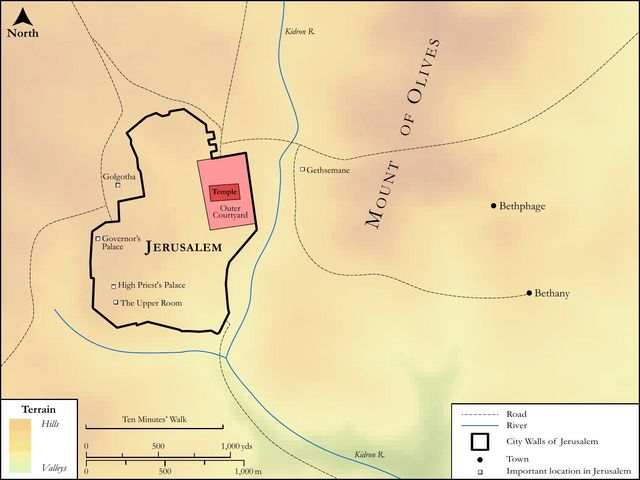
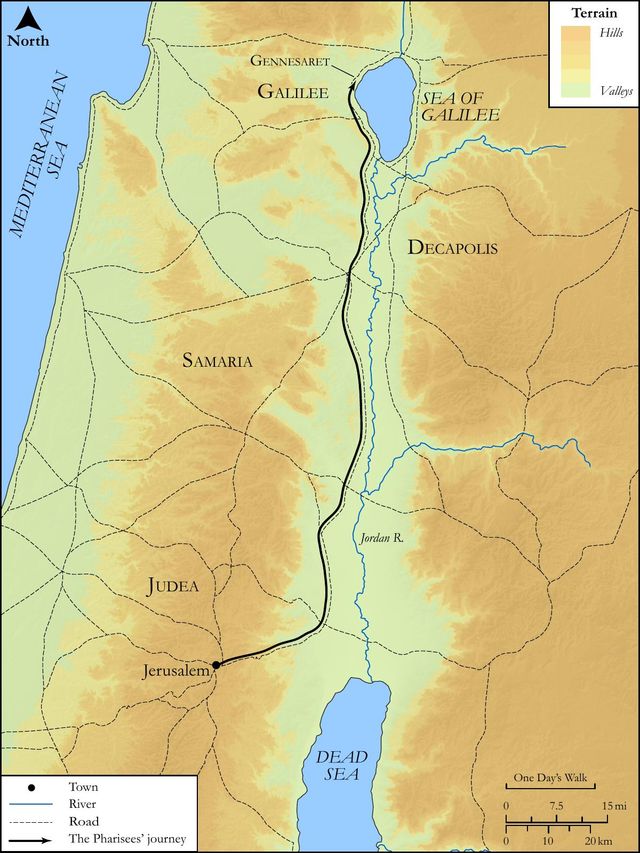
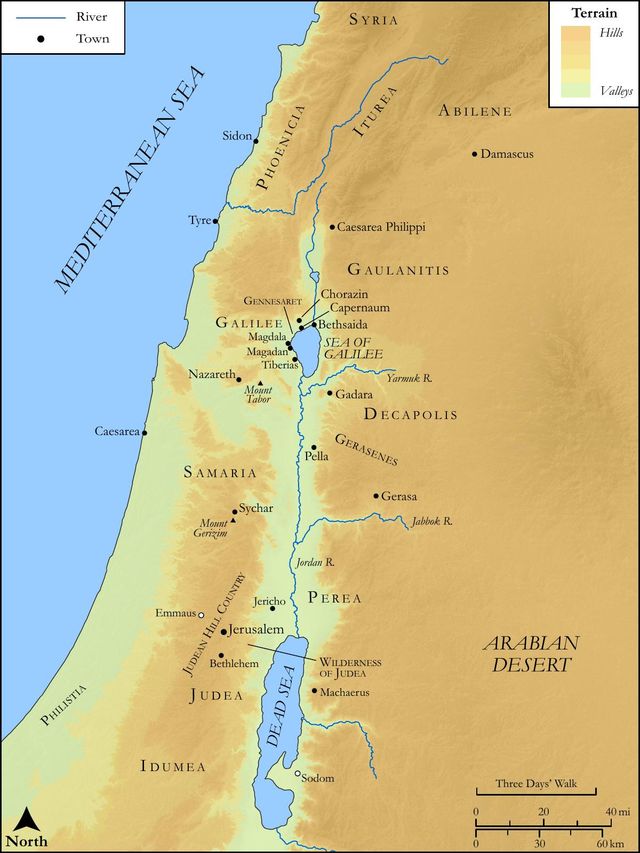
See on the biblical-era maps
Study this verse
Public-domain commentary
Matthew Henry
From his Commentary on the Whole Bible. Henry comments on passages, not single verses — this entry covers Matthew 15:10–20. His four-level outline is real structure in the source text, so it is rendered as structure.
Christ having proved that the disciples, in eating with unwashen hands, were not to be blamed, as transgressing the traditions and injunctions of the elders, comes here to show that they were not to be blamed, as having done any thing that was in itself evil. In the former part of his discourse he overturned the authority of the law, and in this the reason of it. Observe,
I.The solemn introduction to this discourse (Mat 15:10); He called the multitude.
They were withdrawn while Christ discoursed with the scribes and Pharisees; probably those proud men ordered them to withdraw, as not willing to talk with Christ in their hearing; Christ must favour them at their pleasure with a discourse in private. But Christ had a regard to the multitude; he soon despatched the scribes and Pharisees, and then turned them off, invited the mob, the multitude, to be his hearers: thus the poor are evangelized; and the foolish things of the world, and things that are despised hath Christ chosen. The humble Jesus embraced those whom the proud Pharisees looked upon with disdain, and to them he designed it for a mortification. He turns from them as wilful and unteachable, and turns to the multitude, who, though weak, were humble, and willing to be taught. To them he said, Hear and understand. Note, What we hear from the mouth of Christ, we must give all diligence to understand. Not only scholars, but even the multitude, the ordinary people, must apply their minds to understand the words of Christ. He therefore calls upon them to understand, because the lesson he was now about to teach them, was contrary to the notions which they had sucked in with their milk from their teachers; and overturned many of the customs and usages which they were wedded to, and laid stress upon. Note, There is need of a great attention of mind and clearness of understanding to free men from those corrupt principles and practices which they have been bred up in and long accustomed to; for in that case the understanding is commonly bribed and biassed by prejudice.
II.The truth itself laid down (Mat 15:11), in two propositions, which were opposite to the vulgar errors of that time, and were therefore surprising.
1.Not that which goes into the mouth defileth the man. It is not the kind or quality of our food, nor the condition of our hands, that affects the soul with any moral pollution or defilement. The kingdom of God is not meat and drink, Rom 14:17. That defiles the man, by which guilt is contracted before God, and the man is rendered offensive to him, and disfitted for communion with him; now what we eat, if we do not eat unreasonably and immoderately, does not this; for to the pure all things are pure, Tit 1:15. The Pharisees carried the ceremonial pollutions, by eating such and such meats, much further than the law intended, and burdened it with additions of their own, which our Saviour witnesses against; intending hereby to pave the way to a repeal of the ceremonial law in that matter. He was now beginning to teach his followers to call nothing common or unclean; and if Peter, when he was bid to kill and eat, had remembered this word, he would not have said, Not so, Lord, Act 10:13-15, Act 10:28.
2.But that which comes out of the mouth, this defiles a man. We are polluted, not by the meat we eat with unwashen hands, but by the words we speak from an unsanctified heart; thus it is that the mouth causeth the flesh to sin, Ecc 5:6. Christ, in a former discourse, had laid a great stress upon our words (Mat 12:36, Mat 12:37); and that was intended for reproof and warning to those that cavilled at him; this here is intended for reproof and warning to those that cavilled at the disciples, and censured them. It is not the disciples that defile themselves with what they eat, but the Pharisees that defile themselves with what they speak spitefully and censoriously of them. Note, Those who charge guilt upon others for transgressing the commandments of men, many times bring greater guilt upon themselves, by transgressing the law of God against rash judging. Those most defile themselves, who are most forward to censure the defilements of others.
III.The offence that was taken at this truth and the account brought to Christ of that offence (Mat 15:12); "The disciples said unto him, Knowest thou that the Pharisees were offended, and didst thou not foresee that they would be so, at this saying, and would think the worse of thee and of thy doctrine for it, and be the more enraged at thee?"
1.It was not strange that the Pharisees should be offended at this plain truth, for they were men made up of error and enmity, mistakes and malice. Sore eyes cannot bear clear light; and nothing is more provoking to proud imposers than the undeceiving of those whom they have first blindfolded, and then enslaved. It should seem that the Pharisees, who were strict observers of the traditions, were more offended than the scribes, who were the teachers of them; and perhaps they were as much galled with the latter part of Christ's doctrine, which taught a strictness in the government of our tongue, as with the former part, which taught an indifference about washing our hands; great contenders for the formalities of religion, being commonly as great contemners of the substantials of it.
2.The disciples thought it strange that their Master should say that which he knew would give so much offence; he did not use to do so: surely, they think, if he had considered how provoking it would be, he would not have said it. But he knew what he said, and to whom he said it, and what would be the effect of it; and would teach us, that though in indifferent things we must be tender of giving offence, yet we must not, for fear of that, evade any truth or duty. Truth must be owned, and duty done; and if any be offended, it is his own fault; it is scandal, not given, but taken.
Perhaps the disciples themselves stumbled at the word Christ said, which they thought bold, and scarcely reconcileable with the difference that was put by the law of God between clean and unclean meats; and therefore objected this to Christ, that they might themselves be better informed. They seem likewise to have a concern upon them for the Pharisees, though they had quarrelled with them; which teaches us to forgive, and seek the good, especially the spiritual good, of our enemies, persecutors, and slanderers. They would not have the Pharisees go away displeased at any thing Christ had said; and therefore, though they do not desire him to retract it, they hope he will explain, correct, and modify it. Weak hearers are sometimes more solicitous than they should be not to have wicked hearers offended. But if we please men with the concealment of truth, and the indulgence of their errors and corruptions, we are not the servants of Christ.
IV.The doom passed upon the Pharisees and their corrupt traditions; which comes in as a reason why Christ cared not though he offended them, and therefore why the disciples should not care; because they were a generation of men that hated to be reformed, and were marked out for destruction. Two things Christ here foretels concerning them.
1.The rooting out of them and their traditions (Mat 15:13); Every plant which my heavenly Father hath not planted, shall be rooted up. Not only the corrupt opinions and superstitious practices of the Pharisees, but their sect, and way, and constitution, were plants not of God's planting. The rules of their profession were no institutions of his, but owed their origin to pride and formality. The people of the Jews were planted a noble vine; but now that they are become the degenerate plant of a strange vine, God disowned them, as not of his planting. Note,
(1.)In the visible church, it is no strange thing to find plants that our heavenly Father has not planted. It is implied, that whatever is good in the church is of God's planting, Isa 41:19. But let the husbandman be ever so careful, his ground will cast forth weeds of itself, more or less, and there is an enemy busy sowing tares. What is corrupt, though of God's permitting, is not of his planting; he sows nothing but good seed in his field. Let us not therefore be deceived, as if all must needs be right that we find in the church, and all those persons and things our Father's plants that we find in our Father's garden. Believe not every spirit, but try the spirits; see Jer 19:5; Jer 23:31, Jer 23:32.
(2.)Those that are of the spirit of the Pharisees, proud, formal, and imposing, what figure soever they make, and of what denomination soever they be, God will not own them as of his planting. By their fruit you shall know them.
(3.)Those plants that are not of God's planting, shall not be of his protecting, but shall undoubtedly be rooted up. What is not of God shall not stand, Act 5:38. What things are unscriptural, will wither and die of themselves, or be justly exploded by the churches; however in the great day these tares that offend will be bundled for the fire. What is become of the Pharisees and their traditions? They are long since abandoned; but the gospel of truth is great, and will remain. It cannot be rooted up.
2.The ruin of them; and their followers, who had their persons and principles in admiration, Mat 15:14. Where,
(1.)Christ bids his disciples let them alone. "Have no converse with them or concern for them; neither court their favour, nor dread their displeasure; care not though they be offended, they will take their course, and let them take the issue of it. They are wedded to their own fancies, and will have every thing their own way; let them alone. Seek not to please a generation of men that please not God (Th1 2:15), and will be pleased with nothing less than absolute dominion over your consciences. They are joined to idols, as Ephraim (Hos 4:17), the idols of their own fancy; let them alone, let them be filthy still," Rev 22:11. The case of those sinners is sad indeed, whom Christ orders his ministers to let alone.
(2.)He gives them two reasons for it. Let them alone; for,
[1.]They are proud and ignorant; two bad qualities that often meet, and render a man incurable in his folly, Pro 26:12. They are blind leaders of the blind. They are grossly ignorant in the things of God, and strangers to the spiritual nature of the divine law; and yet so proud, that they think they see better and further than any, and therefore undertake to be leaders of others, to show others the way to heaven, when they themselves know not one step of the way; and, accordingly, they prescribe to all, and proscribe those who will not follow them. Though they were blind, if they had owned it, and come to Christ for eye-salve, they might have seen, but they disdained the intimation of such a thing (Joh 9:40); Are we blind also? They were confident that they themselves were guides of the blind (Rom 2:19, Rom 2:20), were appointed to be so, and fit to be so; that every thing they said was an oracle and a law; "Therefore let them alone, their case is desperate; do not meddle with them; you may soon provoke them, but never convince them." How miserable was the case of the Jewish Church now when their leaders were blind, so self-conceitedly foolish, as to be peremptory in their conduct, while the people were so sottishly foolish as to follow them with an implicit faith and obedience, and willingly walk after the commandment, Hos 5:11. Now the prophecy was fulfilled, Isa 29:10, Isa 29:14. And it is easy to imagine what will be in the end hereof, when the prophets prophesy falsely, and the priests bear rule by their means, and the people love to have it so, Jer 5:31.
[2.]They are posting to destruction, and will shortly be plunged into it; Both shall fall into the ditch. This must needs be the end of it, if both be so blind, and yet both so bold, venturing forward, and yet not aware of danger. Both will be involved in the general desolation coming upon the Jews, and both drowned in eternal destruction and perdition. The blind leaders and the blind followers will perish together. We find (Rev 22:15), that hell is the portion of those that make a lie, and of those that love it when it is made. The deceived and the deceiver are obnoxious to the judgment of God, Job 12:16. Note, First, Those that by their cunning craftiness draw others to sin and error, shall not, with all their craft and cunning, escape ruin themselves. If both fall together into the ditch, the blind leaders will fall undermost, and have the worst of it; see Jer 14:15, Jer 14:16. The prophets shall be consumed first, and then the people to whom they prophesy, Jer 20:6; Jer 27:15, Jer 27:16. Secondly, The sin and ruin of the deceivers will be no security to those that are deceived by them. Though the leaders of this people cause them to err, yet they that are led of them are destroyed (Isa 9:16), because they shut their eyes against the light which would have rectified their mistake. Seneca, complaining of most people's being led by common opinion and practice (Unusquisque mavult credere quam judicare - Things are taken upon trust, and never examined), concludes, Indeista tanta coacervatio aliorum super alios ruentium - Hence crowds fall upon crowds, in vast confusion. De Vit Beat. The falling of both together will aggravate the fall of both; for they that have thus mutually increased each other's sin, will mutually exasperate each other's ruin.
V.Instruction given to the disciples concerning the truth Christ had laid down, Mat 15:10.
Though Christ rejects the wilfully ignorant who care not to be taught, he can have compassion on the ignorant who are willing to learn, Heb 5:2. If the Pharisees, who made void the law, be offended, let them be offended: but this great peace have they who love the law, that nothing shall offend them, but, some way or other, the offence shall be taken off, Psa 119:165.
Here is, 1. Their desire to be better instructed in this matter (Mat 15:15); in this request as in many others, Peter was their speaker; the rest, it is probable, putting him on to speak, or intimating their concurrence; Declare unto us this parable. What Christ said was plain, but, because it agreed not with the notions they had imbibed, though they would not contradict it, yet they call it a parable, and cannot understand it. Note, (1.) Weak understandings are apt to turn plain truths into parables, and to seek for a knot in a bulrush. The disciples often did so, as Joh 16:17. Even the grasshopper is a burthen to a weak stomach, and babes in understanding cannot bear and digest strong meat. (2.) Where a weak head doubts concerning any word of Christ, an upright heart and a willing mind will seek for instruction. The Pharisees were offended, but kept it to themselves; hating to be reformed, they hated to be informed; but the disciples, though offended, sought for satisfaction, imputing the offence, not to the doctrine delivered, but to the shallowness of their own capacity.
2.The reproof Christ gave them for their weakness and ignorance (Mat 15:16); Are ye also yet without understanding? As many as Christ loves and teaches, he thus rebukes. Note, They are very ignorant indeed, who understand not that moral pollutions are abundantly worse and more dangerous than ceremonial ones. Two things aggravate their dulness and darkness.
(1.)That they were the disciples of Christ; "Are ye also without understanding? Ye whom I have admitted into so great a degree of familiarity with me, are ye so unskilful in the word of righteousness?" Note, The ignorance and mistakes of those that profess religion, and enjoy the privileges of church-membership, are justly a grief to the Lord Jesus. "No wonder that the Pharisees understand not this doctrine, who know nothing of the Messiah's kingdom: but ye that have heard of it, and embraced it yourselves, and preached it to others, are ye also such strangers to the spirit and genius of it?"
(2.)That they had been a great while Christ's scholars; "Are ye yet so, after ye have been so long under my teaching?" Had they been but of yesterday in Christ's school, it had been another matter, but to have been for so many months Christ's constant hearers, and yet to be without understanding, was a great reproach to them. Note, Christ expects from us some proportion of knowledge, and grace, and wisdom, according to the time and means we have had. See Joh 14:9; Heb 5:12; Ti2 3:7, Ti2 3:8.
3.The explication Christ gave them of this doctrine of pollutions. Though he chid them for their dulness, he did not cast them off, but pitied them, and taught them, as Luk 24:25-27. He here shows us,
(1.)What little danger we are in of pollution from that which entereth in at the mouth, Mat 15:17. An inordinate appetite, intemperance, and excess in eating, come out of the heart, and are defiling; but meat in itself is not so, as the Pharisees supposed. What there is of dregs and defilement in our meat, nature (or rather God of nature) has provided a way to clear us of it; it goes in at the belly, and is cast out into the draught, and nothing remains to us but pure nourishment. So fearfully and wonderfully are we made and preserved, and our souls held in life. The expulsive faculty is as necessary in the body as any other, for the discharge of that which is superfluous, or noxious; so happily is nature enabled to help itself, and shift for its own good: by this means nothing defiles; if we eat with unwashen hands, and so any thing unclean mix with our food, nature will separate it, and cast it out, and it will be no defilement to us. It may be a piece of cleanliness, but it is not point of conscience, to wash before meat; and we go upon a great mistake if we place religion in it. It is not the practice itself, but the opinion it is built upon, that Christ condemns, as if meat commended us to God (Co1 8:8); whereas Christianity stands not in such observances.
(2.)What great danger we are in of pollution from that which proceeds out of the mouth (Mat 15:18), out of the abundance of the heart: compare Mat 12:34. There is no defilement in the products of God's bounty; the defilement arises from the products of out corruption. Now here we have,
[1.]The corrupt fountain of that which proceeds out of the mouth; it comes from the heart; that is the spring and source of all sin, Jer 8:7. It is the heart that is so desperately wicked (Jer 17:9); for there is no sin in a word or deed, which was not first in the heart. There is the root of bitterness, which bears gall and wormwood. It is the inward part of a sinner, that is very wickedness, Psa 5:9. All evil speakings come forth from the heart, and are defiling; from the corrupt heart comes the corrupt communication.
[2.]Some of the corrupt streams which flow from this fountain, specified; though they do not all come out of the mouth, yet they all come out of the man, and are the fruits of that wickedness which is in the heart, and is wrought there, Psa 58:2.
First, Evil thoughts, sins against all the commandments. Therefore David puts vain thoughts in opposition to the whole law, Psa 119:113. These are the first-born of the corrupt nature, the beginning of its strength, and do most resemble it. These, as the son and heir, abide in the house, and lodge within us. There is a great deal of sin that begins and ends in the heart, and goes no further. Carnal fancies and imaginations are evil thoughts, wickedness in the contrivance (dialogismoi ponēroi), wicked plots, purposes, and devices of mischief to others, Mic 2:1.
Secondly, Murders, sins against the sixth commandment; these come from a malice in the heart against our brother's life, or a contempt of it. Hence he that hates his brother, is said to be a murderer; he is so at God's bar, Jo1 3:15. War is in the heart, Psa 55:21; Jam 4:1
Thirdly, Adulteries and fornications, sins against the seventh commandment; these come from the wanton, unclean, carnal heart; and the lust that reigns there, is conceived there, and brings forth these sins, Jam 1:15. There is adultery in the heart first, and then in the act, Mat 5:28.
Fourthly, Thefts, sins against the eighth commandment; cheats, wrongs, rapines, and all injurious contracts; the fountain of all these is in the heart, that is it that is exercised in these covetous practices (Pe2 2:14), that is set upon riches, Psa 62:10. Achan coveted, and then took, Jos 7:20, Jos 7:21.
Fifthly, False witness, against the ninth commandment; this comes from a complication of falsehood and covetousness, or falsehood and covetousness, or falsehood and malice in the heart. If truth, holiness, and love, which God requires in the inward parts, reigned as they ought, there would be no false witness bearing, Psa 64:6 : Jer 9:8.
Sixthly, Blasphemies, speaking evil of God, against the third commandment; speaking evil of our neighbour, against the ninth commandment; these come from a contempt and disesteem of both in the heart; thence the blasphemy against the Holy Ghost proceeds (Mat 12:31, Mat 12:32); these are the overflowing of the gall within.
Now these are the things which defile a man, Mat 15:20. Note, Sin is defiling to the soul, renders it unlovely and abominable in the eyes of a pure and holy God; unfit for communion with him, and for the enjoyment of him in the new Jerusalem, into which nothing shall enter that defileth or worketh iniquity. The mind and conscience are defiled by sin, and that makes every thing else so, Tit 1:15. This defilement by sin was signified by the ceremonial pollutions which the Jewish doctors added to, but understood not. See Heb 9:13, Heb 9:14; Jo1 1:7.
These therefore are the things we must carefully avoid, and all approaches toward them, and not lay stress upon the washing of the hands. Christ doth not yet repeal the law of the distinction of meats (that was not done till Acts 10), but the tradition of the elders, which was tacked to that law; and therefore he concludes, To eat with unwashen hands (which was the matter now in question), this defileth not a man. If he wash, he is not the better before God; if he wash not, he is not the worse.
Historical interpretation
Nine Centuries of Reception
9 surviving comments on this verse. Each one is dated, so this reads as a timeline rather than a list.
Select a marker to jump to its quote. Markers stagger vertically where authors wrote within a few decades of each other.
What He intends then by a plant not planted of His Father, is that tradition of men under cover of which the Law had been transgressed, this He instructs them must be rooted up.
When therefore they had heard these things, "the Pharisees," it is said, "were offended," not the multitudes. For "His disciples," so it is said, "came and said unto Him, Knowest thou that the Pharisees were offended, when they heard the saying?" Yet surely nothing had been said unto them.
What then saith Christ? He did not remove the offense in respect of them, but reproved them, saying, "Every plant which my heavenly Father hath not planted, shall be rooted up." For He is wont both to despise offenses, and not to despise them. Elsewhere, for example, He saith, "But lest we should offend them, cast an hook into the sea:" but here He saith, "Let them alone, they be blind leaders of the blind: and if the blind lead the blind, both shall fall into the ditch."
But these things His disciples said, not as grieving for those men only, but as being themselves also slightly perplexed. But because they durst not say so in their own person, they would fain learn it by their telling Him of others. And as to its being so, hear how after this the ardent and ever-forward Peter came to Him, and saith, "Declare unto us this parable," discovering the trouble in his soul, and not indeed venturing to say openly, "I am offended," but requiring that by His interpretation he should be freed from his perplexity; wherefore also he was reproved.
What then saith Christ? "Every plant which my heavenly Father hath not planted, shall be rooted up."
This, they that are diseased with the Manichaean pest affirm to be spoken of the law; but their mouths are stopped by what had been said before. For if He was speaking of the law, how doth He further back defend it, and fight for it, saying, "Why do ye transgress the commandments of God for your tradition?" And how doth He bring forward the prophet? But of themselves and of their traditions He so speaks. For if God said, "Honor thy father and thy mother," how is not that of God's planting, which was spoken by God?
And what follows also indicates, that of themselves it was said, and of their traditions. Thus He added, "They are blind leaders of the blind." Whereas, had He spoken it of the law, He would have said, "It is a blind leader of the blind." But not so did He speak, but, "They are blind leaders of the blind:" freeing it from the blame, and bringing it all round upon them.
Then to sever the people also from them, as being on the point of falling into a pit by their means, He saith, "If the blind lead the blind, both shall fall into the ditch."
It is a great evil merely to be blind, but to be in such a case and have none to lead him, nay, to occupy the place of a guide, is a double and triple ground of censure. For if it be a dangerous thing for the blind man not to have a guide, much more so that he should even desire to be guide to another.
When the Pharisees heard the things that went before, they made no reply to them, because He had so mightily overthrown them, not only refuting their arguments, but detecting their fraud, but they, not the multitudes, were offended at them; Then came his disciples unto him and said, Knowest thou that the Pharisees were offended after they heard this saying?
Christ does not remove the stumblingblock out of the way of the Pharisees, but rather rebukes them; as it follows, But he answered and said, Every plant which my heavenly Father has not planted shall be rooted up. This Manichæus affirmed was spoken of the Law, but what has been already said is a sufficient refutation of this. For if He had said this of the Law, how would He have above contended for the Law, saying, Why transgress ye the commandment of God through your tradition? Or would He have cited the Prophet? Or how, if God said, Honour thy father and thy mother, is not this, being spoken in the Law, a plant of God?
(Verse 12.) Then his disciples approached him and said to him, 'Do you know that the Pharisees were scandalized when they heard this word? From one speech, all the superstitious observance of the Jews had been eliminated; those who considered their religion to be based on the eating and abstaining from certain foods.' And because the term 'scandal' is frequently used in Ecclesiastical Scriptures, let us briefly explain what it means. Σκῶλον and scandalum can be translated as 'stumbling block,' 'fall,' or 'the stumbling and falling of the foot.' Therefore, when we read this: 'Whoever causes one of these little ones who believe in me to sin, it would be better for him if a great millstone were put around his neck and he were thrown into the sea.'
In one of the Lord's discourses the whole superstition of Jewish observances had been cut down. They placed their whole religion in using or abstaining from certain meats.
As this word 'scandalum' (offence or stumblingblock) is of such frequent use in ecclesiastical writings, we will shortly explain it. We might render it in Latin, 'offendiculum,' or 'ruina,' or 'impactio;' and so when we read, Whosoever shall scandalize, we understand, Whoso by word or deed has given an occasion of falling to any.
Shall that plant also be rooted up of which the Apostle says, I planted, Apollos watered? (1 Cor. 3:6.) The question is answered by what follows, but God gave the increase. He says also, Ye are God's husbandry, a building of God; and in another place, We are workers together of God. And if when Paul plants, and Apollos waters, they are in so doing workers together with God, then God plants and waters together with them. This passage is abused by some who apply it at once to two different kinds of men; they say, 'If every plant, which the Father hath not planted shall be rooted up, then that which He has planted cannot be rooted up.' But let them hear these words of Jeremiah, I had planted thee a true vine, wholly a right seed, how then art thou turned into the bitterness of a strange vine? (Jer. 2:21.) God indeed has planted it, and none may root up His planting. But since that planting was through the disposition of the will of him which was planted, none other can root it up unless its own will consents thereto.
This is also the same as that Apostolic injunction, A heretic after the first and second admonition reject, knowing that such a one is perverse. (Tit. 3:10, 11.) To the same end the Saviour commands evil teachers to be left to their own will, knowing that it is hardly that they can be brought to the truth.
But if any one's faith be so strong that he understands that God's creature can in no way be defiled, let him eat what he will, after the food has been hallowed by the word of God and of prayer; yet so that this his liberty be not made an offence to the weak, as the Apostle speaks.
Every false doctrine and superstitious observance with the workers thereof cannot endure; and because it is not from God the Father, it shall be rooted up with the same. And that only shall endure which is of God.
They are blind, that is, they want the light of God's commandments; and they are leaders of the blind, inasmuch as they draw others headlong, erring, and leading into error; whence it is added, If the blind lead the blind, they both fall into the ditch.
The disciples spoke on behalf of the Pharisees, saying that the Pharisees had taken offense. But that the disciples also were troubled is made clear when Peter approached and asked about this. When Jesus heard, then, that the Pharisees had taken offense, He said:
(interlin.) Or, the plant here spoken of may be the doctors of the Law with their followers, who had not Christ for their foundation. Why they are to be rooted up, He adds, Let them alone; they are blind, leaders of the blind.
Continue studying Matthew 15:12 across the web’s major study libraries — every link below opens this exact verse, chapter, or book on the destination site.
Read & Compare
 BibleGatewayThis verse in more than 200 translations and 70 languages.
 Bible.comThe YouVersion reader — hundreds of translations, reading plans, and highlights.
 ESV.orgCrossway's official English Standard Version reader.
 NET BibleThe NET translation with 60,000+ translators' notes on every rendering decision.
 STEP BibleTyndale House's free study tool — original text, vocabulary, and scholarly resources.
 BibliaLogos Bible Software's free web reader.
 USCCBThe New American Bible (Revised Edition) with the U.S. bishops' study notes.
Commentaries
 BibleHub CommentariesDozens of classic commentaries on this verse, gathered on one page.
 StudyLightMore than 100 commentary sets — the largest collection on the web.
 BibleRefPlain-English commentary on what this verse means, verse by verse.
 Enduring WordDavid Guzik's free commentary on this chapter, widely used by Bible teachers.
 Bible Study ToolsVerse commentary alongside Greek and Hebrew study aids.
Original Language & Research
- BibleHub InterlinearThe verse word by word — original language, transliteration, and English.
- BibleHub LexiconEvery word's original-language definition and Strong's entry.
 Blue Letter BibleDeep-study tools — Strong's numbers, concordance, and word studies.
 CNTR CollationThe earliest Greek manuscripts of this verse, collated letter by letter.
Sermons, Hymns & Audio


TrulyRandomVerse is not affiliated with these sites and doesn’t control their content. They’re linked because they’re genuinely useful.
Summary
Matthew 15:12 captures the disciples' immediate reaction to Jesus' radical teaching on true defilement, expressing concern and curiosity regarding the strong offense taken by the powerful and influential Pharisees. Their question reveals an awareness of the religious leaders' authority and the potential repercussions of Jesus' confrontational message, which directly challenged their deeply held traditions and external piety.
Context
ShowHideLiterary Context
This verse is situated within a critical exchange between Jesus and the religious establishment, specifically the Pharisees and scribes who had traveled from Jerusalem. The preceding verses (Matthew 15:1-9) detail their challenge to Jesus' disciples for not observing the tradition of ceremonial handwashing before meals. Jesus masterfully turns their accusation back on them, exposing their hypocrisy and how their human traditions nullified God's commandments, quoting Isaiah 29:13. The "saying" that offended them, recorded in Matthew 15:11, declared that true defilement comes not from what enters the mouth but from what proceeds from the heart. Following the disciples' question in Matthew 15:12, Jesus further elaborates on the spiritual blindness of the Pharisees in Matthew 15:13-20, likening them to "blind guides" and explaining the true source of evil and defilement within the human heart.
Historical & Cultural Context
The Pharisees were a prominent Jewish religious and political party in the first century, renowned for their meticulous adherence to the Mosaic Law and, crucially, to an extensive body of oral traditions (Halakha) that they considered equally binding. These traditions, such as ceremonial handwashing, were developed to "build a fence around the Torah" and ensure ritual purity. Their authority was significant among the common people. Jesus' teaching directly undermined their authority and their entire system of external righteousness, which relied heavily on such traditions. For the Pharisees, Jesus' words were not just a theological disagreement but a direct assault on their identity, power, and understanding of holiness, making their "offense" understandable within their cultural framework.
Key Themes
ShowHideThis passage powerfully highlights the clash between divine truth and human tradition. Jesus consistently prioritized the spiritual condition of the heart over outward religious rituals, a theme echoed throughout His ministry (e.g., Matthew 23). The Pharisees' offense underscores their spiritual blindness and resistance to God's kingdom. Despite their religious devotion, they failed to recognize divine authority and truth when it challenged their established norms, fulfilling Jesus' later description of them as "blind guides" in Matthew 15:14. Furthermore, the disciples' question reveals their developing understanding of Jesus' mission and the profound implications of His teachings. While still learning, they are beginning to grasp the magnitude of the spiritual conflict Jesus is engaged in and the opposition He faces from the religious elite.
Exposition and Analysis
ShowHideKey Word Analysis
ShowHideFrom μανθάνω, meaning 'a learner, i.e. pupil.' This term emphasizes that those who followed Jesus were not merely casual observers but committed students, actively engaged in learning from His teachings and seeking to understand His message. Their question here reflects their ongoing process of spiritual formation.
A primary verb meaning 'to see (literally or figuratively); by implication, (in the perfect tense only) to know.' The disciples are not asking if Jesus is merely aware of a fact, but if He truly comprehends the significance and potential repercussions of the offense He has caused among the Pharisees. It implies a request for His strategic insight or response to the situation.
From σκάνδαλον, meaning 'to entrap, i.e. trip up (figuratively, stumble (transitively) or entice to sin, apostasy or displeasure).' This word is much stronger than simply "displeased" or "annoyed." It signifies that the Pharisees were caused to stumble, to fall into spiritual error, or to be profoundly shocked and angered to the point of hardening their hearts against Jesus' truth. Their offense was a spiritual stumbling block.
From λέγω, meaning 'something said (including the thought); by implication, a topic (subject of discourse).' Here, it refers specifically to Jesus' profound teaching in Matthew 15:11 that "Not that which goeth into the mouth defileth a man; but that which cometh out of the mouth, this defileth a man." This was the core message that so deeply challenged the Pharisees' system of external purity.
Verse Breakdown
ShowHide"Then came his disciples,"
This phrase indicates the immediate aftermath of Jesus' public teaching and confrontation with the Pharisees. The disciples, having witnessed the exchange, approach Jesus privately, suggesting a desire for clarification or counsel.
"and said unto him,"
This simple introduction sets up the direct communication between the disciples and Jesus, highlighting their initiative in bringing their concern to Him.
"Knowest thou that the Pharisees were offended,"
This is the core of the disciples' question. They are keenly aware of the Pharisees' influential position and their deep-seated displeasure. The question implies a concern about the consequences of offending such powerful religious leaders, perhaps anticipating increased opposition or danger.
"after they heard this saying?"
This specifies the precise cause of the Pharisees' offense: Jesus' teaching on true defilement, which directly contradicted their cherished oral traditions and external purity laws. The disciples correctly identify the source of the conflict.
Literary Devices
ShowHideThe passage employs several significant literary devices. There is clear Contrast between Jesus' emphasis on internal purity and the Pharisees' preoccupation with external rituals. Jesus' teaching challenges the very foundation of their religious system, creating a stark dichotomy between true righteousness and superficial piety. Irony is also present, as the supposed spiritual leaders—the Pharisees—are "offended" by divine truth, revealing their spiritual blindness and resistance to God's authentic message. Their "offense" is not a sign of their righteousness but of their hardened hearts. Furthermore, the disciples' question serves as a moment of Foreshadowing, hinting at the escalating conflict between Jesus and the religious authorities that will ultimately lead to His crucifixion. Their concern over the Pharisees' reaction anticipates the growing opposition that Jesus and His followers will face.
Theological and Thematic Connections
ShowHideMatthew 15:12 underscores the profound theological truth that God values the internal condition of the heart over outward religious observance. This principle is foundational to the New Covenant, where true righteousness is not achieved through ritualistic purity or adherence to human traditions, but through a transformed heart that loves God and neighbor. The offense of the Pharisees highlights the persistent human tendency to substitute man-made rules for God's divine commands, leading to spiritual blindness and a rejection of genuine truth. It serves as a warning against legalism and hypocrisy, emphasizing that true faith must originate from within.
Reflection and Application
ShowHideMatthew 15:12 offers a poignant moment for self-reflection, urging us to examine the source of our own "offenses" and where our priorities lie. Are we, like the Pharisees, more concerned with maintaining external appearances, traditions, or the approval of others, even if it means resisting the challenging truths of God's Word? Or are we, like the disciples, willing to ask questions, learn, and grow, even when Jesus' teachings disrupt our comfortable norms or provoke opposition? This passage calls us to prioritize genuine heart transformation over superficial religiosity. It reminds us that following Christ authentically will inevitably lead to moments of friction with the world's values and even with religious systems that have strayed from God's heart. We are challenged to cultivate a heart that is receptive to God's truth, even when it exposes our own flaws or demands uncomfortable changes, rather than becoming "offended" and hardening ourselves against it.
Questions for Reflection
ShowHideFAQ
ShowHideWhy were the Pharisees so offended by Jesus' "saying" in Matthew 15:11?
ShowHideThe Pharisees were offended because Jesus' teaching directly challenged the core of their religious system and authority. Their piety was heavily invested in external rituals and oral traditions, such as ceremonial handwashing, which they considered as binding as the written Law. Jesus' statement, "Not that which goeth into the mouth defileth a man; but that which cometh out of the mouth, this defileth a man," fundamentally undermined their emphasis on outward purity and exposed their hypocrisy, suggesting that their traditions were man-made and obscured God's true intent for inward holiness. This was a direct assault on their perceived righteousness and spiritual authority.
What does it mean to be "offended" in this biblical context?
ShowHideThe Greek word translated "offended" is skandalízō, which means more than just being annoyed or displeased. It carries the sense of causing someone to stumble, to fall into a snare, or to be led into sin or spiritual error. In this context, the Pharisees were not merely upset; they were profoundly shocked, angered, and caused to stumble spiritually by Jesus' truth. Their "offense" led them to harden their hearts further against Him and His message, rather than to repent or reconsider their ways. This concept is also seen in passages like Matthew 13:57 where Jesus' own townspeople were "offended" by Him.
Christ-Centered Fulfillment
ShowHideMatthew 15:12, with the disciples' concern over the Pharisees' offense, points powerfully to Christ as the ultimate fulfillment of true purity and the radical redefinition of righteousness. Jesus, the Word made flesh, came not to abolish the Law but to fulfill it, revealing its true spiritual intent. His teaching that defilement comes from the heart (Matthew 15:18-19) directly contrasts with the Old Covenant's emphasis on external ritual purity. This shift in focus anticipates the New Covenant, where cleansing is not through ceremonial washings or dietary laws, but through the atoning sacrifice of Christ. He is the Lamb of God who takes away the sin of the world, offering a spiritual cleansing that transforms the heart from within. Through His death and resurrection, Jesus provides the means for a radical internal renewal, making those who believe in Him truly clean, not by what they eat or touch, but by the righteousness imputed to them and the Holy Spirit dwelling within them (Romans 8:1-4). Thus, the offense of the Pharisees against Jesus' truth foreshadows their ultimate rejection of the One who offers genuine, heart-deep purity and reconciliation with God.