


Mark 6:25
Bible text: King James Version (1769 Blayney text) · Public domain
Bible text: King James Version with Strong's numbers · Public domain
Bible text: Berean Standard Bible · Public domain
Bible text: American Standard Version (1901) · Public domain
Bible text: World English Bible, Messianic edition · Public domain
Bible text: Geneva Bible (1599) · Public domain
Bible text: Young's Literal Translation · Public domain
- καὶkaiAndG2532CONJConjunction
- εἰσελθοῦσαeiselthousahaving enteredG1525V-2AAP-NSFVerb 2nd Aorist Active Participle Nominative Singular Feminine
- εὐθὺςeuthusimmediatelyG2112ADVAdverb
- μετὰmetawithG3326PREPPreposition
- σπουδῆςspoudēshasteG4710N-GSFNoun Genitive Singular Feminine
- πρὸςprostoG4314PREPPreposition
- τὸνtontheG3588T-ASMDefinite article Accusative Singular Masculine
- βασιλέαbasileakingG935N-ASMNoun Accusative Singular Masculine
- ᾐτήσατοētēsatoshe askedG154V-AMI-3SVerb Aorist Middle Indicative 3rd Singular
- λέγουσα·legousasayingG3004V-PAP-NSFVerb Present Active Participle Nominative Singular Feminine
- θέλωthelōI desireG2309V-PAI-1SVerb Present Active Indicative 1st Singular
- ἵναinathatG2443CONJConjunction
- ἐξαυτῆςexautēsat onceG1824ADVAdverb
- δῷςdōsmay you giveG1325V-2AAS-2SVerb 2nd Aorist Active Subjunctive 2nd Singular
- μοιmoito meG3165P-1DSPersonal pronoun Dative 1st Singular
- ἐπὶepionG1909PREPPreposition
- πίνακιpinakia platterG4094N-DSMNoun Dative Singular Masculine
- τὴνtēntheG3588T-ASFDefinite article Accusative Singular Feminine
- κεφαλὴνkephalēnheadG2776N-ASFNoun Accusative Singular Feminine
- ἸωάννουIōannouof JohnG2491N-GSM-PNoun Genitive Singular Masculine Individual
- τοῦtoutheG3588T-GSMDefinite article Genitive Singular Masculine
- βαπτιστοῦbaptistouBaptistG910N-GSMNoun Genitive Singular Masculine
English is a literal word-by-word gloss of the Greek, not the KJV's wording. Why?
This is the original text the KJV's translators worked from — each Greek word with its own literal English meaning in this verse, prepared by scholars at Tyndale House, Cambridge. The KJV translates whole sentences, not word by word, so its wording differs: one Greek word can become several English words, and the KJV may choose “charity” where the gloss reads “love”. Both are faithful — they answer different questions. For the KJV's own rendering, switch to the KJV text.
Details
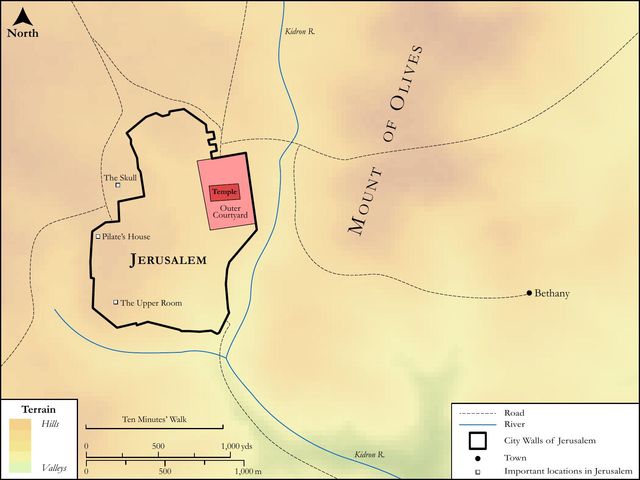
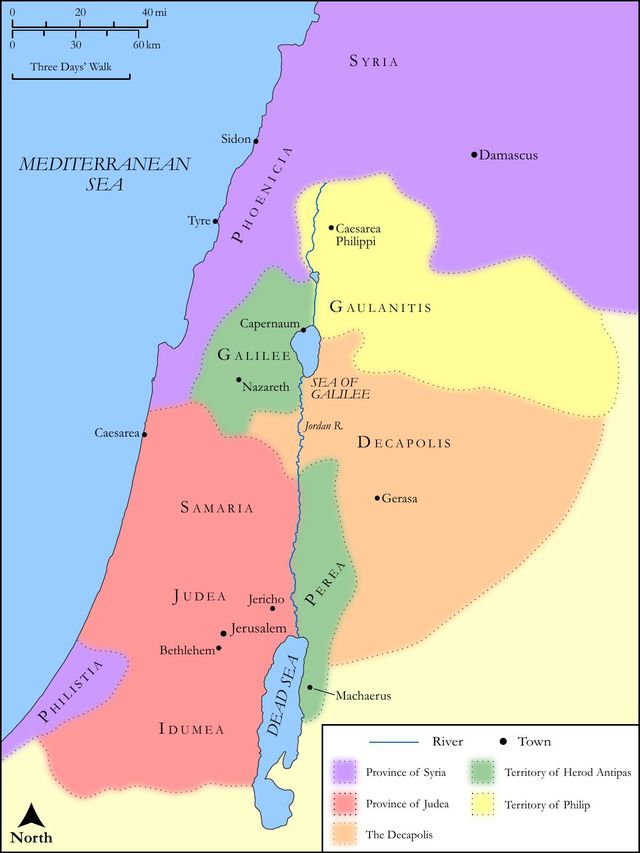
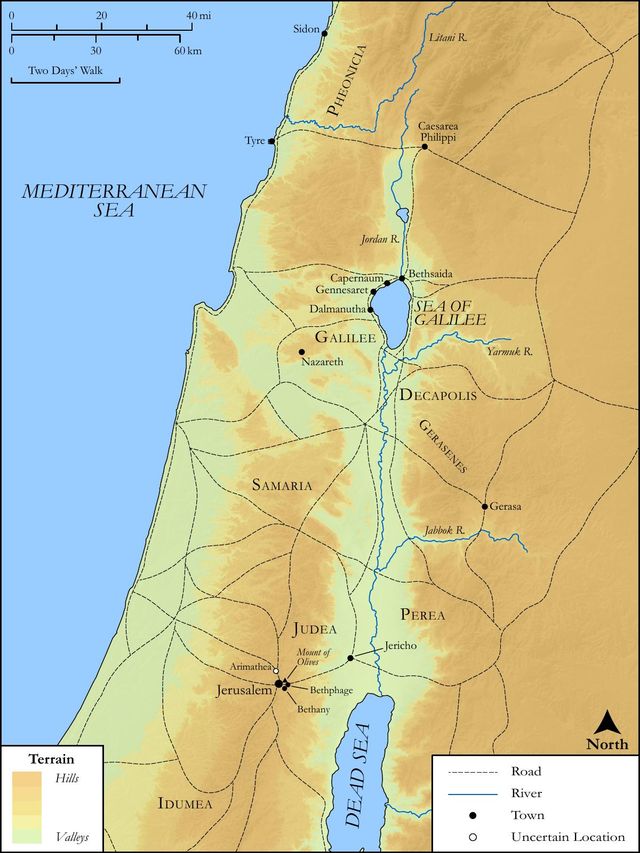
See on the biblical-era maps
Study this verse
Public-domain commentary
Matthew Henry
From his Commentary on the Whole Bible. Henry comments on passages, not single verses — this entry covers Mark 6:14–29. His four-level outline is real structure in the source text, so it is rendered as structure.
Here is, I. The wild notions that the people had concerning our Lord Jesus, Mar 6:15. His own countrymen could believe nothing great concerning him, because they knew his poor kindred; but others that were not under the power of that prejudice against him, were yet willing to believe any thing rather than the truth - that he was the Son of God, and the true Messias: they said, He is Elias, whom they expected; or, He is a prophet, one of the Old Testament prophets raised to life, and returned to this world; or as one of the prophets, a prophet now newly raised up, equal to those under the Old Testament.
II.The opinion of Herod concerning him.
He heard of his name and fame, of what he said and what he did; and he said, "It is certainly John Baptist, Mar 6:14. As sure as we are here, It is John, whom I beheaded, Mar 6:16. He is risen from the dead; and though while he was with us he did no miracle, yet, having removed for awhile to another world, he is come again with greater power, and now mighty works do show forth themselves in him."
Note, 1. Where there is an idle faith, there is commonly a working fancy. The people said, It is a prophet risen from the dead; Herod said, It is John Baptist risen from the dead. It seems by this, that the rising of a prophet from the dead, to do mighty works, was a thing expected, and was thought neither impossible nor improbable, and it was now readily suspected when it was not true; but afterward, when it was true concerning Christ, and a truth undeniably evidenced, yet then it was obstinately gainsaid and denied. Those who most wilfully disbelieve the truth, are commonly most credulous of errors and fancies.
2.They who fight against the cause of God, will find themselves baffled, even when they think themselves conquerors; they cannot gain their point, for the word of the Lord endures for ever. They who rejoiced when the witnesses were slain, fretted as much, when in three or four days they rose again in their successors, Rev 11:10, Rev 11:11. The impenitent unreformed sinner, that escapeth the sword of Jehu, shall Elisha slay.
3.A guilty conscience needs no accuser or tormentor but itself. Herod charges himself with the murder of John, which perhaps no one else dare charge him with; I beheaded him; and the terror of it made him imagine that Christ was John risen. He feared John while he lived, and now, when he thought he had got clear of him, fears him ten times worse when he is dead. One might as well be haunted with ghosts and furies, as with the horrors of an accusing conscience; those therefore who would keep an undisturbed peace, must keep an undefiled conscience, Act 24:16.
4.There may be the terrors of strong conviction, where there is not the truth of a saving conversion. This Herod, who had this notion concerning Christ, afterward sought to kill him (Luk 13:31), and did set him at nought (Luk 23:11); so that he will not be persuaded, though it be by one risen from the dead; no, not by a John the Baptist risen from the dead.
III.A narrative of Herod's putting John Baptist to death, which is brought in upon this occasion, as it was in Matthew. And here we may observe,
1.The great value and veneration which Herod had some time had for John Baptist, which is related only by this evangelist, Mar 6:20. Here we see what a great way a man may go toward grace and glory, and yet come short of both, and perish eternally.
(1.)He feared John, knowing that he was a just man, and a holy. It is possible that a man may have a great reverence for good men, and especially for good ministers, yea, and for that in them that is good, and yet himself be a bad man. Observe,
[1.]John was a just man, and a holy; to make a complete good man, both justice and holiness are necessary; holiness toward God, and justice toward men. John was mortified to this world, and so was a good friend both to justice and holiness.
[2.]Herod knew this, not only by common fame, but by personal acquaintance with him. Those that have but little justice and holiness themselves, may yet discern it with respect in others. And,
[3.]He therefore feared him, he honoured him. Holiness and justice command veneration, and many that are not good themselves, have respect for those that are.
(2.)He observed him; he sheltered him from the malice of his enemies (so some understand it); or, rather, he had a regard to his exemplary conversation, and took notice of that in him that was praiseworthy, and commended it in the hearing of those about him; he made it appear that he observed what John said and did.
(3.)He heard him preach; which was great condescension, considering how mean John's appearance was. To hear Christ himself preach in our streets will be but a poor plea in the great day, Luk 13:26.
(4.)He did many of those things which John in his preaching taught him. He was not only a hearer of the word, but in part a doer of the work. Some sins which John in his preaching reproved, he forsook, and some duties he bound himself to; but it will not suffice to do many things, unless we have respect to all the commandments.
(5.)He heard him gladly. He did not hear him with terror as Felix heard Paul, but heard him with pleasure. There is a flashy joy, which a hypocrite may have in hearing the word; Ezekiel was to his hearers as a lovely song (Eze 33:32); and the stony ground received the word with joy, Luk 8:13.
2.John's faithfulness to Herod, in telling him of his faults. Herod had married his brother Philip's wife, Mar 6:17. All the country, no doubt, cried shame on him for it, and reproached him for it; but John reproved him, told him plainly, It is not lawful for thee to have thy brother's wife. This was Herod's own iniquity, which he could not leave, when he did many things that John taught him; and therefore John tells him of this particularly. Though he were a king, he would not spare him, any more than Elijah did Ahab, when he said, Hast thou killed and also taken possession? Though John had an interest in him, and he might fear this plain-dealing would destroy his interest, yet he reproved him; for faithful are the wounds of a friend (Pro 27:6); and though there are some swine that will turn again, and rend those that cast pearls before them, yet, ordinarily, he that rebuketh a man (if the person reproved has any thing of the understanding of a man), afterwards shall find more favour than he that flattereth with his tongue, Pro 28:23. Though it was dangerous to offend Herod, and much more to offend Herodias, yet John would run the hazard rather than be wanting in his duty. Note, Those ministers that would be found faithful in the work of God, must not be afraid of the face of man. If we seek to please men, further than is for their spiritual good, we are not the servants of Christ.
3.The malice which Herodias bore to John for this (Mar 6:19); She had a quarrel with him, and would have killed him; but when she could not obtain that, she got him committed to prison, Mar 6:17. Herod respected him, till he touched him in his Herodias. Many that pretend to honour prophesying, are for smooth things only, and love good preaching, if it keep far enough from their beloved sin; but if that be touched, they cannot bear it. No marvel if the world hate those who testify of it that its works are evil. But it is better that sinners persecute ministers now for their faithfulness, than curse them eternally for their unfaithfulness.
4.The plot laid to take off John's head. I am apt to think that Herod was himself in the plot, notwithstanding his pretences to be displeased and surprised, and that the thing was concerted between him and Herodias; for it is said to be when a convenient day was come (Mar 6:21), fit for such a purpose.
(1.)There must be a ball at court, upon the king's birthday, and a supper prepared for his lords, high captains, and chief estates of Galilee.
(2.)To grace the solemnity, the daughter of Herodias must dance publicly, and Herod must take on him to be wonderfully charmed with her dancing; and if he be, they that sit with him cannot but, in compliment to him, be so too.
(3.)The king hereupon must make her an extravagant promise, to give her whatever she would ask, even to the half of the kingdom; and yet, that, if rightly understood, would not have reached the end designed, for John Baptist's head was worth more than his whole kingdom. This promise is bound with an oath, that no room might be left to fly off from it; He sware unto her, Whatsoever thou shalt ask, I will give. I can scarcely think he would have made such an unlimited promise, but that he knew what she would ask.
(4.)She, being instructed by Herodias her mother, asked the head of John Baptist; and she must have it brought her in a charger, as a pretty thing for her to play with (Mar 6:24, Mar 6:25); and there must be no delay, no time lost, she must have it by and by.
(5.)Herod granted it, and the execution was done immediately while the company were together, which we can scarcely think the king would have done, if he had not determined the matter before. But he takes on him,
[1.]To be very backward to it, and that he would not for all the world have done it, if he had not been surprised into such a promise; The king was exceeding sorry, that is, he seemed to be so, he said he was so, he looked as if he had been so; but it was all sham and grimace, he was really pleased that he had found a pretence to get John out of the way. Qui nescit dissimulare, nescit regnare - The man who cannot dissemble, knows not how to reign. And yet he was not without sorrow for it; he could not do it but with great regret and reluctancy; natural conscience will not suffer men to sin easily; the very commission of it is vexatious; what then will the reflection upon it be?
[2.]He takes on him to be very sensible of the obligation of his oath; whereas if the damsel had asked but a fourth part of his kingdom, I doubt not but he would have found out a way to evade his oath. The promise was rashly made, and could not bind him to do an unrighteous thing. Sinful oaths must be repented of, and therefore not performed; for repentance is the undoing of what we have done amiss, as far as is in our power. When Theodosius the emperor was urged by a suitor with a promise, he answered, I said it, but did not promise it if it be unjust. If we may suppose that Herod knew nothing of the design when he made that rash promise, it is probable that he was hurried into the doing of it by those about him, only to carry on the humour; for he did it for their sakes who sat with him, whose company he was proud of, and therefore would do any thing to gratify them. Thus do princes make themselves slave to those whose respect they covet, and both value and secure themselves by. None of Herod's subjects stood in more awe of him than he did of his lords, high captains, and chief estates. The king sent an executioner, a soldier of his guard. Bloody tyrants have executioners ready to obey their most cruel and unrighteous decrees. Thus Saul has a Doeg at hand, to fall upon the priests of the Lord, when his own footmen declined it.
5.The effect of this is,
(1.)That Herod's wicked court is all in triumph, because this prophet tormented them; the head is made a present of to the damsel, and by her to her mother, Mar 6:28.
(2.)That John Baptist's sacred college is all in tears; the disciples of John little thought of this; but, when they heard of it, they came, and took up the neglected corpse, and laid it in a tomb; where Herod, if he had pleased, might have found it, when he frightened himself with the fancy that John Baptist was risen from the dead.
Historical interpretation
Twelve Centuries of Reception
7 surviving comments on this verse. Each one is dated, so this reads as a timeline rather than a list.
Select a marker to jump to its quote. Markers stagger vertically where authors wrote within a few decades of each other.
Or else, The head of the law, which is Christ, is cut off from his own body, that is, the Jewish people, and is given to a Gentile damsel, that is, the Roman Church, and the damsel gives it to her adulterous mother, that is, to the synagogue, who in the end will believe. The body of John is buried, his head is put in a dish; thus the human Letter is covered over, the Spirit is honoured, and received on the altar.
Now some of the Jews thought that the destruction of Herod's army came from God, and that very justly, as a punishment of what he did against John, that was called the Baptist: for Herod slew him, who was a good man, and commanded the Jews to exercise virtue, both as to righteousness towards one another, and piety towards God, and so to come to baptism; for that the washing [with water] would be acceptable to him, if they made use of it, not in order to the putting away [or the remission] of some sins [only], but for the purification of the body; supposing still that the soul was thoroughly purified beforehand by righteousness. Now when [many] others came in crowds about him, for they were very greatly moved [or pleased] by hearing his words, Herod, who feared lest the great influence John had over the people might put it into his power and inclination to raise a rebellion, (for they seemed ready to do any thing he should advise,) thought it best, by putting him to death, to prevent any mischief he might cause, and not bring himself into difficulties, by sparing a man who might make him repent of it when it would be too late. Accordingly he was sent a prisoner, out of Herod's suspicious temper, to Macherus, the castle I before mentioned, and was there put to death. Now the Jews had an opinion that the destruction of this army was sent as a punishment upon Herod, and a mark of God's displeasure to him.
For his lustful will drove him to lay hands on a man, whom he knew to be just and holy. And by this, we may see how a less fault became the cause to him of a greater; as it is said, (Rev. 22:11) He which is filthy, let him be filthy still. It goes on, And when a convenient day was come, that Herod on his birthday made a supper to his lords, high captains, and chief estates of Galilee.
(Mor. 3, 7) I cannot, without the greatest wonder, reflect that he, who was filled even in his mother's womb with the spirit of prophecy, and who was the greatest that had arisen amongst those born of women, is sent into prison by wicked men, is beheaded for the dancing of a girl, and though a man of so great austerity, meets death through such a foul instrument. Are we to suppose that there was something evil in his life, to be wiped away by so ignominious a death? When, however, could he commit a sin even in his eating, whose food was only locusts and wild honey? How could he offend in his conversation, who never quitted the wilderness? How is it that Almighty God so despises in this life those whom He has so sublimely chosen before all ages, if it be not for the reason, which is plain to the piety of the faithful, that He thus sinks them into the lowest place, because He sees how He is rewarding them in the highest, and outwardly He throws them down amongst things despised, because inwardly He draws them up even to incomprehensible things. Let each then infer from this what they shall suffer, whom He rejects, if He so grieves those whom he loves.
(ubi sup.) Ancient history relates, that Philip, the son of Herod the great, under whom the Lord fled into Egypt, the brother of this Herod, under whom Christ suffered, married Herodias, the daughter of king Aretas; but afterwards, that his father-in-law, after certain disagreements had arisen with his son-in-law, had taken his daughter away, and, to the grief of her former husband, had given her in marriage to his enemy; therefore John the Baptist rebukes Herod and Herodias for contracting an unlawful union, and because it was not allowed for a man to marry his brother's wife during his lifetime.
(ubi sup.) For Herodias was afraid, lest Herod should repent at some time, or be reconciled to his brother Philip, and so the unlawful marriage be divorced. It goes on, For Herod feared John, knowing that he was a just man, and an holy.
(ubi sup.) The only men whom we read of, as celebrating their birthdays with festive joys are Herod and Pharaoh, but each, with an evil presage, stained his birthday with blood; Herod, however, with so much the greater wickedness, as he slew the holy and guiltless teacher of truth, and that, by the wish, and at the instance of a female dancer. For there follows. And when the daughter of the said Herodias came in, and danced, and pleased Herod and them that sat with him, the king said unto the damsel, Ask of me whatsoever thou wilt, and I will give it thee.
(ubi sup.) His oath does not excuse his murder, for perchance his reason for swearing was, that he might find an opportunity for slaying, and if she had demanded the death of his father and mother, he surely would not have granted it. It goes on, And she went forth, and said unto her mother, What shall I ask? And she said, The head of John the Baptist. Worthy is blood to be asked as the reward of such a deed as dancing. It goes on, And she came in straightway with haste, &c.
(ubi sup.) It is usual with Scripture, that the historian should relate events as they were then believed by all, thus Joseph is called the father of Jesus by Mary herself. So now also Herod is said to be exceeding sorry, for so the guests thought, since the hypocrite bore sadness on his face, when he had joy in his heart; and he excuses his wickedness by his oath, that he might be impious under pretence of piety. Wherefore there follows, For his oath's sake, and for their sakes who sat with him, he would not reject her.
(ubi sup.) In that again which is added, And for their sakes who sat with him, he wishes to make all partakers in his guilt, that a bloody feast might be set before luxurious and impure guests. Wherefore it goes on, But sending an executioner, he commanded his head to be brought in a charger.
Now Herod was not ashamed to bring before his guests the head of a murdered man; but we do not read of such an act of madness in Pharaoh. From both examples, however, it is proved to be more useful, often to call to mind the coming day of our death, by fear and by living chastely, than to celebrate the day of our birth with luxury. For man is born in the world to toil, but the elect pass by death out of the world to repose. It goes on, And he beheaded him in prison, &c.
(ubi sup.) There follows, And when his disciples heard of it, they came and took up his corpse, and laid it in a tomb. Josephus relates, that John was brought bound into the castle of Macheron, and there slain; and ecclesiastical history (Theodoret. Hist. Eccles. 3:3) says that he was buried in Sebaste, a city of Palestine, once called Samaria. But the beheading of John the Baptist signifies the lessening of that fame, by which he was thought to be Christ by the people, as the raising of our Saviour on the cross typifies the advance of the faith, in that He Himself, who was first looked upon as a prophet by the multitude, was recognised as the Son of God by all the faithful; wherefore John, who was destined to decrease, was born when the daylight begins to wax short; but the Lord at that season of the year in which the day begins to lengthen.
The Evangelist Mark, taking occasion from what went before, here relates the death of the Forerunner, saying, For Herod himself had sent forth and laid hold upon John, and bound him in prison for Herodias' sake, his brother Philip's wife: for he had married her.
The law also commanded a brother to marry his brother's wife, if he died without children; but in this case there was a daughter, which made the marriage criminal: there follows, Therefore Herodias had a quarrel against him, and would have killed him; but she could not.
But see how great is the fury of lust, for though Herod had such an awe and fear of John, he forgets it all, that he may minister to his fornication.
For during the banquet, Satan danced in the person of the damsel, and the wicked oath is completed. For it goes on, And he sware unto her, Whatsoever thou shalt ask of me, I will give it thee, unto the half of my kingdom.
The malignant woman begs that the head of John be given to her immediately, that is, at once, in that very hour, for she feared lest Herod should repent. There follows, And the king was exceeding sorry.
Herod not being his own master, but full of lust, fulfilled his oath, and slew the just man; it would have been better however to break his oath, than to commit so great a sin.
'Spiculator' is the name for the public servant commissioned to put men to death.
In a mystical way, however, Herod, whose name means, 'of skin,' is the people of the Jews, and the wife to whom he was wedded means vain glory, whose daughter even now encircles the Jews with her dance, namely, a false understanding of the Scriptures; they indeed beheaded John, that is, the word of prophecy, and hold to him without Christ, his head.
(non occ.) He feared him, I say, because he revered him, for he knew him to be just in his dealings with men, and holy towards God, and he took care that Herodias should not slay him. And when he heard him, he did many things, for he thought that he spake by the Spirit of God, and heard him gladly, because he considered that what he said was profitable.
Continue studying Mark 6:25 across the web’s major study libraries — every link below opens this exact verse, chapter, or book on the destination site.
Read & Compare
 BibleGatewayThis verse in more than 200 translations and 70 languages.
 Bible.comThe YouVersion reader — hundreds of translations, reading plans, and highlights.
 ESV.orgCrossway's official English Standard Version reader.
 NET BibleThe NET translation with 60,000+ translators' notes on every rendering decision.
 STEP BibleTyndale House's free study tool — original text, vocabulary, and scholarly resources.
 BibliaLogos Bible Software's free web reader.
 USCCBThe New American Bible (Revised Edition) with the U.S. bishops' study notes.
Commentaries
 BibleHub CommentariesDozens of classic commentaries on this verse, gathered on one page.
 StudyLightMore than 100 commentary sets — the largest collection on the web.
 BibleRefPlain-English commentary on what this verse means, verse by verse.
 Enduring WordDavid Guzik's free commentary on this chapter, widely used by Bible teachers.
 Bible Study ToolsVerse commentary alongside Greek and Hebrew study aids.
Original Language & Research
- BibleHub InterlinearThe verse word by word — original language, transliteration, and English.
- BibleHub LexiconEvery word's original-language definition and Strong's entry.
 Blue Letter BibleDeep-study tools — Strong's numbers, concordance, and word studies.
 CNTR CollationThe earliest Greek manuscripts of this verse, collated letter by letter.
Sermons, Hymns & Audio


TrulyRandomVerse is not affiliated with these sites and doesn’t control their content. They’re linked because they’re genuinely useful.
Summary
Mark 6:25 captures the chilling moment when Salome, prompted by her vindictive mother Herodias, returns to King Herod Antipas with a shocking and immediate demand: the head of John the Baptist on a platter. This pivotal verse marks the horrific culmination of a plot fueled by malice, a rash oath, and the tragic silencing of a righteous prophet, revealing the destructive power of unchecked sin and the vulnerability of truth in the face of corrupt authority.
Context
ShowHideLiterary Context
This verse is the grim climax of the narrative detailing the imprisonment and execution of John the Baptist, which begins in Mark 6:14. The preceding verses establish Herod's complex relationship with John—he both feared and respected John, even listening to him gladly (Mark 6:20). However, Herodias, his unlawfully wedded wife, harbored a deep-seated hatred for John due to his condemnation of their marriage (Mark 6:17-18). The opportunity for her revenge arises during Herod's birthday feast, where Salome's captivating dance leads Herod to make a public, extravagant, and rash oath to grant her anything she desires, up to half his kingdom (Mark 6:21-23). It is Herodias who instructs Salome to request John's head, setting the stage for this verse's shocking demand and the subsequent execution.
Historical & Cultural Context
Herod Antipas, a tetrarch ruling Galilee and Perea under Roman authority, was known for his political maneuvering and moral compromises. His marriage to Herodias, his brother Philip's wife, was a violation of Jewish law, specifically Leviticus 18:16 and 20:21, making John's public rebuke a direct challenge to his authority and legitimacy in the eyes of many Jews. In that day, public oaths, especially by rulers, were considered binding, regardless of their content or the circumstances under which they were made. To renege on such an oath would lead to immense public shame and a loss of honor, a concept paramount in that culture. The "charger" (a large platter) was a common serving dish, but its use here for a human head underscores the gruesome and barbaric nature of the request, highlighting the depths of Herodias's malice and Herod's moral weakness.
Key Themes
ShowHideMark 6:25 powerfully contributes to several overarching themes within the Gospel of Mark and broader biblical narrative. It starkly illustrates the theme of the cost of truth and prophetic integrity, as John the Baptist pays the ultimate price for speaking God's truth to power, foreshadowing the persecution of Jesus himself. It highlights the destructive nature of sin, particularly malice and revenge, exemplified by Herodias's unrelenting hatred and manipulation. The narrative also underscores the perilous consequences of rash oaths and moral weakness, as Herod's pride and fear of public humiliation trap him into fulfilling a horrific promise. Finally, it touches upon the theme of manipulation and the corruption of innocence, as Salome, though the one making the demand, is clearly a pawn in her mother's vengeful scheme, demonstrating how easily individuals can be used for wicked purposes when influenced by evil.
Exposition and Analysis
ShowHideKey Word Analysis
ShowHideThis adverb (G2112) signifies an immediate, direct, or instantaneous action. Coupled with "with haste," it emphasizes the urgency and lack of hesitation in Salome's return, indicating the predetermined nature of her request and the swiftness with which Herodias's vengeful plan was set into motion.
The verb (G2309) expresses a strong, deliberate act of the will, a determined choice or desire. It conveys Salome's (or rather, Herodias's through Salome's mouth) resolute and unwavering demand, leaving no room for negotiation or reconsideration. It is not a polite request but a forceful declaration of intent.
This noun (G4094) refers to a flat board, plate, or platter. Its specific mention here underscores the gruesome detail of the request—not merely the execution, but the public display of the severed head, turning a serving dish into an instrument of terror and a symbol of Herodias's grotesque triumph.
Verse Breakdown
ShowHide"And she came in straightway with haste unto the king"
This clause emphasizes the immediate and urgent nature of Salome's return. There is no delay, no hesitation, indicating a predetermined course of action, likely instructed by her mother. The "haste" (Greek, spoudḗ) conveys a sense of eager dispatch, not necessarily out of personal desire, but out of obedience to Herodias's malicious instruction.
"and asked, saying, I will that thou give me by and by"
Salome's "asking" is presented as a direct, forceful demand rather than a polite request, reinforced by the strong declaration "I will." The archaic English phrase "by and by" translates the Greek exautēs (G1824), meaning "immediately" or "instantly," not "eventually." This highlights the urgency and the expectation of immediate fulfillment, leaving no time for Herod to reconsider his rash oath.
"in a charger the head of John the Baptist"
This is the horrific core of the demand. The specificity of "the head" and "in a charger" reveals the extreme malice behind the request. It is not just John's death, but the gruesome, public display of his severed head, designed to humiliate, terrorize, and ensure his prophetic voice is definitively silenced.
Literary Devices
ShowHideMark 6:25 is rich with Dramatic Irony, as the reader is fully aware of Herodias's long-standing hatred for John and her desire for his death, while Herod is trapped by his own pride and a rash oath. The verse also employs Pathos, evoking a sense of tragedy and sorrow for John the Baptist, a righteous man brought to a brutal end by the machinations of corrupt power. The specific mention of "the head" on a "charger" serves as vivid Symbolism, where the head, often representing intellect, authority, and prophetic voice, is explicitly targeted for silencing, and the charger, typically for food, becomes a grotesque instrument of death, underscoring the perversion of the celebratory feast. The Foreshadowing of John's death has been present since Herodias's initial desire to kill him, and this verse brings that dark premonition to its chilling fulfillment.
Theological and Thematic Connections
ShowHideThis verse starkly illustrates the profound conflict between the kingdom of God and the kingdoms of this world. John the Baptist, a prophet of righteousness, confronts the moral corruption of Herod's court, embodying the biblical truth that God's standards often clash with worldly power and human depravity. The immediate and gruesome nature of the demand underscores the destructive power of unchecked malice, pride, and the tragic consequences of compromising moral principles for the sake of public image or convenience. It serves as a somber reminder that faithfulness to God's truth can come at a great personal cost, yet it is a cost worth paying for the sake of divine integrity.
Reflection and Application
ShowHideMark 6:25 stands as a powerful and unsettling narrative, urging us to reflect on the moral compromises we might make and the dangers of allowing unchecked desires to fester in our hearts. It challenges us to consider the integrity of our own words and commitments, particularly in moments of pressure or pride. Just as Herod was ensnared by a rash oath, we too can find ourselves trapped by impulsive decisions or a desire to please others over upholding what is right. This passage also calls us to consider the courage required to speak truth, even when it is unpopular or dangerous, and to recognize the spiritual battle against the forces of malice and manipulation that seek to silence righteous voices. Ultimately, it encourages us to cultivate wisdom, discernment, and an unwavering commitment to God's truth, rather than succumbing to the fleeting pressures or corrupting influences of the world.
Questions for Reflection
ShowHideFAQ
ShowHideWhy did Herod agree to such a gruesome request, especially if he respected John?
ShowHideHerod's decision to fulfill Salome's horrific request, despite his personal respect and fear for John the Baptist, stemmed from a complex interplay of factors. Primarily, he was trapped by his own rash oath made publicly before his nobles, military commanders, and leading men of Galilee (Mark 6:21). Among kings, a king's word, especially a sworn oath, was considered binding and a matter of honor; to break it would result in immense public shame and a perceived loss of authority. Furthermore, Herodias's relentless manipulation and deep-seated hatred for John played a crucial role (Mark 6:19). She seized the opportunity to finally silence her critic. While Herod was "greatly distressed" (Mark 6:26), his pride and fear of public humiliation outweighed his moral qualms and his respect for John, leading him to commit this heinous act.
Christ-Centered Fulfillment
ShowHideThe tragic martyrdom of John the Baptist, as depicted in Mark 6:25, serves as a poignant foreshadowing of the ultimate sacrifice of Jesus Christ. John, the forerunner, faithfully prepared the way for the Messiah, rebuking the powerful and challenging the spiritual and moral decay of his generation, much like the prophets of old. His unjust execution by a corrupt worldly authority, driven by malice and a rash promise, mirrors the rejection and crucifixion of Jesus, who also faced the wrath of those whose power and traditions were threatened by divine truth (John 1:11). Both John and Jesus were innocent victims of human sin and political expediency. However, while John's death marked the end of his earthly ministry, Jesus's death on the cross was not an end but a redemptive act, the very means by which God accomplished salvation for humanity (Philippians 2:8). John's head on a platter symbolized the silencing of a prophet; Jesus's broken body and shed blood on the cross became the ultimate, triumphant declaration of God's love and victory over sin and death, leading to a glorious resurrection that forever broke the power of the grave (Romans 6:9). Thus, John's sacrifice points forward to the greater, saving sacrifice of the Lamb of God, who truly takes away the sin of the world (John 1:29).