


Mark 15:1
Bible text: King James Version (1769 Blayney text) · Public domain
Bible text: King James Version with Strong's numbers · Public domain
Bible text: Berean Standard Bible · Public domain
Bible text: American Standard Version (1901) · Public domain
Bible text: World English Bible, Messianic edition · Public domain
Bible text: Geneva Bible (1599) · Public domain
Bible text: Young's Literal Translation · Public domain
- ΚαὶKaiAndG2532CONJConjunction
- εὐθὺςeuthusearlyG2112ADVAdverb
- ἐπὶepiuponG1909PREPPreposition
- τὸto<the>G3588T-NSNDefinite article Nominative Singular Neuter
- πρωῒprōiin the morningG4404ADVAdverb
- συμβούλιονsumbouliona counselG4824N-ASNNoun Accusative Singular Neuter
- ποιήσαντεςpoiēsanteshaving formedG4160V-AAP-NPMVerb Aorist Active Participle Nominative Plural Masculine
- οἱhoitheG3588T-NPMDefinite article Nominative Plural Masculine
- ἀρχιερεῖςarchiereischief priestsG749N-NPMNoun Nominative Plural Masculine
- μετὰmetawithG3326PREPPreposition
- τῶνtōntheG3588T-GPMDefinite article Genitive Plural Masculine
- πρεσβυτέρωνpresbuterōneldersG4245N-GPMNoun Genitive Plural Masculine
- καὶkaiandG2532CONJConjunction
- γραμματέωνgrammateōnscribesG1122N-GPMNoun Genitive Plural Masculine
- καὶkaiandG2532CONJConjunction
- ὅλονholonallG3650A-NSNAdjective Nominative Singular Neuter
- τὸtotheG3588T-NSNDefinite article Nominative Singular Neuter
- συνέδριονsunedrionCouncilG4892N-NSNNoun Nominative Singular Neuter
- δήσαντεςdēsanteshaving boundG1210V-AAP-NPMVerb Aorist Active Participle Nominative Plural Masculine
- τὸνton<the>G3588T-ASMDefinite article Accusative Singular Masculine
- ἸησοῦνIēsounJesusG2424N-ASM-PNoun Accusative Singular Masculine Individual
- ἀπήνεγκανapēnegkanthey led [Him] awayG667V-AAI-3PVerb Aorist Active Indicative 3rd Plural
- καὶkaiandG2532CONJConjunction
- παρέδωκανparedōkandelivered [Him]G3860V-AAI-3PVerb Aorist Active Indicative 3rd Plural
- τῷtō<the>G3588T-DSMDefinite article Dative Singular Masculine
- ΠιλάτῳPilatōto PilateG4091N-DSM-PNoun Dative Singular Masculine Individual
English is a literal word-by-word gloss of the Greek, not the KJV's wording. Why?
This is the original text the KJV's translators worked from — each Greek word with its own literal English meaning in this verse, prepared by scholars at Tyndale House, Cambridge. The KJV translates whole sentences, not word by word, so its wording differs: one Greek word can become several English words, and the KJV may choose “charity” where the gloss reads “love”. Both are faithful — they answer different questions. For the KJV's own rendering, switch to the KJV text.
Details
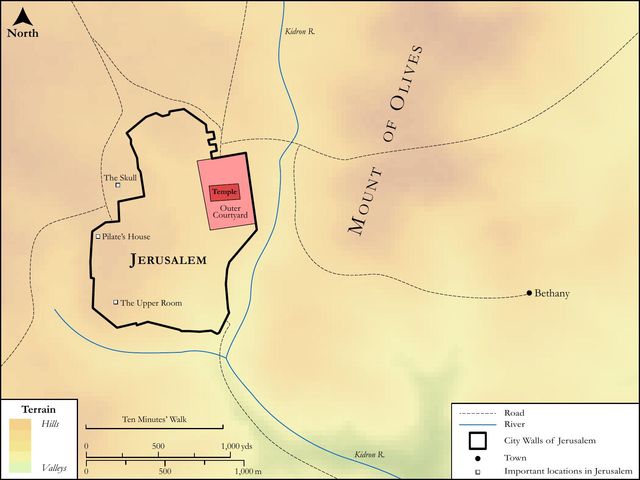
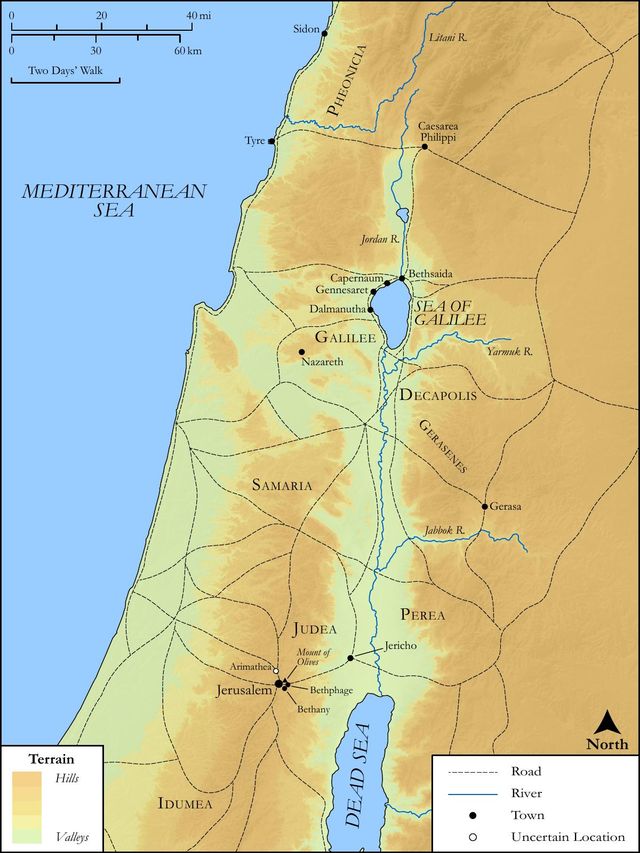
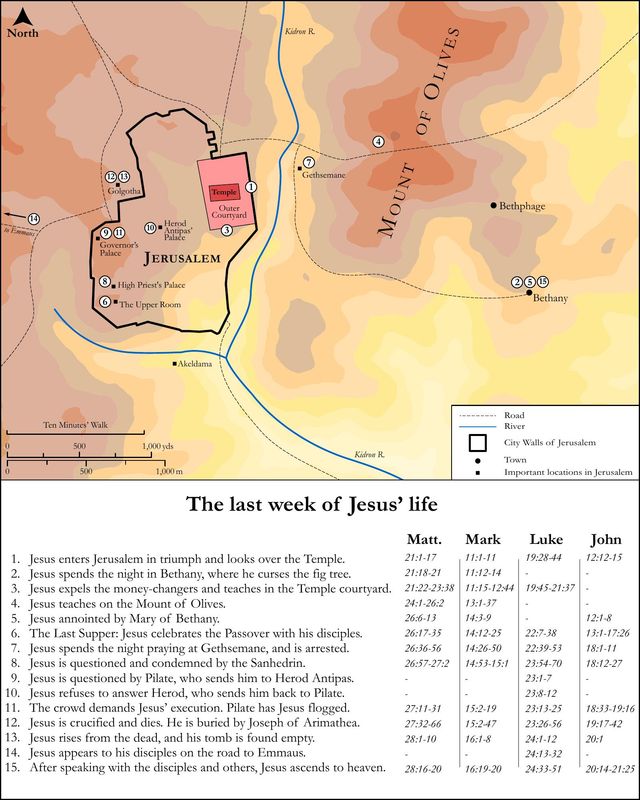
See on the biblical-era maps
Study this verse
Public-domain commentary
Matthew Henry
From his Commentary on the Whole Bible. Henry comments on passages, not single verses — this entry covers Mark 15:1–14. His two-level outline is real structure in the source text, so it is rendered as structure.
Here we have, I. A consultation held by the great Sanhedrim for the effectual prosecution of our Lord Jesus. They met early in the morning about it, and went into a grand committee, to find out ways and means to get him put to death; they lost no time, but followed their blow in good earnest, lest there should be an uproar among the people. The unwearied industry of wicked people in doing that which is evil, should shame us for our backwardness and slothfulness in that which is good. They that war against Christ and thy soul, are up early; How long then wilt thou sleep, O sluggard?
II.The delivering of him up a prisoner to Pilate; they bound him.
He was to be the great sacrifice, and sacrifices must be bound with cords, Psa 118:27. Christ was bound, to make bonds easy to us, and enable us, as Paul and Silas, to sing in bonds. It is good for us often to remember the bonds of the Lord Jesus, as bound with him who was bound for us. They led him through the streets of Jerusalem, to expose him to contempt, who, while he taught in the temple, but a day or two before, was had in veneration; and we may well imagine how miserably he looked after such a night's usage as he had had; so buffeted, spit upon, and abused. Their delivering him to the Roman power was a type of ruin of their church, which hereby they merited, and brought upon themselves; it signified that the promise, the covenant, and the oracles, of God, and the visible state church, which were the glory of Israel, and had been so long in their possession, should now be delivered up to the Gentiles. By delivering up the king they do, in effect, deliver up the kingdom of God, which is therefore, as it were, by their own consent, taken from them, and given to another nation. If they had delivered up Christ, to gratify the desires of the Romans, or to satisfy and jealousies of theirs concerning him, it had been another matter; but they voluntarily betrayed him that was Israel's crown, to them that were Israel's yoke.
III.The examining of him by Pilate upon interrogatories (Mar 15:2); "Art thou the king of the Jews? Dost thou pretend to be so, to be that Messiah whom the Jews expect as a temporal prince?" - "Yea," saith Christ, "it is as thou sayest, I am that Messiah, but not such a one as they expect." He is the king that rules and protects his Israel according to the spirit, who are Jews inwardly by the circumcision of the spirit, and the king that will restrain and punish the carnal Jews, who continue in unbelief.
IV.The articles of impeachment exhibited against him, and his silence under the charge and accusation.
The chief priests forgot the dignity of their place, when they turned informers, and did in person accuse Christ of many things (Mar 15:3), and witness against him, Mar 15:4. Many of the Old Testament prophets charge the priests of their times with great wickedness, in which well did they prophesy of these priests; see Eze 22:26; Hos 5:1; Hos 6:9; Mic 3:11; Zep 3:4; Mal 1:6; Mal 2:8. The destruction of Jerusalem by the Chaldeans is said to be for the iniquity of the priests that shed the blood of the just, Lam 4:13. Note, Wicked priests are generally the worst of men. The better any thing is, the worse it is when it is corrupted. Lay persecutors have been generally found more compassionate than ecclesiastics. These priests were very eager and noisy in their accusation; but Christ answered nothing, Mar 15:3. When Pilate urged him to clear himself, and was desirous he should (Mar 15:4), yet still he stood mute (Mar 15:5), he answered nothing, which Pilate thought very strange. He gave Pilate a direct answer (Mar 15:2), but would not answer the prosecutors and witnesses, because the things they alleged, were notoriously false, and he knew Pilate himself was convinced they were so. Note, As Christ spoke to admiration, so he kept silence to admiration.
V.The proposal Pilate made to the people, to have Jesus released to them, since it was the custom of the feast to grace the solemnity with the release of one prisoner. The people expected and demanded that he should do as he had ever done to them (Mar 15:8); it was not an ill usage, but they would have it kept up. Now Pilate perceived that the chief priests delivered up Jesus for envy, because he had got such a reputation among the people as eclipsed theirs, Mar 15:10. It was easy to see, comparing the eagerness of the prosecutors with the slenderness of the proofs, that it was not his guilt, but his goodness, not any thing mischievous or scandalous, but something meritorious and glorious, that they were provoked at. And therefore, hearing how much he was the darling of the crowd, he thought that he might safely appeal from the priests to the people, and that they would be proud of rescuing him out of the priests' hands; and he proposed an expedient for their doing it without danger of an uproar; let them demand him to be released, and Pilate will be ready to do it, and stop the mouths of the priests with this - that the people insisted upon his release. There was indeed another prisoner, one Barabbas, that had an interest, and would have some votes; but he questioned not but Jesus would out-poll him.
VI.The unanimous outrageous clamours of the people have Christ put to death, and particularly to have him crucified.
It was a great surprise to Pilate, when he found the people so much under the influence of the priests, that they all agreed to desire that Barabbas might be released, Mar 15:11. Pilate opposed it all he could; "What will ye that I shall do to him whom ye call the King of the Jews? Would not ye then have him released too?" Mar 15:12. No, say they, Crucify him. The priests having put that in their mouths, the insist upon it; when Pilate objected, Why, what evil has he done? (a very material question in such a case), they did not pretend to answer it, but cried out more exceedingly, as they were more and more instigated and irritated by the priests, Crucify him, crucify him. Now the priests, who were very busy dispersing themselves and their creatures among the mob, to keep up the cry, promised themselves that it would influence Pilate two ways to condemn him.
1.It might incline him to believe Christ guilty, when there was so general an out-cry against him. "Surely," might Pilate think, "he must needs be a bad man, whom all the world is weary of." He would now conclude that he had been misinformed, when he was told what an interest he had in the people, and that the matter was not so. But the priest had hurried on the prosecution with so much expedition, that we may suppose that they who were Christ's friends, and would have opposed this cry, were at the other end of the town, and knew nothing of the matter. Note, It has been the common artifice of Satan, to put Christ and his religion into an ill name, and so to run them down. When once this sect, as they called it, comes to be every where spoken against, though without cause, then that is looked upon as cause enough to condemn it. But let us judge of persons and things by their merits, and the standard of God's word, and not prejudge by common fame and the cry of the country.
2.It might induce him to condemn Christ, to please the people, and indeed for fear of displeasing them. Though he was not so weak as to be governed by their opinion, to believe him guilty, yet he was so wicked as to be swayed by their outrage, to condemn him, though he believed him innocent; induced thereunto by reasons of state, and the wisdom of the world. Our Lord Jesus dying as a sacrifice for the sins of many, he fell a sacrifice to the rage of many.
Historical interpretation
Nine Centuries of Reception
4 surviving comments on this verse. Each one is dated, so this reads as a timeline rather than a list.
Select a marker to jump to its quote. Markers stagger vertically where authors wrote within a few decades of each other.
For Him it behoved to be made a sacrifice on behalf of all Gentiles, who "was led as a sheep for a victim, and, like a lamb voiceless before his shearer, so opened not His mouth" (for He, when Pilate interrogated Him, spake nothing ); for "in humility His judgment was taken away: His nativity, moreover, who shall declare? "Because no one at all of human beings was conscious of the nativity of Christ at His conception, when as the Virgin Mary was found pregnant by the word of God; and because "His life was to be taken from the land.
(in Marc. 4, 44) The Jews had a custom of delivering him whom they had condemned to death, bound to the judge. Wherefore after the condemnation of Christ, the Evangelist adds: And straightway in the morning the Chief Priests held a consultation with the elders and Scribes and the whole council, and bound Jesus, and carried him away, and delivered him to Pilate. But it must be observed, that they did not then first bind Him, but they bound Him on first taking Him in the garden by night, as John declares.
(ubi sup.) By Pilate's asking Him about no other accusation, except whether He was King of the Jews, they are convicted of impiety, for they could not even find a false accusation against our Saviour. It goes on: And he answering said unto him, Thou sayest. He answers in this way so as both to speak the truth, and yet not to be open to cavil.
(ubi sup.) He indeed who condemns Jesus is a heathen, but he refers it to the people of the Jew's as the cause. There follows: But Jesus yet answered nothing; so that Pilate marvelled. He was unwilling to give an answer, lest He should clear Himself of the charge, and be acquitted by the judge, and so the gain resulting from the Cross should be done away.
And immediately, forming a plan, in the morning the chief priests with the elders and scribes and the whole council, binding Jesus, led Him away and delivered Him to Pilate. He was led not only to Pilate but also to Herod, so that both might mock the Lord. And observe the priests' diligence in evil. All night they stayed awake to commit murder, and they handed over the bound one to Pilate. For they had this custom, that whoever they sentenced to death, they handed over bound to the judge. Nevertheless, it should be noted that they did not bind Him for the first time then, but as soon as He was apprehended in the night in the garden, as John declares, they bound Him and thus brought Him first to Annas.
They then gave Jesus up to the Romans, but were themselves given up by God into the hands of the Romans, that the Scriptures might be fulfilled, which say, Recompense them after the work of their hands. (Ps. 28:5) It goes on: And Pilate asked him, Art thou the King of the Jews?
For His answer is doubtful, since it may mean, Thou sayest, but I say not so. 1And observe that He does somewhere answer Pilate, who condemned Him unwillingly, but does not choose to answer the priests and great men, and judges them unworthy of a reply. It goes on: And the Chief Priests accused him of many things.
But Pilate wondered, because, though He was a teacher of the law, and eloquent, and able by His answer to destroy their accusations, He did not answer any thing, but rather bore their accusations courageously.
Continue studying Mark 15:1 across the web’s major study libraries — every link below opens this exact verse, chapter, or book on the destination site.
Read & Compare
 BibleGatewayThis verse in more than 200 translations and 70 languages.
 Bible.comThe YouVersion reader — hundreds of translations, reading plans, and highlights.
 ESV.orgCrossway's official English Standard Version reader.
 NET BibleThe NET translation with 60,000+ translators' notes on every rendering decision.
 STEP BibleTyndale House's free study tool — original text, vocabulary, and scholarly resources.
 BibliaLogos Bible Software's free web reader.
 USCCBThe New American Bible (Revised Edition) with the U.S. bishops' study notes.
Commentaries
 BibleHub CommentariesDozens of classic commentaries on this verse, gathered on one page.
 StudyLightMore than 100 commentary sets — the largest collection on the web.
 BibleRefPlain-English commentary on what this verse means, verse by verse.
 Enduring WordDavid Guzik's free commentary on this chapter, widely used by Bible teachers.
 Bible Study ToolsVerse commentary alongside Greek and Hebrew study aids.
Original Language & Research
- BibleHub InterlinearThe verse word by word — original language, transliteration, and English.
- BibleHub LexiconEvery word's original-language definition and Strong's entry.
 Blue Letter BibleDeep-study tools — Strong's numbers, concordance, and word studies.
 CNTR CollationThe earliest Greek manuscripts of this verse, collated letter by letter.
Sermons, Hymns & Audio


TrulyRandomVerse is not affiliated with these sites and doesn’t control their content. They’re linked because they’re genuinely useful.
Summary
Mark 15:1 recounts the pivotal moment immediately following Jesus' nocturnal Jewish trial, where the chief priests, elders, scribes, and the entire Sanhedrin reconvened at dawn to formalize their decision and transfer Jesus, bound, into the custody of Pontius Pilate, the Roman governor. This act marked the critical transition from the Jewish religious condemnation to the Roman legal process that would ultimately lead to His crucifixion, underscoring the relentless determination of His accusers and the divine orchestration of His passion.
Context
ShowHideLiterary Context
This verse serves as a crucial bridge in Mark's narrative, connecting the hurried, illegal Jewish trial of Jesus (detailed in Mark 14:53-65) with the subsequent Roman trial before Pilate. The preceding chapter describes Jesus' arrest in Gethsemane, Peter's denial, and the Sanhedrin's condemnation of Jesus for blasphemy. Mark 15:1 signals the immediate next step: the Jewish authorities, having rendered their verdict, now need the Roman power to execute it, as they lacked the legal authority to impose a death sentence under Roman occupation. The transition is swift and deliberate, emphasizing the urgency of their intent.
Historical & Cultural Context
Judea was under Roman occupation, and while the Jewish Sanhedrin (the "whole council") held significant religious and civil authority, they were explicitly denied the right to carry out capital punishment without Roman approval. This historical reality, confirmed by sources like the Talmud and Josephus, necessitated the handover of Jesus to Pilate. The phrase "straightway in the morning" is significant; Jewish law stipulated that capital cases could not be tried at night, and any verdict reached at night had to be confirmed in the morning. This morning "consultation" (Greek: symboulion poiesantes) was likely a formal ratification of the previous night's condemnation and a strategic planning session to formulate charges palatable to Roman law (e.g., sedition, claiming to be "King of the Jews," which was treason against Caesar), rather than the religious charge of blasphemy.
Key Themes
ShowHideMark 15:1 powerfully introduces several key themes. The urgency and determination of the accusers are highlighted by their immediate action "in the morning," demonstrating their relentless pursuit of Jesus' death. This verse also marks a critical transition of authority, as jurisdiction shifts from Jewish religious law to Roman civil law, underscoring the Jewish leaders' subjugation under Roman rule, a point also emphasized in John 18:31. Furthermore, Jesus' passive acceptance of being "bound" and "carried away" foreshadows His willing submission to the Father's plan, aligning with the prophetic imagery of the suffering servant who would not resist (Isaiah 53:7). Finally, the delivery "to Pilate" introduces the crucial figure of the Roman governor, whose role is central to the legal and political dimensions of Jesus' Passion, as seen throughout Mark 15.
Exposition and Analysis
ShowHideKey Word Analysis
ShowHideThis adverb signifies immediacy and directness, indicating that the actions described (the consultation, binding, carrying away, and delivery to Pilate) occurred without delay, right at dawn. It underscores the intense resolve and urgency of the Jewish authorities to expedite Jesus' condemnation and execution.
A primary verb meaning "to bind" in various applications, literally or figuratively. Here, it literally describes the physical restraint placed upon Jesus, symbolizing His capture and the stripping away of His freedom. Figuratively, it speaks to the powerlessness of His human state in the face of His captors, yet paradoxically, His willing submission to the divine plan.
From para (alongside) and didōmi (to give), meaning "to surrender, yield up, intrust, transmit." This word precisely describes the act of handing Jesus over from the Jewish authorities to Pilate. It carries a strong connotation of betrayal and surrender, a key theme throughout the Passion narrative, particularly in relation to Judas's actions.
Verse Breakdown
ShowHide"And straightway in the morning"
This phrase emphasizes the immediate and decisive action taken by the Jewish leaders at the very break of day. It highlights their urgency and determination to move forward with Jesus' condemnation without delay, indicating a formal, perhaps pre-arranged, re-convening after the night trial.
"the chief priests held a consultation with the elders and scribes and the whole council"
This identifies the full Sanhedrin, the supreme Jewish religious and judicial body, as the unified party responsible for the decision. The "consultation" (Greek: symboulion poiesantes) suggests a strategic meeting to formalize their verdict and plan their approach to Pilate, ensuring their charges would be politically effective under Roman law.
"and bound Jesus, and carried him away"
This describes the physical actions taken against Jesus. Being "bound" signifies His status as a prisoner, stripped of freedom and dignity, while being "carried away" indicates His forced removal from the Jewish court to the Roman praetorium, a public spectacle of His humiliation.
"and delivered him to Pilate"
This is the climactic action of the verse, marking the formal transfer of jurisdiction. The Jewish authorities, unable to execute a death sentence themselves, surrender Jesus to the Roman governor, Pontius Pilate, thereby initiating the final phase of His trial and setting the stage for His crucifixion.
Literary Devices
ShowHideMark 15:1 employs several literary devices to convey its profound message. The phrase "straightway in the morning" functions as a powerful Transition, signaling an immediate shift from the clandestine night trial to the public, official Roman proceedings. This sense of urgency heightens the dramatic tension. The act of the Sanhedrin "holding a consultation" after the night's trial, rather than immediately sending Jesus to Pilate, introduces a subtle Irony: despite their condemnation of Jesus for blasphemy, they must now strategize how to present Him to a pagan Roman governor, demonstrating their own political impotence under Roman rule. Furthermore, Jesus being "bound" and "carried away" serves as potent Symbolism of His complete vulnerability and submission to the will of His accusers, yet paradoxically, it also foreshadows His willing surrender to the Father's plan for atonement. The entire verse acts as a Foreshadowing of the Roman trial and the ultimate crucifixion, setting the stage for the climactic events of the Passion.
Theological and Thematic Connections
ShowHideMark 15:1 is deeply significant, illustrating the convergence of human injustice and divine sovereignty. The relentless pursuit of Jesus by the Jewish authorities, culminating in their formal handover to Pilate, underscores the depth of human sin and opposition to God's Anointed One. Yet, within this narrative of betrayal and legal maneuvering, there is a profound theological truth: Jesus' willing submission to being bound and delivered was not a sign of weakness, but an act of profound obedience to His Father's will, a necessary step in the unfolding of God's redemptive plan. This moment highlights the principle that even the wicked actions of humanity can be providentially used by God to accomplish His ultimate purposes, demonstrating His sovereign control over all events, including the most heinous acts of injustice.
Reflection and Application
ShowHideMark 15:1 invites us to reflect on the nature of justice, power, and submission. We witness the full force of human institutions—religious and political—conspiring against an innocent man. The "straightway in the morning" urgency of the accusers serves as a stark reminder of how quickly and relentlessly evil can pursue its aims. Yet, in the face of such overwhelming opposition, Jesus remains silent and submissive, willingly entering the next phase of His suffering. This challenges us to consider our own responses when faced with injustice or false accusation. Do we resist, or do we, like Christ, trust in a higher purpose and a sovereign God who can redeem even the most unjust circumstances? The verse also calls us to examine our own hearts: are we ever among those who, perhaps subtly, contribute to the binding and delivering of truth or righteousness for our own perceived gain or comfort? Ultimately, Mark 15:1 reminds us that our salvation was costly, purchased by a Savior who willingly endured humiliation and injustice, being "bound" and "delivered" for our sake.
Questions for Reflection
ShowHideFAQ
ShowHideWhy did the Jewish authorities "deliver him to Pilate" if they had already condemned him?
ShowHideUnder Roman occupation, the Jewish Sanhedrin, while possessing significant religious and civil authority, did not have the legal right to carry out a death sentence. This power was reserved for the Roman governor, Pontius Pilate, who held the ius gladii (right of the sword). Having condemned Jesus for blasphemy, a religious charge, the Jewish leaders needed Roman approval to execute Him. Therefore, they brought Jesus to Pilate, likely reframing their charges to be politically relevant to Rome, such as claiming to be "King of the Jews," which would constitute treason against Caesar (Luke 23:2). This historical reality is crucial for understanding the transition of Jesus' trial from Jewish to Roman jurisdiction.
What was the "consultation" mentioned in the verse?
ShowHideThe "consultation" (Greek: symboúlion poieō) refers to a formal meeting or strategic session held by the chief priests, elders, and scribes, comprising the full Sanhedrin. After their nocturnal trial of Jesus, which was likely illegal by their own standards for capital cases, this morning meeting served to formalize their decision to condemn Jesus and, more importantly, to strategize how to present their case to Pontius Pilate in a way that would secure a death sentence. It was not a re-trial but a planning session to ensure their charges would be taken seriously by the Roman authority and lead to the desired outcome: Jesus' execution.
Christ-Centered Fulfillment
ShowHideMark 15:1, with its stark depiction of Jesus being "bound" and "delivered" to Pilate, is profoundly Christ-centered, revealing the intentionality of God's redemptive plan. Jesus, the sinless Son of God, willingly submits to this humiliation and injustice, fulfilling the prophecies of the Suffering Servant from Isaiah 53. He is the Lamb of God, who, like a lamb led to the slaughter, does not open His mouth (Isaiah 53:7), allowing Himself to be bound and carried away by human hands. This act of being "delivered" (Greek: paradídōmi) echoes the divine purpose, as Jesus Himself stated that the Son of Man would be "delivered into the hands of men" (Mark 9:31). Furthermore, Peter's sermon in Acts 2:23 explicitly states that Jesus was "delivered up according to the definite plan and foreknowledge of God." Thus, the seemingly chaotic and unjust actions of the chief priests and Pilate were, in fact, orchestrated by divine providence to bring about the ultimate sacrifice. Jesus' being bound and delivered to Pilate was the essential step that led to His crucifixion, His atoning death, and ultimately, our salvation. He was delivered over for our transgressions and raised for our justification (Romans 4:25).