


Luke 12:59
Bible text: King James Version (1769 Blayney text) · Public domain
Bible text: Berean Standard Bible · Public domain
Bible text: American Standard Version (1901) · Public domain
Bible text: World English Bible, Messianic edition · Public domain
Bible text: Geneva Bible (1599) · Public domain
Bible text: Young's Literal Translation · Public domain
- λέγωlegōI sayG3004V-PAI-1SVerb Present Active Indicative 1st Singular
- σοι·soito youG4771P-2DSPersonal pronoun Dative 2nd Singular
- οὐoucertainlyG3756PRT-NNegative Particle Negative
- μὴmēnotG3361PRT-NNegative Particle Negative
- ἐξέλθῃςexelthēsshall you come outG1831V-2AAS-2SVerb 2nd Aorist Active Subjunctive 2nd Singular
- ἐκεῖθενekeithenfrom thereG1564ADVAdverb
- ἕωςhe'ōsuntilG2193PREPPreposition
- οὗhouof whichG3739R-GSMRelative pronoun Genitive Singular Masculine
- καὶkaievenG2532CONJConjunction
- τὸtotheG3588T-ASNDefinite article Accusative Singular Neuter
- ἔσχατονeschatonlastG2078A-ASNAdjective Accusative Singular Neuter
- λεπτὸνleptonleptonG3016N-ASNNoun Accusative Singular Neuter
- ἀποδῷςapodōsyou may have paidG591V-2AAS-2SVerb 2nd Aorist Active Subjunctive 2nd Singular
English is a literal word-by-word gloss of the Greek, not the KJV's wording. Why?
This is the original text the KJV's translators worked from — each Greek word with its own literal English meaning in this verse, prepared by scholars at Tyndale House, Cambridge. The KJV translates whole sentences, not word by word, so its wording differs: one Greek word can become several English words, and the KJV may choose “charity” where the gloss reads “love”. Both are faithful — they answer different questions. For the KJV's own rendering, switch to the KJV text.
Details
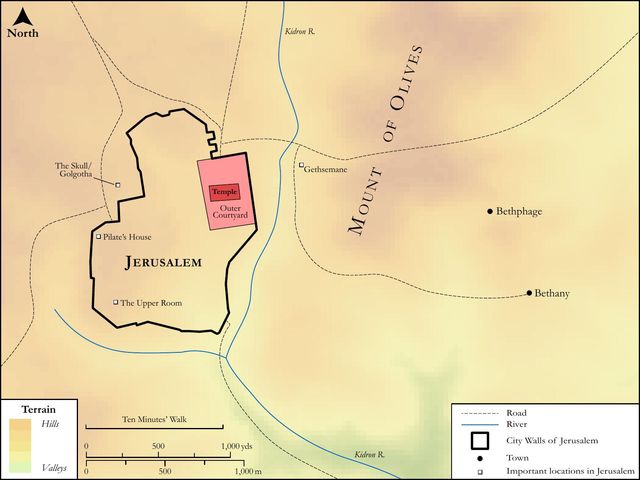
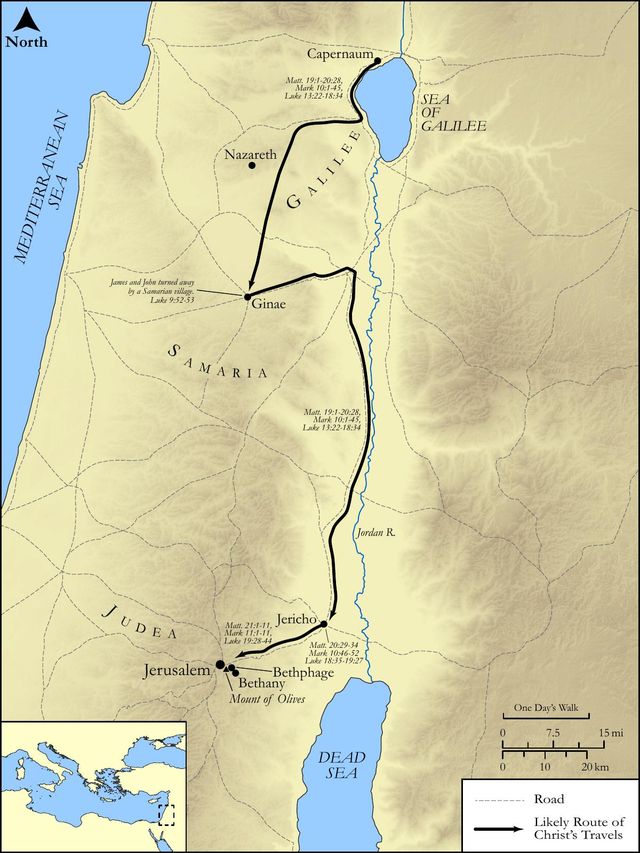
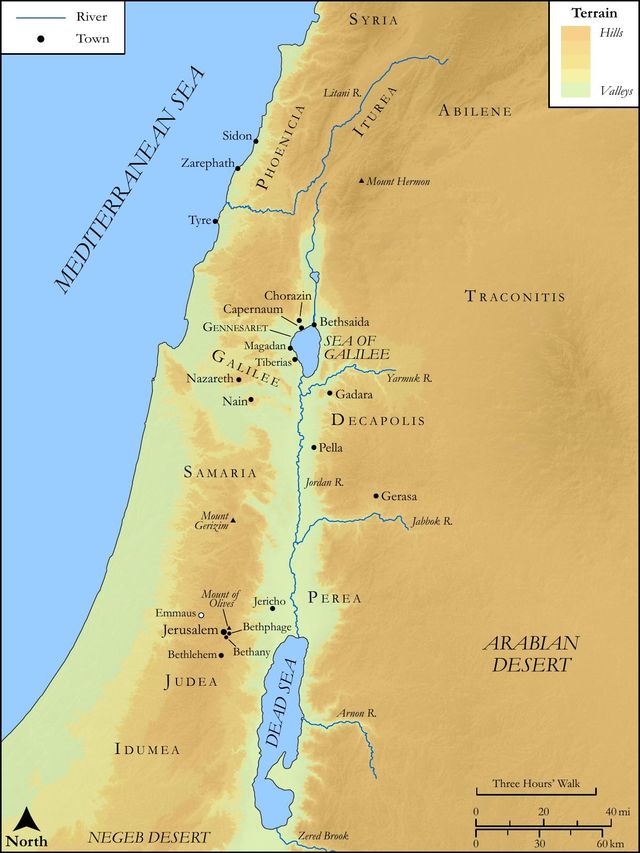
See on the biblical-era maps
Study this verse
Public-domain commentary
Matthew Henry
From his Commentary on the Whole Bible. Henry comments on passages, not single verses — this entry covers Luke 12:54–59. His two-level outline is real structure in the source text, so it is rendered as structure.
Having given his disciples their lesson in the foregoing verses, here Christ turns to the people, and gives them theirs, Luk 12:54. He said also to the people: he preached ad populum - to the people, as well as ad clerum - to the clergy. In general, he would have them be as wise in the affairs of their souls as they are in their outward affairs. Two things he specifies: -
I.Let them learn to discern the way of God towards them, that they may prepare accordingly.
They were weather-wise, and by observing the winds and clouds could foresee when there would be rain and when there would be hot weather (Luk 12:54, Luk 12:55); and, according as they foresaw the weather would be, they either housed their hay and corn, or threw it abroad, and equipped themselves for a journey? Even in regard to changes of the weather God gives warning to us what is coming, and art has improved the notices of nature in weather-glasses. The prognostications here referred to had their origin in repeated observations upon the chain of causes: from what has been we conjecture what will be. See the benefit of experience; by taking notice we may come to give notice. Whose is wise will observe and learn. See now.
1.The particulars of the presages: "When you see a cloud arising out of the west" (the Hebrew would say, out of the sea), "perhaps it is at first no bigger than a man's hand (Kg1 18:44), but you say, There is a shower in the womb of it, and it proves so. When you observe the south wind blow, you say, There will be heat" (for the hot countries of Africa lay not far south from Judea), "and it usually comes to pass;" yet nature has not ties itself to such a track but that sometimes we are mistaken in our prognostics.
2.The inferences from them (Luk 12:56): "Ye hypocrites, who pretend to be wise, but really are not so, who pretend to expect the Messiah and his kingdom" (for so the generality of the Jews did) "and yet are no way disposed to receive and entertain it, how is it that you do not discern this time, that you do not discern that now is the time, according to the indications given in the Old Testament prophecies, for the Messiah to appear, and that, according to the marks given of him, I am he? Why are you not aware that you have now an opportunity which you will not have long, and which you may never have again, of securing to yourselves an interest in the kingdom of God and the privileges of that kingdom?" Now is the accepted time, now or never. It is the folly and misery of man that he knows not his time, Ecc 9:12. This was the ruin of the men of that generation, that they knew not the day of their visitation, Luk 19:44. But a wise man's heart discerns time and judgment; such was the wisdom of the men of Issachar, who had understanding of the times, Ch1 12:32. He adds, "Yea, and why even of yourselves, though ye had not these loud alarms given you, judge ye not what is right? Luk 12:57. You are not only stupid and regardless in matters that are purely of divine revelation, and take not the hints which that gives you, but you are so even in the dictates of the very light and law of nature." Christianity has reason and natural conscience on its side; and, if men would allow themselves the liberty of judging what is right, they would soon find that all Christ's precepts concerning all things are right, and that there is nothing more equitable in itself, nor better becoming us, than to submit to them and be ruled by them.
II.Let them hasten to make their peace with God in time, before it be too late, Luk 12:58, Luk 12:59. This we had upon another occasion, Mat 5:25, Mat 5:26.
1.We reckon it our wisdom in our temporal affairs to compound with those with whom we cannot contend, to agree with our adversary upon the best terms we can, before the equity be foreclosed, and we be left to the rigour of the law: "When thou goest with thine adversary to the magistrate, to whom the appeal is made, and knowest that he has an advantage against thee, and thou art in danger of being cast, thou knowest it is the most prudent course to make the matter up between yourselves; as thou art in the way, give diligence to be delivered from him, to get a discharge, lest judgment be given, and execution awarded according to law." Wise men will not let their quarrels go to an extremity, but accommodate them in time.
2.Let us do thus in the affairs of our souls. We have by sin made God our adversary, have provoked his displeasure against us, and he has both right and might on his side; so that it is to no purpose to think of carrying on the controversy with him either at bar or in battle. Christ, to whom all judgment is committed, is the magistrate before whom we are hastening to appear: if we stand a trial before him, and insist upon our own justification, the cause will certainly go against us, the Judge will deliver us to the officer, the ministers of his justice, and we shall be cast into the prison of hell, and the debt will be exacted to the utmost; though we cannot make a full satisfaction for it, it will be continually demanded, till the last mite be paid, which will not be to all eternity. Christ's sufferings were short, yet the value of them made them fully satisfactory. In the sufferings of damned sinners what is wanting in value must be made up in an endless duration. Now, in consideration of this, let us give diligence to be delivered out of the hands of God as an adversary, into his hands as a Father, and this as we are in the way, which has the chief stress laid upon it here. While we are alive, we are in the way; and now is our time, by repentance and faith through Christ (who is the Mediator as well as the magistrate), to get the quarrel made up, while it may be done, before it be too late. Thus was God in Christ reconciling the world to himself, beseeching us to be reconciled. Let us take hold on the arm of the Lord stretched out in this gracious offer, that we may make peace, and we shall make peace (Isa 27:4, Isa 27:5), for we cannot walk together till we be agreed.
Historical interpretation
Nine Centuries of Reception
12 surviving comments on this verse. Each one is dated, so this reads as a timeline rather than a list.
Select a marker to jump to its quote. Markers stagger vertically where authors wrote within a few decades of each other.
Each one of us incurs a penalty for each single sin, and the size of the penalty is according to the quality and nature of the offense. I should show some testimony from the Scriptures about the penalty and monetary fines. One man incurs a debt of five hundred denarii and owes that much. Another is obliged to pay fifty denarii. The creditor cancels these debts for both debtors. "Another one," as the Scripture says, "is brought forward, who owed ten thousand talents." He is obliged to pay ten thousand talents.…The debt collector comes to claim his due. I resist him. I know that if I owe nothing, he has no power over me. If I am a debtor, the debt collector will send me to prison, fulfilling the order of which we have spoken. The enemy brings me to the ruler, and the ruler to the judge. The judge will hand me over to the debt collector, and the debt collector will put me in prison. What law governs that prison? I will not come out of it, nor will the debt collector allow me to go out, unless I have paid every debt.
Who do you think that judge is? I do not know any other judge besides our Lord Jesus Christ. Of him Scripture says elsewhere, "He will put the sheep on the right, but the goats on the left." "Whoever confesses me before others, him will I also confess before my Father who is in heaven. Whoever denies me before others, I will deny him before my Father who is in heaven."
Or else, He here introduces four characters, the adversary, the magistrate, the officer, and the judge. But with Matthew the character of the magistrate is left out, and instead of the officer a servant is introduced. They differ also in that the one has written a farthing, the other a mite, but each has called it the last. Now we say that all men have present with them two angels, a bad one who encourages them to wicked deeds, a good one who persuades all that is best. Now the former, our adversary whenever we sin rejoices, knowing that he has an occasion for exultations and boasting with the prince of the world, who sent him. But in the Greek, "the adversary" is written with the article, to signify that he is one out of many, seeing that each individual is under the ruler of his nation. Give diligence then that you may be delivered from your adversary, or from the ruler to whom the adversary drags you, by having wisdom, justice, fortitude, and temperance. But if you have given diligence, let it be in Him who says, I am the life, (John 14:6.) otherwise the adversary will hale thee to the judge. Now he says, hale, to point out that they are forced unwillingly to condemnation. But I know no other judge but our Lord Jesus Christ who delivers to the officer. Each of us have our own officers; the officers exercise rule over us, if we owe any thing. If I paid every man every thing, I come to the officers and answer with a fearless heart, "I owe them nothing." But if I am a debtor, the officer will cast me into prison, nor will he suffer me to go out from thence until I have paid every debt. For the officer has no power to let me off even a farthing. He who forgave one debtor five hundred pence and another fifty, (Luke 7:41.) was the Lord, but the exactor is not the master, but one appointed by the master to demand the debts. But the last mite he calls slight and small, for our sins are either heavy or slight. Happy then is he who sinneth not, and next in happiness he who has sinned slightly. Even among slight sins there is diversity, otherwise he would not say until he has paid the last mite. For if he owes a little, he shall not come out till he pays the last mite. But he who has been guilty of a great debt, will have endless ages for his payment.
The debt collector does not have the power to cancel for me even a penny of the debt or the smallest portion of it. Only one can cancel a debt when the debtors are unable to pity their debts. Scripture says, "One man came to him who owed five hundred denarii, and another who owed fifty. Since they did not have the money to pay him, he forgave both of them." He who forgave was the Lord. He who collects debts is not the Lord but one whom the Lord assigns to collect debts.You were not worthy to have a debt of five hundred denarii, or fifty, canceled. You did not deserve to hear, "Your offenses are forgiven you." You will be sent to prison, and there you will have payment exacted by labor and work or by punishments and torture. You will not get out unless you have paid the penny and the "last farthing," which in Greek means "meager amount."
Having recognized the nature of this present time from the signs revealed to us by the Scriptures, we should dispose our affairs accordingly.
Or our adversary is the devil, who lays his baits for sin, that he may have those his partners in punishment who were his accomplices in crime; our adversary is also every vicious practice. Lastly, our adversary is an evil conscience, which affects us both in this world, and will accuse and betray us in the next. Let us then give heed, while we are in this life's course, that we may be delivered from every bad act as from an evil enemy. Nay, while we are going with our adversary to the magistrate, as we are in the way, we should condemn our fault. But who is the magistrate, but He in whose hands is all power? But the Magistrate delivers the guilty to the Judge, that is, to Him, to whom He gives the power over the quick and dead, namely, Jesus Christ, through Whom the secrets are made manifest, and the punishment of wicked works awarded. He delivers to the officer, and the officer casts into prison, for He says, Bind him hand and foot, and cast him into outer darkness. (Matt. 22:12.) And he shows that His officers are the angels, of whom he says, The angels shall come forth, and sever the wicked from among the just, and shall cast them into the furnace of fire; (Matt. 13:49.) but it is added, I tell thee, thou shalt not depart thence till thou hast paid the very last mite. For as they who pay money on interest do not get rid of the debt of interest before that the amount of the whole principal is paid even up to the least sum in every kind of payment, so by the compensation of love and the other acts, or by each particular kind of satisfaction the punishment of sin is cancelled.
(Hom. 16. in Matt.) It seems to me that He is speaking of the present judges, and of the way to the present judgment, and of the prison of this world. For by these things which are visible and at hand, ignorant men are wont to gain improvement. For often He gives a lesson, not only from future good and evil but from present, for the sake of His ruder hearers.
"And why even of yourselves judge you not what is just? For while you are going with him who has a suit against you, in the way to the magistrate, give diligence that you may be delivered from him; lest he drag you to the judge, and the judge deliver you to the exactor, and the exactor cast you into prison. I tell you, you shall not come out thence, until you have made compensation unto the last mite."
Now perhaps it may be imagined that the sense of this passage is difficult to comprehend: but it will become very easy if we examine the metaphor by what takes place among ourselves. For let there be supposed, He says, some one who has brought a charge against you before one of those in authority, and has pointed you out to those whose office it is to carry the accused into court, and is causing you to be taken thither. "While therefore, He says, you are still with him on the way," that is, before you have come to the judge, "give diligence," that is, weary not, in using all your earnestness that you may be delivered from him. For otherwise he will give you up to the judge; and then, when you have been proved to be indebted to him, you will be delivered to the exactors, to those, that is, whose office it is to exact the money; and they will cast you into prison, and make you pay the last mite.
Now all of us, without exception, upon earth are guilty of offences: he who has a suit against us and accuses us is the wicked Satan: for he is "the enemy and the exactor." While therefore we are in the way: that is, ere yet we have arrived at the termination of our life here, let us deliver ourselves from him: let us do away with the offences of which we have been guilty: let us close his mouth: let us seize upon the grace that is by Christ, which frees us from all debt and penalty, and delivers us from fear and torment: lest if our impurity be not cleansed away, we be carried before the judge, and given over to the exactors, that is, the tormentors, from whose cruelty no man can escape: yea, rather, who will exact vengeance for every fault, whether it be great or small.
Where thou wilt suffer want until thou payest the last farthing; and this is what He adds, I say unto you, thou shalt not depart hence.
I tell you, you will not get out of there until you have paid the very last penny. That is, until you have paid for even the smallest sins. Because you will always be able to pay the penalties by suffering, but never able to obtain forgiveness in return (for there will be no place for forgiveness there), you will never come out from where you will bear the eternal penalties for your deeds.
Or else, our adversary in the way is the word of God, which opposes our carnal desires in this life; from which he is delivered who is subject to its precepts. Else he will be delivered to the judge, for of contempt of God's word the sinner will be accounted guilty in the judgment of the judge. The judge will deliver him to the officer, that is, the evil spirit for punishment. He will then be cast into prison, that is, to hell, where because he will ever have to pay the penalty by suffering, but never by paying it obtain pardon, he will never come out from thence, but with that most terrible serpent the devil, will expiate everlasting punishment.
Our Lord having described a rightful difference, next teaches us a rightful reconciliation, saying, When thou goest with thine adversary to the magistrate, as thou art in the way, give diligence that thou mayest be delivered from him, &c. As if He says, When thine adversary is bringing thee to judgment, give diligence, that is, try every method, to be released from him. Or give diligence, that is, although thou hast nothing, borrow in order that thou may be released from him, lest he summon thee before the judge, as it follows, Lest he hale thee to the judge, and the judge deliver thee to the officer, and the officer cast thee into prison.
Continue studying Luke 12:59 across the web’s major study libraries — every link below opens this exact verse, chapter, or book on the destination site.
Read & Compare
 BibleGatewayThis verse in more than 200 translations and 70 languages.
 Bible.comThe YouVersion reader — hundreds of translations, reading plans, and highlights.
 ESV.orgCrossway's official English Standard Version reader.
 NET BibleThe NET translation with 60,000+ translators' notes on every rendering decision.
 STEP BibleTyndale House's free study tool — original text, vocabulary, and scholarly resources.
 BibliaLogos Bible Software's free web reader.
 USCCBThe New American Bible (Revised Edition) with the U.S. bishops' study notes.
Commentaries
 BibleHub CommentariesDozens of classic commentaries on this verse, gathered on one page.
 StudyLightMore than 100 commentary sets — the largest collection on the web.
 BibleRefPlain-English commentary on what this verse means, verse by verse.
 Enduring WordDavid Guzik's free commentary on this chapter, widely used by Bible teachers.
 Bible Study ToolsVerse commentary alongside Greek and Hebrew study aids.
Original Language & Research
- BibleHub InterlinearThe verse word by word — original language, transliteration, and English.
- BibleHub LexiconEvery word's original-language definition and Strong's entry.
 Blue Letter BibleDeep-study tools — Strong's numbers, concordance, and word studies.
 CNTR CollationThe earliest Greek manuscripts of this verse, collated letter by letter.
Sermons, Hymns & Audio


TrulyRandomVerse is not affiliated with these sites and doesn’t control their content. They’re linked because they’re genuinely useful.
Summary
Luke 12:59 concludes Jesus' teaching on spiritual urgency and accountability, likening the divine judgment to a legal dispute that must be settled swiftly and completely. It warns that failure to reconcile with one's "adversary"—understood both literally as an opponent and metaphorically as God's righteous standard—will result in an inescapable consequence, where every minute detail of the "debt" must be satisfied before release. This powerful metaphor underscores the thoroughness of divine justice and the critical need for immediate spiritual preparedness and repentance.
Context
ShowHideLiterary Context
This verse is the culmination of a short parable or teaching segment in Luke 12:57-59. Jesus begins by questioning why people do not "judge for yourselves what is right" (Luke 12:57), implying a lack of spiritual discernment regarding their own standing before God. He then transitions to the practical advice of settling with an "adversary" quickly on the way to court (Luke 12:58). This immediate context frames the warning in Luke 12:59 as a stark consequence of neglecting to address spiritual and moral debts while there is still opportunity, before facing the ultimate Judge. The passage flows from a call for self-assessment to a warning about the inevitability and severity of divine accountability.
Historical & Cultural Context
The imagery of an "adversary," a judge, and paying a debt stems directly from the legal and social customs prevalent in first-century Judea. Disputes were often taken to court, and it was common practice to attempt reconciliation or settlement outside of court to avoid the harsher judgments a judge might impose. The "mite" (Greek: leptón) was the smallest Jewish coin, often mentioned in the Gospels (e.g., the widow's mite in Luke 21:2) to emphasize extreme poverty or, in this case, the absolute smallest unit of payment. This detail would have resonated powerfully with Jesus' audience, signifying an exhaustive and inescapable payment, down to the very last, most insignificant detail. The warning implies a system of justice where even the smallest transgression or debt would be meticulously accounted for.
Key Themes
ShowHideThe overarching theme in this passage, and indeed much of Luke 12, is the urgency of spiritual preparedness and discernment. Jesus repeatedly calls for His followers to be ready for the Kingdom of God, to understand the signs of the times, and to settle their spiritual accounts. This verse specifically highlights divine accountability and the thoroughness of God's justice, emphasizing that every "debt"—every sin, every unfulfilled obligation—will be meticulously judged. It underscores the consequences of delay, painting a vivid picture of a debtor imprisoned until the full, complete payment is made. This aligns with other parables in Luke that stress the importance of immediate action and the dangers of procrastination in spiritual matters, such as the parable of the rich fool in Luke 12:16-21.
Exposition and Analysis
ShowHideKey Word Analysis
ShowHideFrom the root meaning "to issue out," this word signifies "to come forth, go out, or escape." In this context, it emphasizes that there will be no release or freedom from the consequences of judgment until the full payment is made. It speaks to an inescapable confinement or state of being, from which one cannot simply "get out" or "go away" without meeting the demands of justice.
This term means "to give away, render what is due, pay back, or recompense." It conveys the idea of fulfilling an obligation or debt. Here, it highlights the principle of justice and restitution, where a complete and final settlement is required. The implication is that the debt is not forgiven or overlooked, but must be fully satisfied.
As the smallest Jewish coin, the leptón represents the absolute minimum unit of currency. Its inclusion here is a powerful hyperbole, signifying that not even the most insignificant portion of the debt can be left unpaid. It underscores the meticulous and exhaustive nature of the required payment, emphasizing that divine justice will not overlook even the smallest detail.
Verse Breakdown
ShowHide"I tell thee, thou shalt not depart thence"
This opening phrase, "I tell thee," serves as a solemn declaration from Jesus, lending authoritative weight to the warning that follows. The phrase "thou shalt not depart thence" refers to the inescapable confinement or consequence that awaits those who fail to settle their accounts. "Thence" (from that place) points to the metaphorical "prison" of judgment, from which there is no escape or release until the conditions are met.
"till thou hast paid the very last mite."
This clause specifies the condition for release: the complete and exhaustive payment of the debt. The "very last mite" (Greek: éschatos leptón) emphasizes the thoroughness and meticulousness of the required payment. It means that every single aspect of the debt, no matter how small or seemingly insignificant, must be fully satisfied. There is no partial payment or overlooked detail; divine justice demands full restitution.
Literary Devices
ShowHideLuke 12:59 employs several potent literary devices to convey its urgent message. The primary device is a Legal Metaphor, where the divine judgment is cast in the terms of a human legal dispute. The "adversary," the "judge," the "debt," and the "prison" are all elements drawn from the legal system of the day, making the abstract concept of spiritual accountability tangible and relatable. This metaphor highlights the seriousness and inevitability of facing consequences for one's actions. Furthermore, Hyperbole is powerfully used in the phrase "the very last mite." By specifying the smallest possible coin, Jesus exaggerates the meticulousness of the required payment, emphasizing that divine justice leaves no stone unturned and demands complete satisfaction for every transgression, no matter how minor. This also functions as a form of Synecdoche, where the "mite" (a part) stands for the entirety of the debt, underscoring the comprehensive nature of the judgment. The overall tone is one of Urgency, compelling the listener to immediate action.
Theological and Thematic Connections
ShowHideLuke 12:59 profoundly connects to the biblical themes of divine justice, human sin, and the necessity of reconciliation. It underscores the absolute righteousness of God, who will hold every individual accountable for their actions and omissions. The "debt" represents the accumulated weight of sin and unfulfilled obligations against God's holy standard. Humanity, in its fallen state, is utterly incapable of "paying the very last mite" of this debt, highlighting the desperate need for divine intervention and atonement. This verse, therefore, implicitly points to the insurmountable barrier between a holy God and sinful humanity, setting the stage for the ultimate solution found in Christ.
Reflection and Application
ShowHideLuke 12:59 serves as a stark and sobering call to introspective reflection and decisive action in our spiritual lives. It compels us to confront the reality of our own "debts"—our sins, our failures to love God and neighbor, our neglected spiritual duties—and to recognize the urgency of addressing them. The "adversary" can be seen as our own conscience, the Law of God, or even the spiritual forces that accuse us, all pointing to our need for reconciliation. The passage challenges us to consider what unresolved issues, unconfessed sins, or broken relationships might stand between us and God, or between us and others. It is a powerful reminder that the opportunity for repentance and reconciliation is finite, and procrastination carries severe consequences. Instead of facing the full rigor of divine justice unprepared, we are urged to seek resolution now, while grace is still extended. This requires humility, honesty, and a willingness to confront our shortcomings, trusting that God provides a way to settle our accounts.
Questions for Reflection
ShowHideFAQ
ShowHideDoes "the very last mite" imply that we can earn our salvation by paying for our sins?
ShowHideNo, "the very last mite" does not imply that human beings can earn their salvation or pay for their sins through their own efforts. Instead, it highlights the absolute and meticulous nature of divine justice. The point of the verse is to show the impossibility of a sinful human being ever fully satisfying the demands of God's perfect law. Just as one cannot escape a human prison until every last penny of a debt is paid, so too, one cannot escape divine judgment if even the smallest "mite" of sin remains unpaid. This serves to underscore humanity's desperate need for a Savior who can pay the full debt. The New Testament consistently teaches that salvation is a gift of God's grace, received through faith in Jesus Christ, not by works (Ephesians 2:8-9).
Who is the "adversary" in this passage?
ShowHideThe "adversary" (Greek: antídikos) in Luke 12:58 can be understood on multiple levels. Literally, it refers to a legal opponent in a court case. Metaphorically, in the broader spiritual context of Jesus' teaching, it can represent anything that stands in opposition to one's spiritual well-being or relationship with God. This could include:
The primary point is to address the source of the "debt" or conflict swiftly and decisively before facing the final judgment.
Christ-Centered Fulfillment
ShowHideLuke 12:59, with its stark warning about paying "the very last mite," powerfully foreshadows the absolute necessity and comprehensive nature of Christ's atoning work. Humanity, burdened by the insurmountable debt of sin, is utterly incapable of satisfying the meticulous demands of divine justice. Every "mite" of sin, no matter how small, stands as an unpayable obligation. It is precisely this human predicament that highlights the profound glory of Jesus Christ. He is the only one who could and did "pay the very last mite" on our behalf. Through His perfect life, His sacrificial death on the cross, and His glorious resurrection, Jesus fully satisfied the righteous demands of God's law, bearing the full penalty for humanity's sin (2 Corinthians 5:21). His blood, shed on Calvary, is the ultimate payment that reconciles us to God, freeing us from the "prison" of sin and judgment (Colossians 1:13-14). Therefore, while the verse warns of an inescapable debt, it implicitly points to the Savior who has paid it in full, offering forgiveness and eternal life as a free gift to all who believe (Romans 6:23).