


Joshua 22:32
- וַיָּשָׁבvai·Ya·shovand he returnedH7725Conj-w ¦ V-Qal-ConsecImperf-3msVerb Qal Consecutive Imperfect 3rd Singular Masculineוַandיָּשָׁבhe returned
- פִּינְחָסpin·ChasPhinehasH6372N-proper-mNoun Proper Masculine
- בֶּןben[the] son ofH1121N-mscNoun Singular Masculine Construct
- אֶלְעָזָר'el·'a·ZarEleazarH499N-proper-mNoun Proper Masculine
- הַכֹּהֵןha·ko·Henthe priestH3548Art ¦ N-msNoun Singular Masculine Absoluteהַtheכֹּהֵןpriest
- וְהַנְּשִׂיאִיםve·ha·ne·si·'Imand the leadersH5387Conj-w ¦ Art ¦ N-mpNoun Plural Masculine Absoluteוְandהַtheנְּשִׂיאִיםleaders
- מֵאֵתme·'Etfrom withH854Prep-m ¦ DirObjMParticle Object Indicatorמֵfromאֵתwith
- בְּנֵיbe·nei[the] descendants ofH1121N-mpcNoun Plural Masculine Construct
- רְאוּבֵןre·'u·VenReubenH7205N-proper-mNoun Proper Masculine
- וּמֵאֵתu·me·'Etand from withH854Conj-w ¦ Prep-m ¦ DirObjMParticle Object Indicatorוּandמֵfromאֵתwith
- בְּנֵיbe·nei[the] descendants ofH1121N-mpcNoun Plural Masculine Construct
- גָדgadGadH1410N-proper-mNoun Proper Masculine
- מֵאֶרֶץme·'E·retzfrom [the] land ofH776Prep-m ¦ N-fscNoun Singular Feminine Constructמֵfromאֶרֶץ[the] land of
- הַגִּלְעָדha·gil·'Ad<the> GileadH1568Art ¦ N-properNoun Proper Locationהַ<the>גִּלְעָדGilead
- אֶל'eltoH413PrepPreposition
- אֶרֶץ'E·retz[the] land ofH776N-fscNoun Singular Feminine Construct
- כְּנַעַןke·Na·'anCanaanH3667N-properNoun Proper Location
- אֶל'eltoH413PrepPreposition
- בְּנֵיbe·Nei[the] people ofH1121N-mpcNoun Plural Masculine Construct
- יִשְׂרָאֵלYis·ra·'ElIsraelH3478N-properNoun Proper Location
- וַיָּשִׁבוּvai·ya·Shi·vuand they brought backH7725Conj-w ¦ V-Hiphil-ConsecImperf-3mpVerb Hiphil Consecutive Imperfect 3rd Plural Masculineוַandיָּשִׁבוּthey brought back
- אוֹתָם'o·Tamwith themH854Prep ¦ 3mpPreposition Definiteאוֹתָwithםthem
- דָּבָרda·VarwordH1697N-msNoun Singular Masculine Absolute
English is a literal word-by-word gloss of the Hebrew, not the KJV's wording. Why?
This is the original text the KJV's translators worked from — each Hebrew word with its own literal English meaning in this verse, prepared by scholars at Tyndale House, Cambridge. The KJV translates whole sentences, not word by word, so its wording differs: one Hebrew word can become several English words, and the KJV may choose “the LORD” where the gloss reads “Yahweh”. Both are faithful — they answer different questions. For the KJV's own rendering, switch to the KJV text.
Details
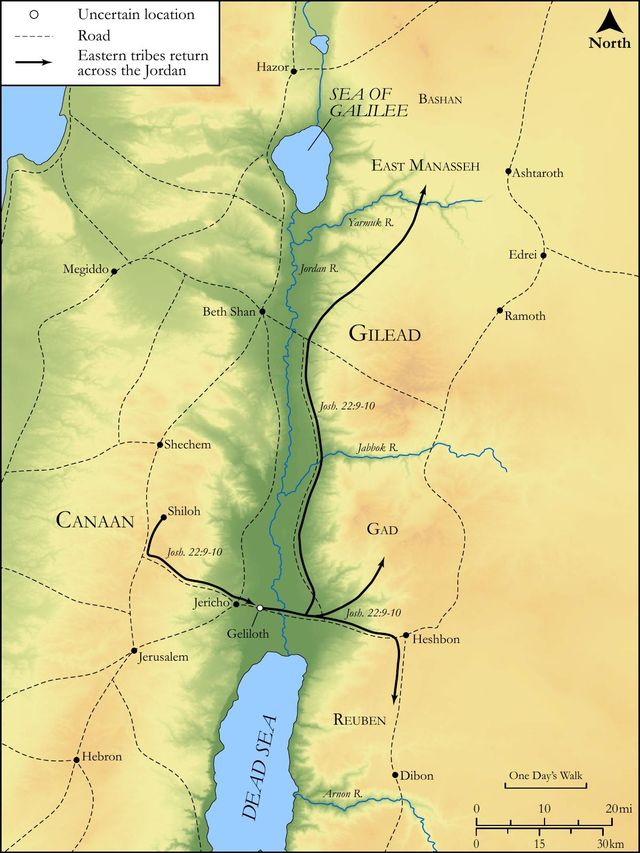
See on the biblical-era map
Study this verse
Continue studying Joshua 22:32 across the web’s major study libraries — every link below opens this exact verse, chapter, or book on the destination site.
Read & Compare
 BibleGatewayThis verse in more than 200 translations and 70 languages.
 Bible.comThe YouVersion reader — hundreds of translations, reading plans, and highlights.
 ESV.orgCrossway's official English Standard Version reader.
 NET BibleThe NET translation with 60,000+ translators' notes on every rendering decision.
 STEP BibleTyndale House's free study tool — original text, vocabulary, and scholarly resources.
 BibliaLogos Bible Software's free web reader.
 USCCBThe New American Bible (Revised Edition) with the U.S. bishops' study notes.
Commentaries
 BibleHub CommentariesDozens of classic commentaries on this verse, gathered on one page.
 StudyLightMore than 100 commentary sets — the largest collection on the web.
 BibleRefPlain-English commentary on what this verse means, verse by verse.
 Enduring WordDavid Guzik's free commentary on this chapter, widely used by Bible teachers.
 Bible Study ToolsVerse commentary alongside Greek and Hebrew study aids.
Original Language & Research
- BibleHub InterlinearThe verse word by word — original language, transliteration, and English.
- BibleHub LexiconEvery word's original-language definition and Strong's entry.
 Blue Letter BibleDeep-study tools — Strong's numbers, concordance, and word studies.
 SefariaThe Hebrew text with Rashi and centuries of Jewish commentary.
Sermons, Hymns & Audio


TrulyRandomVerse is not affiliated with these sites and doesn’t control their content. They’re linked because they’re genuinely useful.
Summary
Joshua 22:32 marks the triumphant return of Phinehas and the delegation of Israelite princes from their mission to the Transjordanian tribes, bringing back the crucial news that averted a potential civil war. This verse signifies the successful resolution of a grave misunderstanding concerning an altar built by Reuben, Gad, and half-Manasseh, confirming their loyalty to Yahweh and preserving the fragile unity of the newly settled nation of Israel, thereby preventing a devastating internal conflict and affirming the covenant bond.
Context
ShowHideLiterary Context
Joshua 22:32 serves as the climactic resolution to a tense narrative arc that begins earlier in Joshua 22. Following the division of the land, the Transjordanian tribes (Reuben, Gad, and half the tribe of Manasseh) built a large, conspicuous altar near the Jordan River as they journeyed back to their inheritance. This act immediately provoked alarm and righteous indignation among the tribes in Canaan, who feared it was an act of apostasy and a direct violation of the covenant, reminiscent of the sin at Baal-peor which brought divine wrath upon the entire community. The initial reaction was to gather for war, but wisely, a delegation led by Phinehas, the high priest's son, was dispatched to confront the Transjordanian tribes. This verse confirms the delegation's successful return and the positive report that brought immense relief, as detailed in Joshua 22:33.
Historical & Cultural Context
The historical setting is the immediate aftermath of Israel's conquest and settlement of Canaan, a period marked by the establishment of their national and religious identity. The Jordan River served as a significant geographical and, potentially, a cultural and religious boundary between the Transjordanian tribes and the rest of Israel. The fear of idolatry and syncretism was deeply ingrained in Israelite consciousness, as their covenant with Yahweh demanded exclusive worship at a single, divinely appointed sanctuary (initially the tabernacle at Shiloh). Building an altar elsewhere was a grave offense, threatening the purity of their worship and the very foundation of their covenant relationship with God. The concept of corporate responsibility meant that the sin of a few could bring judgment upon the entire nation, fueling the urgency and severity of the Canaanite tribes' reaction.
Key Themes
ShowHideThe narrative of Joshua 22 and its resolution in Joshua 22:32 powerfully highlights several key themes. Foremost is the preservation of Israel's unity, demonstrating the paramount importance of maintaining fellowship and preventing internal strife among God's people. This outcome underscored the value of effective communication and understanding over hasty judgment, revealing how dialogue can bridge divides and uncover truth, averting catastrophic conflict. The initial reaction of the western tribes also speaks to their zeal for God's Law and the purity of worship, even if misguided in its initial assumption. Finally, the narrative showcases wise and Spirit-led leadership, particularly in Phinehas, whose priestly authority and diplomatic skill, combined with the presence of the tribal princes, facilitated a peaceful and truthful resolution, echoing his earlier zeal for God in Numbers 25:7-8.
Exposition and Analysis
ShowHideKey Word Analysis
ShowHideThe grandson of Aaron and son of Eleazar the priest, Phinehas is a pivotal figure in Israel's history, known for his zealous act in Numbers 25 which turned away God's wrath from Israel. His leadership of this delegation lent immense authority and credibility to the mission, signaling the seriousness of the concern to the Transjordanian tribes and assuring the other tribes of a thorough, divinely sanctioned inquiry. His presence underscored the religious gravity of the dispute.
This term refers to the exalted heads or leaders of the tribes, indicating that the delegation was not merely a group of individuals but an official, representative body. Their presence alongside Phinehas symbolized the collective concern and unity of the nine and a half tribes in Canaan, giving weight to their inquiry and ensuring that the findings would be accepted by all parties. It highlighted the national scope of the crisis and its resolution.
This term, often translated as "word," also encompasses "matter," "report," or "tidings." In this context, it signifies the crucial message or report delivered by the delegation. It was not merely an account of events but the vital information that clarified the misunderstanding, confirmed the loyalty of the Transjordanian tribes, and ultimately restored peace and unity to the nation, averting civil war.
Verse Breakdown
ShowHide"And Phinehas the son of Eleazar the priest, and the princes, returned"
This clause identifies the key figures of the delegation and their successful completion of the mission. Phinehas's priestly lineage emphasizes the spiritual authority and divine backing of their inquiry. The inclusion of "the princes" highlights the representative nature of the delegation, signifying that this was a collective effort of all the tribes in Canaan.
"from the children of Reuben, and from the children of Gad, out of the land of Gilead"
This specifies the origin of their return journey, indicating that they had successfully reached and engaged with the Transjordanian tribes (Reuben and Gad, implicitly including the half-tribe of Manasseh who also settled in Gilead). "The land of Gilead" pinpoints the geographical location of the encounter and the altar, emphasizing the distance and the distinct inheritance of these tribes.
"unto the land of Canaan, to the children of Israel"
This details their destination and the recipients of their report. Their return "unto the land of Canaan" signifies their rejoining the main body of Israel, and "to the children of Israel" confirms that their message was for the entire nation, not just a select few. It underscores the national scope of the crisis and its resolution.
"and brought them word again"
This final clause succinctly states the purpose and positive outcome of their return. They delivered the crucial report that clarified the misunderstanding about the altar, confirming its purpose as a "witness" and not for illegitimate sacrifice. This "word" was the key to averting civil war and restoring peace and unity among the tribes.
Literary Devices
ShowHideThe narrative culminating in Joshua 22:32 masterfully employs several literary devices. Resolution is the overarching device, as this verse marks the peaceful conclusion of a highly charged conflict, bringing the narrative tension to a satisfying close. The story also utilizes Antithesis, contrasting the initial fear, suspicion, and preparation for war (based on misunderstanding) with the eventual relief, joy, and reaffirmed unity (based on truth and communication). The altar itself functions as a powerful Symbolism, initially perceived as a symbol of rebellion and idolatry, but ultimately revealed as a symbol of unity and witness to future generations. The narrative structure, moving from perceived transgression to confrontation, investigation, and then reconciliation, demonstrates a classic Narrative Arc of conflict and resolution, emphasizing the value of diplomacy and truth-seeking in maintaining the integrity of the community.
Theological and Thematic Connections
ShowHideJoshua 22:32 profoundly underscores the theological imperative of unity within God's people and the vital role of communication in preserving it. The potential for civil war, stemming from a misunderstanding rooted in zeal for God's covenant, highlights the dangers of hasty judgment and the importance of seeking truth before acting. The successful mediation by Phinehas and the princes demonstrates that faithful leadership, characterized by wisdom and a commitment to peace, is essential for maintaining the integrity and witness of the community. The narrative affirms that God desires His people to live in harmony, upholding His commands not through rigid legalism that breeds division, but through a spirit of understanding and reconciliation that reflects His own character.
Reflection and Application
ShowHideThe resolution in Joshua 22:32 offers profound lessons for contemporary believers and communities. It serves as a powerful reminder that misunderstandings, if left unaddressed or fueled by assumptions, can escalate into devastating conflicts, even among those who share a common faith. The narrative champions the values of patient inquiry, open dialogue, and a willingness to listen before condemning. In our own lives and within our faith communities, this verse challenges us to prioritize unity over division, to extend grace and assume the best intentions of others, and to actively pursue reconciliation when disagreements arise. It reminds us that zeal for God's truth must always be tempered with love, humility, and a commitment to building up, rather than tearing down, the body of Christ.
Questions for Reflection
ShowHideFAQ
ShowHideWhat was the primary misunderstanding that led to this crisis?
ShowHideThe primary misunderstanding arose when the tribes in Canaan saw the large altar built by the Transjordanian tribes (Reuben, Gad, and half-Manasseh) near the Jordan River. They immediately assumed it was an act of rebellion against Yahweh, a move toward idolatry, and an attempt to establish an alternative place of worship, thereby violating the covenant that mandated a single, central sanctuary for all Israel. This assumption, though based on a legitimate concern for God's law, was incorrect, as the Transjordanian tribes intended the altar as a "witness" to their shared heritage and a memorial to ensure their future generations would not be cut off from worshipping at the tabernacle in Shiloh (as explained in Joshua 22:26-28).
Why was Phinehas chosen to lead the delegation?
ShowHidePhinehas was chosen to lead the delegation primarily due to his priestly authority and his proven zeal for the Lord. As the son of Eleazar the priest and grandson of Aaron, he held a position of significant spiritual and national leadership. His past actions, particularly his decisive intervention in Numbers 25 which turned away God's wrath from Israel, demonstrated his unwavering commitment to God's covenant and the purity of Israel's worship. This made him the ideal figure to investigate a potential act of apostasy, lending immense credibility and gravity to the mission in the eyes of all the tribes.
What was the significance of the altar's location near the Jordan River?
ShowHideThe location of the altar near the Jordan River was highly significant. For the tribes in Canaan, the Jordan served as a natural boundary, and building an altar on the Transjordanian side might have implied a desire to establish a separate religious identity or even a new, illegitimate center of worship. However, for the Transjordanian tribes, the Jordan was precisely why they built it there. They feared that in future generations, their descendants might be seen as separate or excluded from the main body of Israel, and thus from the central sanctuary in Canaan. The altar was intended as a "witness" ('ed) across the Jordan, a visible reminder and testimony to their shared heritage and right to worship Yahweh alongside their brethren in Canaan, ensuring their children would not be denied access to the Lord's tabernacle (Joshua 22:27-28).
Christ-Centered Fulfillment
ShowHideJoshua 22:32, with its powerful narrative of reconciliation and the preservation of unity, finds its ultimate fulfillment in Jesus Christ. The Old Testament's recurring themes of division, misunderstanding, and the need for a mediator are perfectly resolved in Him. Just as Phinehas mediated between the tribes, averting civil war and restoring peace, so Christ serves as the ultimate High Priest and Mediator of a new and better covenant (Hebrews 8:6). He is the one who breaks down the dividing wall of hostility, reconciling estranged parties—Jew and Gentile—into one new humanity through His cross (Ephesians 2:14-16). The fear of separation from God, which drove the Israelite tribes' initial reaction, is abolished in Christ, who has made full atonement for sin, granting direct access to God the Father through His Spirit (Ephesians 2:18). The unity that was so precariously maintained in Joshua's time is now a spiritual reality in the body of Christ, where believers are called to preserve the unity of the Spirit in the bond of peace, reflecting the very nature of the triune God (Ephesians 4:3-6). In Christ, the longing for true fellowship and unhindered worship, symbolized by the altar of witness, is fully realized, as He is the way, the truth, and the life, through whom all may come to the Father (John 14:6).