


Job 37:17
Bible text: King James Version (1769 Blayney text) · Public domain
Bible text: Berean Standard Bible · Public domain
Bible text: American Standard Version (1901) · Public domain
Bible text: World English Bible, Messianic edition · Public domain
Bible text: Geneva Bible (1599) · Public domain
Bible text: Young's Literal Translation · Public domain
- אֲשֶׁר'a·Sher[you] whomH834RelParticle Relative
- בְּגָדֶיךָbe·ga·Dei·khayour clothesH899N-mpc ¦ 2msNoun Plural Masculine Constructבְּגָדֶיclothesךָyour
- חַמִּיםcha·Mim[are] hotH2525Adj-mpAdjective Plural Masculine Absolute
- בְּהַשְׁקִטbe·hash·Kitwhen is stillH8252Prep-b ¦ V-Hiphil-InfVerb Hiphil Infinitive Constructבְּwhenהַשְׁקִטis still
- אֶרֶץ'E·retz[the] earthH776N-fsNoun Singular Feminine Absolute
- מִדָּרוֹםmi·da·Romfrom [the] southH1864Prep-m ¦ N-msNoun Singular Masculine Absoluteמִfromדָּרוֹם[the] south
English is a literal word-by-word gloss of the Hebrew, not the KJV's wording. Why?
This is the original text the KJV's translators worked from — each Hebrew word with its own literal English meaning in this verse, prepared by scholars at Tyndale House, Cambridge. The KJV translates whole sentences, not word by word, so its wording differs: one Hebrew word can become several English words, and the KJV may choose “the LORD” where the gloss reads “Yahweh”. Both are faithful — they answer different questions. For the KJV's own rendering, switch to the KJV text.
Details
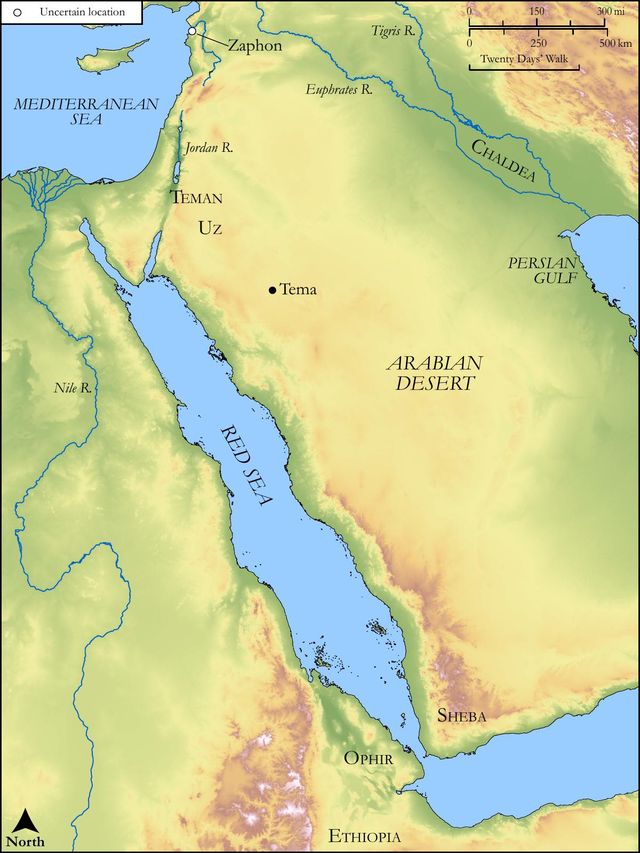
See on the biblical-era map
Study this verse
Public-domain commentary
Matthew Henry
From his Commentary on the Whole Bible. Henry comments on passages, not single verses — this entry covers Job 37:14–20. His four-level outline is real structure in the source text, so it is rendered as structure.
Elihu here addresses himself closely to Job, desiring him to apply what he had hitherto said to himself. He begs that he would hearken to this discourse (Job 37:14), that he would pause awhile: Stand still, and consider the wondrous works of God. What we hear is not likely to profit us unless we consider it, and we are not likely to consider things fully unless we stand still and compose ourselves to the consideration of them. The works of God, being wondrous, both deserve and need our consideration, and the due consideration of them will help to reconcile us to all his providences. Elihu, for the humbling of Job, shows him,
I.That he had no insight into natural causes, could neither see the springs of them nor foresee the effects of them (Job 37:15-17):
Dost thou know this and know that which are the wondrous works of him who is perfect in knowledge? We are here taught,
1.The perfection of God's knowledge. It is one of the most glorious perfections of God that he is perfect in knowledge; he is omniscient. His knowledge is intuitive: he sees, and does not know by report. It is intimate and entire: he knows things truly, and not by their colours - thoroughly, and not by piecemeal. To his knowledge there is nothing distant, but all near - nothing future, but all present - nothing hid, but all open. We ought to acknowledge this in all his wondrous works, and it is sufficient to satisfy us in those wondrous works which we know not the meaning of that they are the works of one that knows what he does.
2.The imperfection of our knowledge. The greatest philosophers are much in the dark concerning the powers and works of nature. We are a paradox to ourselves, and every thing about us is a mystery. The gravitation of bodies, and the cohesion of the parts of matter, are most certain, and yet unaccountable. It is good for us to be made sensible of our own ignorance. Some have confessed their ignorance, and those that would not do this have betrayed it. But we must all infer from it what incompetent judges we are of the divine politics, when we understand so little even of the divine mechanics.
(1.)We know not what orders God has given concerning the clouds, nor what orders he will give, Job 37:15. That all is done by determination and with design we are sure; but what is determined, and what designed, and when the plan was laid, we know not. God often causes the light of his cloud to shine, in the rainbow (so some), in the lightning (so others); but did we foresee, or could we foretell, when he would to it? If we foresee the change of weather a few hours before, by vulgar observation, or when second causes have begun to work by the weather-glass, yet how little do these show us of the purposes of God by these changes!
(2.)We know not how the clouds are poised in the air, the balancing of them, which is one of the wondrous works of God. They are so balanced, so spread, that they never rob us of the benefit of the sun (even the cloudy day is day), so balanced that they do not fall at once, nor burst into cataracts or water-spouts. The rainbow is an intimation of God's favour in balancing the clouds so as to keep them from drowning the world. Nay, so are they balanced that they impartially distribute their showers on the earth, so that, one time or other, every place has its share.
(3.)We know not how the comfortable change comes when the winter is past, Job 37:17.
[1.]How the weather becomes warm after it has been cold. We know how our garment came to be warm upon us, that is, how we come to be warm in our clothes, by reason of the warmth of the air we breathe in. Without God's blessing we should clothe ourselves, yet not be warm, Hag 1:6. But, when he so orders it, the clothes are warm upon us, which, in the extremity of cold weather, would not serve to keep us warm.
[2.]How it becomes calm after it has been stormy: He quiets the earth by the south wind, when the spring comes. As he has a blustering freezing north wind, so he has a thawing, composing, south wind; the Spirit is compared to both, because he both convinces and comforts, Sol 4:16.
II.That he had no share at all in the first making of the world (Job 37:18):
"Hast thou with him spread out the sky? Thou canst not pretend to have stretched it out without him, no, nor to have stretched it out in conjunction with him; for he was far from needing any help either in contriving or in working." The creation of the vast expanse of the visible heavens (Gen 1:6-8), which we see in being to this day, is a glorious instance of the divine power, considering,
1.That, though it is fluid, yet it is firm. It is strong, and has its name from its stability. It still is what it was, and suffers no decay, nor shall the ordinances of heaven be altered till the lease expires with time.
2.That, though it is large, it is bright and most curiously fine: It is a molten looking-glass, smooth and polished, and without the least flaw or crack. In this, as in a looking-glass, we may behold the glory of God and the wisdom of his handy work, Psa 19:1. When we look up to heaven above we should remember it is a mirror or looking-glass, not to show us our own faces, but to be a faint representation of the purity, dignity, and brightness of the upper world and its glorious inhabitants.
III.That neither he nor they were able to speak of the glory of God in any proportion to the merit of the subject, Job 37:19, Job 37:20.
1. He challenges Job to be their director, if he durst undertake the task. He speaks it ironically: "Teach us, if thou canst, what we shall say unto him, Job 37:19. Thou hast a mind to reason with God, and wouldst have us to contend with him on thy behalf; teach us then what we shall say. Canst thou see further into this abyss than we can? If thou canst, favour us with thy discoveries, furnish us with instructions." 2. He owns his own insufficiency both in speaking to God and in speaking of him: We cannot order our speech by reason of darkness. Note, The best of men are much in the dark concerning the glorious perfections of the divine nature and the administrations of the divine government. Those that through grace know much of God, yet know little, yea, nothing, in comparison with what is to be known, and what will be known, when that which is perfect shall come and the veil shall be rent. When we would speak of God we speak confusedly and with great uncertainly, and are soon at a loss and run aground, not for want of matter, but for want of words. As we must always begin with fear and trembling, lest we speak amiss (De Deo etiam vera dicere periculosum est - Even while affirming what is true concerning God we incur risk), so we must conclude with shame and blushing, for having spoken no better. Elihu himself had, for his part, spoken well on God's behalf, and yet is so far from expecting a fee, or thinking that God was beholden to him for it, or that he was fit to be standing counsel for him, that (1.) He is even ashamed of what he has said, not of the cause, but of his own management of it: "Shall it be told him that I speak? Job 37:20. Shall it be reported to him as a meritorious piece of service, worthy his notice? By no means; let it never be spoken of," for he fears that the subject has suffered by his undertaking it, as a fine face is wronged by a bad painter, and his performance is so far from meriting thanks that it needs pardon. When we have done all we can for God we must acknowledge that we are unprofitable servants and have nothing at all to boast of. He is afraid of saying any more: If a man speak, if he undertake to plead for God, much more if he offer to plead against him, surely he shall be swallowed up. If he speak presumptuously, God's wrath shall soon consume him; but, if ever so well, he will soon lose himself in the mystery and be over powered by the divine lustre. Astonishment will strike him blind and dumb.
Historical interpretation
Two Centuries of Reception
2 surviving comments on this verse. Each one is dated, so this reads as a timeline rather than a list.
Select a marker to jump to its quote. Markers stagger vertically where authors wrote within a few decades of each other.
Here he may mean, You are now in the midst of afflictions, but later you will have rest—and there is also the proof given by divine wisdom, which has foreseen death as a solution and end to human tribulations. Or perhaps [he means], even in the midst of your trials, you remain out of the fight of the war and the troubles, and he punishes you in this manner.
63. We have often said already that blessed Job stands for a type of Holy Church. But all they, who are joined to it by the unity of the Faith, are the garments of the Church. Of which the Lord says to the same Church by the Prophet, As I live, thou shall be clothed with all these, as with an ornament. [Is. 49, 18] But by the south wind, which is doubtless warm, is designated, not improperly, the Holy Spirit, for when any one is touched by It, he is freed from the torpor of his iniquity. Whence it is well said in the Song of Songs, Arise, O north wind, and come thou south, blow upon my garden, and let its sweet spices flow out. [Cant. 4, 16] For the north wind is ordered to arise, in order, doubtless, that the opposing spirit, who binds the hearts of mortals, may fly away. For the south wind comes, and blows through the garden, that its sweet spices may flow abroad; because, while the mind of man is filled by the coming of the Holy Spirit, a notion of their virtues is soon scattered abroad from it, that the tongue of the Saints, like a garden which is blown upon by the south wind, may now justly say, We are unto God a sweet odour of Christ. [2 Cor. 2, 15] The garments, therefore, of Holy Church are warm, while the earth is breathed upon by the south wind; because they, who cling to her by faith, glow with fervent zeal of charity, while their mind is streamed through by the breath of the Holy Spirit. But nothing hinders this being understood of this same blessed Job; because we so speak of these things in the Church in general terms, as yet specially to confine them to its separate members.
64. For every one; who lives uprightly, and has been wont also to teach this to others, has, as it were, as many garments, as the hearers who cling to him in agreement. For it is the nature of garments, that they cannot be warm of themselves; but that, when applied to a living body, they cover the exuding pores of the limbs, they keep back the heat which flows forth from within, and from this heat they doubtless become warm: but when they have become warm, by retaining the heat they have received, they return it to the body. What then is signified by garments adhering to the living body, but the life of disciples closely united to teachers who live well? Which receives, as it were, warmth through the pores; because it is kindled with the love of God, both by the example of action, and the impulse of exhortation. Which expels, as it were, its own cold, when it departs from its former iniquity; retains the warmth it has received, because it gains strength in that warmth which it has obtained from preaching. But when holy preachers perceive that their hearers are advancing towards the love of God, they themselves glow the more in power of teaching: and from seeing that they are burning and glowing for the highest objects, they are themselves more mightily kindled to announce the good things of the heavenly country. And if at any time, because they are still passing this corruptible life of human infirmity, they are assaulted by any fault, however slightly, in deed, word, or thought, they look at the progress of their disciples, and are ashamed of being themselves blameable, even in the smallest matters: lest they should by chance set a crooked example to those, whom they are calling to the rule of inward rectitude by the voice of preaching. When hearers then are kindled by the word of their teachers, garments, as it were, become warm from a living body. But when the conduct of the teachers also is improving, from the progress of their hearers, the heat returns, as it were, to the body from the garments which have been warmed. But let not the teachers attribute it to themselves, that they see their hearers advancing to the highest things, through their exhortation: because, if the Holy Spirit fill not their hearts, the voice of teachers sounds in vain to the bodily ears. For teachers can shape their voice without, but cannot impress it within; For neither is he who planteth any thing, neither he that watereth, but God Who giveth the increase. [1 Cor. 3, 7] Let it be said then, Are not thy garments warm, when the earth hath been blown upon by the south wind? Because, namely, hearers, who now adhere to teachers who live aright, receive the warmth of heavenly love, when they are roused by the breath of the Holy Spirit. As if he were saving plainly to blessed Job; Thou in vain attributest it to thyself, if thou beholdest that any have made progress in virtue by thy means; because these, whom thou supposest to have become warm through thee, would be still remaining cold, in their own insensibility, if the warmth of the Holy Spirit did not touch them. But after he spake these things forcibly, he immediately subjoins words of derision, being influenced with levity by arrogance.
Continue studying Job 37:17 across the web’s major study libraries — every link below opens this exact verse, chapter, or book on the destination site.
Read & Compare
 BibleGatewayThis verse in more than 200 translations and 70 languages.
 Bible.comThe YouVersion reader — hundreds of translations, reading plans, and highlights.
 ESV.orgCrossway's official English Standard Version reader.
 NET BibleThe NET translation with 60,000+ translators' notes on every rendering decision.
 STEP BibleTyndale House's free study tool — original text, vocabulary, and scholarly resources.
 BibliaLogos Bible Software's free web reader.
 USCCBThe New American Bible (Revised Edition) with the U.S. bishops' study notes.
Commentaries
 BibleHub CommentariesDozens of classic commentaries on this verse, gathered on one page.
 StudyLightMore than 100 commentary sets — the largest collection on the web.
 BibleRefPlain-English commentary on what this verse means, verse by verse.
 Enduring WordDavid Guzik's free commentary on this chapter, widely used by Bible teachers.
 Bible Study ToolsVerse commentary alongside Greek and Hebrew study aids.
Original Language & Research
- BibleHub InterlinearThe verse word by word — original language, transliteration, and English.
- BibleHub LexiconEvery word's original-language definition and Strong's entry.
 Blue Letter BibleDeep-study tools — Strong's numbers, concordance, and word studies.
 SefariaThe Hebrew text with Rashi and centuries of Jewish commentary.
Sermons, Hymns & Audio


TrulyRandomVerse is not affiliated with these sites and doesn’t control their content. They’re linked because they’re genuinely useful.
Summary
Elihu, in his culminating discourse to Job, presents the warmth brought by the south wind as a direct and tangible manifestation of God's meticulous control over all natural phenomena. This rhetorical question serves to highlight God's absolute sovereignty, not merely in the overwhelming power of storms but also in the subtle, comforting shifts of weather, thereby underscoring His incomprehensible wisdom and benevolent provision for humanity. It challenges Job, and all humanity, to recognize the Creator's absolute dominion over every detail of creation, fostering humility and awe before the divine.
Context
ShowHideLiterary Context
Job 37 serves as the powerful conclusion to Elihu's extensive speeches, which commenced in Job 32. Throughout chapters 36 and 37, Elihu systematically builds a compelling argument for God's unchallengeable power, wisdom, and justice, primarily through the vivid metaphor of natural phenomena. He meticulously describes God's sovereign control over rain, snow, lightning, and thunder, often using these awe-inspiring displays as a backdrop to humble human understanding and assert divine righteousness. Verse 17 specifically marks a significant transition from Elihu's earlier descriptions of harsh, cold, and stormy weather, such as the north wind bringing cold and ice in Job 37:9-10, to the comforting and life-giving warmth of the south wind. This shift demonstrates God's comprehensive dominion over the entire spectrum of atmospheric conditions, from the most formidable tempest to the gentlest breeze. It broadens the scope of God's power, showing that His hand is active not only in the dramatic and destructive but also in the tranquil and comforting, further diminishing human capacity to fully grasp His intricate and purposeful ways.
Historical & Cultural Context
Among the men of the east, where scientific meteorology was non-existent, weather patterns were universally understood as direct expressions of divine activity and will. The "south wind" (Hebrew: dârôwm or teyman) was a well-known and significant meteorological phenomenon, typically bringing warm, often dry air from the vast Arabian desert regions. This warmth frequently provided a welcome and tangible relief after periods of cold, rain, or harsh northern winds, making it a profound and immediate example of divine provision and comfort. The imagery of "garments being warm" speaks directly to the practical, immediate, and deeply personal impact of this weather change on human comfort, well-being, and daily life. Elihu's audience, living in an agrarian society deeply dependent on predictable and beneficial weather for survival and sustenance, would have intimately understood the profound significance of these atmospheric shifts and readily attributed them to the direct intervention of a higher power. This shared experience makes Elihu's rhetorical question particularly potent and relatable.
Key Themes
ShowHideThis verse profoundly contributes to several overarching theological and narrative themes woven throughout the book of Job and Elihu's discourse. Foremost is the theme of God's Absolute Sovereignty over Nature, asserting unequivocally that every meteorological event, from the most destructive storm to the gentlest and most comforting breeze, is under His direct command and precise orchestration. This is a recurring biblical truth, echoed in passages like Psalm 135:7. Secondly, the verse highlights Divine Provision and Comfort, demonstrating God's active and benevolent care for His creation by providing warmth, ease, and sustenance through natural means. It underscores that God's involvement is not merely in grand acts of power but also in the minute details that sustain life and bring comfort. Thirdly, and pivotally for Elihu's argument against Job's questioning, it underscores the Incomprehensibility of God's Ways. If human beings cannot even fully understand, predict, or control the seemingly simple shift in wind patterns, how much less can they comprehend the vastness of God's wisdom, justice, and power? This theme is powerfully reinforced by God's own challenge to Job from the whirlwind in Job 38, where the wonders of creation serve as an irrefutable testament to divine wisdom far surpassing human capacity.
Exposition and Analysis
ShowHideKey Word Analysis
ShowHideThis adjective, derived from a root meaning "to be hot," directly describes the sensation of heat or warmth. In the context of Job 37:17, it refers to the tangible feeling of comfort and relief brought by the south wind, making one's clothing feel warm. It emphasizes the immediate and personal impact of God's atmospheric control, translating a meteorological phenomenon into a human experience of well-being.
This verb signifies to settle, to calm, to be at rest, or to be tranquil. When applied to the earth by the south wind, it implies that God, through this specific wind, brings a cessation of turbulent, cold, or harsh conditions, ushering in a period of calm, stability, and warmth. It suggests a deliberate, purposeful act of bringing order and peace to the earth's atmosphere, rather than a mere random occurrence. This word is also used in other biblical contexts to denote national peace or rest from war, indicating a profound sense of stability and cessation of disturbance, as seen in Judges 3:11.
This noun refers specifically to the geographical direction of the south, and by extension, the south wind. In the land of Uz, the south wind was proverbially associated with warmth and dryness, originating from the vast desert regions. Its specific mention here is not merely descriptive but points to a known meteorological phenomenon that reliably brings comfort and warmth, standing in contrast to the often harsh and cold northern winds. Elihu uses this precise detail to emphasize God's meticulous and specific control over every directional wind and its distinct effects on the environment.
Verse Breakdown
ShowHide"How thy garments [are] warm"
This opening phrase functions as a rhetorical question, designed not to elicit a direct answer but to evoke a profound sense of wonder, contemplation, and acknowledgment from the listener, presumably Job. It directly addresses the human experience, prompting reflection on the tangible and comforting effect of a specific weather phenomenon – the warmth it imparts, making one's clothing feel pleasant and comfortable. This sets a relatable and experiential stage for the subsequent divine explanation.
"when he quieteth the earth by the south [wind]?"
This clause provides the divine explanation and attribution for the warmth experienced. The pronoun "he" explicitly refers to God, attributing the calming and warming effect of the south wind directly to His deliberate and sovereign action. The phrase "quieteth the earth" implies that God brings a sense of tranquility, stability, and relief to the land through the precise action of this specific wind, perhaps following periods of colder or turbulent weather. It powerfully underscores God's active, purposeful, and intimate involvement in even the seemingly subtle shifts and comforting aspects of natural phenomena, demonstrating His comprehensive dominion.
Literary Devices
ShowHideElihu employs several potent literary devices in Job 37:17 to underscore his theological argument. The most prominent is the Rhetorical Question, "How thy garments [are] warm, when he quieteth the earth by the south [wind]?" This question is not posed for an answer but to compel Job and the audience to ponder deeply God's incomprehensible power and meticulous control over nature. It draws the listener into a shared, tangible experience, making the divine action immediately relatable and impactful. There is also a subtle element of Personification in "quieteth the earth," as if the earth itself is a restless or turbulent entity that God actively calms and brings to a state of repose. This imbues the natural world with a sense of responsiveness to divine command, highlighting God's direct interaction with His creation. Furthermore, the verse implicitly uses Contrast by setting the comforting warmth of the south wind against Elihu's earlier descriptions of cold, snow, and ice brought by other winds (e.g., Job 37:9-10). This comprehensive portrayal showcases the full spectrum of God's atmospheric dominion, from the harsh to the gentle. Ultimately, the verse functions as a powerful Argument from Nature, where the wonders and specific workings of creation are presented as irrefutable evidence of God's infinite wisdom and power, far surpassing limited human understanding.
Theological and Thematic Connections
ShowHideJob 37:17 serves as a profound theological statement on God's omnipresent, meticulous, and benevolent control over creation. It transcends the grand, awe-inspiring displays of divine power, such as storms and lightning, to highlight God's sovereign hand in the more subtle, comforting, and seemingly mundane aspects of nature, like the gentle warmth of a specific wind. This demonstrates unequivocally that no natural phenomenon, however seemingly insignificant or commonplace, operates outside of God's direct command, purpose, and sustaining power. It challenges humanity's inherent tendency to compartmentalize God's involvement, reminding us that He is intimately present and actively orchestrating every detail of creation, from the macro to the micro, for His purposes and the ultimate well-being of His creation. This comprehensive and detailed sovereignty is a cornerstone of biblical theology, affirming God as the ultimate sustainer, provider, and orchestrator of all life and order.
Reflection and Application
ShowHideJob 37:17 invites us to cultivate a deeper and more expansive sense of awe and reverence for God, recognizing His presence and power not only in the face of His overwhelming might but also in His gentle, comforting, and consistent provisions. In a world often characterized by chaos, unpredictability, and a pervasive sense of naturalism, this verse serves as a profound reminder that a sovereign God meticulously orchestrates even the seemingly ordinary and mundane aspects of our environment. It challenges us to look beyond purely naturalistic explanations and to consciously recognize the divine hand in the warmth that comforts us, the rain that nourishes the earth, the sun that gives light, and the very air we breathe. This recognition should foster profound humility within us, acknowledging that our understanding is infinitesimally limited compared to God's infinite wisdom and intricate design. Furthermore, it should instill a deep and abiding sense of peace and trust, knowing that the same God who commands the mighty winds and quiets the earth with a gentle breeze is intimately involved in the details of our own lives, providing for our needs, sustaining our existence, and bringing comfort even amidst life's most turbulent storms. Our appropriate response, therefore, should be one of worship, profound gratitude, and humble submission to His perfect and benevolent will.
Questions for Reflection
ShowHideFAQ
ShowHideWhy does Elihu focus so much on natural phenomena in his speeches?
ShowHideElihu uses natural phenomena as a primary and compelling means to illustrate God's unchallengeable power, infinite wisdom, and absolute sovereignty. Unlike Job and his three friends, who primarily debated the intricacies of divine justice in human suffering, Elihu shifts the focus to God's majestic and undeniable presence in creation. He argues that if humanity cannot comprehend or control the intricate workings of nature—the clouds, rain, snow, lightning, and winds—how much less can they fully grasp the ways of the Almighty God, especially concerning His justice, His dealings with humanity, and His overarching purposes. This approach serves to humble Job, preparing him for God's own climactic discourse from the whirlwind in Job 38, which similarly uses the wonders of creation as irrefutable evidence of divine wisdom and power that far transcends human understanding. Elihu's ultimate aim is to demonstrate that God's ways are inscrutable and that true wisdom lies in revering Him, not in questioning His justice or demanding explanations.
What is the significance of the "south wind" specifically bringing warmth?
ShowHideIn the land of Uz, the south wind (Hebrew: dârôwm or teyman) was widely known for bringing warm, often dry air, originating from the vast desert regions to the south. This stood in stark contrast to winds from other directions, such as the north, which could bring cold, storms, or even ice. By specifically mentioning the "south wind," Elihu highlights God's precise, deliberate, and detailed control over every aspect of weather and its specific effects. It's not merely that God controls any wind, but that He specifically orchestrates the type of wind that brings warmth, quietness, and comfort, demonstrating His meticulous provision and benevolent care for creation. This specific detail makes God's sovereignty tangible, relatable, and deeply impactful to the audience's lived experience, underscoring that even the comforting and life-sustaining elements of nature are direct results of His divine command and purposeful design.
Christ-Centered Fulfillment
ShowHideWhile Job 37:17 speaks of God's general providence and sovereign control over natural phenomena, its ultimate fulfillment and deeper redemptive significance are found most perfectly in Jesus Christ. The God who "quieteth the earth by the south [wind]" is the same God revealed in the person of Jesus Christ, who demonstrates not only sovereign control over all creation but also intimate, redemptive care for humanity. Just as the south wind brings physical warmth and comfort, Christ is the ultimate source of spiritual warmth, peace, and true rest, capable of quieting the tumultuous storms of sin, chaos, and anxiety within the human heart. He is the one who, with a mere word, could command the wind and the waves, and they obeyed Him, illustrating His divine authority over creation (Mark 4:39). More profoundly, Christ's sacrificial work on the cross brings a warmth of reconciliation with God and a quietness of conscience that no natural phenomenon or human effort could ever provide. Through His perfect life, atoning death, and glorious resurrection, He provides the ultimate "garments" of righteousness (Isaiah 61:10), covering our sin and offering eternal comfort, rest, and peace to all who believe. Thus, the divine control over the physical world foreshadows the greater, redemptive control of the Son, who not only sustains the physical world but also redeems and transforms the spiritual one, bringing true warmth, peace, and life to the soul (John 14:27).