


Job 37:18
Bible text: King James Version (1769 Blayney text) · Public domain
Bible text: Berean Standard Bible · Public domain
Bible text: American Standard Version (1901) · Public domain
Bible text: World English Bible, Messianic edition · Public domain
Bible text: Geneva Bible (1599) · Public domain
Bible text: Young's Literal Translation · Public domain
- תַּרְקִיעַtar·Ki·a'will you spread out?H7554V-Hiphil-Imperf-2msVerb Hiphil Imperfect 2nd Singular Masculine
- עִמּוֹi·mowith himH5973Prep ¦ 3msPrepositionעִמּwithוֹhim
- לִשְׁחָקִיםlish·cha·Kim<to> cloudsH7834Prep-l ¦ N-mpNoun Plural Masculine Absoluteלִ<to>שְׁחָקִיםclouds
- חֲזָקִיםcha·za·KimhardH2389Adj-mpAdjective Plural Masculine Absolute
- כִּרְאִיkir·'Ilike a mirrorH7209Prep-k ¦ N-msNoun Singular Masculine Absoluteכִּlikeרְאִיa mirror
- מוּצָקmu·TzakmoltenH3332V-Hophal-PassPrtcpl-msVerb Hophal Participle Passive Singular Masculine Absolute
English is a literal word-by-word gloss of the Hebrew, not the KJV's wording. Why?
This is the original text the KJV's translators worked from — each Hebrew word with its own literal English meaning in this verse, prepared by scholars at Tyndale House, Cambridge. The KJV translates whole sentences, not word by word, so its wording differs: one Hebrew word can become several English words, and the KJV may choose “the LORD” where the gloss reads “Yahweh”. Both are faithful — they answer different questions. For the KJV's own rendering, switch to the KJV text.
Details
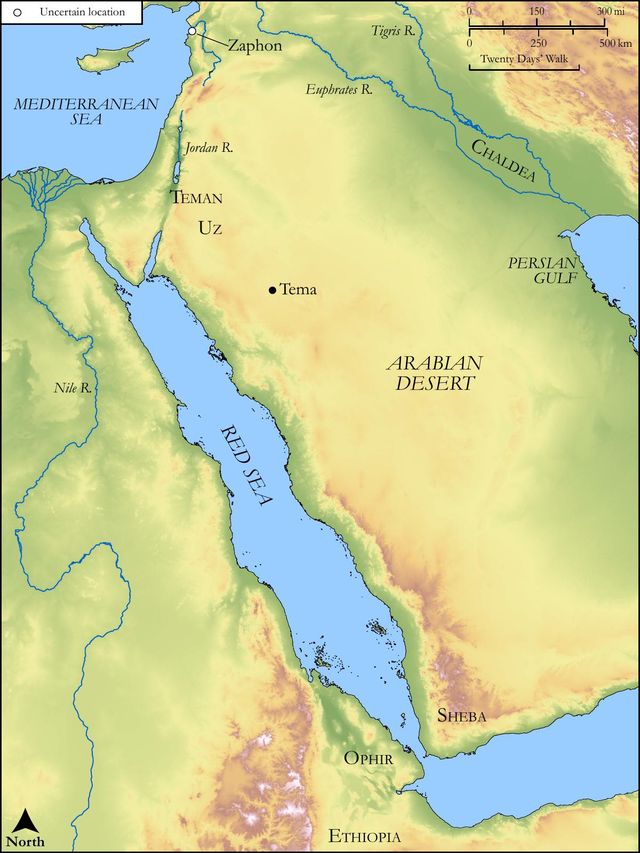
See on the biblical-era map
Study this verse
Public-domain commentary
Matthew Henry
From his Commentary on the Whole Bible. Henry comments on passages, not single verses — this entry covers Job 37:14–20. His four-level outline is real structure in the source text, so it is rendered as structure.
Elihu here addresses himself closely to Job, desiring him to apply what he had hitherto said to himself. He begs that he would hearken to this discourse (Job 37:14), that he would pause awhile: Stand still, and consider the wondrous works of God. What we hear is not likely to profit us unless we consider it, and we are not likely to consider things fully unless we stand still and compose ourselves to the consideration of them. The works of God, being wondrous, both deserve and need our consideration, and the due consideration of them will help to reconcile us to all his providences. Elihu, for the humbling of Job, shows him,
I.That he had no insight into natural causes, could neither see the springs of them nor foresee the effects of them (Job 37:15-17):
Dost thou know this and know that which are the wondrous works of him who is perfect in knowledge? We are here taught,
1.The perfection of God's knowledge. It is one of the most glorious perfections of God that he is perfect in knowledge; he is omniscient. His knowledge is intuitive: he sees, and does not know by report. It is intimate and entire: he knows things truly, and not by their colours - thoroughly, and not by piecemeal. To his knowledge there is nothing distant, but all near - nothing future, but all present - nothing hid, but all open. We ought to acknowledge this in all his wondrous works, and it is sufficient to satisfy us in those wondrous works which we know not the meaning of that they are the works of one that knows what he does.
2.The imperfection of our knowledge. The greatest philosophers are much in the dark concerning the powers and works of nature. We are a paradox to ourselves, and every thing about us is a mystery. The gravitation of bodies, and the cohesion of the parts of matter, are most certain, and yet unaccountable. It is good for us to be made sensible of our own ignorance. Some have confessed their ignorance, and those that would not do this have betrayed it. But we must all infer from it what incompetent judges we are of the divine politics, when we understand so little even of the divine mechanics.
(1.)We know not what orders God has given concerning the clouds, nor what orders he will give, Job 37:15. That all is done by determination and with design we are sure; but what is determined, and what designed, and when the plan was laid, we know not. God often causes the light of his cloud to shine, in the rainbow (so some), in the lightning (so others); but did we foresee, or could we foretell, when he would to it? If we foresee the change of weather a few hours before, by vulgar observation, or when second causes have begun to work by the weather-glass, yet how little do these show us of the purposes of God by these changes!
(2.)We know not how the clouds are poised in the air, the balancing of them, which is one of the wondrous works of God. They are so balanced, so spread, that they never rob us of the benefit of the sun (even the cloudy day is day), so balanced that they do not fall at once, nor burst into cataracts or water-spouts. The rainbow is an intimation of God's favour in balancing the clouds so as to keep them from drowning the world. Nay, so are they balanced that they impartially distribute their showers on the earth, so that, one time or other, every place has its share.
(3.)We know not how the comfortable change comes when the winter is past, Job 37:17.
[1.]How the weather becomes warm after it has been cold. We know how our garment came to be warm upon us, that is, how we come to be warm in our clothes, by reason of the warmth of the air we breathe in. Without God's blessing we should clothe ourselves, yet not be warm, Hag 1:6. But, when he so orders it, the clothes are warm upon us, which, in the extremity of cold weather, would not serve to keep us warm.
[2.]How it becomes calm after it has been stormy: He quiets the earth by the south wind, when the spring comes. As he has a blustering freezing north wind, so he has a thawing, composing, south wind; the Spirit is compared to both, because he both convinces and comforts, Sol 4:16.
II.That he had no share at all in the first making of the world (Job 37:18):
"Hast thou with him spread out the sky? Thou canst not pretend to have stretched it out without him, no, nor to have stretched it out in conjunction with him; for he was far from needing any help either in contriving or in working." The creation of the vast expanse of the visible heavens (Gen 1:6-8), which we see in being to this day, is a glorious instance of the divine power, considering,
1.That, though it is fluid, yet it is firm. It is strong, and has its name from its stability. It still is what it was, and suffers no decay, nor shall the ordinances of heaven be altered till the lease expires with time.
2.That, though it is large, it is bright and most curiously fine: It is a molten looking-glass, smooth and polished, and without the least flaw or crack. In this, as in a looking-glass, we may behold the glory of God and the wisdom of his handy work, Psa 19:1. When we look up to heaven above we should remember it is a mirror or looking-glass, not to show us our own faces, but to be a faint representation of the purity, dignity, and brightness of the upper world and its glorious inhabitants.
III.That neither he nor they were able to speak of the glory of God in any proportion to the merit of the subject, Job 37:19, Job 37:20.
1. He challenges Job to be their director, if he durst undertake the task. He speaks it ironically: "Teach us, if thou canst, what we shall say unto him, Job 37:19. Thou hast a mind to reason with God, and wouldst have us to contend with him on thy behalf; teach us then what we shall say. Canst thou see further into this abyss than we can? If thou canst, favour us with thy discoveries, furnish us with instructions." 2. He owns his own insufficiency both in speaking to God and in speaking of him: We cannot order our speech by reason of darkness. Note, The best of men are much in the dark concerning the glorious perfections of the divine nature and the administrations of the divine government. Those that through grace know much of God, yet know little, yea, nothing, in comparison with what is to be known, and what will be known, when that which is perfect shall come and the veil shall be rent. When we would speak of God we speak confusedly and with great uncertainly, and are soon at a loss and run aground, not for want of matter, but for want of words. As we must always begin with fear and trembling, lest we speak amiss (De Deo etiam vera dicere periculosum est - Even while affirming what is true concerning God we incur risk), so we must conclude with shame and blushing, for having spoken no better. Elihu himself had, for his part, spoken well on God's behalf, and yet is so far from expecting a fee, or thinking that God was beholden to him for it, or that he was fit to be standing counsel for him, that (1.) He is even ashamed of what he has said, not of the cause, but of his own management of it: "Shall it be told him that I speak? Job 37:20. Shall it be reported to him as a meritorious piece of service, worthy his notice? By no means; let it never be spoken of," for he fears that the subject has suffered by his undertaking it, as a fine face is wronged by a bad painter, and his performance is so far from meriting thanks that it needs pardon. When we have done all we can for God we must acknowledge that we are unprofitable servants and have nothing at all to boast of. He is afraid of saying any more: If a man speak, if he undertake to plead for God, much more if he offer to plead against him, surely he shall be swallowed up. If he speak presumptuously, God's wrath shall soon consume him; but, if ever so well, he will soon lose himself in the mystery and be over powered by the divine lustre. Astonishment will strike him blind and dumb.
Historical interpretation
Two Centuries of Reception
2 surviving comments on this verse. Each one is dated, so this reads as a timeline rather than a list.
Select a marker to jump to its quote. Markers stagger vertically where authors wrote within a few decades of each other.
Here he may mean, You are now in the midst of afflictions, but later you will have rest—and there is also the proof given by divine wisdom, which has foreseen death as a solution and end to human tribulations. Or perhaps [he means], even in the midst of your trials, you remain out of the fight of the war and the troubles, and he punishes you in this manner.
65. By ‘heavens,’ those who are created in the heavens, the angelic spirits, can be designated. Whence also we are instructed by the voice of Truth to say in our Prayer, Thy will be done as in heaven, so in earth. [Matt. 6, 10] That the will of God may be doubtless observed in all things even by human infirmity, as it is done by the higher creation. Of whom it is well said, They are most solid, as if cast in brass. For it is of the nature of brass, that it is difficult to be consumed by rust. And the angelic powers, which stood fixed in Divine love, when the proud angels fell, received this, as their reward of retribution, that they are no longer consumed by any rust of sin stealing upon them, that they continue in the contemplation of their Creator, without end to their felicity, and exist with eternal stability, in that which they were created. Which the very words of the history in Moses concerning the origin of the world will attest, when both the heaven is said to have been first made, and this is after wards called the firmament. [Gen. l, 17] Because, namely, the nature of Angels was both first fashioned more subtilly, in the regions above, and was afterwards still more wonderfully strengthened, that it might never fall. But, as we have often said, by the ‘heavens’ can be expressed the minds of the Elect, raised up by inward love from all earthly pollutions. For though, in the body, they dwell below, yet, because they cleave in their heart, even now, to the highest objects, they truly say, Our conversation is in heaven. [Phil. 3, 20] Who are most solid, as if cast in brass, because they are not wasted away from the integrity of their original strength, by any rust of changeableness. To whom, boldly bearing up against adversities, it is said by the voice of their Maker, Ye are My friends, which have continued with Me in My temptations. [John 15, 14; Luke 22, 28] But though this learned and haughty one, when endeavouring to make a jest of this holy man, blends noble sayings with his derision, yet he ever falls back, from those noble sayings, into empty words.
Continue studying Job 37:18 across the web’s major study libraries — every link below opens this exact verse, chapter, or book on the destination site.
Read & Compare
 BibleGatewayThis verse in more than 200 translations and 70 languages.
 Bible.comThe YouVersion reader — hundreds of translations, reading plans, and highlights.
 ESV.orgCrossway's official English Standard Version reader.
 NET BibleThe NET translation with 60,000+ translators' notes on every rendering decision.
 STEP BibleTyndale House's free study tool — original text, vocabulary, and scholarly resources.
 BibliaLogos Bible Software's free web reader.
 USCCBThe New American Bible (Revised Edition) with the U.S. bishops' study notes.
Commentaries
 BibleHub CommentariesDozens of classic commentaries on this verse, gathered on one page.
 StudyLightMore than 100 commentary sets — the largest collection on the web.
 BibleRefPlain-English commentary on what this verse means, verse by verse.
 Enduring WordDavid Guzik's free commentary on this chapter, widely used by Bible teachers.
 Bible Study ToolsVerse commentary alongside Greek and Hebrew study aids.
Original Language & Research
- BibleHub InterlinearThe verse word by word — original language, transliteration, and English.
- BibleHub LexiconEvery word's original-language definition and Strong's entry.
 Blue Letter BibleDeep-study tools — Strong's numbers, concordance, and word studies.
 SefariaThe Hebrew text with Rashi and centuries of Jewish commentary.
Sermons, Hymns & Audio


TrulyRandomVerse is not affiliated with these sites and doesn’t control their content. They’re linked because they’re genuinely useful.
Summary
Job 37:18 presents a profound rhetorical question from Elihu to Job, challenging human capacity in light of God's unparalleled omnipotence, demonstrably evident in creation. Elihu directs Job's attention to the vast and enduring sky, vividly describing it as "strong" and "as a molten looking glass"—a polished, reflective expanse. This verse serves as a powerful statement designed to humble Job, emphasizing the incomprehensible power and wisdom of God, who alone possesses the ability to "spread out" the heavens, a feat utterly beyond any human comprehension or capability. It stands as a climactic point in Elihu's extensive argument for God's unchallengeable sovereignty, effectively preparing the narrative for God's direct intervention and address to Job.
Context
ShowHideLiterary Context
Job 37:18 serves as a climactic summation within Elihu's final discourse, spanning chapters 32-37, immediately preceding God's direct address to Job in Job 38. Throughout his speeches, Elihu aims to reframe Job's understanding of God's justice and sovereignty, often by meticulously detailing God's majestic power as manifested in natural phenomena. Chapter 37, in particular, focuses on God's absolute control over weather patterns—including storms, lightning, clouds, and cold—culminating in this awe-inspiring description of the celestial expanse. Elihu's rhetorical questions, such as his inquiry in Job 37:16 concerning the balancing of clouds, are strategically posed to underscore human ignorance and God's unparalleled wisdom. Verse 18 functions as a powerful crescendo to this argument, employing the heavens themselves as an irrefutable testament to divine power, a creation far beyond human ability to conceive, sustain, or even fully comprehend.
Historical & Cultural Context
In Scripture, the sky is the "firmament" (Hebrew: raqia') that served to separate the waters above from the waters below, as vividly portrayed in Genesis 1:6-8. This widespread understanding naturally contributed to the perception of the sky as being "strong" or enduring. Mirrors during this historical period were not fabricated from glass but from meticulously polished metal, typically bronze or copper, which could be melted and cast into a smooth, reflective surface. Thus, the imagery of a "molten looking glass" would have powerfully evoked a vast, smooth, and potentially shimmering expanse, reflecting light with the brilliance of a highly polished shield. The men of the east were profoundly dependent on and reverent of weather patterns, interpreting phenomena such as rain, thunder, and storms as direct, tangible manifestations of divine activity. Elihu's appeal to these natural wonders would have resonated deeply with his audience, effectively demonstrating God's immediate, overwhelming, and unchallengeable presence in the world, entirely beyond human control or understanding.
Key Themes
ShowHideThis verse robustly contributes to several foundational themes within the book of Job and broader biblical theology. Paramount among these is God's Omnipotence and Sovereignty, as the act of "spreading out the sky" is exclusively attributed to Him, underscoring His unique creative power and absolute control over all creation. It starkly highlights Human Limitation and Humility, contrasting the finite capabilities of humanity with the infinite, boundless power of God. Elihu's challenging question, "Hast thou with him spread out the sky?", serves as a profound rhetorical device to humble Job and emphasize the immense, unbridgeable chasm between human understanding and God's infinite wisdom, a theme that God Himself will later powerfully elaborate upon in Job 38. Furthermore, the verse eloquently exemplifies the Testimony of Creation, where the natural world—and specifically the heavens—stands as irrefutable evidence of God's glory, majesty, and unsearchable wisdom, echoing the profound sentiments articulated in Psalm 19:1.
Exposition and Analysis
ShowHideKey Word Analysis
ShowHideThis verb, a primitive root, fundamentally means "to pound the earth (as a sign of passion)" and by analogy, "to expand (by hammering)." It also implies "to overlay (with thin sheets of metal)." This is the very same verb used in Genesis 1:6-7 to describe God's creation of the "firmament" or "expanse" of the sky. In Job 37:18, it powerfully conveys the idea of God actively stretching out the heavens, imbuing them with their vastness and perhaps their perceived solidity or structure, much like a craftsman hammering out a metal sheet or spreading a vast canopy. This emphasizes God's direct, powerful, and intentional hand in creation.
Derived from the root meaning "to seize, be strong," this adjective denotes firmness, might, hardness, or durability. When applied to the sky, it suggests its enduring nature, its vast and unyielding quality, and reflects the ancient perception of the firmament as a solid, impenetrable dome. It speaks to the stability, permanence, and immense power inherent in God's handiwork, standing in stark contrast to the fragility and transience of all human endeavors.
This vivid and composite phrase combines "looking glass" (rᵉʼîy H7209), meaning a mirror (typically crafted from highly polished metal in that day), with "molten" (yâtsaq H3332), which refers to something poured out, cast as metal, or made firm. The combined image is that of a vast, smooth, and brilliantly polished surface, akin to a mirror fashioned from cast metal. This striking simile beautifully describes the appearance of a clear, blue sky—smooth, reflective, and seemingly impenetrable. It speaks to both the aesthetic beauty and the perceived solidity of the heavens, reflecting light and, implicitly, the ineffable glory of God Himself.
Verse Breakdown
ShowHide"Hast thou with him spread out the sky,"
This opening clause is a direct, challenging rhetorical question posed by Elihu to Job. The crucial phrase "with him" unequivocally underscores that the act of "spreading out the sky" is an exclusive divine prerogative, an act that only God can accomplish. It implicitly asks Job if he possesses even a fraction of the same creative power, knowledge, or authority as the Almighty, thereby powerfully highlighting human inadequacy and God's unique, unparalleled omnipotence.
"[which is] strong,"
This descriptive clause attributes a fundamental characteristic to the sky, emphasizing its inherent durability, stability, and immense vastness. It suggests an enduring, unyielding structure that defies human comprehension or replication. This inherent "strength" of the heavens serves as a direct testament to the boundless power of its Creator, who established it with such permanence and might, far surpassing any human construction or design.
"[and] as a molten looking glass?"
This concluding clause employs a profound and evocative simile, likening the sky to a mirror crafted from cast, highly polished metal. This rich imagery conveys the sky's smooth, clear, and potentially reflective appearance, particularly on a bright, cloudless day. It speaks not only to its aesthetic beauty but also to its seemingly impenetrable quality and, perhaps most profoundly, its capacity to reflect the divine glory, much like a perfectly polished mirror reflects an image.
Literary Devices
ShowHideElihu's discourse in Job 37:18 masterfully employs several literary devices to powerfully convey God's overwhelming might and to effectively humble Job. The most prominent device is the Rhetorical Question, "Hast thou with him spread out the sky...?", which is not intended to elicit a direct answer but rather to provoke profound contemplation and highlight the immense, unbridgeable chasm between finite human capability and infinite divine omnipotence. This question serves to underscore human limitation, ignorance, and God's absolute, unchallengeable sovereignty. A striking Simile is utilized in the phrase "as a molten looking glass," comparing the sky's appearance to a meticulously polished metal mirror. This comparison evokes vivid Imagery of a smooth, vast, and reflective expanse, emphasizing the sky's beauty, clarity, and perceived solidity. The descriptive use of the word "strong" further enhances this imagery, attributing a physical characteristic to the heavens that powerfully points to the enduring, unwavering power of their Creator. This strategic combination of literary devices culminates in a powerful and memorable statement about God's unparalleled majesty, profoundly revealed in the intricate tapestry of His creation.
Theological and Thematic Connections
ShowHideJob 37:18 profoundly connects to the biblical understanding of God as the singular, transcendent Creator, whose power, wisdom, and majesty are utterly beyond human comprehension. It powerfully reinforces the pervasive biblical theme that the natural world serves as a constant, irrefutable testimony to God's glory, invariably prompting awe, reverence, and humility in humanity. Elihu's challenge to Job in this verse is a deliberate precursor to God's own direct, unanswerable questions in the subsequent chapters, both aiming to reorient Job's perspective from his personal suffering to the majestic, all-encompassing sovereignty of the One who meticulously controls all things. The "strength" and "molten looking glass" imagery of the sky points not only to the physical attributes of the heavens but also symbolically to God's steadfastness, His unwavering character, and the crystalline clarity with which His attributes are revealed in creation, provided one has the spiritual eyes to perceive them. This profound revelation calls for unwavering trust in His sovereign plan, even when life's circumstances are perplexing, painful, or seemingly inexplicable.
Reflection and Application
ShowHideJob 37:18 stands as a timeless and profound invitation to pause, reflect, and meditate on the immense power, infinite wisdom, and meticulous artistry of God, so gloriously displayed in the very sky that stretches above us. Even in our age of advanced scientific understanding, the sheer vastness, intricate complexity, and breathtaking beauty of the heavens continue to inspire profound awe and point unequivocally to a Creator whose capabilities and knowledge far exceed our own. This verse cultivates a deep sense of humility within us, urging us to recognize our inherently limited perspective in stark comparison to God's infinite knowledge and boundless power. It calls us to marvel at the everyday miracle of the sky—strong, vast, and beautiful like a polished mirror—and to worship the God who meticulously "spread it out" with divine precision. If we, with all our technological prowess, cannot even replicate or fully comprehend something as seemingly familiar as the sky, how much less can we fully grasp the intricate ways, sovereign purposes, and ultimate wisdom of the One who spoke it into existence? This perspective is absolutely crucial for cultivating unwavering trust in God's overarching plan, especially when our personal circumstances are confusing, painful, or seemingly unjust, much like Job was challenged to do. It serves as a powerful reminder that even amidst our deepest questions and most profound suffering, God remains the unchallengeable, all-wise, and perfectly sovereign Creator, eternally deserving of our unwavering faith, adoration, and humble submission.
Questions for Reflection
ShowHideFAQ
ShowHideWhat does "molten looking glass" mean in the context of Job 37:18?
ShowHideIn that day, a "looking glass" was the common term for a mirror, and these were typically crafted from highly polished metal, such as bronze or copper, rather than the glass we are familiar with today. The term "molten" refers to metal that has been melted down and then cast into a solid, specific form. Therefore, "molten looking glass" describes a mirror made of metal that was first melted and then solidified into a smooth, reflective surface. When this vivid imagery is applied to the sky in Job 37:18, it suggests a celestial expanse that is vast, smooth, clear, and highly reflective, perhaps shimmering with light. It powerfully conveys the sky's immense beauty, its seemingly impenetrable quality, and its capacity to reflect the divine glory, much like a perfectly polished shield or mirror.
Why does Elihu ask Job, "Hast thou with him spread out the sky?"
ShowHideElihu's question is a potent rhetorical device strategically employed to humble Job and underscore the vast, unbridgeable chasm between finite human capability and infinite divine omnipotence. Throughout his extensive discourse, Elihu consistently asserts God's absolute justice and unchallengeable sovereignty, frequently using various natural phenomena as irrefutable evidence of God's incomprehensible greatness. By directly asking Job if he possesses the power to "spread out the sky"—a monumental feat attributed solely to God throughout Scripture, as seen in passages like Isaiah 40:22—Elihu effectively highlights human limitation, ignorance, and utter dependence. His overarching purpose is to silence Job's complaints, challenge his presumptions of understanding God's intricate ways, and ultimately prepare him to humbly submit to the Almighty's unsearchable wisdom and sovereign plan, even amidst profound suffering.
Christ-Centered Fulfillment
ShowHideWhile Job 37:18 primarily extols the incomparable power and profound wisdom of God the Creator, its foundational themes find their ultimate fulfillment, deepest meaning, and most glorious expression in the person and work of Jesus Christ. The "spreading out of the sky" points to an act of creation of unimaginable scale, and the New Testament unequivocally reveals that all things—including the heavens and the earth—were created through and for Christ. As John 1:3 majestically declares, "All things were made through him, and without him was not anything made that was made." Similarly, Colossians 1:16 affirms that "by him all things were created, in heaven and on earth, visible and invisible... all things were created through him and for him." The inherent "strength" of the sky, testifying to an enduring and steadfast Creator, finds its ultimate and perfect expression in Christ, who "upholds the universe by the word of his power" (Hebrews 1:3). He is the steadfast, unchanging Son, the very image of the invisible God (Colossians 1:15). The "molten looking glass" of the sky, reflecting God's glory and beauty, serves as a powerful Old Testament foreshadowing of the ultimate and most profound revelation of God's glory found in the face of Jesus Christ (2 Corinthians 4:6). Elihu's rhetorical question, "Hast thou with him spread out the sky?", finds its profound and glorious answer not in human ability or wisdom, but in the divine person of Christ, who is God with us, Immanuel, the very one through whom all things were made and are eternally sustained, inviting us to behold His glory and be progressively transformed into His likeness (2 Corinthians 3:18).