


Job 9:9
Bible text: King James Version (1769 Blayney text) · Public domain
Bible text: Berean Standard Bible · Public domain
Bible text: American Standard Version (1901) · Public domain
Bible text: World English Bible, Messianic edition · Public domain
Bible text: Geneva Bible (1599) · Public domain
Bible text: Young's Literal Translation · Public domain
- עֹשֶׂה'o·seh[one who] makesH6213V-Qal-Prtcpl-msVerb Qal Participle Singular Masculine Absolute
- עָשׁ'ash[the] BearH5906N-fsNoun Title Singular Feminine Absolute
- כְּסִילke·SilOrionH3685N-msNoun Title Singular Masculine Absolute
- וְכִימָהve·khi·Mahand PleiadesH3598Conj-w ¦ N-fsNoun Title Singular Feminine AbsoluteוְandכִימָהPleiades
- וְחַדְרֵיve·chad·Reiand [the] chambers ofH2315Conj-w ¦ N-mpcNoun Plural Masculine Constructוְandחַדְרֵי[the] chambers of
- תֵמָןte·Man[the] southH8486N-fsNoun Singular Feminine Absolute
English is a literal word-by-word gloss of the Hebrew, not the KJV's wording. Why?
This is the original text the KJV's translators worked from — each Hebrew word with its own literal English meaning in this verse, prepared by scholars at Tyndale House, Cambridge. The KJV translates whole sentences, not word by word, so its wording differs: one Hebrew word can become several English words, and the KJV may choose “the LORD” where the gloss reads “Yahweh”. Both are faithful — they answer different questions. For the KJV's own rendering, switch to the KJV text.
Details
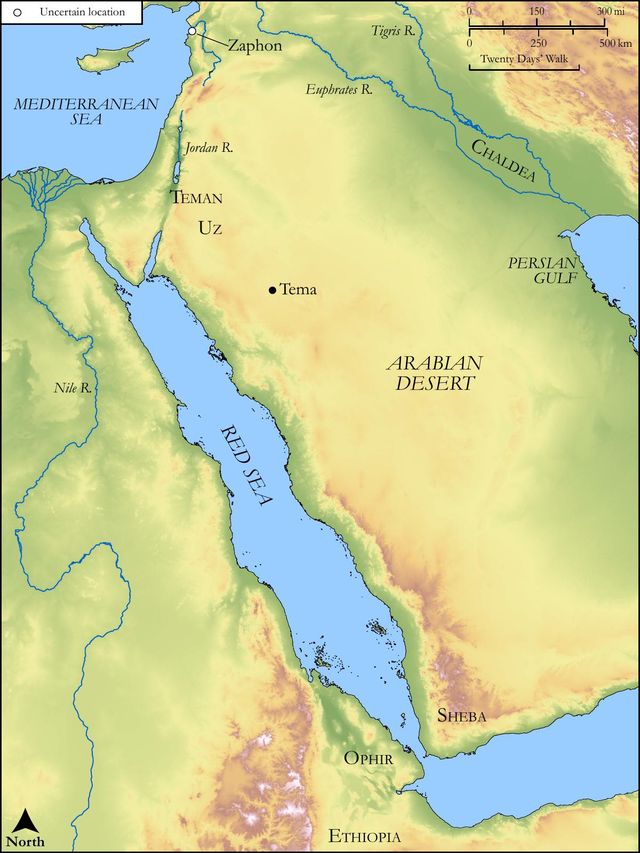
See on the biblical-era map
Study this verse
Public-domain commentary
Matthew Henry
From his Commentary on the Whole Bible. Henry comments on passages, not single verses — this entry covers Job 9:1–13. His four-level outline is real structure in the source text, so it is rendered as structure.
Bildad began with a rebuke to Job for talking so much, Job 8:2. Job makes no answer to that, though it would have been easy enough to retort it upon himself; but in what he next lays down as his principle, that God never perverts judgment, Job agrees with him: I know it is so of a truth, Job 9:2. Note, We should be ready to own how far we agree with those with whom we dispute, and should not slight, much less resist, a truth, though produced by an adversary and urged against us, but receive it in the light and love of it, though it may have been misapplied. "It is so of a truth, that wickedness brings men to ruin and the godly are taken under God's special protection. These are truths which I subscribe to; but how can any man make good his part with God?" In his sight shall no flesh living be justified, Psa 143:2. How should man be just with God? Some understand this as a passionate complaint of God's strictness and severity, that he is a God whom there is no dealing with; and it cannot be denied that there are, in this chapter, some peevish expressions, which seem to speak such language as this. But I take this rather as a pious confession of man's sinfulness, and his own in particular, that, if God should deal with any of us according to the desert of our iniquities, we should certainly be undone.
I.He lays this down for a truth, that man is an unequal match for his Maker, either in dispute or combat.
1.In dispute (Job 9:3): If he will contend with him, either at law or at an argument, he cannot answer him one of a thousand.
(1.)God can ask a thousand puzzling questions which those that quarrel with him, and arraign his proceedings, cannot give an answer to. When God spoke to Job out of the whirlwind he asked him a great many questions (Dost thou know this? Canst thou do that?) to none of which Job could give an answer, ch. 38, 39. God can easily manifest the folly of the greatest pretenders to wisdom.
(2.)God can lay to our charge a thousand offences, can draw up against us a thousand articles of impeachment, and we cannot answer him so as to acquit ourselves from the imputation of any of them, but must, by silence, give consent that they are all true. We cannot set aside one as foreign, another as frivolous, and another as false. We cannot, as to one, deny the fact, and plead not guilty, and, as to another, deny the fault, confess and justify. No, we are not able to answer him, but must lay our hand upon our mouth, as Job did (Job 40:4, Job 40:5), and cry, Guilty, guilty.
2.In combat (Job 9:4): "Who hath hardened himself against him and hath prospered?" The answer is very easy. You cannot produce any instance, from the beginning of the world to this day, of any daring sinner who has hardened himself against God, has obstinately persisted in rebellion against him, who did not find God too hard for him and pay dearly for his folly. Such transgressors have not prospered or had peace; they have had no comfort in their way nor any success. What did ever man get by trials of skill, or trials of titles, with his Maker? All the opposition given to God is but setting briers and thorns before a consuming fire; so foolish, so fruitless, so destructive, is the attempt, Isa 27:4; Eze 28:24; Co1 10:22. Apostate angels hardened themselves against God, but did not prosper, Pe2 2:4. The dragon fights, but is cast out, Rev 12:9. Wicked men harden themselves against God, dispute his wisdom, disobey his laws, are impenitent for their sins and incorrigible under their afflictions; they reject the offers of his grace, and resist the strivings of his Spirit; they make nothing of his threatenings, and make head against his interest in the world. But have they prospered? Can they prosper? No; they are but treasuring up for themselves wrath against the day of wrath. Those that roll this will find it return upon them.
II.He proves it by showing what a God he is with whom we have to do:
He is wise in heart, and therefore we cannot answer him at law; he is mighty in strength, and therefore we cannot fight it out with him. It is the greatest madness that can be to think to contend with a God of infinite wisdom and power, who knows every thing and can do every thing, who can be neither outwitted nor overpowered. The devil promised himself that Job, in the day of his affliction, would curse God and speak ill of him, but, instead of that, he sets himself to honour God and to speak highly of him. As much pained as he is, and as much taken up with his own miseries, when he has occasion to mention the wisdom and power of God he forgets his complaints, dwells with delight, and expatiates with a flood of eloquence, upon that noble useful subject. Evidences of the wisdom and power of God he fetches,
1.From the kingdom of nature, in which the God of nature acts with an uncontrollable power and does what he pleases; for all the orders and all the powers of nature are derived from him and depend upon him.
(1.)When he pleases he alters the course of nature, and turns back its streams, Job 9:5-7. By the common law of nature the mountains are settled and are therefore called everlasting mountains, the earth is established and cannot be removed (Psa 93:1) and the pillars there of are immovably fixed, the sun rises in its season, and the stars shed their influences on this lower world; but when God pleases he can not only drive out of the common track, but invert the order and change the law of nature.
[1.]Nothing more firm than the mountains. When we speak of removing mountains we mean that which is impossible; yet the divine power can make them change their seat: He removes them and they know not, removes them whether they will or no; he can make them lower their heads; he can level them, and overturn them in his anger; he can spread the mountains as easily as the husbandman spreads the molehills, be they ever so high, and large, and rocky. Men have much ado to pass over them, but God, when he pleases, can make them pass away. He made Sinai shake, Psa 68:8. The hills skipped, Psa 114:4. The everlasting mountains were scattered, Hab 3:6.
[2.]Nothing more fixed than the earth on its axletree; yet God can, when he pleases, shake the earth out of its place, heave it off its centre, and make even its pillars to tremble; what seemed to support it will itself need support when God gives it a shock. See how much we are indebted to God's patience. God has power enough to shake the earth from under that guilty race of mankind which makes it groan under the burden of sin, and so to shake the wicked out of it (Job 38:13); yet he continues the earth, and man upon it, and does not make it, as once, to swallow up the rebels.
[3.]Nothing more constant than the rising sun, it never misses its appointed time; yet God, when he pleases, can suspend it. He that at first commanded it to rise can countermand it. Once the sun was told to stand, and another time to retreat, to show that it is still under the check of its great Creator. Thus great is God's power; and how great then is his goodness, which causes his sun to shine even upon the evil and unthankful, though he could withhold it! He that made the stars also, can, if he pleases, seal them up, and hide them from our eyes. By earthquakes and subterraneous fires mountains have sometimes been removed and the earth shaken: in very dark and cloudy days and nights it seems to us as if the sun were forbidden to rise and the stars were sealed up, Act 27:20. It is sufficient to say that Job here speaks of what God can do; but, if we must understand it of what he has done in fact, all these verses may perhaps be applied to Noah's flood, when the mountains of the earth were shaken, and the sun and stars were darkened; and the world that now is we believe to be reserved for that fire which will consume the mountains, and melt the earth, with its fervent heat, and which will turn the sun into darkness.
(2.)As long as he pleases he preserves the settled course and order of nature; and this is a continued creation. He himself alone, by his own power, and without the assistance of any other,
[1.]Spreads out the heaven (Job 9:8), not only did spread them out at first, but still spreads them out (that is, keeps them spread out), for otherwise they would of themselves roll together like a scroll of parchment.
[2.]He treads upon the waves of the sea; that is, he suppresses them and keeps them under, that they return not to deluge the earth (Psa 104:9), which is given as a reason why we should all fear God and stand in awe of him, Jer 5:22. He is mightier than the proud waves Psa 93:4; Psa 65:7.
[3.]He makes the constellations; three are named for all the rest (Job 9:9), Arcturus, Orion, and Pleiades, and in general the chambers of the south. The stars of which these are composed he made at first, and put into that order, and he still makes them, preserves them in being, and guides their motions; he makes them to be what they are to man, and inclines the hearts of man to observe them, which the beasts are not capable of doing. Not only those stars which we see and give names to, but those also in the other hemisphere, about the antarctic pole, which never come in our sight, called here the chambers of the south, are under the divine direction and dominion. How wise is he then, and how mighty!
2.From the kingdom of Providence, that special Providence which is conversant about the affairs of the children of men. Consider what God does in the government of the world, and you will say, He is wise in heart and mighty in strength.
(1.)He does many things and great, many and great to admiration, Job 9:10. Job here says the same that Eliphaz had said (Job 5:9), and in the original in the very same words, not declining to speak after him, though now his antagonist. God is a great God, and doeth great things, a wonder-working God; his works of wonder are so many that we cannot number them and so mysterious that we cannot find them out. O the depth of his counsels!
(2.)He acts invisibly and undiscerned, Job 9:11. "He goes by me in his operations, and I see him not, I perceive him not. His way is in the sea," Psa 77:19. The operations of second causes are commonly obvious to sense, but God does all about us and yet we see him not, Act 17:23. Our finite understandings cannot fathom his counsels, apprehend his motions, or comprehend the measures he takes; we are therefore incompetent judges of God's proceedings, because we know not what he does or what he designs. The arcana imperii - secrets of government, are things above us, which therefore we must not pretend to expound or comment upon.
(3.)He acts with an incontestable sovereignty, Job 9:12. He takes away our creature-comforts and confidences when and as he pleases, takes away health, estate, relations, friends, takes away life itself; whatever goes, it is he that takes it; by what hand so ever it is removed, his hand must be acknowledged in its removal. The Lord takes away, and who can hinder him? Who can turn him away? (Margin, Who shall make him restore?) Who can dissuade him or alter his counsels? Who can resist him or oppose his operations? Who can control him or call him to an account? What action can be brought against him? Or who will say unto him, What doest thou? Or, Why doest thou so? Dan 4:35. God is not obliged to give us a reason of what he does. The meanings of his proceedings we know no now; it will be time enough to know hereafter, when it will appear that what seemed now to be done by prerogative was done in infinite wisdom and for the best.
(4.)He acts with an irresistible power, which no creature can resist, Job 9:13. If God will not withdraw his anger (which he can do when he pleases, for he is Lord of his anger, lets it out or calls it in according to his will), the proud helpers do stoop under him; that is, He certainly breaks and crushes those that proudly help one another against him. Proud men set themselves against God and his proceedings. In this opposition they join hand in hand. The kings of the earth set themselves, and the rulers take counsel together, to throw off his yoke, to run down his truths, and to persecute his people. Men of Israel, help, Act 21:28; Psa 83:8. If one enemy of God's kingdom fall under his judgment, the rest come proudly to help that, and think to deliver that out of his hand: but in vain; unless he pleases to withdraw his anger (which he often does, for it is the day of his patience) the proud helpers stoop under him, and fall with those whom they designed to help. Who knows the power of God's anger? Those who think they have strength enough to help others will not be able to help themselves against it.
Historical interpretation
Historical reception
2 surviving comments on this verse. Each one is dated, so this reads as a timeline rather than a list.
12. The word of Truth never follows the vain fables of Hesiod, Aratus, or Callimachus, that in naming Arcturus it should take the last of the seven stars for the tail of the bear, or as if Orion were holding a sword as a mad lover; for these names of the stars were invented by the votaries of carnal wisdom, but Holy Scripture for this reason makes use of these words, that the things which it aims to convey instruction about, may be represented by the customariness of their usual designation. For if he had spoken of any stars he might wish by names unknown to us, man, for whom this very Scripture was made, would assuredly have known nothing what he heard. Thus in Holy Writ the wise ones of God derive their speech from the wise ones of the world, in like sort as therein God the very Creator of man, for man's benefit, takes in Himself the tones of human passion, i.e. so as to say, It repenteth Me that I have made man upon the earth [Gen. 6, 6. 7.]; whereas it is plain and undoubted that He, Who beholds all things before they come, after He has done any thing, never repents by feeling regret. What wonder is it, then, if spiritual men use the words of carnal men, when the Ineffable Spirit Himself, Which is the Creator of all things, in order to draw the flesh to the understanding of Him, in His own case frames His speech of the flesh? Thus in Holy Writ, when we hear the familiar names of the stars, we learn what stars the discourse runs on. And after we have well weighed what stars are described, it remains that from their motions we be led to raise ourselves to the mysteries of the spiritual meaning. For not even after the letter is there any thing strange, in that it is said that God created Arcturus, and the Orions, and the Hyades, concerning Whom it is an acknowledged truth, that there is nothing of any sort in the world but He Himself made it. But the holy man declares that the Lord made these, by which he means properly to denote things that are done in a spiritual way.
13. For what is represented by the name of Arcturus, which being set in the polar region of the heavens shines bright with the rays of seven stars, except the Church universal, which is represented in the Apocalypse of John by the seven Churches and the seven candlesticks? Which same, while She contains in Herself the gifts of seven-fold grace, beaming with the brightness of highest virtue, as it were gives light from the polar region of Truth. And it is furthermore to be considered, that Arcturus is ever turned about, and never sunk from sight, in that Holy Church ever undergoes the persecutions of the wicked without ceasing, and yet endures without failing ‘even unto the end of the world.’ For oftentimes because the sons of perdition have persecuted her even to the death, they have been persuaded that they had as it were utterly extinguished her, but she returned with manifold increase to the rearing of her full growth, in proportion as she travailed in dying amidst the hands of Her persecutors. Thus while Arcturus is turned about, he is set on high, for Holy Church is then more strongly reinvigorated in the Truth, when she spends herself more fervently for the Truth.
14. Hence too after Arcturus he immediately subjoins the ‘Oriones’ with propriety. For they arise in the very heaviest of the winter season, and they stir up storms by their rising, and put sea and land in commotion. What then is denoted by ‘the Oriones,’ after ‘Arcturus,’ saving the Martyrs? who, while Holy Church is set on high to take her stand of preaching, destined to undergo the weight of the persecutors and harassing treatment, came into the face of heaven, as it were, in the winter season. For when they were born, the sea and the land were troubled, in that when the Gentile world grieved that its method of life was undone, on their courage appearing, it set up for their destruction not only the fiery and turbulent, but the mild among men also. And thus the winter lowered in ‘the Oriones,’ in that when the constancy of the Saints shone out, the frozen soul of the unbelievers lashed itself into a tempest of persecution. And so ‘the heavens’ gave forth the Oriones, when Holy Church sent out her Martyrs, who whilst they had boldness to speak what is right to the uninstructed, brought upon themselves every thing most heavy from the adverse bitterness of cold.
15. Now he justly subjoins the Hyades directly, which, when the springtide is waxing, go forth into the face of heaven, and, when the sun is now putting out the power of his heat, are given to sight. For they are attached to the beginnings of that sign, which the wise of this world call ‘the Bull,’ at which the sun begins to increase, and arises with more fervent heat, to lengthen out the periods of the day. Who, then, after ‘the Oriones,’ are denoted by the title of ‘the Hyades,’ saving the Doctors of Holy Church, who; when the Martyrs were taken away, came at that period to the world's knowledge, when faith now shines forth the brighter, and the winter of infidelity being forced back, the sun of truth flows deeper through the hearts of the faithful. These, when the storm of persecution was overpast, and the nights of long infidelity consummated, then arose to Holy Church, when the year now opens brighter in the vernal season of belief. Nor are the holy Doctors improperly denoted by the designation of ‘Hyades,’ for in the Greek tongue rain is called ‘Hyetus;’ and the ‘Hyades’ have received their name from the rains, surely because at their rising they bring showers. Thus they are well represented by the title of ‘the Hyades,’ who, brought out in the settled frame of Holy Church, as it were into the face of heaven, upon the parched earth of the human heart poured down the showers of holy preaching. For if the word of preaching were not rain, Moses would never have said, Let my doctrine be waited for as the rain. [Deut. 32, 2] ‘Truth’ would never have said by the lips of Isaiah, I will also command the clouds that they rain no rain upon it; [Is. 5, 6] and that which we brought forward a little above, Therefore the stars [d] of the showers are withholden. [Jer. 3, 3] Thus while the Hyades come bringing showers, the sun is led on to the higher regions of heaven; in that, when the knowledge of the Doctors appears, while our minds drink in the showers of preaching, the heat of faith increases. And the earth being irrigated is rendered productive in fruit, when the light of the sky is fired; in that we yield the fruit of good works the more plentifully, the brighter we burn within our breasts through the flame of sacred instruction. And while heavenly lore is displayed to view by them more and more day by day, it is as if the springtide of interior light were opened upon us, that the new Sun may glow brightly in our souls, and being by their words made known to us, may daily surpass itself in brilliancy. For the end of the world being close at hand, the knowledge from above advances, and waxes bigger with the progress of time. For hence it is said by Daniel, Many shall run to and fro, and knowledge shall be increased. [Dan. 12, 4] Hence the Angel saith to John in the former part of the Revelation, Seal up those things, which the seven thunders uttered; [Rev. 10, 4] and yet at the end of that Revelation he bids him, saying, Seal not the sayings of the prophecy of this book. [Ib. 22, 10] For the first part of the Revelation is commanded to be sealed, but the end not to be sealed; for whatever was hidden in the beginnings of Holy Church, the end clears up day by day. But some imagine that ‘the Hyades’ are named from the Greek letter which is rendered by ‘y;’ which, if it be so, is not opposed to the sense which we have given: the Doctors are not unsuitably represented by those stars which have their name from letters; but, though ‘the Hyades’ are not unlike the look of that letter, yet it is a fact that a shower is called ‘Hyetus,’ and that those at their rising bring with them rain.
16. Therefore let the holy man, viewing the order of our redemption, feel wonder, and wondering let him cry out, in the words, Which alone spreadeth out the heavens, and treadeth upon the waves of the sea. Which maketh Arcturus, the Oriones, and Hyades. For, when the heavens were spread out, the Lord made ‘Arcturus,’ in that, when the Apostles were brought to honour, He stablished the Church in heavenly conversation, and when Arcturus was made, He framed ‘the Oriones,’ in that the faith of the Church Universal being established, He launched forth the Martyrs against the storms of the world. And when ‘the Oriones’ were launched in heaven, He set forth ‘the Hyades,’ in that when the Martyrs proved strong against adversities, He vouchsafed the teaching of Masters, to water the drought of human hearts. These then are the ranks of the spiritual stars, which while they stand out conspicuous by the highest virtues, are ever shining from above.
17. But what remains after these things, saving that Holy Church, receiving the fruit of her toils, should attain to behold the inner depths of the Country above? And hence, whereas he had said, Which maketh Arcturus, the Oriones, and the Hyades; he rightly added directly, and the chambers of the South. For what is here denoted by the name of ‘the South,’ saving the fervour of the Holy Spirit? with which he that is replenished, kindles to the love of the spiritual Country. And hence it is said by the voice of the Spouse in the Song of Solomon, Arise, O north wind, and come thou south, blow upon my garden, that the spices thereof may flow out. For upon the ‘south wind’ coming, the ‘north wind’ arising departs, when our old enemy, who had bound up our soul in inactivity, being expelled by the coming of the Holy Spirit, takes himself away. And ‘the south wind blows upon the garden’ of the Spouse, that ‘the spices thereof may flow down;’ in that, whensoever the Spirit of Truth has filled Holy Church with the excellences of His gifts, He scatters far and wide from her the odours of good works. And thus ‘the chambers of the South’ are those unseen orders of the Angels, and those unfathomed depths of the heavenly Country, which are filled with the heat of the Holy Spirit. For thither are brought the souls of the Saints, both at this present time divested of the body, and hereafter restored to the same anew, and like stars they are concealed in hidden depths. There all the day, as at midday, the fire of the sun burns with a brighter lustre, in that the brightness of our Creator, which is now overlaid with the mists of our mortal state, is rendered more clearly visible; and the beam of the orb seems to raise itself to higher regions, in that ‘Truth’ from Its own Self enlightens us more completely through and through. There the light of interior contemplation is seen without the intervening shadow of mutability; there is the heat of supreme Light without any dimness from the body; there the unseen bands of Angels glitter like stars in hidden realms, which cannot now be seen by men, in proportion as they are deeper bathed in the flame of the true Light. Thus it is altogether marvellous that, in the sending of the Apostles, the Lord stretched out the Heavens; that, in moderating the swellings of persecution He trode the waves of the sea, and kept them down; that in the stablishing of the Church, He set ‘Arcturus’ in his place; that in making the Martyrs proof against afflictions, He sent forth ‘the Oriones;’ that in the Doctors being replenished in peace, He gave forth ‘the Hyades;’ but after these it is beyond all comparison marvellous, that He should have provided for us the haven of the heavenly Land, as ‘the chambers of the South.'
18. All this is beautiful, that is seen as it were in the face of heaven of God's ordering; but infinitely and incomparably more beautiful is that, to which we are brought without its being able to be seen. Hence the Spouse justly repeats a second time in the commendation of His Bride; Behold thou art fair, my love; behold thou art fair: thou hast doves’ eyes, besides that which lieth hidden within. [Cant. 4, 1] He describes her ‘fair,’ and says again ‘fair,’ in that there is one sort of beauty of life and conduct, wherein she is now seen, and another beauty of rewards, wherein she will then be lifted up in the likeness of her Creator; and because her members, which are all the Elect, go about all things with simplicity, her eyes are called ‘doves’ eyes;’ which shine with extraordinary light, for that they glitter even with the signs of miraculous power. But how great is all this marvel, which is able to be seen! That marvel relating to things of the interior is more wonderful, which is not now able to be seen, concerning which it is fitly added in that place, Besides that which lieth hidden within. For the glory of the visible world is great, but the glory of the secret recompensing far beyond comparison. That, then, which is denoted by the name of ‘stars’ by blessed Job, is in the words of Solomon represented by the title of ‘eyes;’ and what is described by Solomon, Besides that which lieth within, blessed Job conveys to us, when he extols ‘the chambers of the South.’ But see; the holy man in admiring things without, and contemplating those of the interior, telling of things manifest, and diving into things secret, aims to describe all that is done both within and without; but when shall the tongue of flesh unfold the works of the Supreme Greatness? And hence with just propriety directly afterwards, by giving up the attempt, he measures the compass of these same works the more effectually.
For what does the name “the heavens” denote but this deeply heavenly life of those who preach, of whom the psalmist speaks, “The heavens declare the glory of God.” Thus the same persons are recorded to be the heavens, and the same to be the sun. Indeed they are the heavens, because they protect by praying for all; they are the sun, because they show the power of light by preaching. And so, as the “earth was shaken,” “the heavens were spread out.” For when Judea fed greedily on the violence of persecution, the Lord spread about the life of the apostles, so that all the Gentiles might acquaint themselves with them.… For what is denoted by the title of “the sea” but this world’s bitterness raging in the destruction of the righteous? The psalmist also speaks concerning this: “He gathers the waters of the sea together as in a skin.” For the Lord “gathers the water of the sea together as in a skin” as he disposes all things with wonderful governance. He restrains the carnal threats pent up in their hearts. Thus “the Lord treads upon the waves of the sea.” When the storms of persecution lift up themselves, they are dashed to pieces in astonishment at his miracles. Since he that brings down the swellings of humanity’s madness, as it were, treads the waters as they stand in a heap.
Continue studying Job 9:9 across the web’s major study libraries — every link below opens this exact verse, chapter, or book on the destination site.
Read & Compare
 BibleGatewayThis verse in more than 200 translations and 70 languages.
 Bible.comThe YouVersion reader — hundreds of translations, reading plans, and highlights.
 ESV.orgCrossway's official English Standard Version reader.
 NET BibleThe NET translation with 60,000+ translators' notes on every rendering decision.
 STEP BibleTyndale House's free study tool — original text, vocabulary, and scholarly resources.
 BibliaLogos Bible Software's free web reader.
 USCCBThe New American Bible (Revised Edition) with the U.S. bishops' study notes.
Commentaries
 BibleHub CommentariesDozens of classic commentaries on this verse, gathered on one page.
 StudyLightMore than 100 commentary sets — the largest collection on the web.
 BibleRefPlain-English commentary on what this verse means, verse by verse.
 Enduring WordDavid Guzik's free commentary on this chapter, widely used by Bible teachers.
 Bible Study ToolsVerse commentary alongside Greek and Hebrew study aids.
Original Language & Research
- BibleHub InterlinearThe verse word by word — original language, transliteration, and English.
- BibleHub LexiconEvery word's original-language definition and Strong's entry.
 Blue Letter BibleDeep-study tools — Strong's numbers, concordance, and word studies.
 SefariaThe Hebrew text with Rashi and centuries of Jewish commentary.
Sermons, Hymns & Audio


TrulyRandomVerse is not affiliated with these sites and doesn’t control their content. They’re linked because they’re genuinely useful.
Summary
Job 9:9 serves as a profound declaration by Job concerning God's unassailable power and meticulous control over the heavens and the earth. Amidst his intense suffering and theological debate with his friends, Job acknowledges God's omnipotence by listing prominent celestial bodies—Arcturus, Orion, and Pleiades—along with the unseen "chambers of the south." This enumeration stands as irrefutable evidence of the Creator's boundless wisdom, sovereignty, and comprehensive dominion over all creation, from the most familiar constellations to the most distant and unknown stellar regions, underscoring the vast chasm between divine might and human frailty.
Context
ShowHideLiterary Context
Job 9:9 is strategically placed within Job's extended and deeply theological response to Bildad's second speech in Job 8. Having affirmed God's justice and power, Job grapples with the perplexing reality of his own inexplicable suffering, which seems to contradict traditional wisdom. In the preceding verses, Job 9:4-8 establishes God's overwhelming might, portraying Him as one who "removeth the mountains, and they know not," "shaketh the earth out of her place," and "commandeth the sun, and it riseth not." Verse 9 extends this dominion from terrestrial and atmospheric phenomena to the celestial realm, using specific constellations to illustrate God's meticulous, ongoing creative and sustaining power. This serves to underscore the vast chasm between God's infinite power and human frailty, setting the stage for Job's lament about his inability to contend with such a mighty God. The theme of God's mastery over the heavens will be picked up again by God Himself in Job 38:31-33, where He challenges Job's understanding of these very celestial bodies, further emphasizing His unchallengeable wisdom.
Historical & Cultural Context
The Book of Job is set in the land of Uz, generally understood to be in the patriarchal period, though its precise dating remains a subject of scholarly debate. The nations of that day, including the Israelites, were deeply observant of the night sky. Astronomy was not merely for navigation or timekeeping but was often intertwined with religious beliefs, where celestial bodies were sometimes deified or seen as indicators of divine will or fate. In stark contrast, the biblical worldview, exemplified here, consistently attributes the creation and ordering of all celestial bodies solely to Yahweh, the one true God, thereby stripping them of any independent power or divinity. The mention of specific constellations like Arcturus (Ursa Major), Orion, and Pleiades indicates a sophisticated, albeit ancient, understanding of the night sky, demonstrating that even common astronomical knowledge pointed to a divine architect. The "chambers of the south" likely refers to stars or constellations visible from southern latitudes, perhaps beyond the common observation of Job's audience, further emphasizing God's comprehensive knowledge of all creation, even its most remote parts.
Key Themes
ShowHideThis verse contributes significantly to several overarching themes in the Book of Job and broader biblical theology. Firstly, it powerfully asserts Divine Omnipotence and Sovereignty, showcasing God's absolute control over the most immense and distant aspects of creation. The precise arrangement and sustained movement of these vast celestial bodies are attributed solely to His hand, underscoring that nothing in the universe is beyond His power or understanding. This theme is foundational to understanding God's character throughout the Old Testament, as seen in passages like Psalm 104:1-5. Secondly, it highlights God's Incomprehensible Wisdom; the ability to "make" and order such intricate structures of the heavens speaks to an unparalleled intellect that far exceeds human comprehension, a point Job repeatedly grapples with. This divine wisdom is a recurring motif, as expressed in Proverbs 3:19-20. Thirdly, the heavens serve as a perpetual Creation as a Witness to God's glory and might, echoing sentiments found in Psalm 19:1-4, where "The heavens declare the glory of God; and the firmament sheweth his handywork." Finally, by listing these immense and distant objects, Job implicitly contrasts God's vastness with Human Insignificance and limited understanding, a recurring motif that prepares the reader for God's eventual revelation from the whirlwind, where He will further humble Job by questioning his knowledge of creation.
Exposition and Analysis
ShowHideKey Word Analysis
ShowHideThis verb signifies not merely an initial act of creation but an ongoing, active role in forming, doing, and sustaining. In the context of the heavens, it implies God's continuous work in bringing these celestial bodies into existence and maintaining their order and movement. It speaks to a dynamic, ever-present Creator, not a distant clockmaker.
This term likely refers to the constellation Ursa Major, commonly known as the Great Bear, or possibly the specific star Arcturus within it. As a prominent northern constellation, its inclusion signifies God's mastery over the familiar and visible celestial objects, demonstrating His ordering of the northern sky and the regular, predictable patterns of the heavens.
This word denotes an apartment, inner room, or innermost part. When combined with "of the south," it refers to the hidden or less accessible regions of the southern sky, beyond the common observation of Job's audience. Its use emphasizes God's comprehensive knowledge and control over even the most remote, unseen, or less-understood parts of the heavens, demonstrating His universal dominion that extends to every hidden corner of creation.
Verse Breakdown
ShowHide"Which maketh Arcturus, Orion, and Pleiades"
This opening clause directly attributes the very existence and ordered arrangement of these well-known and distinct celestial bodies to God. The verb "maketh" (עֹשֶׂה, ‘oseh) implies not just an initial act of creation but an ongoing, active role in their formation and sustenance. By naming specific, prominent constellations—Arcturus (Ursa Major/Great Bear), Orion (the mighty hunter), and Pleiades (the Seven Sisters, a star cluster)—Job provides concrete, observable evidence of God's creative power and meticulous design. This appeals to common knowledge of the night sky to illustrate divine majesty, showcasing God's sovereignty over the most imposing and beautiful features of the heavens.
"and the chambers of the south"
This concluding phrase expands God's dominion beyond the commonly observed northern and equatorial skies to the less familiar, southern celestial regions. "Chambers" suggests hidden, perhaps mysterious, or less accessible parts of the heavens, implying areas unknown or rarely seen by human observers. This inclusion underscores the boundless scope of God's knowledge and power, encompassing even those parts of creation unknown or unseen by humanity. It reinforces the idea of His total and unchallenged sovereignty over all creation, demonstrating that no part of the universe, however distant or obscure, lies outside His omniscient grasp and omnipotent control.
Literary Devices
ShowHideJob 9:9 employs several powerful literary devices to convey God's immense power and Job's profound awe. The most prominent is Merism, where "Arcturus, Orion, and Pleiades, and the chambers of the south" are listed to represent the entirety of the heavens. By naming constellations from different parts of the sky (northern, equatorial, and southern), this technique emphasizes God's comprehensive dominion over all celestial bodies, leaving no part of creation outside His creative and sustaining power. Closely related is Synecdoche, where specific parts (these prominent constellations) stand for the whole (the entire universe), highlighting God's meticulous control over every detail of His vast creation. The verse also utilizes Allusion to common astronomical knowledge of the time, grounding Job's theological assertion in observable reality and making God's power relatable through familiar examples. Furthermore, the cumulative effect of listing these immense and distant objects evokes a profound sense of Awe and Wonder, intended to humble the human observer before the Creator's unfathomable majesty and wisdom, reinforcing Job's realization of his own utter inability to contend with such a God.
Theological and Thematic Connections
ShowHideJob 9:9 profoundly articulates the biblical truth of God's absolute sovereignty and omnipotence, particularly as demonstrated through His creative work. It serves as a powerful reminder that the same God who meticulously ordains the paths of distant stars also governs the affairs of humanity, even amidst suffering. This verse challenges any notion of a limited or localized deity, presenting a God whose reach extends to the farthest "chambers" of creation, highlighting His infinite wisdom and power that transcends human comprehension. The ordered beauty and vastness of the heavens become a silent, yet eloquent, testimony to the Creator's glory, inviting awe, humility, and profound submission before His majestic presence.
Reflection and Application
ShowHideJob 9:9 invites us to lift our gaze from our immediate circumstances and contemplate the boundless majesty of God. In a world often consumed by human problems, anxieties, and perceived limitations, this verse serves as a powerful antidote, reminding us that the God who meticulously crafted and sustains the most distant and immense celestial bodies is the same God who is intimately involved in our lives. It cultivates a sense of profound awe and humility, encouraging us to trust in His overarching control even when His ways are inscrutable. If God can order the vastness of the heavens with such precision and power, then surely He is capable of managing the complexities of our individual lives, the chaos of the world, and even our most profound sufferings. This perspective can bring immense comfort, peace, and renewed faith, shifting our focus from our struggles to His limitless capacity, unwavering faithfulness, and perfect wisdom, knowing that His plan for us is as meticulously designed as the constellations themselves.
Questions for Reflection
ShowHideFAQ
ShowHideWhy does Job mention specific constellations like Arcturus, Orion, and Pleiades?
ShowHideJob mentions these specific constellations to provide concrete, observable examples of God's creative and sustaining power. These were prominent and recognizable celestial features to ancient observers, serving as irrefutable evidence that the God Job speaks of is the sovereign Lord over all creation, from the familiar to the distant. Their mention underscores God's meticulous design and ongoing control over all creation, demonstrating that His power is not abstract but tangibly evident in the very fabric of the universe.
What is meant by "the chambers of the south"?
ShowHide"The chambers of the south" refers to constellations or star fields visible in the southern hemisphere, which would have been largely unknown or less accessible to Job's audience in the northern latitudes. This phrase emphasizes God's comprehensive knowledge and dominion over all creation, including its most remote, unseen, or mysterious parts. It signifies that God's sovereignty extends beyond what is known or seen by humanity, highlighting the boundless scope of His power and wisdom that encompasses every hidden corner of creation.
How does this verse relate to God's challenge to Job in later chapters?
ShowHideJob 9:9 powerfully foreshadows God's direct challenge to Job in Job 38:31-33, where God asks Job, "Canst thou bind the sweet influences of Pleiades, or loose the bands of Orion? Canst thou bring forth Mazzaroth in his season? or canst thou guide Arcturus with his sons?" This demonstrates that the very constellations Job uses to illustrate God's power are later used by God to humble Job and highlight the vast difference between divine and human understanding, reinforcing God's unchallengeable wisdom and authority. It underscores that Job, despite his intellectual grasp of God's power, lacks the experiential knowledge and divine perspective to truly comprehend the Creator's ways.
Christ-Centered Fulfillment
ShowHideWhile Job 9:9 speaks of God the Father as the ultimate Creator, the New Testament reveals that all creation, including the celestial bodies, was brought into existence through and for Jesus Christ. John 1:3 unequivocally declares, "All things were made by him; and without him was not any thing made that was made," identifying Christ as the active agent in creation. Similarly, Colossians 1:16-17 further states, "For by him were all things created, that are in heaven, and that are in earth, visible and invisible... all things were created by him, and for him: And he is before all things, and by him all things consist." Thus, the Arcturus, Orion, Pleiades, and the "chambers of the south" that testify to God's power in Job 9:9 are, in fact, a testament to the creative and sustaining power of the pre-existent Word, Jesus Christ. He is not only the Creator but also the One who "upholds all things by the word of his power" (Hebrews 1:3). The vastness and ordered beauty of the heavens, which humble Job and reveal God's incomprehensible wisdom, point ultimately to the infinite wisdom and glory of the Son, through whom the Father's majesty is fully revealed. It is this same Christ who, in His incarnation, entered the very creation He made to redeem it, demonstrating His ultimate sovereignty over sin and death, just as He holds sway over the stars.