


Job 21:20
Bible text: King James Version (1769 Blayney text) · Public domain
Bible text: Berean Standard Bible · Public domain
Bible text: American Standard Version (1901) · Public domain
Bible text: World English Bible, Messianic edition · Public domain
Bible text: Geneva Bible (1599) · Public domain
Bible text: Young's Literal Translation · Public domain
- יִרְאוּyir·'Ulet them seeH7200V-Qal-Imperf-3mpVerb Qal Imperfect 3rd Plural Masculine
- עֵינָיוei·novhis own eyesH5869N-fdc ¦ 3msNoun Dual Feminine Constructעֵינָיown eyesוhis
- כִּידוֹki·Dohis destructionH3589N-msc ¦ 3msNoun Singular Masculine Constructכִּידdestructionוֹhis
- וּמֵחֲמַתu·me·cha·Matand from [the] rage ofH2534Conj-w ¦ Prep-m ¦ N-fscNoun Singular Feminine Constructוּandמֵfromחֲמַת[the] rage of
- שַׁדַּיsha·Dai[the] AlmightyH7706N-properNoun Proper Title
- יִשְׁתֶּהyish·Tehlet him drinkH8354V-Qal-Imperf-3msVerb Qal Imperfect 3rd Singular Masculine
English is a literal word-by-word gloss of the Hebrew, not the KJV's wording. Why?
This is the original text the KJV's translators worked from — each Hebrew word with its own literal English meaning in this verse, prepared by scholars at Tyndale House, Cambridge. The KJV translates whole sentences, not word by word, so its wording differs: one Hebrew word can become several English words, and the KJV may choose “the LORD” where the gloss reads “Yahweh”. Both are faithful — they answer different questions. For the KJV's own rendering, switch to the KJV text.
Details
See on the biblical-era map
Study this verse
Public-domain commentary
Matthew Henry
From his Commentary on the Whole Bible. Henry comments on passages, not single verses — this entry covers Job 21:17–26. His three-level outline is real structure in the source text, so it is rendered as structure.
Job had largely described the prosperity of wicked people; now, in these verses,
I.He opposes this to what his friends had maintained concerning their certain ruin in this life.
"Tell me how often do you see the candle of the wicked put out? Do you not as often see it burnt down to the socket, until it goes out of itself? Job 21:17. How often do you see their destruction come upon them, or God distributing sorrows in his anger among them? Do you not as often see their mirth and prosperity continuing to the last?" Perhaps there are as many instances of notorious sinners ending their days in pomp as ending them in misery, which observation is sufficient to invalidate their arguments against Job and to show that no certain judgment can be made of men's character by their outward condition.
II.He reconciles this to the holiness and justice of God.
Though wicked people prosper thus all their days, yet we are not therefore to think that God will let their wickedness always go unpunished. No,
1.Even while they prosper thus they are as stubble and chaff before the stormy wind, Job 21:18. They are light and worthless, and of no account either with God or with wise and good men. They are fitted to destruction, and continually lie exposed to it, and in the height of their pomp and power there is but a step between them and ruin.
2.Though they spend all their days in wealth God is laying up their iniquity for their children (Job 21:19), and he will visit it upon their posterity when they are gone. The oppressor lays up his goods for his children, to make them gentlemen, but God lays up his iniquity for them, to make them beggars. He keeps an exact account of the fathers' sins, seals them up among his treasures (Deu 32:34), and will justly punish the children, while the riches, to which the curse cleaves, are found as assets in their hands.
3.Though they prosper in this world, yet they shall be reckoned with in another world. God rewards him according to his deeds at last (Job 21:19), though the sentence passed against his evil works be not executed speedily. Perhaps he may not now be made to fear the wrath to come, but he may flatter himself with hopes that he shall have peace though he go on; but he shall be made to feel it in the day of the revelation of the righteous judgment of God. He shall know it (Job 21:20): His eyes shall see his destruction which he would not be persuaded to believe. They will not see, but they shall see, Isa 26:11. The eyes that have been wilfully shut against the grace of God shall be opened to see his destruction. He shall drink of the wrath of the Almighty; that shall be the portion of his cup. Compare Psa 11:6 with Rev 14:10. The misery of damned sinners is here set forth in a few words, but very terrible ones. They lie under the wrath of an Almighty God, who, in their destruction, both shows his wrath and makes known his power; and, if this will be his condition in the other world, what good will his prosperity in this world do him? What pleasure has he in his house after him? Job 21:21. Our Saviour has let us know how little pleasure the rich man in hell had in his house after him, when the remembrance of the good things he had received in his life-time would not cool his tongue, but added much to his misery, as did also the sorrow he was in lest his five brethren, whom he left in his house after him, should follow him to that place of torment, Luk 16:25-28. So little will the gain of the world profit him that has lost his soul.
III.He resolves this difference which Providence makes between one wicked man and another into the wisdom and sovereignty of God (Job 21:22):
Shall any pretend to teach God knowledge? Dare we arraign God's proceedings or blame his conduct? Shall we take upon us to tell God how he should govern the world, what sinner he should spare and whom he should punish? He has both authority and ability to judge those that are high. Angels in heaven, princes and magistrates on earth, are accountable to God, and must receive their doom from him. He manages them, and makes what use he pleases of them. Shall he then be accountable to us, or receive advice from us? He is the Judge of all the earth, and therefore no doubt he will do right (Gen 18:25, Rom 3:6), and those proceedings of his providence which seem to contradict one another he can make, not only mutually to agree, but jointly to serve his own purposes. The little difference there is between one wicked man's dying so in pain and misery, when both will at last meet in hell, he illustrates by the little difference there is between one man's dying suddenly and another's dying slowly, when they will both meet shortly in the grave. So vast is the disproportion between time and eternity that, if hell be the lot of every sinner at last, it makes little difference if one goes singing thither and another sighing. See,
1.How various the circumstances of people's dying are. There is one way into the world, we say, but many out; yet, as some are born by quick and easy labour, others by that which is hard and lingering, so dying is to some much more terrible than to others; and, since the death of the body is the birth of the soul into another world, death-bed agonies may not unfitly be compared to child-bed throes. Observe the difference.
(1.)One dies suddenly, in his full strength, not weakened by age or sickness (Job 21:23), being wholly at ease and quiet, under no apprehension at all of the approach of death, nor in any fear of it; but, on the contrary, because his breasts are full of milk and his bones moistened with marrow (Job 21:24), that is, he is healthful and vigorous, and of a good constitution (like a milch cow that is fat and in good liking), he counts upon nothing but to live many years in mirth and pleasure. Thus fair does he bid for life, and yet he is cut off in a moment by the stroke of death. Note, It is a common thing for persons to be taken away by death when they are in their full strength, in the highest degree of health, when they least expect death, and think themselves best armed against it, and are ready not only to set death at a distance, but to set it at defiance. Let us therefore never be secure; for we have known many well and dead in the same week, the same day, the same hour, nay, perhaps, the same minute. Let us therefore be always ready.
(2.)Another dies slowly, and with a great deal of previous pain and misery (Job 21:25), in the betterness of his soul, such as poor Job was himself now in, and never eats with pleasure, has no appetite to his food nor any relish of it, through sickness, or age, or sorrow of mind. What great reason have those to be thankful that are in health and always eat with pleasure! And what little reason have those to complain who sometimes do not eat thus, when they hear of many that never do!
2.How undiscernible this difference is in the grave. As rich and poor, so healthful and unhealthful, meet there (Job 21:26): They shall lie down alike in the dust, and the worms shall cover them, and feed sweetly on them. Thus, if one wicked man die in a palace and another in a dungeon, they will meet in the congregation of the dead and damned, and the worm that dies not, and the fire that is not quenched, will be the same to them, which makes those differences inconsiderable and not worth perplexing ourselves about.
Historical interpretation
Two Centuries of Reception
2 surviving comments on this verse. Each one is dated, so this reads as a timeline rather than a list.
Select a marker to jump to its quote. Markers stagger vertically where authors wrote within a few decades of each other.
Since he spoke before him [Zophar] and said “from the time man was set upon the earth,” things go on in this manner. Job addresses his reproaches to him, because he ignores what is clear and evident. He says to him, you asserted that things are not as I said, but quite the opposite. Therefore, no one must know the secret plans of God, who rules the entire creation. Now tell me, why are those who are not impious punished? One is in need, the other in wealth, but their wickedness is the same.
59. This man, if whilst placed in this life he had been willing to open his eyes to his sin, would not hereafter ‘drink of the wrath of the Almighty.’ But he that here turns away his eyes from the sight of his guilt, cannot there avoid the sentence of condemnation. But often those that do not fear eternal punishments, at all events on account of temporal chastening are afraid to do what is bad. But there are some that have become so hardened in wickedness that they do not fear to be stricken even in the very things that they love, if only they can accomplish what they have iniquitously planned.
Continue studying Job 21:20 across the web’s major study libraries — every link below opens this exact verse, chapter, or book on the destination site.
Read & Compare
 BibleGatewayThis verse in more than 200 translations and 70 languages.
 Bible.comThe YouVersion reader — hundreds of translations, reading plans, and highlights.
 ESV.orgCrossway's official English Standard Version reader.
 NET BibleThe NET translation with 60,000+ translators' notes on every rendering decision.
 STEP BibleTyndale House's free study tool — original text, vocabulary, and scholarly resources.
 BibliaLogos Bible Software's free web reader.
 USCCBThe New American Bible (Revised Edition) with the U.S. bishops' study notes.
Commentaries
 BibleHub CommentariesDozens of classic commentaries on this verse, gathered on one page.
 StudyLightMore than 100 commentary sets — the largest collection on the web.
 BibleRefPlain-English commentary on what this verse means, verse by verse.
 Enduring WordDavid Guzik's free commentary on this chapter, widely used by Bible teachers.
 Bible Study ToolsVerse commentary alongside Greek and Hebrew study aids.
Original Language & Research
- BibleHub InterlinearThe verse word by word — original language, transliteration, and English.
- BibleHub LexiconEvery word's original-language definition and Strong's entry.
 Blue Letter BibleDeep-study tools — Strong's numbers, concordance, and word studies.
 SefariaThe Hebrew text with Rashi and centuries of Jewish commentary.
Sermons, Hymns & Audio


TrulyRandomVerse is not affiliated with these sites and doesn’t control their content. They’re linked because they’re genuinely useful.
Summary
Job 21:20 stands as Job's stark declaration concerning the certain and intensely personal judgment awaiting the wicked, serving as a powerful counterpoint to the simplistic retribution theology advocated by his friends. Despite any temporary prosperity or apparent impunity enjoyed by the ungodly in this life, Job asserts with unwavering conviction that they will ultimately and undeniably witness their own ruin and fully experience the consuming, righteous indignation of the Almighty God. This verse profoundly underscores the certainty of divine justice, affirming God's absolute sovereignty over all human affairs and His unchallengeable power to execute judgment, even if its timing transcends human expectation or comprehension.
Context
ShowHideLiterary Context
Job 21:20 is strategically placed within Job's third and most impassioned rebuttal to his friends, specifically addressing and refuting Zophar's arguments from Job 20. Throughout Job 21, Job directly confronts the foundational tenet of his friends' theology: the rigid belief that suffering is always a direct consequence of sin, and prosperity an immediate sign of righteousness. Job observes that, in stark reality, the wicked frequently flourish, enjoy long lives, and often die peacefully, seemingly escaping any immediate divine punishment (e.g., Job 21:7-13). However, even as he articulates this uncomfortable truth, Job does not abandon his core belief in God's ultimate justice. Instead, Job 21:20 serves as a pivotal counter-assertion to his own observations, reaffirming that despite outward appearances, the wicked's judgment is certain, severe, and profoundly personal, albeit often delayed according to God's inscrutable timing. This verse marks a crucial moment where Job, having highlighted the apparent injustice of the present, reasserts a foundational, enduring truth about God's character and His ultimate moral governance.
Historical & Cultural Context
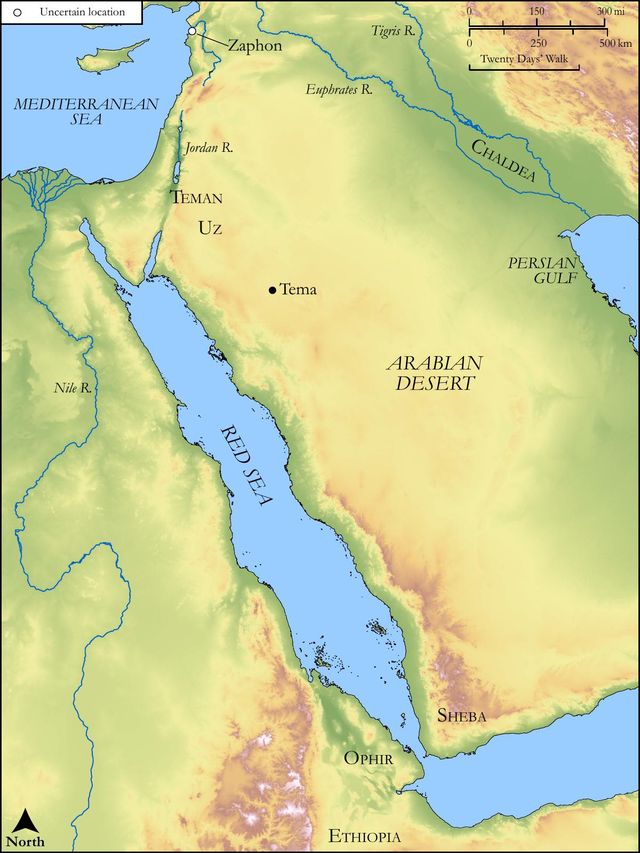
The book of Job is set in the land of Uz, a region generally believed to be east of Edom, and deeply reflects the wisdom tradition of the men of the east. While the precise historical period remains a subject of scholarly debate, the patriarchal customs, the notable absence of references to the Mosaic Law, and the frequent use of "El Shaddai" (Almighty God) suggest a very early, pre-Mosaic era. The prevailing cultural belief among Job's friends, a common framework in their day, was the principle of immediate retribution: good deeds were instantly rewarded, and evil deeds swiftly punished. This "Deuteronomic theology" (though predating the written book of Deuteronomy) provided a seemingly straightforward framework for understanding divine justice. Job's radical challenge in Job 21 directly confronts this simplistic worldview, acknowledging the complex reality where the wicked frequently prosper. Yet, even within this challenge, Job 21:20 firmly grounds itself in the understanding of divine judgment held by the patriarchs, in which "the Judge of all the earth" will surely do right and punish the wicked, even if His timing and methods remain mysterious to humanity.
Key Themes
ShowHideJob 21:20 contributes significantly to several profound themes woven throughout the book of Job. Firstly, it grapples intensely with the perennial problem of suffering and divine justice, specifically addressing the perplexing prosperity of the wicked, which is a central tension in the book. Job's friends advocate for a rigid cause-and-effect relationship between sin and suffering, while Job presents a more nuanced and often uncomfortable reality. Secondly, the verse highlights the theme of God's sovereignty and inscrutable timing. While Job challenges the immediate application of justice, he never denies God's ultimate power to judge, consistently emphasizing that God's ways are beyond human comprehension or control (Job 9:10). Thirdly, the verse powerfully reinforces the inevitability of divine judgment, asserting that regardless of earthly appearances, God's wrath is a certain, personal, and consuming experience for the unrepentant. This theme serves as a crucial corrective to superficial observations of the wicked's temporary success, pointing instead to a higher, eternal reckoning (Psalm 73:18-19).
Exposition and Analysis
ShowHideKey Word Analysis
ShowHideThis term (H3589) originates from a root meaning "to strike," signifying a crushing, calamity, or ruin. It describes a complete and devastating end, far beyond a mere setback. In the context of divine judgment, it implies an inescapable and comprehensive undoing of the wicked's perceived security and prosperity. It speaks to a final, irreversible state of ruin that they cannot evade, emphasizing the absolute and devastating nature of their ultimate fate.
The Hebrew word (H2534) denotes intense heat, burning anger, or furious indignation. It is a strong term for passionate displeasure, frequently used to describe God's righteous anger and fervent opposition against sin and rebellion. When one "drinks" this wrath, it implies a full, personal, and internal experience of its consuming power, leaving no aspect of their being untouched. It is not a mild displeasure but a consuming, active, and inescapable judgment that permeates their very existence.
This profound name for God (H7706) is derived from a root meaning "to be mighty" or "to destroy," and is one of the oldest and most frequently used divine titles in the book of Job. It emphasizes God's omnipotence, self-sufficiency, and His absolute power to both sustain and, crucially in this context, to destroy. Its inclusion here underscores that the judgment described is not a random event or a mere consequence of natural law, but the direct, sovereign act of the all-powerful God, whose justice is inescapable and whose decrees are utterly unchallengeable.
Verse Breakdown
ShowHide"His eyes shall see his destruction"
This clause powerfully emphasizes the personal, undeniable, and unavoidable nature of the wicked's downfall. It is not a distant or abstract judgment, but one they will witness with their own eyes, a terrifying and immediate confrontation with their own ruin. The phrase suggests a profound and inescapable realization of their undoing, a direct and horrifying acknowledgment of the consequences of their actions. It implies a complete lack of escape or mitigation; they will be forced to acknowledge their own comprehensive ruin.
"and he shall drink of the wrath of the Almighty"
This potent metaphor depicts the full, unmitigated, and internal experience of God's judgment. "Drinking a cup" of something is a common biblical idiom for experiencing a full measure of it, whether suffering, joy, or wrath. Here, it signifies a complete and internalizing of God's intense, righteous anger, consuming them from within. The "wrath of the Almighty" highlights both the divine source and the immense magnitude of this judgment – it emanates directly from the all-powerful, sovereign God, ensuring its absolute certainty and overwhelming severity. The imagery suggests a forced consumption, an inescapable and utterly devastating destiny.
Literary Devices
ShowHideJob 21:20 employs several potent literary devices to convey its stark and unyielding message of divine judgment. Imagery is central, particularly the vivid visual of "His eyes shall see his destruction" and the visceral, gustatory image of "he shall drink of the wrath of the Almighty." These images are not merely descriptive but are designed to evoke a profound sense of personal, unavoidable, and complete experience of judgment. The act of "seeing" one's own destruction intensifies the terror and finality, while "drinking" the wrath conveys a full, internal, and inescapable consumption of divine fury. The phrase "drink of the wrath" functions as a powerful metaphor, transforming an abstract concept (wrath) into a tangible, consumable substance, thereby emphasizing its overwhelming and deeply personal impact. Furthermore, the verse utilizes parallelism in its two clauses, where the second clause ("he shall drink of the wrath of the Almighty") amplifies and deepens the meaning of the first ("His eyes shall see his destruction"), moving from an external, horrifying observation to an internal, consuming experience. The specific use of "Almighty" (Shaddai) serves as a potent epithet, underscoring the immense divine power and unchallengeable authority behind this inevitable and certain judgment.
Theological and Thematic Connections
ShowHideJob 21:20 stands as a crucial theological statement within the broader biblical narrative concerning divine justice. While Job challenges the simplistic, immediate retribution theology of his friends, this verse firmly reasserts the ultimate certainty of God's judgment against the wicked. It highlights that God's justice is not always immediate or visibly manifest according to human timelines, but it is absolutely inevitable, personal, and comprehensive. This concept resonates throughout the entirety of Scripture, affirming God's unwavering moral governance of the universe and His steadfast commitment to upholding righteousness. The "cup of wrath" metaphor is particularly significant, symbolizing a full, unmitigated measure of divine judgment that the unrepentant must drink, emphasizing that no one can ultimately escape accountability before a holy and just God. This profound truth provides comfort and reassurance to the righteous who may feel disheartened or perplexed by the apparent prosperity of the wicked, while simultaneously serving as a sober and urgent warning to those who persist in rebellion against God's commands.
Reflection and Application
ShowHideJob 21:20, though a stark and solemn declaration, offers profound and enduring lessons for contemporary believers navigating a complex world. In an age where injustice often seems to prevail and the wicked appear to prosper without immediate consequence, this verse serves as a powerful anchor for faith, reminding us that God's justice is not contingent on our immediate perception or human timeline. It actively encourages patience, perseverance, and unwavering trust in God's ultimate sovereignty, reassuring us that every act of wickedness will ultimately face its divine reckoning. For those who might be tempted by the allure of worldly success gained through unrighteous means, it acts as a sober and urgent warning: temporary gain is a fleeting illusion, no substitute for eternal ruin. The intensely personal nature of the judgment – "his eyes shall see," "he shall drink" – calls for deep introspection into one's own standing before God. It compels us to live lives aligned with God's righteousness, not solely out of fear, but out of a profound reverence for His holy character and a clear understanding of the gravity of His justice. This verse ultimately calls for a radical reorientation of our perspective from fleeting earthly circumstances to the eternal, unshakeable reality of God's righteous judgment and His gracious call to repentance and faith.
Questions for Reflection
ShowHideFAQ
ShowHideDoes Job 21:20 contradict Job's earlier arguments about the prosperity of the wicked?
ShowHideNo, Job 21:20 does not contradict Job's earlier arguments; rather, it provides a crucial nuance and affirmation of his underlying belief in God's ultimate justice. Throughout Job 21, Job challenges his friends' simplistic theology by pointing out the observable reality that the wicked often prosper, live long, and die peacefully (e.g., Job 21:7-13). This was a direct refutation of their "retribution theology," which insisted on immediate punishment for sin. However, Job is not arguing that the wicked never face judgment or that God is unjust. Instead, Job 21:20 serves as his powerful reaffirmation that despite appearances and delayed timing, divine judgment is absolutely certain and unavoidable for the unrepentant. He acknowledges the complexity of God's timing but never denies the certainty and severity of God's ultimate wrath.
What is the significance of the phrase "drink of the wrath"?
ShowHideThe phrase "drink of the wrath" is a powerful and recurring biblical metaphor that signifies experiencing the full, unmitigated measure of divine judgment. It implies a personal, internal, and inescapable consumption of God's intense, righteous indignation against sin. This vivid imagery is found throughout the Old Testament (e.g., Isaiah 51:17, Jeremiah 25:15) and extends into the New Testament (e.g., Revelation 14:10). It communicates that God's wrath is not a light displeasure but a consuming, active, and overwhelming force that will be fully poured out upon the wicked, leaving no part of their being untouched by its consequences. The act of "drinking" emphasizes the forced and unavoidable nature of this experience, highlighting that there is no escape from God's ultimate and righteous reckoning.
Christ-Centered Fulfillment
ShowHideWhile Job 21:20 speaks with solemn warning of the wicked seeing their destruction and drinking God's wrath, the New Testament reveals the ultimate fulfillment of divine judgment and, remarkably, God's glorious provision for escape through Christ. The profound "cup of wrath" imagery finds its most complete and redemptive expression in the person of Jesus Christ. In the Garden of Gethsemane, Jesus prayed with agonizing intensity, "My Father, if it be possible, let this cup pass from me; nevertheless, not as I will, but as you will" (Matthew 26:39). This "cup" was the full, bitter measure of God's righteous wrath against the sin of all humanity, precisely the wrath that Job 21:20 declares the wicked will drink. Yet, Christ, the sinless Lamb of God, willingly drank that cup to its dregs on the cross, bearing the infinite judgment that was justly due to us (2 Corinthians 5:21). His substitutionary sacrifice means that for all who believe and trust in Him, the destruction and wrath described in Job 21:20 are miraculously averted. Instead of seeing their own destruction, believers are given new and eternal life in Him (John 3:16), and instead of drinking wrath, they drink from the cup of blessing, participating in His covenant of grace and peace (1 Corinthians 10:16). Thus, Job's solemn warning of inescapable judgment for the wicked ultimately points to the glorious truth that in Christ, God's justice is perfectly satisfied, and His boundless mercy triumphs for those who trust in Him, offering redemption from the very destruction and wrath so powerfully described.