


Job 12:9
Bible text: King James Version (1769 Blayney text) · Public domain
Bible text: Berean Standard Bible · Public domain
Bible text: American Standard Version (1901) · Public domain
Bible text: World English Bible, Messianic edition · Public domain
Bible text: Geneva Bible (1599) · Public domain
Bible text: Young's Literal Translation · Public domain
- מִיmiwho?H4310InterrogPronoun Interrogative
- לֹאlo'notH3808NegParticle Negative
- יָדַעya·Da'does it knowH3045V-Qal-Perf-3msVerb Qal Perfect 3rd Singular Masculine
- בְּכָלbe·kholamong allH3605Prep-b ¦ N-mscNoun Singular Masculine Constructבְּamongכָלall
- אֵלֶּה'E·lehtheseH428PrtParticle Demonstrative
- כִּיkiforH3588PrtParticle Conditional
- יַדyad[the] hand ofH3027N-cscNoun Singular common gender Construct
- יְהוָהYah·wehYahwehH3068N-properNoun Proper Title
- עָשְׂתָה'A·se·tahit has doneH6213V-Qal-Perf-3fsVerb Qal Perfect 3rd Singular Feminine
- זֹּאתZotthisH2063PrtParticle Demonstrative
English is a literal word-by-word gloss of the Hebrew, not the KJV's wording. Why?
This is the original text the KJV's translators worked from — each Hebrew word with its own literal English meaning in this verse, prepared by scholars at Tyndale House, Cambridge. The KJV translates whole sentences, not word by word, so its wording differs: one Hebrew word can become several English words, and the KJV may choose “the LORD” where the gloss reads “Yahweh”. Both are faithful — they answer different questions. For the KJV's own rendering, switch to the KJV text.
Details
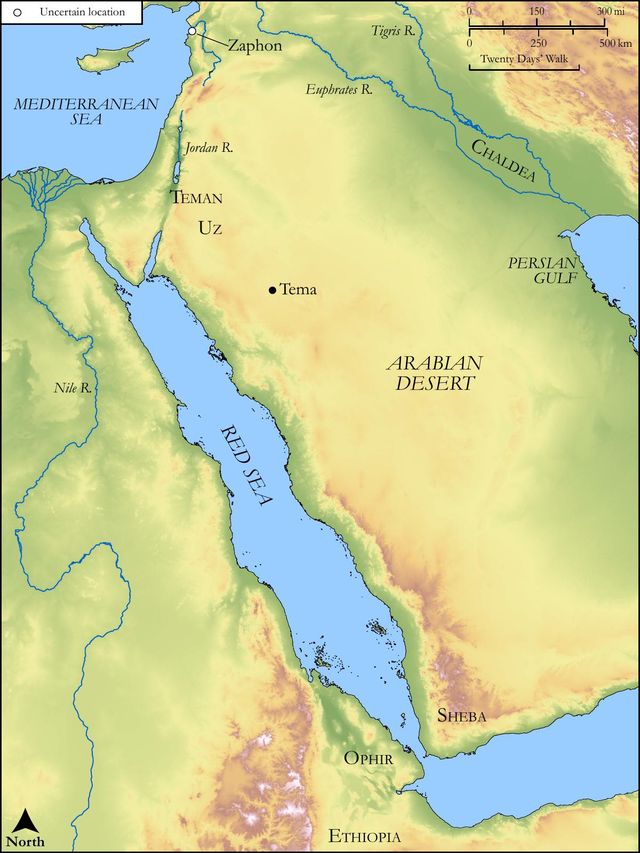
See on the biblical-era map
Study this verse
Public-domain commentary
Matthew Henry
From his Commentary on the Whole Bible. Henry comments on passages, not single verses — this entry covers Job 12:6–11. His three-level outline is real structure in the source text, so it is rendered as structure.
Job's friends all of them went upon this principle, that wicked people cannot prosper long in this world, but some remarkable judgment or other will suddenly light on them: Zophar had concluded with it, that the eyes of the wicked shall fail, Job 11:20. This principle Job here opposes, and maintains that God, in disposing men's outward affairs, acts as a sovereign, reserving the exact distribution of rewards and punishments for the future state.
I.He asserts it as an undoubted truth that wicked people may, and often do, prosper long in this world, Job 12:6. Even great sinners may enjoy great prosperity. Observe,
1.How he describes the sinners. They are robbers, and such as provoke God, the worst kind of sinners, blasphemers and persecutors. Perhaps he refers to the Sabeans and Chaldeans, who had robbed him, and had always lived by spoil and rapine, and yet they prospered; all the world saw they did, and there is no disputing against sense; one observation built upon matter of fact is worth twenty notions framed by an hypothesis. Or more generally, All proud oppressors are robbers and pirates. It is supposed that what is injurious to men is provoking to God, the patron of right and the protector of mankind. It is not strange if those that violate the bonds of justice break through the obligations of all religion, bid defiance even to God himself, and make nothing of provoking him.
2.How he describes their prosperity. It is very great; for,
(1.)Even their tabernacles prosper, those that live with them and those that come after them and descend from them. It seems as if a blessing were entailed upon their families; and that is sometimes preserved to succeeding generations which was got by fraud.
(2.)They are secure, and not only feel no hurt, but fear none, are under no apprehensions of danger either from threatening providences or an awakened conscience. But those that provoke God are never the more safe for their being secure.
(3.)Into their hand God brings abundantly. They have more than heart could wish (Psa 73:7), not for necessity only, but for delight - not for themselves only, but for others - not for the present only, but for hereafter; and this from the hand of Providence too. God brings plentifully to them. We cannot therefore judge of men's piety by their plenty, nor of what they have in their heart by what they have in their hand.
II.He appeals even to the inferior creatures for the proof of this - the beasts, and fowls, and trees, and even the earth itself; consult these, and they shall tell thee, Job 12:7, Job 12:8. Many a good lesson we may learn from them, but what are they here to teach us?
1.We may from them learn that the tabernacles of robbers prosper (so some); for,
(1.)Even among the brute creatures the greater devour the less and the stronger prey upon the weaker, and men are as the fishes of the sea, Hab 1:14. If sin had not entered, we may suppose there would have been no such disorder among the creatures, but the wolf and the lamb would have lain down together.
(2.)These creatures are serviceable to wicked men, and so they declare their prosperity. Ask the herds and the flocks to whom they belong, and they will tell you that such a robber, such an oppressor, is their owner: the fishes and fowls will tell you that they are served up to the tables, and feed the luxury, of proud sinners. The earth brings forth her fruits to them (Job 9:24), and the whole creation groans under the burden of their tyranny, Rom 8:20, Rom 8:22. Note, All the creatures which wicked men abuse, by making them the food and fuel of their lusts, will witness against them another day, Jam 5:3, Jam 5:4.
2.We may from them learn the wisdom, power, and goodness of God, and that sovereign dominion of his into which plain and self-evident truth all these difficult dispensations must be resolved. Zophar had made a vast mystery of it, Job 11:7. "So far from that," says Job, "that what we are concerned to know we may learn even from the inferior creatures; for who knows not from all these? Job 12:9. Any one may easily gather from the book of the creatures that the hand of the Lord has wrought this," that is, "that there is a wise Providence which guides and governs all these things by rules which we are neither acquainted with nor are competent judges of." Note, From God's sovereign dominion over the inferior creatures we should learn to acquiesce in all his disposals of the affairs of the children of men, though contrary to our measures.
III.He resolves all into the absolute propriety which God has in all the creatures (Job 12:10):
In whose hand is the soul of every living thing. All the creatures, and mankind particularly, derive their being from him, owe their being to him, depend upon him for the support of it, lie at his mercy, are under his direction and dominion and entirely at his disposal, and at his summons must resign their lives. All souls are his; and may he not do what he will with his own? The name Jehovah is used here (Job 12:9), and it is the only time that we meet with it in all the discourses between Job and his friends; for God was, in that age, more known by the name of Shaddai - the Almighty.
IV.Those words - (Job 12:11), Doth not the ear try words, as the mouth tastes meat? may be taken either as the conclusion to the foregoing discourse or the preface to what follows. The mind of man has as good a faculty of discerning between truth and error, when duly stated, as the palate has of discerning between what is sweet and what is bitter. Job therefore demands from his friends a liberty to judge for himself of what they had said, and desires them to use the same liberty in judging of what he had said; nay, he seems to appeal to any man's impartial judgment in this controversy; let the ear try the words on both sides, and it would be found that he was in the right. Note, The ear must try words before it receives them so as to subscribe to them. As by the taste we judge what food is wholesome to the body and what not, so by the spirit of discerning we must judge what doctrine is sound, and savoury, and wholesome, and what not, Co1 10:15; Co1 11:13.
Historical interpretation
Two Centuries of Reception
2 surviving comments on this verse. Each one is dated, so this reads as a timeline rather than a list.
Select a marker to jump to its quote. Markers stagger vertically where authors wrote within a few decades of each other.
Why do you behave as if you had made a great and wonderful discovery? It was necessary, in fact, that such a man died, and nobody ignores it. At the same time, we all know that “in his hand is the life of every human being.” Do you see how not only creation but Providence also testifies to God? They both give witness that he controls everything and supports both the life and soul of human beings, so well that he can, when he wants, punish and correct them.
6. As if he said in plain terms; ‘Whether you ask the dull of understanding, or persons full of the loftiest subjects, or those devoted to earthly ways, or the men busied with investigations that belong to this world, all of them acknowledge God to be the Creator of all things, and with one consent agree about His Power, though they do not with one consent live in submission to it. For that which the righteous man speaks by his way of living too, that the unrighteous man generally is constrained to own concerning God by his voice alone, if not otherwise; and it comes to pass that evil-doers, by attesting Him, do homage to the Creator of all things, Whom by their deeds they rebel against, in that Him, Whom they have dared to fight against by their lives, they cannot deny to be the Creator of all things.
Yet this same may also be understood to good purpose after the mere form of the letter alone; in that every creature, when it is looked at, as it were utters a voice of its own, bearing witness by that mere form which it has. We ask ‘the beasts,’ or ‘the fowls of the air,’ ‘the earth,’ or ‘the fish,’ whilst we view them, and these answer us with one accord, that ‘the Hand of the Lord hath wrought all things,’ in that whilst they present their lineaments to our eyes, they bear witness that they are not from themselves. For by the mere circumstance that they are created, by the figure they present, they render as it were the voice of confession to their Creator, Who, as He created all things, likewise ordained how they should be conducted.
Continue studying Job 12:9 across the web’s major study libraries — every link below opens this exact verse, chapter, or book on the destination site.
Read & Compare
 BibleGatewayThis verse in more than 200 translations and 70 languages.
 Bible.comThe YouVersion reader — hundreds of translations, reading plans, and highlights.
 ESV.orgCrossway's official English Standard Version reader.
 NET BibleThe NET translation with 60,000+ translators' notes on every rendering decision.
 STEP BibleTyndale House's free study tool — original text, vocabulary, and scholarly resources.
 BibliaLogos Bible Software's free web reader.
 USCCBThe New American Bible (Revised Edition) with the U.S. bishops' study notes.
Commentaries
 BibleHub CommentariesDozens of classic commentaries on this verse, gathered on one page.
 StudyLightMore than 100 commentary sets — the largest collection on the web.
 BibleRefPlain-English commentary on what this verse means, verse by verse.
 Enduring WordDavid Guzik's free commentary on this chapter, widely used by Bible teachers.
 Bible Study ToolsVerse commentary alongside Greek and Hebrew study aids.
Original Language & Research
- BibleHub InterlinearThe verse word by word — original language, transliteration, and English.
- BibleHub LexiconEvery word's original-language definition and Strong's entry.
 Blue Letter BibleDeep-study tools — Strong's numbers, concordance, and word studies.
 SefariaThe Hebrew text with Rashi and centuries of Jewish commentary.
Sermons, Hymns & Audio


TrulyRandomVerse is not affiliated with these sites and doesn’t control their content. They’re linked because they’re genuinely useful.
Summary
Job 12:9 presents a powerful rhetorical question from Job, asserting that the undeniable and pervasive evidence of God's sovereign power and creative agency is so universally manifest throughout creation that its truth should be self-evident to all. In challenging the simplistic, retributive theology of his friends, Job points to the visible and undeniable display of the Lord's active "hand" in orchestrating all things, implying that true wisdom acknowledges God's ultimate and often inscrutable control over every aspect of existence, even amidst profound suffering.
Context
ShowHideLiterary Context
Job 12:9 is embedded within Job's extended and impassioned rebuttal to his three friends, Eliphaz, Bildad, and Zophar. These friends have consistently maintained that Job's immense suffering is a direct consequence of his sin, adhering to a rigid theology of divine retribution. Job vehemently rejects their simplistic explanations, which fail to account for the complexity of God's governance. In the verses immediately preceding Job 12:9, Job employs biting sarcasm, suggesting that even the animals of the field, the birds of the air, the fish of the sea, and the very earth itself could instruct his friends on the reality of God's pervasive power and control over all creation. This sets the stage for verse 9, which functions as a climactic rhetorical question, emphasizing the undeniable truth of divine sovereignty and thereby dismantling his friends' limited and flawed understanding of God's complex interaction with the world. Job's broader argument in this section (Job 12 through Job 14) centers on the incomprehensibility of God's ways and His absolute, unchallengeable sovereignty, which transcends human attempts to neatly categorize or explain His actions.
Historical & Cultural Context
The men of the east, among whom Job lived, widely recognized the concept of divine power and control over the natural world. While the specific attributes and moral character of deities varied among the nations, the notion of a supreme being's involvement in the affairs of heaven and earth was foundational. Wisdom, prized in this period among "all the children of the east country" and in Egypt, frequently grappled with the problem of suffering and the nature of divine justice, yet rarely questioned the deity's ultimate power. The idiom "the hand of the LORD" (יַד־יְהוָה, yad-Yahweh) is a deeply entrenched Hebrew expression, signifying God's active power, direct intervention, and sovereign control. It denotes not merely influence but direct, effective agency in bringing about events and sustaining creation. Job's audience, steeped in a worldview where divine involvement in daily life and natural phenomena was assumed, would immediately grasp the profound implications of God's "hand" being at work in "all these" things. The book of Job itself serves as a profound theological challenge to the prevailing retributive theology of its time, pushing its audience to embrace a deeper, more mysterious, and ultimately more truthful understanding of God's relationship with humanity and His governance of all creation.
Key Themes
ShowHideJob 12:9 powerfully contributes to several overarching themes central to the book of Job and broader biblical theology. Firstly, it emphatically underscores the theme of Divine Sovereignty and Omnipotence, asserting God's absolute power and control over all creation, from the grandest events in the heavens to the most minute details of life. The phrase "the hand of the LORD" signifies His active involvement and supreme authority, highlighting that nothing in the universe occurs outside of His sovereign will, as powerfully articulated in passages such as Daniel 4:35. Secondly, the verse speaks to the concept of General Revelation, arguing that God's power and existence are not hidden mysteries but are plainly visible and universally knowable through the natural world. The order, complexity, and sheer power evident in creation speak volumes about its Creator, aligning with other biblical passages that describe the heavens declaring the glory of God and His invisible attributes being clearly seen from what has been made (Romans 1:20). Thirdly, it embodies Job's Challenge to Human Presumption and Limited Wisdom. By posing the question "Who knoweth not in all these...?", Job subtly rebukes his friends, implying that their rigid theological framework fails to grasp this fundamental and widely acknowledged truth of God's unchallengeable power, suggesting that their wisdom is inferior to even the common understanding derived from observing nature.
Exposition and Analysis
ShowHideKey Word Analysis
ShowHideThis verb (H3045) is a primitive root meaning "to know," "to perceive," "to understand," or "to be acquainted with." It encompasses a wide range of knowledge, from simple observation to deep, intimate understanding. In Job 12:9, it implies a knowledge that is not merely intellectual or theoretical, but one that is evident, intuitive, and universally accessible through observation of the created order. Job is asserting that this truth about God's activity is so self-evident that it should be common knowledge, even to those without formal theological training.
This is a powerful and common biblical idiom. "Hand" (H3027, yâd) is a primitive word referring to the open hand, often indicating power, means, or direction. "LORD" (H3068, Yᵉhôvâh) refers to the self-Existent or Eternal God, Jehovah, the covenant name of God. Together, "the hand of the LORD" serves as a metonymy for God's active power, direct intervention, and sovereign control. It signifies divine agency, authority, and the ability to bring about whatever He wills. It is not merely a metaphor for influence but points to His direct, effective action in bringing things to pass, whether in creation, judgment, or deliverance.
This versatile primitive root (H6213) means "to do or make, in the broadest sense and widest application." It can mean "to accomplish," "to create," "to perform," or "to bring about." In this context, it highlights God as the ultimate artisan, orchestrator, and active agent of all that exists and occurs. It conveys the idea of God's purposeful, intentional, and effective work in the world, encompassing both the natural order and the events of human history.
Verse Breakdown
ShowHide"Who knoweth not in all these"
This opening phrase is a potent rhetorical question, designed not to elicit an answer but to emphasize the undeniable nature of the truth being presented. "All these" refers back explicitly to the preceding verses (Job 12:7-8), where Job points to the animal kingdom, the birds of the air, the fish of the sea, and the earth itself as witnesses to God's power and wisdom. The implication is that the knowledge of God's sovereign work is so obvious and pervasive in creation that anyone, even the simplest observer, should grasp it. It serves as a profound challenge to his friends' perceived wisdom, suggesting they are missing what is plainly evident to even the non-human world.
"that the hand of the LORD"
This clause identifies the ultimate, singular agent behind all the observable phenomena. "The hand of the LORD," as a powerful idiom, underscores God's active, sovereign power and direct control. It asserts that the events and order of the world are not random, nor are they solely the result of impersonal natural processes or human actions, but are ultimately orchestrated by the divine will and irresistible power of Yahweh, the covenant-keeping God.
"hath wrought this?"
This concluding phrase refers to the comprehensive scope of God's work. "This" encompasses everything that has been observed in creation—the behavior of animals, the processes of nature, the very fabric of existence, and implicitly, the events of human life and suffering. The use of "wrought" emphasizes God's active, intentional, and effective work in bringing all these things into being, sustaining them, and directing their course. The rhetorical question thus asserts that the divine authorship and control over all creation and its unfolding is an undeniable, self-evident truth that should be universally acknowledged.
Literary Devices
ShowHideJob 12:9 masterfully employs several literary devices to convey its profound message and underscore Job's argument. The most prominent is the Rhetorical Question, "Who knoweth not in all these that the hand of the LORD hath wrought this?" This question is not meant to be answered, but rather to assert an obvious, undeniable truth, implying that the knowledge of God's sovereign work is so universally evident that only the willfully ignorant or intellectually arrogant could miss it. This device serves to forcefully challenge Job's friends' claims of wisdom and highlight their failure to grasp a fundamental reality. Secondly, Metonymy is powerfully present in the phrase "the hand of the LORD," where "hand" stands for God's power, agency, and active involvement. It is a part representing the whole, effectively conveying God's direct, personal, and sovereign action in the world. Finally, there is a subtle but potent layer of Irony at play. Job's friends present themselves as purveyors of profound divine wisdom, yet Job suggests that even the unthinking creation (animals, earth) possesses a more accurate and fundamental understanding of God's pervasive power than their rigid, limited theological framework allows. This highlights the ironic contrast between their presumed sagacity and their actual limited insight into the true nature of God's governance.
Theological and Thematic Connections
ShowHideJob 12:9 stands as a profound declaration of God's absolute sovereignty and the universal accessibility of His power through creation. It resonates deeply with the biblical doctrine of general revelation, asserting that God's existence, power, and attributes are clearly discernible through the natural world, leaving humanity without excuse for denying Him. This verse challenges any human attempt to confine God's actions within predictable, simplistic frameworks, especially concerning suffering, and instead calls for a humble acknowledgment of His inscrutable yet ultimately just and powerful governance over all things. It underscores that true wisdom begins with recognizing and submitting to the Lord's supreme authority, even when His ways are beyond full human comprehension, fostering a posture of awe and reverent trust in His ultimate control over all circumstances.
Reflection and Application
ShowHideIn a world often defined by chaos, uncertainty, and profound suffering, Job 12:9 offers both profound comfort and a sobering call to humility. It reminds us that behind the bewildering events of life, whether personal trials or global upheavals, there is an all-powerful, sovereign God whose "hand" is actively at work, orchestrating all things according to His perfect and often mysterious will. This truth should lead us to a deeper, more resilient trust in His ultimate plan, even when His ways are inscrutable or painful to our limited understanding. Rather than striving to fully comprehend or explain God's every action, we are called to acknowledge His undeniable power and wisdom, finding peace and stability in His unshakeable control. It encourages us to cultivate a posture of awe and reverence, recognizing God's signature in the intricate beauty of creation and His sovereign sway over the unfolding of history, including the most intimate details of our personal lives. This perspective transforms our understanding of trials, moving us from despair to a quiet, confident assurance that the Lord "hath wrought this" for His purposes, which are always good, even if currently veiled from our sight.
Questions for Reflection
ShowHideFAQ
ShowHideWhat does Job mean by "Who knoweth not in all these that the hand of the LORD hath wrought this?"
ShowHideJob 12:9 is a rhetorical question through which Job asserts that the evidence of God's sovereign power and creative activity is so overwhelmingly obvious in the natural world and in the course of events that it should be universally recognized by all rational beings. When Job says "in all these," he is referring back to his previous statements in Job 12:7-8, where he sarcastically suggests that even animals, birds, fish, and the earth itself can teach humans about God's power and wisdom. The phrase "the hand of the LORD" is a powerful Hebrew idiom for God's active, direct, and powerful intervention and control over all things. "Hath wrought this" means that God has brought all these things into being, continues to sustain them, and orchestrates their unfolding. Essentially, Job is arguing that it is a self-evident truth that God is in complete, active control of everything, a reality so basic and undeniable that anyone should know it, implying that his friends, despite their claims of wisdom, are missing this fundamental reality of divine sovereignty.
Christ-Centered Fulfillment
ShowHideJob 12:9, with its powerful affirmation of God's absolute sovereignty and creative agency, finds its ultimate and most profound fulfillment in the person and work of Jesus Christ. While Job points broadly to the "hand of the LORD" as the orchestrator of all things, the New Testament reveals that this divine "hand" is supremely and personally manifest in the Son. John 1:3 unequivocally declares that "All things were made through him, and without him was not anything made that was made," directly attributing the work of creation to Christ. Similarly, Colossians 1:16-17 expands on this, stating that "by him all things were created, in heaven and on earth, visible and invisible... all things were created through him and for him. And he is before all things, and in him all things hold together." This means that the very "this" that the hand of the LORD "hath wrought" is intricately linked to Christ's pre-existent power and ongoing sustenance of all things. Furthermore, Christ's earthly ministry powerfully demonstrated this divine sovereignty over creation (e.g., stilling the storm with a word in Mark 4:39) and over life and death (e.g., raising Lazarus from the tomb in John 11:43-44). Ultimately, the "hand of the LORD" that "wrought this" is the same hand that was pierced on the cross, accomplishing the greatest work of redemption for humanity, and is now exalted at the right hand of God, wielding all authority in heaven and on earth (Matthew 28:18). Thus, the universal knowledge of God's power, which Job asserts, culminates in the revelation of Christ, through whom all things exist, are sustained, and are ultimately reconciled to God (2 Corinthians 5:19).