


Jeremiah 8:15
Bible text: King James Version (1769 Blayney text) · Public domain
Bible text: Berean Standard Bible · Public domain
Bible text: American Standard Version (1901) · Public domain
Bible text: World English Bible, Messianic edition · Public domain
Bible text: Geneva Bible (1599) · Public domain
Bible text: Young's Literal Translation · Public domain
- קַוֵּהka·Vehwe waited eagerlyH6960V-Piel-Imp-2msVerb Piel Imperative 2nd Singular Masculine
- לְשָׁלוֹםle·sha·Lomfor peaceH7965Prep-l ¦ N-msNoun Singular Masculine Absoluteלְforשָׁלוֹםpeace
- וְאֵיןve·'Einand there notH369Conj-w ¦ N-mscNoun Singular Masculine Constructוְandאֵיןthere not
- טוֹבTov[was] goodH2896Adj-msAdjective Singular Masculine Absolute
- לְעֵתle·'Etfor a time ofH6256Prep-l ¦ N-cscNoun Singular common gender Constructלְforעֵתa time of
- מַרְפֵּהmar·PehhealingH4832N-msNoun Singular Masculine Absolute
- וְהִנֵּהve·hi·Nehand there!H2009Conj-w ¦ PrtParticle Interjectionוְandהִנֵּהthere!
- בְעָתָהve·'a·TahterrorH1205N-fsNoun Singular Feminine Absolute
English is a literal word-by-word gloss of the Hebrew, not the KJV's wording. Why?
This is the original text the KJV's translators worked from — each Hebrew word with its own literal English meaning in this verse, prepared by scholars at Tyndale House, Cambridge. The KJV translates whole sentences, not word by word, so its wording differs: one Hebrew word can become several English words, and the KJV may choose “the LORD” where the gloss reads “Yahweh”. Both are faithful — they answer different questions. For the KJV's own rendering, switch to the KJV text.
Details
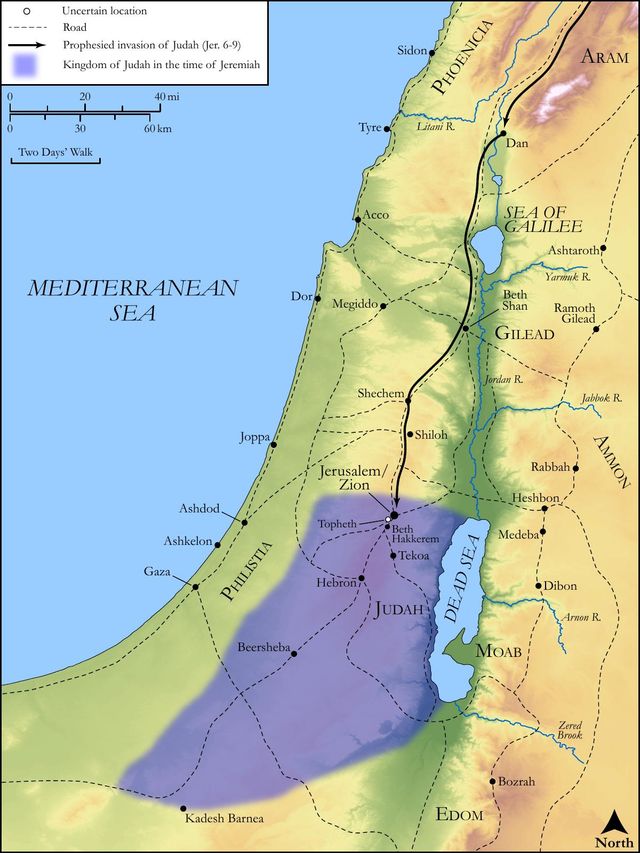
See on the biblical-era map
Study this verse
Public-domain commentary
Matthew Henry
From his Commentary on the Whole Bible. Henry comments on passages, not single verses — this entry covers Jeremiah 8:13–22. His three-level outline is real structure in the source text, so it is rendered as structure.
In these verses we have,
I.God threatening the destruction of a sinful people.
He has borne long with them, but they are still more and more provoking, and therefore now their ruin is resolved on: I will surely consume them (Jer 8:13), consuming I will consume them, not only surely, but utterly, consume them, will follow them with one judgment after another, till they are quite consumed; it is a consumption determined, Isa 10:23.
1.They shall be quite stripped of all their comforts (Jer 8:13): There shall be no grapes on the vine. Some understand this as intimating their sin; God came looking for grapes from this vineyard, seeking fruit upon this fig-tree, but he found none (as Isa 5:2, Luk 13:6); nay, they had not so much as leaves, Mat 21:19. But it is rather to be understood of God's judgments upon them, and may be meant literally - The enemy shall seize the fruits of the earth, shall pluck the grapes and figs for themselves and beat down the very leaves with them; or, rather, figuratively - They shall be deprived of all their comforts and shall have nothing left them wherewith to make glad their hearts. It is expounded in the last clause: The things that I have given them shall pass away from them. Note, God's gifts are upon condition, and revocable upon non-performance of the condition. Mercies abused are forfeited, and it is just with God to take the forfeiture.
2.They shall be set upon by all manner of grievances, and surrounded with calamities (Jer 8:17): I will send serpents among you, the Chaldean army, fiery serpents, flying serpents, cockatrices; these shall bite them with their venomous teeth, give them wounds that shall be mortal; and they shall not be charmed, as some serpents used to be, with music. These are serpents of another nature, that are not so wrought upon, or they are as the deaf adder, that stops her ear, and will not hear the voice of the charmer. The enemies are so intent upon making slaughter that it will be to no purpose to accost them gently, or offer any thing to pacify them, or mollify them, or to bring them to a better temper. No peace with God, therefore none with them.
II.The people sinking into despair under the pressure of those calamities.
Those that were void of fear (when the trouble was at a distance) and set it at defiance, are void of hope now that it breaks in upon them, and have no heart either to make head against it or to bear up under it, Jer 8:14. They cannot think themselves safe in the open villages: Why do we sit still here? Let us assemble, and go into a body into the defenced cities. Though they could expect no other than to be surely cut off there at last, yet not so soon as in the country, and therefore, "Let us go, and be silent there; let us attempt nothing, nor so much as make a complaint; for to what purpose?" It is not a submissive, but a sullen silence, that they here condemn themselves to. Those that are most jovial in their prosperity commonly despond most, and are most melancholy, in trouble. Now observe what it is that sinks them.
1.They are sensible that God is angry with them: "'The Lord our God has put us to silence, has struck us with astonishment, and given us water of gall to drink, which is both bitter and stupifying, or intoxicating. Psa 60:3, Thou hast made us to drink the wine of astonishment. We had better sit still than rise up and fall; better say nothing than say nothing to the purpose. To what purpose is it to contend with our fate when God himself has become our enemy and fights against us? Because we have sinned against the Lord, therefore we are brought to the plunge." This may be taken as the language,
(1.)Of their indignation. They seem to quarrel with God as if he had dealt hardly with them in putting them to silence, not permitting them to speak for themselves, and then telling them that it was because they had sinned against him. Thus men's foolishness perverts their way, and then their hearts fret against the Lord. Or rather,
(2.)Of their convictions. At length they begin to see the hand of God lifted up against them, and stretched out in the calamities under which they are now groaning, and to own that they have provoked him to contend with them. Note, Sooner or later God will bring the most obstinate to acknowledge both his providence and his justice in all the troubles they are brought into, to see and say both that it is his hand and that he is righteous.
2.They are sensible that the enemy is likely to be too hard for them, Jer 8:16. They are soon apprehensive that it is to no purpose to make head against such a mighty force; they and their people are quite dispirited; and, when the courage of a nation is gone, their numbers will stand them in little stead. The snorting of the horses was heard from Dan, that is, the report of the formidable strength of their cavalry was soon carried all the nation over and every body trembled at the sound of the neighing of his steeds; for they have devoured the land and all that is in the city; both town and country are laid waste before them, not only the wealth, but the inhabitants, of both, those that dwell therein. Note, When God appears against us, every thing else that is against us appears very formidable; whereas, if he be for us, every thing appears very despicable, Rom 8:31.
3.They are disappointed in their expectations of deliverance out of their troubles, as they had been surprised when their troubles came upon them; and this double disappointment very much aggravated their calamity.
(1.)The trouble came when they little expected it (Jer 8:15): We looked for peace, the continuance of our peace, but no good came, no good news from abroad; we looked for a time of health and prosperity to our nation, but, behold, trouble, the alarms of war; for, as it follows (Jer 8:16), the noise of the enemies' horses was heard from Dan. Their false prophets had cried Peace, peace, to them, which made it the more terrible when the scene of war opened on a sudden. This complaint will occur again, ch. 14:19.
(2.)The deliverance did not come when they had long expected it (Jer 8:20): The harvest is past, the summer is ended; that is, there is a great deal of time gone. Harvest and summer are parts of the year, and when they are gone the year draws towards a conclusion; so the meaning is, "One year passes after another, one campaign after another, and yet our affairs are in as bad a posture as ever they were; no relief comes, nor is any thing done towards it: We are not saved." Nay, there is a great deal of opportunity lost, the season of action is over and slipped, the summer and harvest are gone, and a cold and melancholy winter succeeds. Note, The salvation of God's church and people often goes on very slowly, and God keeps his people long in the expectation of it, for wise and holy ends. Nay, they stand in their own light, and put a bar in their own door, and are not saved because they are not ready for salvation.
4.They are deceived in those things which were their confidence and which they thought would have secured their peace to them (Jer 8:19): The daughter of my people cries, cries aloud, because of those that dwell in a far country, because of the foreign enemy that invades them, that comes from a far country to take possession of ours; this occasions the cry; and what is the cry? It is this: Is not the Lord in Zion? Is not her king in her? These were the two things that they had all along buoyed up themselves with and depended upon,
(1.)That they had among them the temple of God, and the tokens of his special presence with them. The common cant was, "Is not the Lord in Zion? What danger then need we fear?" And they held by this when the trouble was breaking in upon them. "Surely we shall do well enough, for have we not God among us?" But, when it grew to an extremity, it was an aggravation of their misery that they had thus flattered themselves.
(2.)That they had the throne of the house of David. As they had a temple, so they had a monarchy, jure divino - by divine right: Is not Zion's king in her? And will not Zion's God protect Zion's king and his kingdom? Surely he will; but why does he not? "What" (say they) "has Zion neither a God nor a king to stand by her and help her, that she is thus run down and likely to be ruined?" This outcry of theirs reflects upon God, as if his power and promise were broken or weakened; and therefore he returns an answer to it immediately: Why have they provoked me to anger with their graven images? They quarrel with God as if he had dealt unkindly by them in forsaking them, whereas they by their idolatry had driven him from them; they have withdrawn from their allegiance to him, and so have thrown themselves out of this protection. They fret themselves, and curse their king and their God (Isa 8:21), when it is their own sin that separates between them and God (Isa 59:2); they feared not the Lord, and then what can a king do for them? Hos 10:3.
III.We have here the prophet himself bewailing the calamity and ruin of his people; for there were more of the lamentations of Jeremiah than those we find in the book that bears that title. Observe here,
1.How great his griefs were. He was an eyewitness of the desolations of his country, and saw those things which by the spirit of prophecy he had foreseen. In the foresight, much more in the sight, of them, he cries out, "My heart is faint in me, I sink, I die away at the consideration of it, Jer 8:18. When I would comfort myself against my sorrow, I do but labour in vain; nay, every attempt to alleviate the grief does but aggravate it." It is our wisdom and duty, under mournful events, to do what we can to comfort ourselves against our sorrow, by suggesting to ourselves such considerations as are proper to allay the grief and balance the grievance. But sometimes the sorrow is such that the more it is repressed the more strongly it recoils. This may sometimes be the case of very good men, as of the prophet here, whose soul refused to be comforted and fainted at the cordial, Psa 77:2, Psa 77:3. He tells us (Jer 8:21) what was the matter: "It is for the hurt of the daughter of my people that I am thus hurt; it is for their sin, and the miseries they have brought upon themselves by it; it is for this that I am black, that I look black, that I go in black as mourners do, and that astonishment has taken hold on me, so that I know not what to do nor which way to turn." Note, The miseries of our country ought to be very much the grief of our souls. A gracious spirit will be a public spirit, a tender spirit, a mourning spirit. It becomes us to lament the miseries of our fellow-creatures, much more to lay to heart the calamities of our country, and especially of the church of God, to grieve for the affliction of Joseph. Jeremiah had prophesied the destruction of Jerusalem, and, though the truth of his prophecy was questioned, yet he did not rejoice in the proof of the truth of his prophecy was questioned, yet he did not rejoice in the proof of the truth of it by the accomplishment of it, preferring the welfare of his country before his own reputation. If Jerusalem had repented and been spared, he would have been far from fretting as Jonah did. Jeremiah had many enemies in Judah and Jerusalem, that hated, and reproached, and persecuted him; and in the judgments brought upon them God reckoned with them for it and pleaded his prophet's cause; yet he was far from rejoicing in it, so truly did he forgive his enemies and desire that God would forgive them.
2.How small his hopes were (Jer 8:22): "Is there no balm in Gilead - no medicine proper for a sick and dying kingdom? Is there no physician there - no skilful faithful hand to apply the medicine?" He looks upon the case to be deplorable and past relief. There is no balm in Gilead that can cure the disease of sin, no physician there that can restore the health of a nation quite overrun by such a foreign army as that of the Chaldeans. The desolations made are irreparable, and the disease has presently come to such a height that there is no checking it. Or this verse may be understood as laying all the blame of the incurableness of their disease upon themselves; and so the question must be answered affirmatively: Is there no balm in Gilead - no physician there? Yes, certainly there is; God is able to help and heal them, there is a sufficiency in him to redress all their grievances. Gilead was a place in their own land, not far off. They had among themselves God's law and his prophets, with the help of which they might have been brought to repentance, and their ruin might have been prevented. They had princes and priests, whose business it was to reform the nation and redress their grievances. What could have been done more than had been done for their recovery? Why then was not their health restored? Certainly it was not owing to God, but to themselves; it was not for want of balm and a physician, but because they would not admit the application nor submit to the methods of cure. The physician and physic were both ready, but the patient was wilful and irregular, would not be tied to rules, but must be humoured. Note, If sinners die of their wounds, their blood is upon their own heads. The blood of Christ is balm in Gilead, his Spirit is the physician there, both sufficient, all-sufficient, so that they might have been healed, but would not.
Historical interpretation
Historical reception
1 surviving comment on this verse from the historical church.
(Vers. 14, 15.) Why are we sitting? Come together, and let us enter the fortified city or cities, and let us remain silent there or be cast out there, for our Lord has made us silent and has given us the drink of gall water. For we have sinned against the Lord, we have waited for peace, and it was not good: a time of healing, and behold, fear. The voice of the people responding is introduced, and confessing its own vices, and encouraging one another, to enter the fortified cities or walled city, or one city, Jerusalem: for the others had already been captured. And let us be silent there, he says, because our Lord has made us silent: for we do not have confidence in praying, whether we are cast there or expelled like refuse. He himself has given us a drink of bitter water: because we have turned sweet into bitterness against God. And the reason is clear why we drink such waters: For we have sinned against the Lord, and we have expected peace, even though we have done no good works: and we thought that the time of healing had come for us, when everything was filled with fear and terror. The change of persons, especially in the Prophets, makes understanding difficult: but if they are restored to their proper places, causes, and times, what seemed obscure will become clear.
Continue studying Jeremiah 8:15 across the web’s major study libraries — every link below opens this exact verse, chapter, or book on the destination site.
Read & Compare
 BibleGatewayThis verse in more than 200 translations and 70 languages.
 Bible.comThe YouVersion reader — hundreds of translations, reading plans, and highlights.
 ESV.orgCrossway's official English Standard Version reader.
 NET BibleThe NET translation with 60,000+ translators' notes on every rendering decision.
 STEP BibleTyndale House's free study tool — original text, vocabulary, and scholarly resources.
 BibliaLogos Bible Software's free web reader.
 USCCBThe New American Bible (Revised Edition) with the U.S. bishops' study notes.
Commentaries
 BibleHub CommentariesDozens of classic commentaries on this verse, gathered on one page.
 StudyLightMore than 100 commentary sets — the largest collection on the web.
 BibleRefPlain-English commentary on what this verse means, verse by verse.
 Enduring WordDavid Guzik's free commentary on this chapter, widely used by Bible teachers.
 Bible Study ToolsVerse commentary alongside Greek and Hebrew study aids.
Original Language & Research
- BibleHub InterlinearThe verse word by word — original language, transliteration, and English.
- BibleHub LexiconEvery word's original-language definition and Strong's entry.
 Blue Letter BibleDeep-study tools — Strong's numbers, concordance, and word studies.
 SefariaThe Hebrew text with Rashi and centuries of Jewish commentary.
Sermons, Hymns & Audio


TrulyRandomVerse is not affiliated with these sites and doesn’t control their content. They’re linked because they’re genuinely useful.
Summary
Jeremiah 8:15 poignantly captures the profound disillusionment and shattered expectations of the people of Judah. Despite their fervent longing for peace and national restoration, they were met instead with overwhelming calamity and terror. This verse starkly contrasts human desire with divine judgment, serving as a bitter realization of the futility of false hopes and the inescapable consequences of persistent spiritual apostasy and rejection of God's warnings. It underscores the tragic outcome when a nation turns away from the true source of its well-being.
Context
ShowHideLiterary Context
Jeremiah 8:15 is situated within a series of prophetic laments and severe pronouncements of judgment against Judah, particularly spanning chapters 7-10. Jeremiah has relentlessly delivered God's message of impending doom due to the nation's rampant idolatry, moral corruption, and their dangerous reliance on false prophets who deceptively proclaimed "peace, peace" when no true peace existed (Jeremiah 6:14). The preceding verses in chapter 8 vividly detail the extent of Judah's spiritual sickness, comparing their wound to one that is incurable, a lament echoed in the prophet's own anguish (Jeremiah 8:21-22). The people's desperate cry in verse 15, "We looked for peace, but no good [came; and] for a time of health, and behold trouble!", functions as a climactic, bitter realization of the futility of their self-deception and the inescapable reality of God's righteous judgment, which was about to be executed through the devastating Babylonian invasion.
Historical & Cultural Context
The late 7th and early 6th centuries BCE were a period of immense geopolitical upheaval for the Kingdom of Judah. The once-dominant Assyrian Empire was in decline, giving way to the formidable rising power of Babylon. Judah, precariously positioned between these superpowers, frequently sought alliances with Egypt, directly defying God's explicit command to trust Him alone. Spiritually, the nation was deeply entrenched in syncretism, blending the worship of Yahweh with abhorrent pagan practices, including child sacrifice and idol worship even within the sacred precincts of the Temple of Jerusalem (Jeremiah 7:30-31). Culturally, a pervasive sense of self-deception prevailed, actively fostered by false prophets and corrupt priests who assured the populace of divine protection and prosperity despite their flagrant covenant violations. This created a widespread cultural expectation of peace and security, even as the ominous drums of war grew louder on their borders, leading to the profound shock and terror expressed in this verse when the promised "peace" catastrophically failed to materialize.
Key Themes
ShowHideJeremiah 8:15 powerfully contributes to several overarching themes woven throughout the book of Jeremiah. Firstly, it underscores the theme of Shattered Expectations – the stark and painful contrast between human desires and divine reality. The people's longing for "peace" and "health" was a natural human aspiration, but their chosen means of pursuing it (through idolatry, covenant infidelity, and reliance on false security) were fundamentally flawed, leading inevitably to the opposite outcome. Secondly, it highlights the Consequences of Disobedience, a central tenet of the Mosaic Covenant, where blessings were promised for obedience and curses for rebellion (Deuteronomy 28:15-68). Jeremiah consistently warned that covenant infidelity would lead to judgment, and this verse is a vivid, agonizing illustration of that principle in action. Thirdly, the verse exposes the grave danger of False Security and the destructive influence of false prophets who proclaimed "peace, peace; when there is no peace" (Jeremiah 6:14). The "trouble" that arrived was the painful, undeniable truth breaking through the comforting, yet ultimately destructive, lies. Finally, it speaks to the theme of Divine Judgment, demonstrating that God's justice is not arbitrary but a righteous, necessary response to persistent rebellion, intended either to bring about repentance or, failing that, to uphold His holy character and covenant faithfulness.
Exposition and Analysis
ShowHideKey Word Analysis
ShowHideMeaning "to bind together (perhaps by twisting), i.e. collect; (figuratively) to expect; gather (together), look, patiently, tarry, wait (for, on, upon)." This word implies an earnest, often patient, waiting or hoping. The people of Judah were not passively wishing; they were actively "looking" or "waiting" with a profound sense of expectation for peace, perhaps clinging desperately to the false assurances of their leaders and prophets.
Meaning "safe, i.e. (figuratively) well, happy, friendly; also (abstractly) welfare, i.e. health, prosperity, peace." Shâlôwm is a comprehensive term, signifying far more than merely the absence of conflict. It denotes a state of wholeness, well-being, prosperity, completeness, and flourishing in all aspects of life—physical, spiritual, communal, and relational. The people yearned for this holistic restoration and security.
Meaning "properly, curative, i.e. literally (concretely) a medicine, or (abstractly) a cure; figuratively (concretely) deliverance, or (abstractly) placidity." This word speaks to healing, restoration, or soundness. The desire for "health" extended beyond mere physical well-being to a yearning for national and spiritual recovery from the deep-seated societal ills and spiritual sickness that plagued Judah, a longing for things to be made right.
Meaning "fear; trouble." This word conveys a sense of sudden terror, alarm, or overwhelming calamity. It describes an abrupt, devastating, and terrifying experience, a stark and horrifying contrast to the peace and health they desperately sought and expected.
Verse Breakdown
ShowHide"We looked for peace,"
This opening clause expresses the deep longing, active expectation, and perhaps even a sense of entitlement on the part of the people of Judah. They were actively hoping for a return to national stability, security, and the comprehensive well-being implied by shalom. This expectation was likely fueled by a combination of genuine human desire for tranquility and the pervasive, deceptive assurances of false prophets who promised peace regardless of their spiritual state.
"but no good [came;"
This segment introduces the crushing disappointment and the bitter reality. Despite their earnest looking, waiting, and hoping, the anticipated "good" (ṭôwb – signifying prosperity, welfare, pleasantness, and all that is desirable) did not materialize. Instead, their hopes were utterly dashed, indicating a severe and painful disconnect between their self-generated expectations and the unfolding, divinely ordained reality.
"and for a time of health,"
This phrase reiterates and intensifies their yearning for restoration and healing. They desired a specific period of recovery and soundness from the profound spiritual, social, and political maladies that afflicted their nation. This points to a recognition, perhaps subconscious or unacknowledged, of their broken state and a desperate, yet ultimately misdirected, desire for things to be made right.
"and behold trouble!"
This final, emphatic declaration delivers the shocking, undeniable, and painful reality of their situation. The "behold" (Hebrew hinneh) serves as a dramatic interjection, drawing immediate attention to the unexpected and terrifying outcome. Instead of the longed-for peace and health, they were confronted with sudden, overwhelming "trouble" or terror, signifying the abrupt and devastating arrival of divine judgment in the form of invasion, destruction, and exile.
Literary Devices
ShowHideJeremiah 8:15 is rich in literary devices that amplify its poignant and tragic message. The most prominent is Antithesis or Juxtaposition, where the verse sets up a stark and agonizing contrast between what was fervently desired ("peace," "good," "health") and what was catastrophically received ("trouble"). This creates a powerful sense of disillusionment and highlights the tragic irony of their self-inflicted predicament. The parallel structure of "We looked for peace, but no good came; and for a time of health, and behold trouble!" powerfully emphasizes this complete reversal of their expectations. There is also a strong element of Pathos, as the verse evokes deep sympathy for the people's shattered hopes and the profound suffering they endured, even as it underscores the justice of their predicament. The lament-like tone captures the collective cry of a nation realizing the devastating consequences of its folly. Furthermore, the use of the interjection "behold" (KJV "and behold trouble!") serves as a dramatic Exclamation, drawing the reader's immediate attention to the sudden, unexpected, and shocking nature of the calamity that befell them, transforming a hopeful expectation into a fearful and inescapable reality.
Theological and Thematic Connections
ShowHideJeremiah 8:15 serves as a profound theological statement on the nature of divine justice, the futility of seeking true peace apart from God, and the severe consequences of covenant infidelity. It teaches that genuine peace (shalom) and authentic well-being are not merely the absence of external threats but are fundamentally rooted in a right, obedient relationship with the sovereign Lord. When a people persistently rejects God's covenant, embraces idolatry, and succumbs to moral corruption, their human desires for prosperity and security will inevitably be thwarted by divine judgment. This verse underscores the immutable principle that God is faithful to His warnings as much as to His promises, and that consequences for persistent sin are real, unavoidable, and often devastating. It challenges any notion of cheap grace or a superficial peace that ignores the foundational demands of righteousness and holiness.
Reflection and Application
ShowHideJeremiah 8:15 offers a timeless warning and a crucial, challenging lesson for individuals, communities, and nations today. It compels us to deeply examine the sources of our hope and the foundations upon which we build our expectations for peace, well-being, and flourishing. Are we diligently seeking the true peace that comes from reconciliation with God and humble obedience to His Word, or are we clinging to false assurances, superficial solutions, or worldly comforts that promise peace but are ultimately incapable of delivering it? This verse reminds us that genuine human flourishing—spiritual, emotional, relational, and societal—is inextricably linked to our alignment with God's will and His righteous standards. When we persist in patterns of disobedience, neglect spiritual disciplines, or embrace a compromised faith, we inevitably set ourselves up for profound disillusionment and "trouble," even if our intentions are to find "good" or "health." The path to true and lasting peace is not found in ignoring spiritual sickness or rationalizing sin, but in humbly seeking divine healing, repentance, and restoration through God's grace.
Questions for Reflection
ShowHideFAQ
ShowHideWhy did the people of Judah "look for peace" when Jeremiah was clearly prophesying judgment?
ShowHideThe people of Judah, particularly their ruling class and the influential false prophets, were deeply entrenched in a dangerous and pervasive delusion. They clung to a distorted and self-serving understanding of God's covenant, believing that because they were God's chosen people and possessed the sacred Temple in Jerusalem, God would never allow them to be utterly destroyed, regardless of their persistent sin. This false sense of security was actively promoted by deceptive prophets who cried "Peace, peace; when there is no peace" (Jeremiah 6:14). They desired comfort, prosperity, and an easy path, and they found voices that affirmed these desires, leading them to stubbornly reject Jeremiah's harsh but truthful warnings. Their "looking for peace" was not necessarily a sign of genuine repentance or a desire for true reconciliation with God, but often a clinging to a superficial hope that willfully ignored the deep spiritual sickness and moral decay within the nation, as vividly described throughout Jeremiah 7.
What was the nature of the "trouble" that came upon Judah instead of peace?
ShowHideThe "trouble" (Hebrew bᵉʻâthâh, meaning "fear," "terror," or "calamity") refers primarily to the devastating series of Babylonian invasions, culminating in the destruction of Jerusalem and its Temple, and the subsequent exile of the majority of the population. This was not merely a minor inconvenience or a temporary setback, but a cataclysmic national disaster that resulted in widespread death, famine, disease, the utter desolation of their land, and the forced deportation of the surviving populace to Babylon (Jeremiah 25:11). It was a sudden, terrifying, and overwhelming divine judgment that completely shattered their national identity, their political autonomy, and their deeply ingrained false sense of security, tragically fulfilling the dire warnings that Jeremiah had tirelessly proclaimed for decades.
Christ-Centered Fulfillment
ShowHideJeremiah 8:15, with its lament over the shattered expectations of peace and health, finds its ultimate Christ-centered fulfillment in the person and redemptive work of Jesus. The people of Judah desperately sought a temporal, national peace and healing, a shalom that their profound sin made utterly impossible to attain. However, Jesus Christ is the true "Prince of Peace" (Isaiah 9:6), who brings a peace that far surpasses any earthly understanding or human capacity. He offers not merely the absence of conflict, but a profound spiritual shalom—a state of wholeness, complete reconciliation with God, and an inner tranquility—that the world simply cannot give (John 14:27). Through His perfect life, atoning sacrifice on the cross, and victorious resurrection, Jesus became the ultimate "Lamb of God, who takes away the sin of the world!" (John 1:29), bearing the "trouble" and righteous judgment that humanity deserved for its rebellion. By His stripes, we are healed (Isaiah 53:5), receiving spiritual "health" and complete restoration from the debilitating sickness of sin. The "good" that Judah desperately looked for, but never found in their own misguided efforts, is fully and eternally realized in Christ, who is the inexhaustible source of all true blessing and spiritual prosperity for all who believe in Him (Ephesians 1:3). In Him, the deep human yearning for peace and health is not met with trouble, but with eternal life, an unshakeable hope, and a lasting peace with God (Romans 5:1).