


Jeremiah 34:16
Bible text: King James Version (1769 Blayney text) · Public domain
Bible text: King James Version with Strong's numbers · Public domain
Bible text: Berean Standard Bible · Public domain
Bible text: American Standard Version (1901) · Public domain
Bible text: World English Bible, Messianic edition · Public domain
Bible text: Geneva Bible (1599) · Public domain
Bible text: Young's Literal Translation · Public domain
- וַתָּשֻׁבוּva·ta·Shu·vuand you turned backH7725Conj-w ¦ V-Qal-ConsecImperf-2mpVerb Qal Consecutive Imperfect 2nd Plural Masculineוַandתָּשֻׁבוּyou turned back
- וַתְּחַלְּלוּva·te·cha·le·Luand you profanedH2490Conj-w ¦ V-Piel-ConsecImperf-2mpVerb Piel Consecutive Imperfect 2nd Plural Masculineוַandתְּחַלְּלוּyou profaned
- אֶת'et<obj.>H853DirObjMParticle Object Indicator
- שְׁמִיshe·Mimy nameH8034N-msc ¦ 1csNoun Singular Masculine Constructשְׁמִnameיmy
- וַתָּשִׁבוּva·ta·Shi·vuand you took backH7725Conj-w ¦ V-Hiphil-ConsecImperf-2mpVerb Hiphil Consecutive Imperfect 2nd Plural Masculineוַandתָּשִׁבוּyou took back
- אִישׁ'isheveryoneH376N-msNoun Singular Masculine Absolute
- אֶת'et<obj.>H853DirObjMParticle Object Indicator
- עַבְדּוֹav·Do[male] his slaveH5650N-msc ¦ 3msNoun Singular Masculine Constructעַבְדּ[male] slaveוֹhis
- וְאִישׁve·'Ishand everyoneH376Conj-w ¦ N-msNoun Singular Masculine Absoluteוְandאִישׁeveryone
- אֶת'et<obj.>H853DirObjMParticle Object Indicator
- שִׁפְחָתוֹshif·cha·Tohis female slaveH8198N-fsc ¦ 3msNoun Singular Feminine Constructשִׁפְחָתfemale slaveוֹhis
- אֲשֶׁר'a·SherwhomH834RelParticle Relative
- שִׁלַּחְתֶּםshi·lach·Temyou had let goH7971V-Piel-Perf-2mpVerb Piel Perfect 2nd Plural Masculine
- חָפְשִׁיםcha·fe·Shimfree [people]H2670Adj-mpAdjective Plural Masculine Absolute
- לְנַפְשָׁםle·naf·Shamto their desireH5315Prep-l ¦ N-fsc ¦ 3mpNoun Singular Feminine Constructלְtoנַפְשָׁdesireםtheir
- וַתִּכְבְּשׁוּva·tikh·be·Shuand you subjugatedH3533Conj-w ¦ V-Qal-ConsecImperf-2mpVerb Qal Consecutive Imperfect 2nd Plural Masculineוַandתִּכְבְּשׁוּyou subjugated
- אֹתָם'o·Tam<obj.> themH853DirObjM ¦ 3mpParticle Object Indicatorאֹתָ<obj.>םthem
- לִהְיוֹתlih·Yotto becomeH1961Prep-l ¦ V-Qal-InfVerb Qal Infinitive Constructלִtoהְיוֹתbecome
- לָכֶםla·Khemof youPrep-l ¦ 2mpSuffix Personal 2nd Plural Masculineלָofכֶםyou
- לַעֲבָדִיםla·'a·va·Dim<into> [male] slavesH5650Prep-l ¦ N-mpNoun Plural Masculine Absoluteלַ<into>עֲבָדִים[male] slaves
- וְלִשְׁפָחוֹתve·lish·fa·Chotand <into> female slavesH8198Conj-w ¦ Prep-l ¦ N-fpNoun Plural Feminine Absoluteוְandלִ<into>שְׁפָחוֹתfemale slaves
English is a literal word-by-word gloss of the Hebrew, not the KJV's wording. Why?
This is the original text the KJV's translators worked from — each Hebrew word with its own literal English meaning in this verse, prepared by scholars at Tyndale House, Cambridge. The KJV translates whole sentences, not word by word, so its wording differs: one Hebrew word can become several English words, and the KJV may choose “the LORD” where the gloss reads “Yahweh”. Both are faithful — they answer different questions. For the KJV's own rendering, switch to the KJV text.
Details
See on the biblical-era map
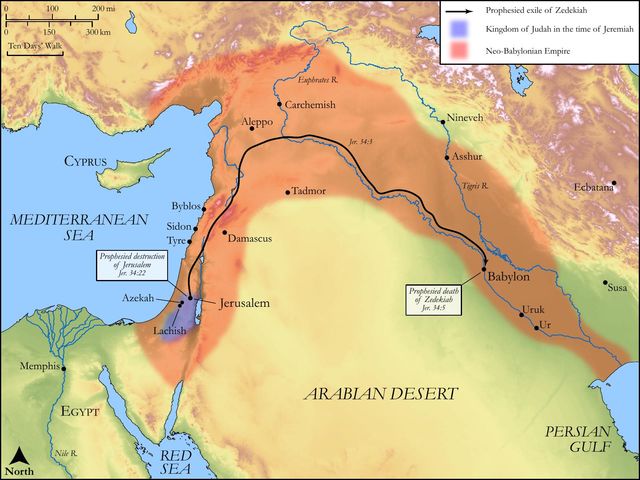
Study this verse
Public-domain commentary
Matthew Henry
From his Commentary on the Whole Bible. Henry comments on passages, not single verses — this entry covers Jeremiah 34:8–22. His three-level outline is real structure in the source text, so it is rendered as structure.
We have here another prophecy upon a particular occasion, the history of which we must take notice of, as necessary to give light to the prophecy.
I.When Jerusalem was closely besieged by the Chaldean army the princes and people agreed upon a reformation in one instance, and that was concerning their servants.
1.The law of God was very express, that those of their own nation should not be held in servitude above seven years, but, after they had served one apprenticeship, they should be discharged and have their liberty; yea, though they had sold themselves into servitude for the payment of their debts, or though they were sold by the judges for the punishment of their crimes. This difference was put between their brethren and strangers, that those of other nations taken in war, or bought with money, might be held in perpetual slavery, they and theirs; but their brethren must serve but for seven years at the longest. This God calls the covenant that he had made with them when he brought them out of the land of Egypt, Jer 34:13, Jer 34:14. This was the first of the judicial laws which God gave them (Exo 21:2), and there was good reason for this law.
(1.)God had put honour upon that nation, and he would have them thus to preserve the honour of it themselves and to put a difference between it and other nations.
(2.)God had brought them out of slavery in Egypt, and he would have them thus to express their grateful sense of that favour, by letting those go to whom their houses were houses of bondage, as Egypt had been to their forefathers. That deliverance is therefore mentioned here (Jer 34:13) as the ground of that law. Note, God's compassions towards us should engage our compassions towards our brethren; we must release as we are released, forgive as we are forgiven, and relieve as we are relieved. And this is called a covenant; for our performance of the duty required is the condition of the continuance of the favours God has bestowed.
2.This law they and their fathers had broken. Their worldly profit swayed more with them than God's command or covenant. When their servants had lived seven years with them they understood their business, and how to apply themselves to it, better than they did when they first came to them, and therefore they would then by no means part with them, though God himself by his law had made them free: Your fathers hearkened not to me in this matter (Jer 34:14), so that from the days of their fathers they had been in this trespass; and they thought they might do it because their fathers did it, and their servants had by disuse lost the benefit of the provision God made for them; whereas against an express law, especially against an express law of God, no custom, usage, nor prescription, is to be admitted in plea. For this sin of theirs, and their fathers, God now brought them into servitude, and justly.
3.When they were besieged, and closely shut in, by the army of the Chaldeans, they, being told of their fault in this matter, immediately reformed, and let go all their servants that were entitled to their freedom by the law of God, as Pharaoh, who, when the plague was upon him, consented to let the people go, and bound themselves in a covenant to do so.
(1.)The prophets faithfully admonished them concerning their sin. From them they heard that they should let their Hebrew servants go free, Jer 34:10. They might have read it themselves in the book of the law, but did not, or did not heed it, therefore the prophets told them what the law was. See what need there is of the preaching of the word; people must hear the word preached because they will not make the use they ought to make of the word written.
(2.)All orders and degrees of men concurred in this reformation. The king, and the princes, and all the people, agreed to let go their servants, whatever loss or damage they might sustain by so doing. When the king and princes led in this good work the people could not for shame but follow. The example and influence of great men would go very far towards extirpating the most inveterate corruptions.
(3.)They bound themselves by a solemn oath and covenant that they would do this, whereby they engaged themselves to God and one another. Note, What God has bound us to by his precept, it is good for us to bind ourselves to by our promise. This covenant was very solemn: it was made in a sacred place, made before me, in the house which is called by my name (Jer 34:15), in the special presence of God, the tokens of which, in the temple, ought to strike an awe upon them and make them very sincere in their appeals to him. It was ratified by a significant sign; they cut a calf in two, and passed between the parts thereof (Jer 34:18, Jer 34:19) with this dreadful imprecation, "Let us be in like manner cut asunder if we do not perform what we now promise." This calf was probably offered up in sacrifice to God, who was thereby made a party to the covenant. When God covenanted with Abraham, for the ratification of it, a smoking furnace and a burning lamp passed between the pieces of the sacrifice, in allusion to this federal rite, Gen 15:17. Note, In order that we may effectually oblige ourselves to our duty, it is good to alarm ourselves with the apprehensions of the terror of the wrath and curse to which we expose ourselves if we live in the contempt of it, that wrath which will cut sinners asunder (Mat 24:51), and sensible signs may be of use to make the impressions of it deep and durable, as here.
(4.)They conformed themselves herein to the command of God and their covenant with him; they did let their servants go, though at this time, when the city was besieged, they could very ill spare them. Thus they did right in God's sight, Jer 34:15. Though it was their trouble that drove them to it, yet he was well pleased with it; and if they had persevered in this act of mercy to the poor, to their poor servants, it might have been a lengthening of their tranquillity, Dan 4:27.
II.When there was some hope that the siege was raised and the danger over they repented of their repentance, undid the good they had done, and forced the servants they had released into their respective services again.
1.The king of Babylon's army had now gone up from them, Jer 34:21. Pharaoh was bringing an army of Egyptians to oppose the progress of the king of Babylon's victories, upon the tidings of which the Chaldeans raised the siege for a time, as we find, Jer 37:5. They departed from Jerusalem. See how ready God was to put a stop to his judgments, upon the first instance of reformation, so slow is he to anger and so swift to show mercy. As soon as ever they let their servants go free God let them go free.
2.When they began to think themselves safe from the besiegers they made their servants come back into subjection to them, Jer 34:11, and again Jer 34:16. This was a great abuse to their servants, to whom servitude would be more irksome, after they had had some taste of the pleasures of liberty. It was a great shame to themselves that they could not keep in a good mind when they were in it. But it was especially an affront to God; in doing this they polluted his name, Jer 34:16. It was a contempt of the command he had given them, as if that were of no force at all, but they might either keep it or break it as they thought fit. It was a contempt of the covenant they had made with him, and of that wrath which they had imprecated upon themselves in case they should break that covenant. It was jesting with God almighty, as if he could be imposed upon by fallacious promises, which, when they had gained their point, they would look upon themselves no longer obliged by. it was lying to God with their mouths and flattering him with their tongues. It was likewise a contempt of the judgments of God and setting them at defiance; as if, when once the course of them was stopped a little and interrupted, they would never proceed again and the judgment would never be revived; whereas reprieves are so far from being pardons that if they be abused thus, and sinners take encouragement from them to return to sin, they are but preparatives for heavier strokes of divine vengeance.
III.For this treacherous dealing with God they are here severely threatened.
Be not deceived; God is not mocked. Those that think to put a cheat upon God by a dissembled repentance, a fallacious covenant, and a partial temporary reformation, will prove in the end to have put the greatest cheat upon their own souls; for the Lord, whose name is Jealous, is a jealous God. it is here threatened, with an observable air of displeasure against them,
1.That, since they had not given liberty to their servants to go where they pleased, God would give all his judgments liberty to take their course against them without control (Jer 34:17): You have not proclaimed liberty to your servants. Though they had done it (Jer 34:10), yet they might truly be said not to have done it, because they did not stand to it, but undid it again; and factum non dicitur quod non perseverat - that is not said to be done which does not last. The righteousness that is forsaken and turned away from shall be forgotten, and not mentioned any more than if it had never been, Eze 18:24. "Therefore I will proclaim a liberty for you; I will discharge you from my service, and put you out of my protection, which those forfeit that withdraw from their allegiance. You shall have liberty to choose which of these judgments you will be cut off by, sword, famine, or pestilence;" such a liberty as was offered to David, which put him into a great strait, Sa2 24:14. Note, Those that will not be in subjection to the law of God put themselves into subjection to the wrath and curse of God. But this shows what liberty to sin really - it is but a liberty to the sorest judgments.
2.That, since they had brought their servants back into confinement in their houses, God would make them to be removed into all the kingdoms of the earth, where they should live in servitude, and, being strangers, could not expect the privileges of free-born subjects.
3.That, since they had broken the covenant which they ratified by a solemn imprecation, God would bring on them the evil which they imprecated upon themselves in case they should break it. out of their own mouth will he judge them, and so shall their doom be; the penalty of their bond shall be recovered, because they have not performed the condition; for so some read Jer 34:18, "I will make the men which have transgressed my covenant as the calf which they cut in twain; I will divide them asunder as they divided it asunder." 4. That, since they would not let go their servants out of the hands, God would deliver them into the hands of those that hated them, even the princes and nobles both of Judah and Jerusalem (of the country and of the city), the eunuchs (chamberlains, or great officers of the court), the priests, and all the people, Jer 34:19. They had all dealt treacherously with God, and therefore shall all be involved in the common ruin without exception. They shall all be given unto the hand of their enemies, that seek, not their wealth only, or their service, but their life, and they shall have what they seek; but neither shall that content them: when they have their lives they shall leave their dead bodies unburied, a loathsome spectacle to all mankind and an easy prey to the fowls and beasts, a lasting mark of ignominy being hereby fastened on them, Jer 34:20. 5. That, since they had emboldened themselves in returning to their sin, contrary to their covenant, by the retreat of the Chaldean army from them, God would therefore bring it upon them again: "They have now gone up from you, and your fright is over for the present, but I will command them to face about as they were; they shall return to this city, and take it and burn it," Jer 34:22. Note,
(1.)As confidence in God is a hopeful presage of approaching deliverance, so security in sin is a sad omen of approaching destruction.
(2.)When judgments are removed from a people before they have done their work, leave them, but leave them unhumbled and unreformed, it is cum animo revertendi - with a design to return; they do but retreat to come on again with so much the greater force; for when God judges he will overcome.
(3.)It is just with God to disappoint those expectations of mercy which his providence had given cause for when we disappoint those expectations of duty which our professions, pretensions, and fair promises, had given cause for. If we repent of the good we had purposed, God will repent of the good he had purposed. With the froward thou will show thyself froward.
Historical interpretation
Historical reception
1 surviving comment on this verse from the historical church.
[Daniel 7:1] "In the first year of Belshazzar, King of Babylon, Daniel beheld a dream. And a vision of his head upon his bed. And when he wrote the dream down, he comprehended it in a few words and gave a brief summary of it, saying..." This section which we now undertake to explain, and also the subsequent section which we are going to discuss, is historically prior to the two previous sections. For this present section and that which follows it are recorded to have taken place in the first and third years of the reign of King Belshazzar (Jeremiah 39) [Jerome's citation of Jeremiah 39 seems quite pointless in this connection]. But the section which we read previously to the one just preceding this, is recorded to have taken place in the last year, indeed on the final day, of Belshaz-zar's reign. And we meet this phenomenon not only in Daniel but also in Jeremiah [cf. Jeremiah 35 and Jeremiah 34] and Ezekiel (Ezekiel 17), as we shall be able to show, if life spares us that long. But in the earlier portion of the book, the historical order has been followed, namely the events which occurred in the time of Nebuchadnezzar, and Belshazzar, and Darius or Cyrus. But in the passages now before us an account is given of various visions which were beheld on particular occasions and of which only the prophet himself was aware, and which therefore lacked any importance as signs or revelations so far as the barbarian nations were concerned. But they were written down only that a record of the things beheld might be preserved for posterity.
Continue studying Jeremiah 34:16 across the web’s major study libraries — every link below opens this exact verse, chapter, or book on the destination site.
Read & Compare
 BibleGatewayThis verse in more than 200 translations and 70 languages.
 Bible.comThe YouVersion reader — hundreds of translations, reading plans, and highlights.
 ESV.orgCrossway's official English Standard Version reader.
 NET BibleThe NET translation with 60,000+ translators' notes on every rendering decision.
 STEP BibleTyndale House's free study tool — original text, vocabulary, and scholarly resources.
 BibliaLogos Bible Software's free web reader.
 USCCBThe New American Bible (Revised Edition) with the U.S. bishops' study notes.
Commentaries
 BibleHub CommentariesDozens of classic commentaries on this verse, gathered on one page.
 StudyLightMore than 100 commentary sets — the largest collection on the web.
 BibleRefPlain-English commentary on what this verse means, verse by verse.
 Enduring WordDavid Guzik's free commentary on this chapter, widely used by Bible teachers.
 Bible Study ToolsVerse commentary alongside Greek and Hebrew study aids.
Original Language & Research
- BibleHub InterlinearThe verse word by word — original language, transliteration, and English.
- BibleHub LexiconEvery word's original-language definition and Strong's entry.
 Blue Letter BibleDeep-study tools — Strong's numbers, concordance, and word studies.
 SefariaThe Hebrew text with Rashi and centuries of Jewish commentary.
Sermons, Hymns & Audio


TrulyRandomVerse is not affiliated with these sites and doesn’t control their content. They’re linked because they’re genuinely useful.
Summary
Jeremiah 34:16 delivers a scathing divine indictment against the people of Judah and King Zedekiah for their profound and hypocritical unfaithfulness. After initially freeing their Hebrew servants and handmaids under the immediate threat of Babylonian invasion—an act ostensibly aligning with Mosaic Law—they shamelessly reversed course once the immediate danger seemed to pass. This verse captures God's furious condemnation of their re-enslavement of those they had just liberated, declaring that by this act of treachery and injustice, they had "polluted" His holy name, demonstrating a deep-seated spiritual rebellion and a blatant disregard for a solemn covenant made before Him.
Context
ShowHideLiterary Context
Jeremiah 34:16 is situated within a broader prophetic message concerning Judah's impending judgment and the fall of Jerusalem to Babylon. The immediate literary context is crucial: verses Jeremiah 34:8-11 describe a covenant made by King Zedekiah and the people, under duress from Nebuchadnezzar's siege, to free their Hebrew slaves in accordance with the Law. This act of "repentance" was short-lived. When the Babylonian army temporarily withdrew due to an approaching Egyptian force, as mentioned in Jeremiah 37:5, the people immediately reneged on their promise, forcibly bringing the freed individuals back into servitude. Verse 16 serves as God's indignant response to this egregious betrayal, highlighting the superficiality of their earlier compliance and setting the stage for the renewed and irreversible siege that would lead to Jerusalem's destruction. This specific verse encapsulates the core of their offense, which triggers the severe judgment detailed in the subsequent verses of Jeremiah 34.
Historical & Cultural Context
The events of Jeremiah 34 unfold during the final, desperate years of the Kingdom of Judah, specifically during the reign of King Zedekiah (597-586 BCE), as the Babylonian Empire under Nebuchadnezzar tightened its grip on the region. Jerusalem was under siege, facing imminent destruction. The Mosaic Law, particularly as outlined in Exodus 21:2-6 and Deuteronomy 15:12-18, mandated that Hebrew servants be released after six years of service, with provisions for their well-being. This law was rooted in Israel's own liberation from slavery in Egypt and was designed to prevent perpetual bondage among God's people. The act of freeing slaves in Jeremiah 34:8 was a desperate attempt to appease God and avert disaster, reflecting a cultural understanding that national crisis often called for acts of repentance and adherence to neglected laws. Their subsequent reversal, however, exposed a deep-seated opportunism rather than genuine obedience, revealing a society where self-interest superseded divine command and human compassion.
Key Themes
ShowHideThis verse powerfully encapsulates several critical themes prevalent throughout Jeremiah and the prophetic tradition. Foremost is the theme of covenant breaking and unfaithfulness, as the people's actions represent a direct violation of their solemn oath to God and His established law, echoing Israel's long history of straying from the covenant stipulations found in books like Deuteronomy. It exposes their hypocrisy and superficial repentance, demonstrating that their initial obedience was motivated by fear of judgment rather than true transformation of heart, a recurring critique seen in prophets like Isaiah. The phrase "polluted my name" underscores the theme of profaning God's holiness, revealing how human injustice and disobedience can bring dishonor upon the divine character and reputation among the nations, a concept deeply rooted in the Levitical laws concerning holiness in Leviticus 19. Finally, it highlights God's unwavering demand for justice and righteousness, particularly concerning the vulnerable and oppressed, making it clear that the treatment of the neighbor is inseparable from true worship and devotion, a message championed by prophets such as Amos.
Exposition and Analysis
ShowHideKey Word Analysis
ShowHideThis verb (H2490) signifies to profane, defile, or desecrate something sacred, treating it as common or worthless. In this context, the people's actions of breaking their covenant and re-enslaving freed individuals were not merely social or legal transgressions but a direct affront to God's holy character and His reputation. By acting unjustly and breaking a solemn oath made in His name, they effectively dragged His name through the mud, implying a violation of the sacred trust placed in His people to represent Him faithfully to the world.
Used twice in the verse (H7725), this word primarily means to turn back, away, or again. Here, it denotes a spiritual turning away from God's command and a physical turning back to oppressive practices. The repetition emphasizes the deliberate and conscious reversal of their previous, righteous act, highlighting their profound apostasy and lack of genuine commitment. It signifies a complete change of direction from obedience to defiance.
This root (H3533) means to tread down, conquer, or subjugate, implying forceful control and domination. It vividly describes the coercive act of bringing the freed servants back into bondage, stripping them of their recently granted liberty. This word underscores the oppressive nature of the people's actions, which stood in stark contrast to God's liberating character, revealing their willingness to forcefully suppress the freedom they had just granted.
Verse Breakdown
ShowHide"But ye turned and polluted my name"
This opening clause immediately establishes the core offense. The conjunction "But" signals a sharp contrast to their earlier, seemingly obedient act. Their turning away from their covenant commitment is equated with defiling the very name of the Holy One of Israel, implying a profound breach of trust and a misrepresentation of His justice to the world. This is not merely a social wrong but a direct affront to God's character and reputation.
"and caused every man his servant, and every man his handmaid"
This phrase emphasizes the widespread nature of the sin. It wasn't an isolated incident by a few individuals but a collective, pervasive act of injustice across the community. The repetition of "every man" underscores the societal complicity and the pervasive nature of their disobedience, indicating a national failure to uphold righteousness.
"whom ye had set at liberty at their pleasure, to return"
This highlights the hypocrisy and betrayal inherent in their actions. They had granted freedom, albeit under duress, only to revoke it. The phrase "at their pleasure" exposes the insincerity of their initial act, revealing that their "repentance" was conditional and self-serving, not rooted in genuine obedience to God's law or compassion for the oppressed. Their turning back was a deliberate choice, not an accidental lapse.
"and brought them into subjection, to be unto you for servants and for handmaids."
This final clause explicitly states the unjust reversal. The re-enslavement is described as bringing them "into subjection," emphasizing the forceful and oppressive nature of their actions. They had returned these individuals to the very state of bondage from which they had just been released, violating both human dignity and divine command, thereby completing their act of profound injustice.
Literary Devices
ShowHideJeremiah 34:16 employs several potent literary devices to convey its message of divine condemnation. Repetition is evident in the phrase "every man his servant, and every man his handmaid," which serves to emphasize the pervasive and collective nature of the sin, highlighting that this was not an isolated incident but a widespread societal transgression. The recurring terms "servants and handmaids" also frame the entire act of liberation and re-enslavement, underscoring the specific group affected by this injustice. A strong sense of Irony pervades the verse, as the people, who had just sought God's favor by freeing slaves in an act of supposed repentance, immediately revert to oppression once the immediate threat subsides. This stark contrast between their professed piety and their actual behavior underscores their profound hypocrisy and the superficiality of their faith. Furthermore, the declaration "polluted my name" is a powerful instance of Anthropomorphism, attributing human characteristics (being defiled or dishonored) to God's holy name. This device vividly communicates the depth of God's offense and how the people's actions directly impacted His reputation and character in the eyes of both Israel and the nations. The strong, condemnatory language also employs Intensification, elevating the gravity of their sin beyond a mere legal infraction to a profound spiritual offense against the divine character and covenant.
Theological and Thematic Connections
ShowHideJeremiah 34:16 stands as a stark reminder of the inseparability of true worship from righteous living and justice. Theologically, it underscores God's unwavering commitment to justice and His abhorrence of oppression, particularly against the vulnerable. The act of "polluting God's name" reveals that covenant faithfulness is not merely about ritual observance but about living out God's character in all relationships, especially in how power is exercised over others. When His people act unjustly, they misrepresent His holy character to the world, bringing dishonor upon Him. This passage also highlights the danger of superficial repentance—a turning to God born out of fear or convenience rather than a genuine transformation of heart and a commitment to His commands. God demands not just outward compliance, but an inward change that leads to consistent obedience and a deep concern for the well-being and freedom of all people, reflecting His own liberating nature.
Reflection and Application
ShowHideJeremiah 34:16 serves as a timeless mirror, challenging us to examine the authenticity of our faith and the integrity of our commitments. It compels us to ask whether our obedience to God is truly heart-deep and consistent, or merely a convenient response to difficult circumstances. Are we prone to making promises to God, or to others, only to renege on them when the pressure subsides? This passage powerfully reminds us that our actions, especially as those who claim to bear God's name, have profound implications for His reputation in the world. When we act unjustly, hypocritically, or with a lack of integrity, we risk "polluting" the very name we profess to honor, misrepresenting His character to a watching world. True faith demands not only personal piety but also a fervent commitment to justice, compassion, and freedom for all, particularly the vulnerable. It calls us to live lives that consistently reflect the liberating, righteous, and faithful character of God, upholding our word and striving for righteousness in every sphere of influence, from our homes to our workplaces and communities.
Questions for Reflection
ShowHideFAQ
ShowHideWhy was re-enslaving the freed people considered "polluting God's name"?
ShowHideRe-enslaving the freed people was considered "polluting God's name" because it directly violated God's explicit law regarding Hebrew servants (Deuteronomy 15:12-18) and a solemn covenant made in His name. To "pollute" God's name (Hebrew: châlal) means to profane or desecrate something holy, treating it as common or worthless. By breaking their word and His law, the people acted contrary to God's character of justice, faithfulness, and holiness. This made it appear as if God condoned injustice or was powerless to enforce His will, thereby bringing dishonor and shame upon His reputation in the eyes of both Israel and the surrounding nations, who observed their conduct.
What was the original law regarding Hebrew servants that Judah violated?
ShowHideThe Mosaic Law, as detailed in Exodus 21:2 and Deuteronomy 15:12-18, mandated that Hebrew servants (both male and female) were to be set free after six years of service. Upon their release, they were not to be sent away empty-handed but were to be generously provided for from the master's flock, threshing floor, and winepress. This law was a foundational aspect of Israelite society, designed to prevent perpetual bondage among God's people and to remind them of their own liberation from slavery in Egypt under God's mighty hand. It was a reflection of God's liberating character and His desire for justice within His covenant community.
How does this event relate to the fall of Jerusalem?
ShowHideThis act of covenant-breaking and profound hypocrisy was a critical factor in sealing Jerusalem's fate. God had offered Judah a chance to repent and avert judgment through their initial act of freeing the slaves. However, their immediate reversal demonstrated their unrepentant hearts and their deep-seated rebellion against God's commands and character. This act of injustice, coupled with their consistent idolatry and moral decay, showed that Judah had completely rejected God's path. Consequently, God declared that He would "proclaim liberty" to the sword, famine, and pestilence against them (Jeremiah 34:17), ensuring the city's destruction and the people's exile to Babylon. Their failure to uphold justice and their profaning of God's name directly led to the divine judgment that culminated in the siege and fall of Jerusalem in 586 BCE.
Christ-Centered Fulfillment
ShowHideJeremiah 34:16, with its stark portrayal of covenant-breaking and the pollution of God's name, powerfully foreshadows the profound need for a perfect covenant-keeper and a true deliverer. Israel's repeated failure to uphold God's righteous standards, especially in their treatment of the vulnerable, highlighted their inherent inability to perfectly reflect God's character or maintain His covenant. This profound human inadequacy points directly to Jesus Christ. He is the one who perfectly upholds the divine covenant, not by temporary acts of convenience, but by His very nature and His obedient life. Where Israel "polluted" God's name through their injustice, Christ glorified His Father's name through His perfect righteousness and sacrificial obedience, praying, "I have glorified You on the earth. I have finished the work which You have given Me to do" (John 17:4). He is the ultimate Liberator, who came not merely to free physical slaves, but to set spiritual captives free from the bondage of sin and death, proclaiming, "He has sent Me to proclaim liberty to the captives and recovery of sight to the blind, to set at liberty those who are oppressed" (Luke 4:18). Through His atoning sacrifice on the cross, Jesus cleanses the stain of humanity's "polluted name" and restores our relationship with a holy God. He establishes a New Covenant, written not on stone tablets but on the hearts of believers, where God declares, "I will put My laws into their minds and write them on their hearts" (Hebrews 8:10), enabling genuine, Spirit-empowered obedience and a true reflection of God's justice and love in the world. In Christ, the broken promises are fulfilled, and true, eternal liberty is found.