


Isaiah 18:3
- כָּלkolO allH3605N-mscNoun Singular Masculine Construct
- יֹשְׁבֵיyo·she·Vei[the] inhabitants ofH3427V-Qal-Prtcpl-mpVerb Qal Participle Plural Masculine Construct
- תֵבֵלte·Vel[the] worldH8398N-fsNoun Singular Feminine Absolute
- וְשֹׁכְנֵיve·Sho·khe·neiand [those who] dwellH7931Conj-w ¦ V-Qal-Prtcpl-mpVerb Qal Participle Plural Masculine Constructוְandשֹׁכְנֵי[those who] dwell
- אָרֶץ'A·retz<of> earthH776N-fsNoun Singular Feminine Absolute
- כִּנְשֹׂאkin·so'when lifts upH5375Prep-k ¦ V-Qal-InfVerb Qal Infinitive Constructכִּwhenנְשֹׂאlifts up
- נֵסnesa standardH5251N-msNoun Singular Masculine Absolute
- הָרִיםha·RimmountainsH2022N-mpNoun Plural Masculine Absolute
- תִּרְאוּtir·'Uyou will see [it]H7200V-Qal-Imperf-2mpVerb Qal Imperfect 2nd Plural Masculine
- וְכִתְקֹעַve·khit·Ko·a'and just as soundsH8628Conj-w ¦ Prep-k ¦ V-Qal-InfVerb Qal Infinitive Constructוְandכִjust asתְקֹעַsounds
- שׁוֹפָרsho·Fara trumpetH7782N-msNoun Singular Masculine Absolute
- תִּשְׁמָעוּtish·Ma·'uyou will hear [it]H8085V-Qal-Imperf-2mpVerb Qal Imperfect 2nd Plural Masculine
English is a literal word-by-word gloss of the Hebrew, not the KJV's wording. Why?
This is the original text the KJV's translators worked from — each Hebrew word with its own literal English meaning in this verse, prepared by scholars at Tyndale House, Cambridge. The KJV translates whole sentences, not word by word, so its wording differs: one Hebrew word can become several English words, and the KJV may choose “the LORD” where the gloss reads “Yahweh”. Both are faithful — they answer different questions. For the KJV's own rendering, switch to the KJV text.
Details
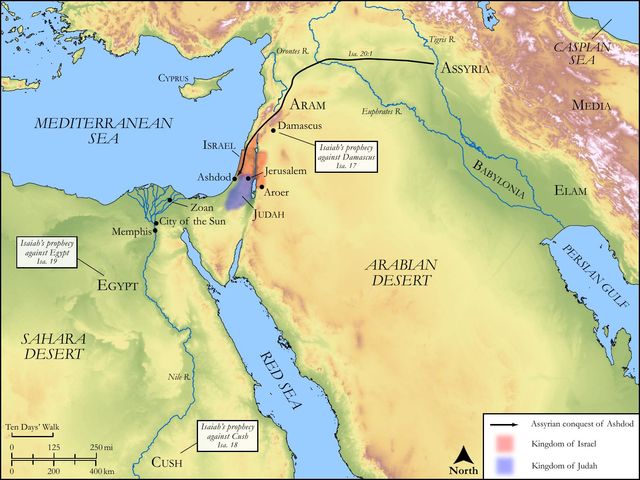
See on the biblical-era map
Study this verse
Public-domain commentary
Matthew Henry
From his Commentary on the Whole Bible. Henry comments on passages, not single verses — this entry covers Isaiah 18:1–7. His three-level outline is real structure in the source text, so it is rendered as structure.
Interpreters are very much at a loss where to find this land that lies beyond the rivers of Cush. Some take it to be Egypt, a maritime country, and full of rivers, and which courted Israel to depend upon them, but proved broken reeds; but against this it is strongly objected that the next chapter is distinguished from this by the title of the burden of Egypt. Others take it to be Ethiopia, and read it, which lies near, or about, the rivers of Ethiopia, not that in Africa, which lay south of Egypt, but that which we call Arabia, which lay east of Canaan, which Tirhakah was now king of. He thought to protect the Jews, as it were, under the shadow of his wings, by giving a powerful diversion to the king of Assyria, when he made a descent upon his country, at the time that he was attacking Jerusalem, Kg2 19:9. But though by his ambassadors he bade defiance to the king of Assyria, and encouraged the Jews to depend upon him, God by the prophet slights him, and will not go forth with him; he may take his own course, but God will take another course to protect Jerusalem, while he suffers the attempt of Tirhakah to miscarry and his Arabian army to be ruined; for the Assyrian army shall become a present or sacrifice to the Lord of hosts, and to the place of his name, by the hand of an angel, not by the hand of Tirhakah king of Ethiopia, Isa 18:7. This is a very probable exposition of this chapter. But from a hint of Dr. Lightfoot's, in his Harmony of the Old Testament, I incline to understand this chapter as a prophecy against Assyria, and so a continuation of the prophecy in the last three verses of the foregoing chapter, with which therefore this should be joined. That was against the army of the Assyrians which rushed in upon Judah; this is against the land of Assyria itself, which lay beyond the rivers of Arabia, that is, the rivers Euphrates and Tigris, which bordered on Arabia Deserta. And in calling it the land shadowing with wings he seems to refer to what he himself had said of it (Isa 8:8), that the stretching out of his wings shall fill the breadth of thy land, O Immanuel! The prophet might perhaps describe the Assyrians by such dark expressions, not naming them, for the same reason that St. Paul, in his prophecy, speaks of the Roman empire by a periphrasis: He who now letteth, Th2 2:7. Here is,
I.The attempt made by this land (whatever it is) upon a nation scattered and peeled, Isa 18:2.
Swift messengers are sent by water to proclaim war against them, as a nation marked by Providence, and meted out, to be trodden under foot. Whether this refer to the Ethiopians waging war with the Assyrians, or the Assyrians with Judah, it teaches us,
1.That a people which have been terrible from their beginning, have made a figure and borne a mighty sway, may yet become scattered and peeled, and may be spoiled even by their own rivers, that should enrich both the husbandman and the merchant. Nations which have been formidable, and have kept all in awe about them, may by a concurrence of accidents become despicable and an easy prey to their insulting neighbours.
2.Princes and states that are ambitious of enlarging their territories will always have some pretence or other to quarrel with those whose countries they have a mind to. "It is a nation that has been terrible, and therefore we must be revenged on it; it is now a nation scattered and peeled, meted out and trodden down, and therefore it will be an easy prey for us." Perhaps it was not brought so low as they represented it. God's people are trampled on as a nation scattered and peeled; but whoever think to swallow them up may find them still as terrible as they have been from their beginning; they are cast down, but not deserted, not destroyed.
II.The alarm sounded to the nations about, by which they are summoned to take notice of what God is about to do, Isa 18:3.
The Ethiopians and Assyrians have their counsels and designs, which they have laid deep, and promise themselves much from, and, in prosecution of them, send their ambassadors and messengers from place to place; but let us now enquire what the great God says to all this.
1.He lifts up an ensign upon the mountains, and blows a trumpet, by which he proclaims war against the enemies of his church, and calls in all her friends and well-wishers into her service, Isa 18:3. He gives notice that he is about to do some great work, as Lord of hosts.
2.All the world is bidden to take notice of it; all the dwellers on earth must see the ensign and hear the trumpet, must observe the motions of the divine providence and attend the directions of the divine will. Let all enlist under God's banner, and be on his side, and hearken to the trumpet of his word, which gives not an uncertain sound.
III.The assurance God gives to his prophet, by him to be given to his people, that, though he might seem for a time to sit by as an unconcerned spectator, yet he would certainly and seasonably appear for the comfort of his people and the confusion of his and their enemies (Isa 18:4): So the Lord said unto me. Men will have their saying, but God also will have his; and, as we may be sure his word shall stand, so he often whispers it in the ears of his servants the prophets. When he says, I will take my rest, it is not as if he were weary of governing the world, of as if he either needed or desired to retire from it and repose himself; but it intimates that the great God has a perfect, undisturbed, enjoyment of himself, in the midst of all the agitations and changes of this world (the Lord sits even upon the floods unshaken; the Eternal Mind is always easy), and, though he may sometimes seem to his people as if he took not wonted notice of what is done in this lower world (they are tempted to think he is as one asleep, or as one astonished, Psa 44:23; Jer 14:9), yet even then he knows very well what men are doing and what he himself will do.
1.He will take care of his people, and be a shelter to them. He will regard his dwelling-place; his eye and his heart are, and shall be, upon it for good continually. Zion is his rest for ever, where he will dwell; and he will look after it (so some read it); he will lift up the light of his countenance upon it, will consider over it what is to be done, and will be sure to do all for the best. He will adapt the comforts and refreshments he provides for his people to the exigencies of their case; and they will therefore be acceptable, because seasonable.
(1.)Like a clear heat after rain (so the margin), which is very reviving and pleasant, and makes the herbs to flourish.
(2.)Like a dew and a cloud in the heat of harvest, which are very welcome, the dew to the ground and the cloud to the labourers. Note, There is that in God which is a shelter and refreshment to his people in all weathers and arms them against the inconveniences of every change. Is the weather cool? There is that in his favour which will warm them. Is it hot? There is that in his favour which will cool them. Great men have their winter-house and their summer-house (Amo 3:15); but those that are at home with God have both in him.
2.He will reckon with his and their enemies, Isa 18:5, Isa 18:6. When the Assyrian army promises itself a plentiful harvest in the taking of Jerusalem and the plundering of that rich city, when the bud of that project is perfect, before the harvest is gathered in, while the sour grape of their enmity to Hezekiah and his people is ripening in the flower and the design is just ready to be put in execution, God shall destroy that army as easily as the husbandman cuts off the sprigs of the vine with pruning hooks, or because the grape is sour and good for nothing, and will not be cured, takes away and cuts down the branches. This seems to point at the overthrow of the Assyrian army by a destroying angel, when the dead bodies of the soldiers were scattered like the branches and sprigs of a wild vine, which the husbandman has cut to pieces. And they shall be left to the fowls of the mountains, and the beasts of the earth, to prey upon, both winter and summer; for as God's people are protected all seasons of the year, both in cold and heat (Isa 18:4), so their enemies are at all seasons exposed; birds and beasts of prey shall both summer and winter upon them, till they are quite ruined.
IV.The tribute of praise which should be brought to God from all this (Isa 18:7):
In that time, when this shall be accomplished, shall the present be brought unto the Lord of hosts.
1.Some understand this of the conversion of the Ethiopians to the faith of Christ in the latter days, of which we have the specimen and beginning in Philip's baptizing the Ethiopian eunuch, Act 8:27, etc. Those that were a people scattered and peeled, meted out, and trodden down (Isa 18:2), shall be a present to the Lord: and, though they seem useless and worthless, they shall be an acceptable present to him who judges of men by the sincerity of their faith and love, not by the pomp and prosperity of their outward condition. Therefore the gospel was ministered to the Gentiles that the offering up of the Gentiles might be acceptable, Rom 15:16. It is prophesied (Psa 68:31) that Ethiopia shall soon stretch out her hands unto God.
2.Others understand it of the spoil of Sennacherib's army, out of which, as usual, presents were brought to the Lord of hosts, Num 31:50. It was the present of a people scattered and peeled.
(1.)It was won from the Assyrians, who were now themselves reduced to such a condition as they scornfully described Judah to be in, Isa 18:1. Those that unjustly trample upon others shall themselves be justly trampled upon.
(2.)It was offered by the people of God, who were, in disdain, called a people scattered and peeled. God will put honour upon his people, though men put contempt upon them. Lastly, Observe, The present that is brought to the Lord of hosts must be brought to the place of the name of the Lord of hosts; what is offered to God must be offered in the way that he has appointed; we must be sure to attend him, and expect him to meet us, where he records his name.
Historical interpretation
Historical reception
2 surviving comments on this verse. Each one is dated, so this reads as a timeline rather than a list.
(Chapter 18—Verse 1 and following) Woe to the land of buzzing wings, which is beyond the rivers of Ethiopia, that sends ambassadors by sea, in vessels of papyrus on the waters. Go, you swift messengers, to a nation tall and smooth-skinned, to a people feared near and far, a mighty nation and conquering, whose land the rivers divide. All you inhabitants of the world, you who dwell on the earth, when a signal is raised on the mountains, you will see it, and when a trumpet is blown, you will hear it. LXX: Woe to the land of winged ships beyond the rivers of Ethiopia, who send ambassadors by sea in papyrus vessels over the water. Go, swift messengers, to a tall and smooth-skinned nation, to a people feared far and wide, a powerful and oppressive nation whose land the rivers divide. All you people of the world, you who live on the earth, when a banner is raised on the mountains, you will see it, and when a trumpet sounds, you will hear it. I have placed both editions in the most obscure prophecy so that nothing may seem to be lacking to those who want to understand what is written. At the same time, I greatly admire those who think that our faith and Christian hope are satisfied with simplicity, because it is written: The commandment of God is a clear light, enlightening the eyes (Ps. XIX, 9): and that we should not seek more than what is commanded, but that what is commanded should be done: for this reason, both the whole Scripture and the Prophets are specifically involved in the mysteries of the future, so that they may provoke us to understanding and to what is said in the Gospel: Ask and you shall receive, seek and you shall find, knock and it shall be opened to you. Therefore, since I have explained the history and what is contained in Hebrew in the fifth book, now I will explain what seems to me according to the allegory. Perhaps a discerning reader may inquire what the Vision, or the Burden of Damascus, the sounding cymbal, and the other things that follow mean. After the calling of the Gentiles was mentioned, along with the objection of the Jews and their election, those who believed through the Apostles, and then the multitude of the Gentiles and the persecutors who were compared to the waves of the sea: it followed that the prophetic discourse would also announce the heresies that have troubled and continue to ravage the Church, which, while the master of the household slept, sowed weeds in the field of the Church (Matthew 13). And they are called cymbals, lacking the love of God, according to the saying of the Apostle: 'If I speak with the tongues of men and of angels, but do not have love, I have become a noisy gong or a clanging cymbal' (1 Corinthians 13:1). And not only a cymbal with its harsh resounding sound, but because of the lightweight heretical discourse that flows in different directions, they are called cymbals of wings, or according to the Septuagint, wings of ships, who, promising great goods, sail in the waves of this world. But understand the wings of the ships, the sails by which they are suspended and drawn. And beautifully he called them the wings of the ships, for every heretic promises lofty things and boasts of having wings, yet he clings to the salty waves and does not depart far from land, and in the middle of his course he suddenly suffers shipwreck. Hence the Eagle, as a symbol of the ship, interpreted the shadow of the wings, for eagles do not have wings, but a resemblance to wings. And he brings forth the fact that which is beyond the rivers of Ethiopia, signifies that all heretics are conquered by their impiety. For example: Epicurus says that there is no providence, and that pleasure is the greatest good. By comparison, Marcion is even more wicked, and all heretics who tear apart the Old Testament. For when they reject providence, they accuse the Creator, and assert that He has erred in most of His works, and has not done them as He should have. For what benefit do serpents, scorpions, crocodiles, fleas, bugs, and mosquitoes bring to human beings? Therefore, these people across the rivers of Ethiopia are sending messengers into the sea of this world, that is, their disciples, who are said to carry their volumes, rightly called papyrus vessels, that is, papers carried on the water, which are quickly erased. For just as books are quickly obscured and destroyed by water and moisture, so too their message and teaching, once it appears to possess some strength in the beginning, passes away and slips away. Therefore, through irony, it is said to them: O Angels of heretics, go quickly. These false apostles, deceitful workers, who transform themselves into apostles of Christ, are referred to as such by the blessed apostle Paul (2 Cor. XI). And go to the nation torn and ravaged: torn from God and torn apart by the bites of heretics. To a horrible people; for there is nothing more horrible than blasphemy, which lifts up its own mouth in arrogance. After which there is no other people; for every sin when compared to blasphemy is lighter. A people waiting, waiting, and trampled upon. For all heretics promise themselves celestial things, and they promise great things, and yet they are trampled upon by demons. Whose land the rivers have plundered, which do not have waters from the sky, but from the earth. For what corner is there, what remote wilderness of the earth, to which the polluted speech of heretics does not reach? Therefore, all who dwell and live in the world, lift up their eyes to the sign of the heretics, which is raised as if on mountains, and they hear the sound of the trumpet, that is, their teaching. These things are according to Hebrew. Furthermore, according to the Seventy, the wings of the heretics lament, which fly like ships across the sea of this age, and they surpass the impiety of the Gentiles, whom Scripture now calls Ethiopians: and it is said about their teaching and their language: You who send books of this age into the sea, the hostages of your perversity, and letters to deceive those who will read them. The swift messengers go to the high and foreign people, and the most wicked. For no ecclesiastics have so much zeal for good as heretics have for evil, and they believe they will gain advantage by deceiving others and destroying those who are already doomed. But this people is called exalted because of their pride: and foreign and wicked because they are estranged from God. Truly a people without hope, and oppressed, whose rivers throughout the whole earth imitate the dwelling of the Church, so that they may find for themselves a home and a region, in which they may raise the sign of their teaching, in which they may sound the trumpet of the Scriptures.
(Verse 3.) All the inhabitants of the world who dwell on the earth, when the signal is raised on the mountains, you will see and hear the sound of the trumpet. All the nations, he says, around, when you hear my command, like a signal raised on the mountains, and my authority, like the sound of a triumphantly resounding trumpet, then you will see what I have ordered.
Continue studying Isaiah 18:3 across the web’s major study libraries — every link below opens this exact verse, chapter, or book on the destination site.
Read & Compare
 BibleGatewayThis verse in more than 200 translations and 70 languages.
 Bible.comThe YouVersion reader — hundreds of translations, reading plans, and highlights.
 ESV.orgCrossway's official English Standard Version reader.
 NET BibleThe NET translation with 60,000+ translators' notes on every rendering decision.
 STEP BibleTyndale House's free study tool — original text, vocabulary, and scholarly resources.
 BibliaLogos Bible Software's free web reader.
 USCCBThe New American Bible (Revised Edition) with the U.S. bishops' study notes.
Commentaries
 BibleHub CommentariesDozens of classic commentaries on this verse, gathered on one page.
 StudyLightMore than 100 commentary sets — the largest collection on the web.
 BibleRefPlain-English commentary on what this verse means, verse by verse.
 Enduring WordDavid Guzik's free commentary on this chapter, widely used by Bible teachers.
 Bible Study ToolsVerse commentary alongside Greek and Hebrew study aids.
Original Language & Research
- BibleHub InterlinearThe verse word by word — original language, transliteration, and English.
- BibleHub LexiconEvery word's original-language definition and Strong's entry.
 Blue Letter BibleDeep-study tools — Strong's numbers, concordance, and word studies.
 SefariaThe Hebrew text with Rashi and centuries of Jewish commentary.
Sermons, Hymns & Audio


TrulyRandomVerse is not affiliated with these sites and doesn’t control their content. They’re linked because they’re genuinely useful.
Summary
Isaiah 18:3 issues a profound, universal summons to all humanity, urging them to observe and heed the decisive actions of God. Set within a prophecy concerning a distant, powerful nation, it transcends its immediate historical context to declare that God's sovereign interventions in world affairs will be unmistakably clear, signaled by a visible standard raised on the mountains and an audible trumpet blast, demanding the attention and acknowledgment of every inhabitant of the globe.
Context
ShowHideLiterary Context
Isaiah 18 is part of a series of "burdens" or oracles against foreign nations (chapters 13-23). Specifically, chapter 18 addresses a land "shadowing with wings" (v. 1), often identified as Cush (ancient Ethiopia), a powerful nation known for its swift messengers and distant reach. The preceding verses describe this nation's activities, but verse 3 shifts the focus dramatically from human actions to divine initiative. It serves as a pivotal announcement, declaring that while human powers may scheme and act, God's ultimate intervention will be globally proclaimed and undeniable, setting the stage for the subsequent description of God's judgment and ultimate gathering of His people in Jerusalem (vv. 4-7). This verse acts as a divine interjection, asserting God's overarching control over international politics and human history.
Historical & Cultural Context
The historical backdrop is the late 8th century BCE, a period of significant geopolitical upheaval. Assyria was the dominant superpower, threatening Judah and surrounding nations. Cush, located south of Egypt, was a formidable kingdom, often allied with Egypt against Assyria. In the ancient Near East, the raising of an "ensign" (or standard/banner) on a high place was a common practice to signal the gathering of an army, the declaration of war, or the announcement of a significant event visible from afar. Similarly, the blowing of a "trumpet" (shophar) served as an unmistakable auditory signal for assembly, battle, or important proclamations. These were universally understood symbols of authority, command, and impending action. The prophet uses these familiar human signals to convey the universal and undeniable nature of God's impending actions, demonstrating that His power transcends any earthly empire, even those as mighty as Cush or Assyria.
Key Themes
ShowHideThis verse powerfully contributes to several overarching themes within Isaiah and the broader prophetic literature. Firstly, it underscores Divine Sovereignty, asserting God's ultimate authority and control over all nations and their affairs, irrespective of their perceived strength or distance. His actions are not confined to Judah but are global in scope, as seen in His judgment against nations like Babylon and Egypt. Secondly, it highlights Universal Revelation, emphasizing that God's purposes will be made manifest to "all ye inhabitants of the world," leaving no room for ignorance or denial of His work. This theme of universal knowledge of God is echoed in passages like Habakkuk 2:14. Thirdly, the use of "ensign" and "trumpet" signifies Clear and Unmistakable Signals, portraying God's actions as decisive and demanding immediate attention and response, much like the call to battle or assembly. Finally, the imperatives "see ye" and "hear ye" constitute a direct Call to Witness, inviting humanity to actively observe and acknowledge God's unfolding plan, which encompasses both judgment and the ultimate establishment of His kingdom.
Exposition and Analysis
ShowHideKey Word Analysis
ShowHideMeaning "to sit down," "to dwell," or "to remain." In this context, it refers to those who permanently reside or settle in a place, emphasizing the universality of the call – it is for all who are established on the earth, not just transient visitors. The repetition with "dwellers" (H7931, shâkan') reinforces this global scope, encompassing everyone living across the world.
Meaning a flag, banner, standard, or signal. It is often set on a high pole to be seen from afar, serving as a rallying point or a declaration. Here, it symbolizes a clear, highly visible, and unmistakable signal of divine activity or impending action, demanding universal attention. It represents God's authoritative display of His power and purpose.
Meaning "to hear intelligently," often with an implication of attention, understanding, and obedience. It's not merely about perceiving sound, but about comprehending the message and responding appropriately. The imperative "hear ye" underscores the necessity of not only perceiving God's signals but also internalizing their meaning and acting upon them.
Verse Breakdown
ShowHide"All ye inhabitants of the world, and dwellers on the earth"
This opening phrase establishes the universal audience for God's impending revelation. "Inhabitants of the world" (têbêl, H8398) and "dwellers on the earth" ('erets, H776) are parallel expressions, emphasizing that God's message and actions are not confined to a specific nation or people but are directed to the entirety of humanity, regardless of their location or status. It highlights the global reach and significance of divine sovereignty.
"see ye, when he lifteth up an ensign on the mountains"
This is the first imperative and the first divine signal. "See ye" (râʼâh, H7200) is a command to observe, to pay close attention. The "ensign" (nêç, H5251), a banner or standard, is "lifteth up" (nâsâʼ, H5375) "on the mountains" (har, H2022), high places that ensure its visibility to a wide audience. This imagery conveys a clear, public, and unmistakable visual sign of God's decisive action, a rallying point or declaration of His sovereign will that cannot be ignored.
"and when he bloweth a trumpet, hear ye"
This is the second imperative and the second divine signal, complementing the visual with an auditory command. "Hear ye" (shâmaʻ, H8085) is a command to listen and comprehend. The "trumpet" (shôwphâr, H7782), a ram's horn, is "bloweth" (tâqaʻ, H8628), producing a loud, piercing sound. This signifies an urgent, attention-grabbing announcement, a call to assembly, or a declaration of war or a momentous event. Together, the ensign and trumpet represent a dual, undeniable, and universally accessible declaration of God's intervention in human affairs.
Literary Devices
ShowHideIsaiah 18:3 employs several powerful literary devices to convey its universal and urgent message. Parallelism is evident in the opening address, "All ye inhabitants of the world, and dwellers on the earth," where two phrases with similar meanings are used to reinforce the idea of a global audience. This is further mirrored in the paired commands and actions: "see ye, when he lifteth up an ensign" and "hear ye, when he bloweth a trumpet," creating a sense of balance and emphasizing the dual nature of God's clear communication. Imagery is central, with the vivid pictures of an "ensign" (banner or standard) raised on "mountains" and the sound of a "trumpet" being blown. These are not merely abstract concepts but concrete, universally understood signals from the ancient world, evoking a sense of urgency, authority, and impending momentous events. The "mountains" provide a natural stage for maximum visibility. The use of Imperative Mood in "see ye" and "hear ye" directly addresses the audience, creating a sense of immediacy and demanding an active response, rather than passive observation. Finally, the verse is rich in Symbolism, where the ensign and trumpet symbolize God's sovereign power, His clear communication, and the undeniable nature of His intervention in human history, serving as a divine call to attention for all humanity.
Theological and Thematic Connections
ShowHideIsaiah 18:3 profoundly asserts God's active involvement and ultimate control over global events, signaling His intentions to all humanity. It underscores the biblical truth that God is not a distant, disengaged deity but the sovereign Lord who orchestrates history and reveals His purposes clearly. This verse anticipates a time when God's glory and judgment will be universally known, demanding a response from every nation and individual. It sets the stage for understanding that divine judgment and salvation are not confined to a single people but have cosmic implications, ultimately culminating in the establishment of God's universal kingdom.
Reflection and Application
ShowHideIsaiah 18:3 serves as a timeless reminder that God is actively engaged in the world, and His plans are unfolding with divine precision, visible and audible to those who pay attention. In an age often characterized by confusion, noise, and a sense of human powers being out of control, this verse calls believers to a posture of watchful discernment. We are not to be passive observers but active participants in "seeing" God's hand at work in global events, in the church, and in our personal lives. It encourages us to listen intently for His "trumpet blasts" – whether they come through His Word, through the promptings of the Holy Spirit, or through the signs of the times. This active engagement fosters faith, knowing that even amidst chaos, God is raising His standard and sounding His call, inviting all to acknowledge His sovereignty and align with His purposes. It challenges us to consider how we might be part of making His "ensign" visible and His "trumpet" heard in a world that desperately needs to see and hear Him.
Questions for Reflection
ShowHideFAQ
ShowHideWhat is the "ensign" and "trumpet" symbolic of in this verse?
ShowHideIn Isaiah 18:3, the "ensign" (Hebrew: nes, H5251) and "trumpet" (Hebrew: shophar, H7782) are powerful symbols of God's clear and undeniable communication and action. The ensign represents a highly visible standard or banner raised on a mountain, serving as a rallying point or a declaration of a significant event, much like a flag signaling a battle or victory. It symbolizes God's public display of His sovereign power and purpose, visible to all. The trumpet represents an unmistakable, urgent sound, like a ram's horn used in ancient times to summon assemblies, announce war, or proclaim important news. It symbolizes God's audible call to attention, demanding immediate response and comprehension. Together, they signify that God's interventions in world affairs will be so clear and decisive that no one can claim ignorance; they are universally accessible signals of divine initiative, whether for judgment or salvation. This imagery is echoed in other prophetic passages, such as Isaiah 11:10.
Does this verse refer to a specific historical event, or does it have broader prophetic implications?
ShowHideWhile Isaiah 18 is part of a series of oracles against specific foreign nations, particularly Cush (Ethiopia) in this chapter, verse 3 transcends this immediate historical context to have broader prophetic implications. The initial context describes God's response to a powerful nation, but the call to "all ye inhabitants of the world, and dwellers on the earth" signifies a universal message. The "ensign" and "trumpet" are timeless symbols of divine action and revelation that extend beyond any single historical event. The verse sets a pattern for how God reveals His sovereign will and interventions on a global scale. Ultimately, it points to God's ultimate eschatological actions, when His glory and judgment will be universally manifest, as seen in passages like Revelation 1:7, where every eye will see the returning Christ.
Christ-Centered Fulfillment
ShowHideIsaiah 18:3 finds its ultimate and most profound fulfillment in the person and work of Jesus Christ. The "ensign" lifted up on the mountains, visible to all the world, powerfully prefigures Christ himself, who was "lifted up" on the cross, not as a sign of defeat, but as the ultimate banner of salvation and judgment for all humanity. Just as Moses lifted up the serpent in the wilderness, so too was the Son of Man lifted up, that whoever believes in Him should not perish but have eternal life. Jesus declared, "And I, when I am lifted up from the earth, will draw all people to myself" (John 12:32), becoming the universal rallying point for all nations. Similarly, the "trumpet" that calls all to hear finds its echo in the proclamation of the Gospel, which is the divine summons to repentance and faith, sounding forth to the ends of the earth (Romans 10:18). Ultimately, the universal "seeing" and "hearing" of Isaiah 18:3 will reach its crescendo at Christ's glorious return, when He will descend with a "loud command, with the voice of the archangel and with the trumpet call of God" 1 Thessalonians 4:16, and "every eye will see him" (Revelation 1:7), fulfilling the ancient prophecy of a universally manifest divine intervention.