


Genesis 49:12
Bible text: King James Version (1769 Blayney text) · Public domain
Bible text: Berean Standard Bible · Public domain
Bible text: American Standard Version (1901) · Public domain
Bible text: World English Bible, Messianic edition · Public domain
Bible text: Geneva Bible (1599) · Public domain
Bible text: Young's Literal Translation · Public domain
- חַכְלִילִיchakh·li·Lidark ofH2447Adj-mscAdjective Singular Masculine Construct
- עֵינַיִם'ei·Na·yimeyesH5869N-fdNoun Dual Feminine Absolute
- מִיָּיִןmi·Ya·yinmore than wineH3196Prep-m ¦ N-msNoun Singular Masculine Absoluteמִmore thanיָּיִןwine
- וּלְבֶןu·le·venand white ofH3836Conj-w ¦ Adj-mscAdjective Singular Masculine Constructוּandלְבֶןwhite of
- שִׁנַּיִםshi·Na·yimteethH8127N-fdNoun Dual Feminine Absolute
- מֵחָלָבme·cha·Lavmore than milkH2461Prep-m ¦ N-msNoun Singular Masculine Absoluteמֵmore thanחָלָבmilk
English is a literal word-by-word gloss of the Hebrew, not the KJV's wording. Why?
This is the original text the KJV's translators worked from — each Hebrew word with its own literal English meaning in this verse, prepared by scholars at Tyndale House, Cambridge. The KJV translates whole sentences, not word by word, so its wording differs: one Hebrew word can become several English words, and the KJV may choose “the LORD” where the gloss reads “Yahweh”. Both are faithful — they answer different questions. For the KJV's own rendering, switch to the KJV text.
Details
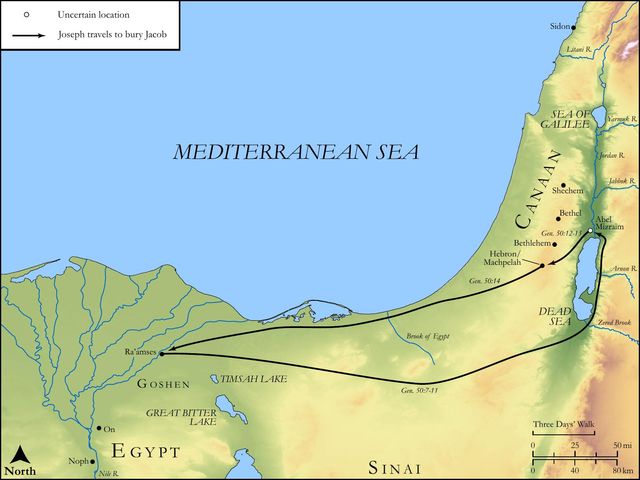
See on the biblical-era maps


Study this verse
Public-domain commentary
Matthew Henry
From his Commentary on the Whole Bible. Henry comments on passages, not single verses — this entry covers Genesis 49:8–12.
Glorious things are here said of Judah. The mention of the crimes of the three elder of his sons had not so put the dying patriarch out of humour but that he had a blessing ready for Judah, to whom blessings belonged. Judah's name signifies praise, in allusion to which he says, Thou art he whom thy brethren shall praise, Gen 49:8. God was praised for him (Gen 29:35), praised by him, and praised in him; and therefore his brethren shall praise him. Note, Those that are to God for a praise shall be the praise of their brethren. It is prophesied that, 1. The tribe of Judah should be victorious and successful in war: Thy hand shall be in the neck of thy enemies. This was fulfilled in David, Psa 18:40. 2. It should be superior to the rest of the tribes; not only in itself more numerous and illustrious, but having a dominion over them: Thy father's children shall bow down before thee. Judah was the lawgiver, Psa 60:7. That tribe led the van through the wilderness, and in the conquest of Canaan, Jdg 1:2. The prerogatives of the birthright which Reuben had forfeited, the excellence of dignity and power, were thus conferred upon Judah. Observe, "Thy brethren shall bow down before thee, and yet shall praise thee, reckoning themselves happy in having so wise and bold a commander." Note, Honour and power are then a blessing to those that have them when they are not grudged and envied, but praised and applauded, and cheerfully submitted to. 3. It should be a strong and courageous tribe, and so qualified for command and conquest: Judah is a lion's whelp, Gen 49:9. The lion is the king of beasts, the terror of the forest when he roars; when he seizes his prey, none can resist him; when he goes up from the prey, none dare pursue him to revenge it. By this it is foretold that the tribe of Judah should become very formidable, and should not only obtain great victories, but should peaceably and quietly enjoy what was obtained by those victories - that they should make war, not for the sake of war, but for the sake of peace. Judah is compared, not to a lion rampant, always tearing, always raging, always ranging; but to a lion couchant, enjoying the satisfaction of his power and success, without creating vexation to others: this is to be truly great. 4. It should be the royal tribe, and the tribe from which Messiah the Prince should come: The sceptre shall not depart from Judah, till Shiloh come, Gen 49:10. Jacob here foresees and foretels, (1.) That the sceptre should come into the tribe of Judah, which was fulfilled in David, on whose family the crown was entailed. (2.) That Shiloh should be of this tribe - his seed, that promised seed, in whom the earth should be blessed: that peaceable and prosperous one, or the Saviour, so others translate it, he shall come of Judah. Thus dying Jacob, at a great distance, saw Christ's day, and it was his comfort and support on his death-bed. (3.) That after the coming of the sceptre into the tribe of Judah it should continue in that tribe, at least a government of their own, till the coming of the Messiah, in whom, as the king of the church, and the great high priest, it was fit that both the priesthood and the royalty should determine. Till the captivity, all along from David's time, the sceptre was in Judah, and subsequently the governors of Judea were of that tribe, or of the Levites that adhered to it (which was equivalent), till Judea became a province of the Roman empire, just at the time of our Saviour's birth, and was at that time taxed as one of the provinces, Luk 2:1. And at the time of his death the Jews expressly owned, We have no king but Caesar. Hence it is undeniably inferred against the Jews that our Lord Jesus is he that should come, and that we are to look for no other; for he came exactly at the time appointed. Many excellent pens have been admirable well employed in explaining and illustrating this famous prophecy of Christ. 5. It should be a very fruitful tribe, especially that it should abound with milk for babes, and wine to make glad the heart of strong men (Gen 49:11, Gen 49:12) - vines so common in the hedge-rows and so strong that they should tie their asses to them, and so fruitful that they should load their asses from them - wine as plentiful as water, so that the men of that tribe should be very healthful and lively, their eyes brisk and sparkling, their teeth white. Much of what is here said concerning Judah is to be applied to our Lord Jesus. (1.) He is the ruler of all his father's children, and the conqueror of all his father's enemies; and he it is that is the praise of all the saints. (2.) He is the lion of the tribe of Judah, as he is called with reference to this prophecy (Rev 5:5), who, having spoiled principalities and powers, went up a conqueror, and couched so as none can stir him up, when he sat down on the right hand of the Father. (3.) To him belongs the sceptre; he is the lawgiver, and to him shall the gathering of the people be, as the desire of all nations (Hag 2:7), who, being lifted up from the earth, should draw all men unto him (Joh 12:32), and in whom the children of God that are scattered abroad should meet as the centre of their unity, Joh 11:52. (4.) In him there is plenty of all that which is nourishing and refreshing to the soul, and which maintains and cheers the divine life in it; in him we may have wine and milk, the riches of Judah's tribe, without money and without price, Isa 55:1.
Historical interpretation
Two Centuries of Reception
5 surviving comments on this verse. Each one is dated, so this reads as a timeline rather than a list.
Select a marker to jump to its quote. Markers stagger vertically where authors wrote within a few decades of each other.
“Eyes” then, the prophets have been the eyes of Christ when they rejoiced in the power of the Spirit, and announced in advance the sufferings which had to rush upon him and which were useful for the generations after him to understand that every person can be saved. Through the words “His teeth (ARE) whiter than milk” he signified either the apostles sanctified by the Word himself and become like milk, the apostles who have provided us with the spiritual and heavenly nourishment. Or, … he means the commandments of the Lord, which were uttered by a holy mouth but remain for us milk, so that by obtaining from them nourishment and growth we may take our part of the heavenly bread.
Hipp. That is, his eyes are brilliant as with the word of truth; for they regard all who believe upon him. And his teeth are white as milk;-that denotes the luminous power of his words: for this reason he calls them white, and compares them to milk, as that which nourishes the flesh and the soul. And Zabulun is, by interpretation, "fragrance" and "blessing."
Then, after something from Cyril:-
Hipp. Again, I think, it mystically signifies the sacraments of the New Testament of our Saviour; and the words, "his teeth are white as milk," denote the excellency and purity of the sacramental food. And again, these words, "his teeth are white as milk," we take in the sense that His words give light to those who believe on Him.
And in saying, moreover, that Zabulun will dwell by the sea, he speaks prophetically of his territory as bordering on the sea, and of Israel as mingling with the Gentiles, the two nations being brought as it were into one flock. And this is manifest in the Gospel. "The land of Zabulun, and the land of Nephthalim," etc. And you will mark more fully the richness of his lot as having both inland territory and seaboard.
"And he is by a haven of ships; "that is, as in a safe anchorage, referring to Christ, the anchor of hope. And this denotes the calling of the Gentiles-that the grace of Christ shall go forth to the whole earth and sea. For he says, "And (he is) by a haven of ships, and shall extend as far as Sidon." And that this is said prophetically of the Church of the Gentiles, is made apparent to us in the Gospel: "The land of Zabulun, and the land of Nephthalim, by the way of the sea, beyond Jordan, Galilee of the Gentiles; the people which sat in darkness saw great light." In saying, then, that he, namely Zabulun, would inhabit a territory bordering on the sea, he plainly confirmed that, just as if he had said that in the future Israel would mingle with the Gentiles, the two peoples being brought together into one fold and under the hand of one chief Shepherd, the good (Shepherd) by nature, that is, Christ. In blessing him Moses said, "Zabulun shall rejoice." And Moses prophesies, that in the allocation of the land he should have abundance ministered of the good things both of land and sea, under the hand of One. "By a haven of ships; "that is, as in an anchorage that proves safe, referring to Christ, the anchor of hope. For by His grace he shall come forth out of many a tempest, and shall be brought hereafter to land, like ships secure in harbours. Besides, he said that "he extends as far even as Sidon," indicating, as it seems, that so complete a unity will be effected in the spirit's course between the two peoples, that those of the blood of Israel shall occupy those very cities which once were exceeding guilty in the sight of God.
After something from Cyril:-
Hipp. And "that the land was fat; "that is, the flesh of our Lord: "fat," that is, "rich; "for it flows with honey and milk. The parts of the land are marked off for an inheritance and possession to him-that means the doctrine of the Lord. For this is a pleasant rest, as He says Himself: "Come unto me, all ye that labour and are heavy laden," etc. For they who keep the commandments, and do not disclaim the ordinances of the law, enjoy rest both in them and in the doctrine of our Lord; and that is the meaning of "in the midst of the lots." As the Lord says, "I am not come to destroy the law and the prophets, but to fulfil them." For even our Lord, in the fact that He keeps the commandments, does not destroy the law and the prophets, but fulfils them, as He says in the Gospels. "He set his shoulder to toil, and became a husbandman." This the apostles did. Having received power from God, and having set themselves to labour, they became husbandmen of the Lord, cultivating the earth-that is, the human race-with the preaching of our Lord.
And therefore the prophet says, “His eyes are joyful from wine, and his teeth are whiter than milk,” for he means the prophets and the apostles. For some, like eyes of Christ, have foreseen and announced his coming, and of them Christ himself says, “Abraham saw my day and he rejoiced,” and one of the prophets says, “I saw the Lord of hosts.” Seeing him, they were filled with a spiritual joy. Others, however, that is, the apostles, whom the Lord cleansed from every stain of sin, were made whiter than milk, for no blemish darkened them afterward. Indeed, milk is a temporal thing, but the grace of the apostles remains forever. They provided us with that spiritual sustenance which is of heaven, and they nourished the vitals of the spirit which is within. There are also those who think that the commandments of the Lord, which were revealed from the mouth of God, being clear, have become to us like milk. Nourished upon them, we come to the sustenance of the bread of heaven. On this account also Paul says, “I gave you milk to drink, not solid food; for you were not yet ready.” The Corinthian in the beginning of faith is initiated with milk to drink, whereas those saints whose faith is proclaimed in the whole world are strengthened with more solid food, as if they had been weaned.
And also Christ’s eyes will be like this, those eyes which bring the light of knowledge to the whole body, according to what is written in the Gospel: “The lamp of your body is the eye.” Therefore these eyes are made graceful: a word of knowledge is seasoned with salt to be pleasing to the audience. The one who proclaims the word of knowledge is not said to be “made graceful” just because he has in himself the grace but because he also acts in order that his listeners may have the grace. In fact, “after comprehending that, the wise man will become wiser.” His eyes are made graceful by wine because nothing is watery, nothing is fluid, nothing is cold in the word of knowledge. It is like a wine that cheers the human heart and is sprinkled on the wounds of the victims of robbers. This means that the wounds of the listeners, their sins, are not only soothed by the sweetness of oil but are also purified by the harshness of wine.
We have already discussed many times about the nature and quality of Christ’s limbs, and it seems to be superfluous to repeat again the same things in this passage. So his teeth whiter than milk are those who can chew and grind with their teeth the strong and solid food of the Word of God to extreme fineness, those about whom the apostle in his epistle to the Hebrews says, “Solid food is for the mature, for those whose faculties have been trained by practice to distinguish good from evil.” About the still imperfect Corinthians he says, “I fed you with milk, not solid food, for you were not ready for solid food.” Since they are superior to those who live on milk, his teeth are therefore white, that is, those who can take and eat solid food are superior to those who still need milk like babies. That is why in the law those animals which ruminate and bring back to their teeth the food that they had previously eaten, in order to make it very fine for their feeding, are called pure animals. And so in the most consistent manner his teeth are said to be white. All those who are perfect and, by explaining through worthy and proper interpretations the food of the Scripture, administer to the church the subtle and fine intelligence, which is called spiritual, must be pure and free and faultless, so that they may never be told, “You, then, that teach others, will you not teach yourself?”
Continue studying Genesis 49:12 across the web’s major study libraries — every link below opens this exact verse, chapter, or book on the destination site.
Read & Compare
 BibleGatewayThis verse in more than 200 translations and 70 languages.
 Bible.comThe YouVersion reader — hundreds of translations, reading plans, and highlights.
 ESV.orgCrossway's official English Standard Version reader.
 NET BibleThe NET translation with 60,000+ translators' notes on every rendering decision.
 STEP BibleTyndale House's free study tool — original text, vocabulary, and scholarly resources.
 BibliaLogos Bible Software's free web reader.
 USCCBThe New American Bible (Revised Edition) with the U.S. bishops' study notes.
Commentaries
 BibleHub CommentariesDozens of classic commentaries on this verse, gathered on one page.
 StudyLightMore than 100 commentary sets — the largest collection on the web.
 BibleRefPlain-English commentary on what this verse means, verse by verse.
 Enduring WordDavid Guzik's free commentary on this chapter, widely used by Bible teachers.
 Bible Study ToolsVerse commentary alongside Greek and Hebrew study aids.
Original Language & Research
- BibleHub InterlinearThe verse word by word — original language, transliteration, and English.
- BibleHub LexiconEvery word's original-language definition and Strong's entry.
 Blue Letter BibleDeep-study tools — Strong's numbers, concordance, and word studies.
 SefariaThe Hebrew text with Rashi and centuries of Jewish commentary.
Sermons, Hymns & Audio


TrulyRandomVerse is not affiliated with these sites and doesn’t control their content. They’re linked because they’re genuinely useful.
Summary
Genesis 49:12, a pivotal verse within Jacob's prophetic blessings upon his sons, offers a vivid and deeply symbolic portrayal of the extraordinary prosperity and abundance destined for the tribe of Judah. Far from implying intoxication, the imagery of "eyes red with wine" and "teeth white with milk" serves as a powerful metaphor for an overwhelming richness of agricultural produce and dairy, signifying unparalleled material blessing, robust health, and divine favor. This prophecy underscores Judah's future preeminence, foreshadowing the royal lineage from which the Messiah would ultimately emerge, establishing a kingdom characterized by both earthly plenty and spiritual significance.
Context
ShowHideLiterary Context
Genesis chapter 49 serves as Jacob's final testament, a series of prophetic pronouncements delivered to his twelve sons on his deathbed, revealing what would befall their descendants "in the last days" (Genesis 49:1). The prophecy concerning Judah stands out as particularly extensive and significant, beginning in Genesis 49:8 and extending through Genesis 49:12. Jacob likens Judah to a lion, foretelling his dominance, leadership, and the enduring nature of his royal line. Crucially, Genesis 49:10 predicts that "the scepter shall not depart from Judah... until Shiloh come," a widely recognized messianic prophecy that elevates Judah's status far beyond his brothers. This sets the stage for the imagery of verse 12, which builds directly upon the theme of immense agricultural wealth introduced in Genesis 49:11, where Judah is depicted binding his donkey to a choice vine and washing his clothes in wine, emphasizing an unimaginable superabundance of grapes and wine production.
Historical & Cultural Context
In Scripture, wine and milk were not merely beverages but foundational elements of sustenance, wealth, and cultural identity. Abundance of these commodities indicated a fertile land, successful agriculture, and thriving livestock, all signs of divine blessing and prosperity. A land "flowing with milk and honey" was the ultimate symbol of God's promised provision. For a tribe's eyes to be "red with wine" and teeth "white with milk" would have immediately conveyed an image of extraordinary, almost overflowing, richness in their agricultural and pastoral output. This imagery would have resonated deeply with an agrarian society, signifying a life free from want, robust health, and a secure future, contrasting sharply with the harsh realities of famine or scarcity that often plagued the region. The geographical territory later allotted to the tribe of Judah, characterized by its fertile valleys and hills suitable for vineyards and pastures, would indeed become a region of significant agricultural productivity.
Key Themes
ShowHideGenesis 49:12 contributes significantly to several overarching themes within Jacob's blessings and the broader book of Genesis. It highlights the theme of Divine Sovereignty and Election, as God's plan for Israel's future unfolds through specific tribal destinies, with Judah receiving a preeminent blessing that sets him apart. This verse also powerfully illustrates Abundance and Provision, portraying a "golden age" of material prosperity that reflects God's covenant faithfulness to bless His people. Furthermore, it reinforces the theme of Messianic Expectation, as the material blessings and leadership role prophesied for Judah serve as a direct precursor and backdrop to the ultimate spiritual and eternal abundance that would come through the "Shiloh" figure mentioned in Genesis 49:10. The imagery of agricultural wealth also connects to the biblical theme of Land and Inheritance, where the fertility of the land is a tangible sign of God's presence and blessing upon His chosen people.
Exposition and Analysis
ShowHideGenesis 49:12 continues the rich, symbolic language detailing the future prosperity of the tribe of Judah, building upon the themes of preeminence and abundance established in the preceding verses.
Key Word Analysis
ShowHideFrom an unused root meaning to be dark, this word describes something "darkly flashing" or "brilliant" when stimulated. In the context of "eyes red with wine," it signifies a deep saturation, not of intoxication, but of the rich, dark color of abundant wine, as if the very essence of the wine's plenty is reflected in Judah's appearance, indicating a life immersed in agricultural wealth.
Derived from a root meaning "to effervesce," this term refers to fermented grape juice. Here, it is used to denote an overwhelming quantity of wine, symbolizing extraordinary agricultural productivity and the resulting prosperity. It speaks to a land so bountiful that wine is not merely consumed but is almost an environmental feature.
This word refers to milk, specifically emphasizing its richness (as from kine). In this context, "white with milk" points to the plentiful supply of dairy products, indicating flourishing livestock, rich pastures, and a land capable of sustaining abundant herds, providing a constant source of nourishment and wealth. It signifies health, vitality, and a well-nourished state.
Verse Breakdown
ShowHide"His eyes [shall be] red with wine"
This vivid phrase does not suggest drunkenness but rather an overwhelming, almost immersive, abundance of wine. The "redness" signifies a deep saturation, as if Judah's very being, even his eyes, are imbued with the richness and quantity of wine available. It speaks to a land so overflowing with vineyards and wine production that it is reflected in the physical appearance of its inhabitants, indicating a life of ease, vitality, and plenty derived from agricultural wealth. It implies that wine is so plentiful it's almost used for washing, as suggested in the previous verse, leading to a physical manifestation of this abundance.
"and his teeth white with milk"
This parallel imagery further reinforces the theme of extraordinary prosperity, health, and nourishment. "White teeth" are a universally recognized sign of good health and a nutritious diet, implying a plentiful supply of dairy products. This points to flourishing livestock, rich pastures, and a land capable of sustaining abundant herds, providing a constant source of nourishment and wealth. It suggests a diet so rich in milk that it contributes to the physical well-being and appearance of the people, signifying a state of robust health and complete provision.
Literary Devices
ShowHideGenesis 49:12 is rich in Symbolism, using physical imagery to convey abstract concepts of abundance and blessing. The "redness" of eyes from wine symbolizes an overwhelming quantity of wine, not intoxication, while "white teeth" from milk symbolize robust health and plentiful dairy. The verse also employs Parallelism, specifically synonymous parallelism, where the two clauses ("eyes red with wine" and "teeth white with milk") express similar ideas of superabundance and prosperity through different but related imagery. This reinforces the central message. Furthermore, there is an element of Hyperbole, as the literal interpretation of eyes being "red with wine" and teeth "white with milk" is an exaggeration used to emphasize the extraordinary, almost unimaginable, extent of the prosperity. Finally, the imagery can be seen as a form of Merism, where "eyes" and "teeth" represent the whole person, and "wine" and "milk" represent the full spectrum of agricultural and pastoral wealth, indicating a complete and total immersion in abundance.
Theological and Thematic Connections
ShowHideGenesis 49:12 stands as a profound testament to God's lavish provision and covenant faithfulness. It paints a picture of a divinely blessed existence, echoing the recurring biblical theme of a "land flowing with milk and honey," first promised to Israel in Exodus 3:8, signifying a land of extraordinary fertility and blessing. The material abundance described for Judah is not merely an earthly promise but is intrinsically linked to his unique role in God's redemptive plan, particularly the prophecy of Shiloh in Genesis 49:10. This suggests that the physical prosperity of Judah serves as a tangible sign of divine favor, setting the stage for the spiritual and eternal abundance that would come through the ultimate King from Judah's line. It highlights God's sovereign choice and favor, which would manifest in Judah's leadership and the perpetuation of his royal lineage, ultimately culminating in the Messiah's arrival.
Reflection and Application
ShowHideWhile Genesis 49:12 is a specific prophecy about the ancient tribe of Judah, its underlying message of divine provision and blessing remains profoundly relevant for believers today. It serves as a powerful reminder of God's faithfulness to His promises and His desire for His people to experience a life of abundance—not solely in material terms, but more significantly, in the spiritual riches found in Christ. This verse encourages us to trust in God's unfailing provision, to cultivate a spirit of gratitude for the blessings we receive, and to prioritize seeking His kingdom and righteousness, confident that all other necessities will be added unto us (Matthew 6:33). It challenges us to reflect on what true abundance means in light of God's grace and the spiritual inheritance we possess, recognizing that the greatest wealth is found in a relationship with the Giver of all good things. We are called to live with a generous spirit, knowing that God supplies all our needs according to His riches in glory (Philippians 4:19).
Questions for Reflection
ShowHideFAQ
ShowHideDoes "red with wine" imply intoxication?
ShowHideNo, in the context of Genesis 49:12, "his eyes red with wine" is a vivid metaphor for an overwhelming, almost unbelievable, abundance of wine. It signifies such a plentiful supply and consumption that the very richness and color of the wine are reflected in the individual's appearance, rather than indicating drunkenness. It speaks to a life of ease and prosperity where wine is so common it's almost an intrinsic part of the environment, symbolizing a land overflowing with agricultural produce.
Why is Judah singled out for such extraordinary prosperity?
ShowHideJudah's extraordinary prosperity is a direct outcome of Jacob's prophetic blessing, which also designates him as the leader among his brothers and the tribe from which kingship, and ultimately the Messiah (Shiloh), would emerge. This material abundance symbolizes the divine favor and preeminence that would characterize Judah's role in Israel's history and God's redemptive plan. It's a sign of a blessed and powerful kingdom, reflecting God's sovereign choice to work through this particular lineage to bring about His ultimate purposes.
How does this verse relate to the biblical phrase "a land flowing with milk and honey"?
ShowHideThe imagery in Genesis 49:12 directly parallels and amplifies the promise of "a land flowing with milk and honey" (Exodus 3:8). Both phrases are biblical idioms for extraordinary fertility, agricultural richness, and divine blessing. While "milk and honey" generally describes the promised land as a whole, this verse applies specific, vivid imagery of wine and milk abundance to Judah, emphasizing his particular share in this promised prosperity and highlighting the exceptional nature of his tribal blessing. It paints an even more detailed picture of the abundance implied by the broader phrase.
Is this prophecy only about material wealth?
ShowHideWhile Genesis 49:12 primarily describes material prosperity, its deeper significance is profoundly theological and redemptive. The abundance symbolizes God's favor and blessing upon Judah, which is intrinsically linked to his role as the royal tribe and the lineage of the Messiah. Thus, the material blessings foreshadow the spiritual and eternal blessings that would come through the ultimate King from Judah's line, Jesus Christ, who brings spiritual abundance far surpassing any earthly wealth. The earthly prosperity serves as a signpost pointing to a greater, divine reality.
Christ-Centered Fulfillment
ShowHideThe extraordinary prosperity and preeminence prophesied for Judah in Genesis 49:12 find their ultimate and most glorious fulfillment in Jesus Christ, the Lion of the tribe of Judah (Revelation 5:5). The prophecy of Shiloh in Genesis 49:10 clearly points to the Messiah, establishing a direct link between Judah's earthly blessings and Christ's eternal reign. While Judah's eyes were to be "red with wine" and his teeth "white with milk" as a sign of material abundance, Christ offers a spiritual abundance that transcends all earthly provision. He is the true vine (John 15:1) who provides living water (John 4:10) and the bread of life (John 6:35), and in Him, believers experience a spiritual richness, peace, and eternal life that far surpasses any earthly "golden age." His kingdom is one of righteousness, joy, and peace in the Holy Spirit (Romans 14:17), fulfilling Judah's promise of preeminence in an eternal, redemptive sense, offering not just physical sustenance but eternal life and spiritual satiation to all who believe.