


Genesis 36:27
Bible text: King James Version (1769 Blayney text) · Public domain
Bible text: Berean Standard Bible · Public domain
Bible text: American Standard Version (1901) · Public domain
Bible text: World English Bible, Messianic edition · Public domain
Bible text: Geneva Bible (1599) · Public domain
Bible text: Young's Literal Translation · Public domain
- אֵלֶּה'E·lehtheseH428PrtParticle Demonstrative
- בְּנֵיbe·nei[were] [the] sons ofH1121N-mpcNoun Plural Masculine Construct
- אֵצֶר'E·tzerEzerH687N-proper-mNoun Proper Masculine
- בִּלְהָןbil·HanBilhanH1092N-proper-mNoun Proper Masculine
- וְזַעֲוָןve·za·'a·Vanand ZaavanH2190Conj-w ¦ N-proper-mNoun Proper MasculineוְandזַעֲוָןZaavan
- וַעֲקָןva·'a·Kanand AkanH6130Conj-w ¦ N-proper-mNoun Proper MasculineוַandעֲקָןAkan
English is a literal word-by-word gloss of the Hebrew, not the KJV's wording. Why?
This is the original text the KJV's translators worked from — each Hebrew word with its own literal English meaning in this verse, prepared by scholars at Tyndale House, Cambridge. The KJV translates whole sentences, not word by word, so its wording differs: one Hebrew word can become several English words, and the KJV may choose “the LORD” where the gloss reads “Yahweh”. Both are faithful — they answer different questions. For the KJV's own rendering, switch to the KJV text.
Details
See on the biblical-era maps


Study this verse
Public-domain commentary
Matthew Henry
From his Commentary on the Whole Bible. Henry comments on passages, not single verses — this entry covers Genesis 36:20–30.
In the midst of this genealogy of the Edomites here is inserted the genealogy of the Horites, those Canaanites, or Hittites (compare Gen 26:34), that were the natives of Mount Seir. Mention is made of them, Gen 14:6, and of their interest in Mount Seir, before the Edomites took possession of it, Deu 2:12, Deu 2:22. This comes in here, not only to give light to the story, but to be a standing reflection upon the Edomites for intermarrying with them, by which, it is probable, they learned their way, and corrupted themselves. Esau having sold his birthright, and lost his blessing, and entered into alliance with the Hittites, his posterity and the sons of Seir are here reckoned together. Note, Those that treacherously desert God's church are justly numbered with those that were never in it; apostate Edomites stand on the same ground with accursed Horites. Particular notice is taken of one Anah who fed the asses of Zibeon his father (Gen 36:24), and yet is called duke Anah, Gen 36:29. Note, Those that expect to rise high should begin low. An honourable descent should not keep men from an honest employment, nor a mean employment hinder any man's preferment. This Anah was not only industrious in his business, but ingenious too, and successful; for he found mules, or (as some read it) waters, hot-baths, in the wilderness. Those that are diligent in their business sometimes find more advantages than they expected.
Continue studying Genesis 36:27 across the web’s major study libraries — every link below opens this exact verse, chapter, or book on the destination site.
Read & Compare
 BibleGatewayThis verse in more than 200 translations and 70 languages.
 Bible.comThe YouVersion reader — hundreds of translations, reading plans, and highlights.
 ESV.orgCrossway's official English Standard Version reader.
 NET BibleThe NET translation with 60,000+ translators' notes on every rendering decision.
 STEP BibleTyndale House's free study tool — original text, vocabulary, and scholarly resources.
 BibliaLogos Bible Software's free web reader.
 USCCBThe New American Bible (Revised Edition) with the U.S. bishops' study notes.
Commentaries
 BibleHub CommentariesDozens of classic commentaries on this verse, gathered on one page.
 StudyLightMore than 100 commentary sets — the largest collection on the web.
 BibleRefPlain-English commentary on what this verse means, verse by verse.
 Enduring WordDavid Guzik's free commentary on this chapter, widely used by Bible teachers.
 Bible Study ToolsVerse commentary alongside Greek and Hebrew study aids.
Original Language & Research
- BibleHub InterlinearThe verse word by word — original language, transliteration, and English.
- BibleHub LexiconEvery word's original-language definition and Strong's entry.
 Blue Letter BibleDeep-study tools — Strong's numbers, concordance, and word studies.
 SefariaThe Hebrew text with Rashi and centuries of Jewish commentary.
Sermons, Hymns & Audio


TrulyRandomVerse is not affiliated with these sites and doesn’t control their content. They’re linked because they’re genuinely useful.
Summary
Genesis 36:27 meticulously records three sons of Ezer the Horite—Bilhan, Zaavan, and Akan—as part of the extensive genealogy of Esau (Edom). This verse, situated within a chapter detailing Esau's descendants and the original Horite inhabitants of Seir, underscores the Bible's profound commitment to historical accuracy and provides essential context for understanding the diverse nations that interacted with ancient Israel, revealing God's intricate orchestration of all human history.
Context
ShowHideLiterary Context
Genesis chapter 36 serves as a detailed and comprehensive genealogical interlude, specifically outlining the descendants of Esau, also known as Edom, the twin brother of Jacob. This chapter meticulously records Esau's wives, his sons, and the chiefs (dukes) who descended from him, along with the Horite inhabitants of the land of Seir, whom Esau's progeny eventually displaced and settled. Verses 20-30 are dedicated to the lineage of Seir the Horite, an indigenous people of Seir, into whose families the Edomites intermarried and from whom they eventually inherited the land. Verse 27, by listing the children of Ezer, a son of Seir the Horite, further elaborates on these original inhabitants, providing a granular level of detail that distinguishes the lineage of Esau from that of Jacob and sets the historical stage for future interactions between Israel and Edom. This meticulous record-keeping reflects the biblical narrative's deep concern for historical and familial continuity, even for peoples outside the direct covenant line.
Historical & Cultural Context
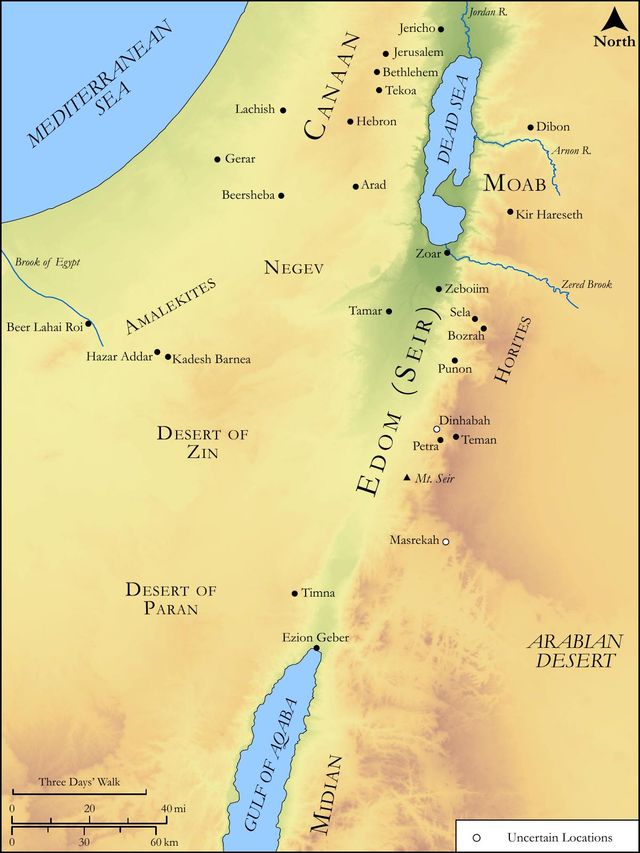
The Horites were an ancient people group who inhabited the mountainous region of Seir, south of the Dead Sea, before the Edomites, descendants of Esau, settled there. Archaeological evidence and other biblical texts (e.g., Deuteronomy 2:12) confirm their presence and subsequent displacement by the Edomites. Among the peoples of Genesis, genealogies were not merely lists of names but vital documents that established identity, validated claims to land and inheritance, solidified tribal alliances, and provided a historical foundation for national identity. The inclusion of Horite lineages within Esau's genealogy in Genesis 36 suggests a process of intermarriage and cultural assimilation, where the Edomites integrated with and eventually absorbed or displaced the indigenous population. This detailed record highlights the dynamic nature of ancient settlements and the importance of lineage in defining a people's place and rights within a specific territory.
Key Themes
ShowHideGenesis 36, and specifically verse 27, contributes to several overarching themes. Firstly, it emphasizes Genealogical Precision, showcasing the Bible's meticulous commitment to historical record-keeping, even for nations outside the direct covenant line of Abraham, Isaac, and Jacob. This precision serves to validate the historical claims and relationships presented throughout Scripture, providing a robust foundation for the unfolding narrative. Secondly, it subtly highlights Divine Sovereignty Over All Nations. While the primary focus of Genesis is the covenant line that leads to Israel, the inclusion of detailed genealogies for other nations like the Horites and Edomites affirms God's universal governance, demonstrating His intricate plan encompasses every people group and their historical development. This meticulous record of Esau's descendants, alongside Jacob's, also reinforces the theme of Distinct Destinies, as prophesied in Genesis 25:23, where two nations would emerge from Rebekah's womb, one stronger than the other, and the older would serve the younger. The detailed account of Edom's rise and settlement in Seir provides the historical backdrop for understanding future interactions with Israel, as seen in books like Numbers 20 and Obadiah.
Exposition and Analysis
ShowHideGenesis 36:27 states, "The children of Ezer [are] these; Bilhan, and Zaavan, and Akan." This verse is a straightforward genealogical entry, listing three sons of Ezer, who was himself a son of Seir the Horite, an original inhabitant of the land of Seir. Such lists underscore the biblical commitment to historical detail, tracing the origins and relationships of various peoples.
Key Word Analysis
ShowHideFrom the root meaning "to build," this term refers to a son, but in its widest sense, it encompasses descendants, offspring, or even members of a group or nation. Here, it denotes direct male progeny, emphasizing the continuation of the family line and the establishment of distinct tribal units within the Horite people.
Meaning "treasure," Ezer is a proper noun identifying one of the sons of Seir the Horite, as listed in Genesis 36:20. The name's meaning, "treasure," may allude to the value placed on lineage and descendants in that day, or it could simply be a personal name with an inherent meaning.
Derived from an unused root meaning "to twist," suggesting "tortuous" or "troublesome." This name is notable because it appears as "Jaakan" (Hebrew, Ya'aqan') in other biblical genealogies, specifically in 1 Chronicles 1:42. This variation is a common phenomenon in ancient texts, reflecting minor differences in transcription or pronunciation over time rather than a historical discrepancy. Both names refer to the same individual, a descendant of Ezer the Horite, highlighting the fluidity of ancient orthography while maintaining the integrity of the historical record.
Verse Breakdown
ShowHide"The children of Ezer [are] these"
This introductory clause clearly identifies the subject of the verse as the direct descendants of Ezer, establishing a specific lineage within the broader Horite genealogy. It functions as a heading for the subsequent list, ensuring clarity in the genealogical record.
"Bilhan, and Zaavan, and Akan"
This segment provides the names of the three sons of Ezer. These names represent distinct individuals who would have contributed to the Horite tribal structure, further detailing the composition of the indigenous peoples of Seir. The listing of specific names underscores the Bible's commitment to historical precision, even for figures who do not play a prominent role in the main narrative of Israel's covenant history.
Literary Devices
ShowHideThe primary literary device at play in Genesis 36:27, and indeed throughout much of Genesis 36, is Genealogy. This is a specific literary form used to trace lineages, establish connections, and provide historical continuity. Its function here is not merely to list names but to delineate the family tree of Esau and the Horites, setting the stage for future interactions between nations. Another device is Nomenclature, the study and use of names. The specific names (Bilhan, Zaavan, Akan) carry inherent meanings that, while not explicitly expounded upon in the text, contribute to the richness of the naming conventions of the patriarchal age and provide subtle insights into the characteristics or circumstances associated with these individuals or their families. Furthermore, the use of Formulaic Language ("The children of X are these; Y, and Z, and A") is typical of biblical genealogies, providing a consistent and recognizable structure that aids in the organization and comprehension of extensive family records.
Theological and Thematic Connections
ShowHideThe meticulous recording of lineages, even of non-covenant peoples like the Horites and Edomites, in Genesis 36:27 highlights profound theological truths. It underscores God's comprehensive sovereignty, demonstrating that His providential hand is at work not only in the covenant line of Israel but also in the formation and development of all nations. Every detail, no matter how seemingly minor, contributes to the grand tapestry of God's plan, revealing His precise oversight of history and His faithfulness in orchestrating the rise and fall of peoples according to His divine purpose. These genealogies provide the historical scaffolding upon which the larger narrative of redemption is built, reminding us that God's plan is vast enough to encompass all humanity, even as it unfolds through a specific chosen people.
Reflection and Application
ShowHideWhile a list of names might initially seem peripheral or even tedious, Genesis 36:27 offers profound insights for contemporary readers. It reminds us that every detail in Scripture, no matter how seemingly minor, holds significance within God's grand narrative, affirming that every individual and lineage plays a role in divine providence. This verse teaches us about God's meticulousness and His commitment to historical accuracy, encouraging us to approach all of Scripture with reverence and diligent study, trusting that even the "boring" parts are divinely inspired and purposeful. Understanding these historical backgrounds, such as the roots of the Edomites and their interaction with the Horites, is crucial for appreciating the complexities of later biblical narratives and the ongoing interactions between nations. Ultimately, these precise records subtly underscore God's unwavering faithfulness in preserving lineages and orchestrating events, even among those outside the direct covenant line, to fulfill His overarching purposes for humanity, inviting us to trust His sovereign hand in the details of our own lives.
Questions for Reflection
ShowHideFAQ
ShowHideWhy are genealogies so important in the Bible?
ShowHideBiblical genealogies serve multiple crucial purposes, extending far beyond mere lists. They establish identity and tribal connections, validate inheritance rights and claims to land, demonstrate historical legitimacy for individuals and nations, and most significantly, meticulously trace the lineage of the Messiah, proving His fulfillment of ancient prophecies. They are foundational elements that underscore the Bible's historical accuracy and God's faithfulness in preserving specific lines for His redemptive plan, often setting the stage for major theological developments, such as the covenant promises to Abraham found in Genesis 12:1-3.
Who were the Horites mentioned in Genesis 36?
ShowHideThe Horites were an ancient people group who inhabited the land of Seir (later Edom) before Esau and his descendants settled there. Genesis 36 describes them as the original inhabitants whom the Edomites eventually displaced, as detailed in Deuteronomy 2:12. Their inclusion in Esau's genealogy highlights the intermarriage and cultural integration that occurred as the Edomites established their nation, demonstrating a complex process of settlement and assimilation rather than simple conquest.
Why do names like "Akan" sometimes vary in biblical texts (e.g., "Jaakan")?
ShowHideVariations in names, such as Akan and Jaakan, are common in ancient texts and reflect different transliterations, pronunciations, or scribal traditions over time. They are generally not contradictions but rather linguistic nuances that arise from the nature of ancient Hebrew orthography, which sometimes allowed for flexibility in spelling. In this specific case, both "Akan" in Genesis 36:27 and "Jaakan" in 1 Chronicles 1:42 refer to the same individual, demonstrating the flexibility of ancient orthography while maintaining the historical integrity of the record.
Christ-Centered Fulfillment
ShowHideWhile Genesis 36:27 details the lineage of Ezer the Horite, a people outside the direct covenant line of Abraham, Isaac, and Jacob, it subtly points to Christ by demonstrating God's comprehensive sovereignty over all nations and peoples. The meticulous preservation of even non-covenant genealogies underscores God's providential oversight of all humanity, orchestrating the rise and fall of nations according to His divine plan. This detailed historical record, by contrasting with the covenant line of Jacob, highlights the specific path through which the Messiah would come, as meticulously traced in the genealogies of Matthew 1:1-17 and Luke 3:23-38. Ultimately, Christ's redemptive work and future reign are not limited to a single lineage but extend to all peoples, including those represented by the Horites and Edomites. He is the "seed" through whom "all the nations of the earth shall be blessed" (Genesis 22:18). This verse, therefore, serves as a foundational piece in the grand narrative that culminates in Christ's universal dominion, where He will gather a people for Himself "from every tribe and language and people and nation" (Revelation 5:9).