


Genesis 25:29
Bible text: King James Version (1769 Blayney text) · Public domain
Bible text: Berean Standard Bible · Public domain
Bible text: American Standard Version (1901) · Public domain
Bible text: World English Bible, Messianic edition · Public domain
Bible text: Geneva Bible (1599) · Public domain
Bible text: Young's Literal Translation · Public domain
- וַיָּזֶדvai·Ya·zedand he had cookedH2102Conj-w ¦ V-Hiphil-ConsecImperf-3msVerb Hiphil Consecutive Imperfect 3rd Singular Masculineוַandיָּזֶדhe had cooked
- יַעֲקֹבya·'a·KoJacobH3290N-proper-mNoun Proper Masculine
- נָזִידna·Zidcooked foodH5138N-msNoun Singular Masculine Absolute
- וַיָּבֹאvai·ya·Vo'and he cameH935Conj-w ¦ V-Qal-ConsecImperf-3msVerb Qal Consecutive Imperfect 3rd Singular Masculineוַandיָּבֹאhe came
- עֵשָׂו'e·SavEsauH6215N-proper-mNoun Proper Masculine
- מִןminfromH4480PrepPreposition
- הַשָּׂדֶהha·sa·Dehthe fieldH7704Art ¦ N-msNoun Singular Masculine Absoluteהַtheשָּׂדֶהfield
- וְהוּאve·Hu'and heH1931Conj-w ¦ Pro-3msPronoun Personal 3rd Singular Masculineוְandהוּאhe
- עָיֵף'a·Yef[was] exhaustedH5889Adj-msAdjective Singular Masculine Absolute
English is a literal word-by-word gloss of the Hebrew, not the KJV's wording. Why?
This is the original text the KJV's translators worked from — each Hebrew word with its own literal English meaning in this verse, prepared by scholars at Tyndale House, Cambridge. The KJV translates whole sentences, not word by word, so its wording differs: one Hebrew word can become several English words, and the KJV may choose “the LORD” where the gloss reads “Yahweh”. Both are faithful — they answer different questions. For the KJV's own rendering, switch to the KJV text.
Details
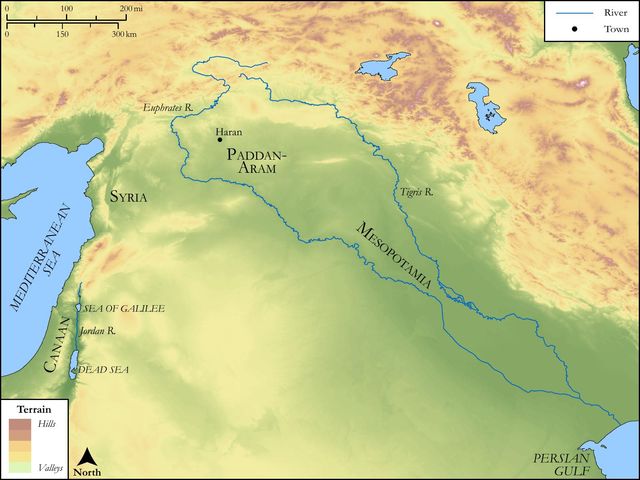
See on the biblical-era maps


Study this verse
Public-domain commentary
Matthew Henry
From his Commentary on the Whole Bible. Henry comments on passages, not single verses — this entry covers Genesis 25:29–34. His three-level outline is real structure in the source text, so it is rendered as structure.
We have here a bargain made between Jacob and Esau about the birthright, which was Esau's by providence but Jacob's by promise. It was a spiritual privilege, including the excellency of dignity and the excellency of power, as well as the double portion, Gen 49:3. It seemed to be such a birthright as had then the blessing annexed to it, and the entail of the promise. Now see,
I.Jacob's pious desire of the birthright, which yet he sought to obtain by indirect courses, not agreeable to his character as a plain man.
It was not out of pride or ambition that he coveted the birthright, but with an eye to spiritual blessings, which he had got well acquainted with in his tents, while Esau had lost the scent of them in the field. For this he is to be commended, that he coveted earnestly the best gifts; yet in this he cannot be justified, that he took advantage of his brother's necessity to make him a very hard bargain (Gen 25:31): Sell me this day thy birthright. Probably there had formerly been some communication between them about this matter, and then it was not so great a surprise upon Esau as here it seems to be; and, it may be, Esau had sometimes spoken slightly of the birthright and its appurtenances, which encouraged Jacob to make this proposal to him. And, if so, Jacob is, in some measure, excusable in what he did to gain his point. Note, Plain men that have their conversation in simplicity and godly sincerity, and without worldly wisdom, are often found wisest of all for their souls and eternity. Those are wise indeed that are wise for another world. Jacob's wisdom appeared in two things: - 1. He chose the fittest time, took the opportunity when it offered itself, and did not let it slip. 2. Having made the bargain, he made it sure, and got it confirmed by Esau's oath: Swear to me this day, Gen 25:33. He took Esau when he was in the mind, and would not leave him a power of revocation. In a case of this nature, it is good to be sure.
II.Esau's profane contempt of the birthright, and the foolish sale he made of it.
He is called profane Esau for it (Heb 12:16), because for one morsel of meat he sold his birthright, as dear a morsel as ever was eaten since the forbidden fruit; and he lived to regret it when it was too late. Never was there such a foolish bargain as this which Esau now made; and yet he valued himself upon his policy, and had the reputation of a cunning man, and perhaps had often bantered his brother Jacob as a weak and simple man. Note, There are those that are penny-wise and pound-foolish, cunning hunters that can out-wit others and draw them into their snares, and yet are themselves imposed upon by Satan's wiles and led captive by him at his will. Again, God often chooses the foolish things of the world, by them to confound the wise. Plain Jacob makes a fool of cunning Esau. Observe the instances of Esau's folly.
1.His appetite was very strong, Gen 25:29, Gen 25:30. Poor Jacob had got some bread and pottage (Gen 25:29) for his dinner, and was sitting down to it contentedly enough, without venison, when Esau came from hunting, hungry and weary, and perhaps had caught nothing. And now Jacob's pottage pleased his eye better than ever his game had done. Give me (says he) some of that red, that red, as it is in the original; it suited his own colour (Gen 25:25), and, in reproach to him for this, he was ever afterwards called Edom, red. Nay, it should seem, he was so faint that he could not feed himself, nor had he a servant at hand to help him, but entreats his brother to feed him. Note,
(1.)Those that addict themselves to sport weary themselves for very vanity, Hab 2:13. They might do the most needful business, and gain the greatest advantages, with half the pains they take, and half the perils they run into, in pursuit of their foolish pleasures.
(2.)Those that work with quietness are more constantly and comfortably provided for than those that hunt with noise: bread is not always to the wise, but those that trust in the Lord and do good verily they shall be fed, fed with daily bread; not as Esau, sometimes feasting and sometimes fainting.
(3.)The gratifying of the sensual appetite is that which ruins thousands of precious souls: surely, if Esau was hungry and faint, he might have got a meal's meat cheaper than at the expense of his birthright; but he was unaccountably fond of the colour of this pottage, and could not deny himself the satisfaction of a mess of it, whatever it cost him. Never better can come of it, when men's hearts walk after their eyes (Job 31:7), and when they serve their own bellies: therefore look not thou upon the wine, or, as Esau, upon the pottage, when it is red, when it gives that colour in the cup, in the dish, which is most inviting, Pro 23:31. If we use ourselves to deny ourselves, we break the forces of most temptations.
2.His reasoning was very weak (Gen 25:32): Behold, I am at the point to die; and, if he were, would nothing serve to keep him alive but this pottage? If the famine were now in the land (Gen 26:1), as Dr. Lightfoot conjectures, we cannot suppose Isaac so poor, or Rebekah so bad a house-keeper, but that he might have been supplied with food convenient, other ways, and might have saved his birthright: but his appetite has the mastery of him; he is in a longing condition, nothing will please him but this red this red pottage, and, to palliate his desire, he pretends he is at the point to die. If it had been so, was it not better for him to die in honour than to live in disgrace, to die under a blessing than to live under a curse? The birthright was typical of spiritual privileges, those of the church of the first-born. Esau was now tried how he would value them, and he shows himself sensible only of present grievances; may he but get relief against them, he cares not for his birthright. Better principled was Naboth, who would lose his life rather than sell his vineyard, because his part in the earthly Canaan signified is part in the heavenly, Kg1 21:3.
(1.)If we look on Esau's birthright as only a temporal advantage, what he said had something of truth in it, namely, that our worldly enjoyments, even those we are most fond of, will stand us in no stead in a dying hour (Psa 49:6-8); they will not put by the stroke of death, nor ease the pangs nor remove the sting: yet Esau, who set up for a gentleman, should have had a greater and more noble spirit than to sell even such an honour so cheaply.
(2.)But, being of a spiritual nature, his undervaluing it was the greatest profaneness imaginable. Note, It is egregious folly to part with our interest in God, and Christ, and heaven, for the riches, honours, and pleasures, of this world, as bad a bargain as his that sold a birthright for a dish of broth.
3.Repentance was hidden from his eyes (Gen 25:34): He did eat and drink, pleased his palate, satisfied his cravings, congratulated himself on the good meal's meat he had had, and then carelessly rose up and went his way, without any serious reflections upon the bad bargain he had made, or any show of regret. Thus Esau despised his birthright; he used no means at all to get the bargain revoked, made no appeal to his father about it, nor proposed to his brother to compound the matter; but the bargain which his necessity had made (supposing it were so) his profaneness confirmed ex post facto - after the deed; and by his subsequent neglect and contempt he did, as it were, acknowledge a fine, and by justifying himself in what he had done he put the bargain past recall. Note, People are ruined, not so much by doing what is amiss, as by doing it and not repenting of it, doing it and standing to it.
Continue studying Genesis 25:29 across the web’s major study libraries — every link below opens this exact verse, chapter, or book on the destination site.
Read & Compare
 BibleGatewayThis verse in more than 200 translations and 70 languages.
 Bible.comThe YouVersion reader — hundreds of translations, reading plans, and highlights.
 ESV.orgCrossway's official English Standard Version reader.
 NET BibleThe NET translation with 60,000+ translators' notes on every rendering decision.
 STEP BibleTyndale House's free study tool — original text, vocabulary, and scholarly resources.
 BibliaLogos Bible Software's free web reader.
 USCCBThe New American Bible (Revised Edition) with the U.S. bishops' study notes.
Commentaries
 BibleHub CommentariesDozens of classic commentaries on this verse, gathered on one page.
 StudyLightMore than 100 commentary sets — the largest collection on the web.
 BibleRefPlain-English commentary on what this verse means, verse by verse.
 Enduring WordDavid Guzik's free commentary on this chapter, widely used by Bible teachers.
 Bible Study ToolsVerse commentary alongside Greek and Hebrew study aids.
Original Language & Research
- BibleHub InterlinearThe verse word by word — original language, transliteration, and English.
- BibleHub LexiconEvery word's original-language definition and Strong's entry.
 Blue Letter BibleDeep-study tools — Strong's numbers, concordance, and word studies.
 SefariaThe Hebrew text with Rashi and centuries of Jewish commentary.
Sermons, Hymns & Audio


TrulyRandomVerse is not affiliated with these sites and doesn’t control their content. They’re linked because they’re genuinely useful.
Summary
Genesis 25:29 presents a seemingly mundane domestic scene that serves as the crucial prelude to one of the Bible's most significant familial transactions. It depicts Jacob preparing a meal while his twin brother, Esau, arrives from the strenuous labor of the field, utterly exhausted and famished. This verse subtly highlights the contrasting natures and priorities of the two brothers, setting the stage for Esau's impulsive decision to trade his invaluable birthright for immediate gratification, thereby initiating a narrative thread of divine election, human choice, and profound consequences that reverberates throughout redemptive history.
Context
ShowHideLiterary Context
This verse is strategically placed within the narrative of Jacob and Esau's early lives, immediately following the description of their contrasting personalities and occupations in Genesis 25:27-28. While Esau is portrayed as a "cunning hunter, a man of the field," Jacob is characterized as a "plain man, dwelling in tents." The domestic scene of Jacob preparing food and Esau returning "faint" from the field directly sets up the pivotal exchange of the birthright in Genesis 25:30-34, making this verse the dramatic fulcrum upon which the subsequent narrative hinges. It is the moment where their differing characters are put to the ultimate test, revealing their true values.
Historical & Cultural Context
Among the patriarchs, the birthright (Hebrew: bekorah) was a highly significant institution, granting the firstborn son a double portion of the inheritance, leadership of the family, and a special spiritual blessing from the patriarch. This was not merely a material advantage but a position of honor, authority, and covenantal privilege. The act of "sodding pottage" (boiling stew) points to the simple, often communal, meals common in nomadic and semi-nomadic societies. Esau's "faintness" from the field underscores the physical demands of hunting and the immediate, overwhelming nature of hunger, which in a culture without readily available food, could lead to desperate measures. The value placed on a meal versus a sacred inheritance would have been starkly understood by the original audience.
Key Themes
ShowHideGenesis 25:29 introduces and develops several key themes that permeate the book of Genesis and beyond. Firstly, it highlights the contrast between immediate gratification and long-term spiritual value, a theme profoundly explored in Esau's subsequent actions. Secondly, it subtly introduces the theme of divine sovereignty versus human responsibility, as God's prior declaration that "the elder shall serve the younger" (Genesis 25:23) begins to unfold through the choices made by the individuals. Thirdly, it underscores the consequences of choices, particularly those made under duress or driven by carnal desires, setting the stage for the complex and often challenging relationship between the twin brothers and their descendants.
Exposition and Analysis
ShowHideKey Word Analysis
ShowHideA primitive root meaning "to seethe" or "to boil." Figuratively, it can also mean "to be insolent" or "to be proud." In this context, it refers to Jacob's act of cooking or boiling a meal, specifically the pottage. The dual meaning, though not directly applicable to Jacob's cooking here, hints at the underlying "presumptuous" or "insolent" nature of the subsequent transaction, where Jacob will presumptuously seek to acquire what is not rightfully his by birth.
Derived from the root zûwd, meaning "something boiled" or "soup." This refers to the stew or lentil soup that Jacob was preparing. The simplicity and commonness of this dish stand in stark contrast to the immense value of the birthright for which it is later exchanged, making the "pottage" a powerful symbol of temporal, fleeting satisfaction.
From a root meaning "to be languid." It describes Esau's physical state of being "weary," "exhausted," or "famished" from his labors in the field. This word emphasizes the severity of his hunger and physical depletion, which significantly impaired his judgment and made him vulnerable to Jacob's proposition. His "faintness" is not merely tiredness but a deep, debilitating hunger that overrides rational thought and long-term perspective.
Verse Breakdown
ShowHide"And Jacob sod pottage"
This clause establishes Jacob's domestic activity, portraying him as a "plain man, dwelling in tents" (Genesis 25:27). The preparation of food, particularly a simple stew, highlights his immediate practicality and perhaps his foresight in having sustenance ready. This seemingly innocuous action becomes the catalyst for the dramatic events that follow, revealing Jacob's opportunistic nature.
"and Esau came from the field"
This describes Esau's return from his hunting expedition, aligning with his characterization as a "cunning hunter, a man of the field" (Genesis 25:27). His return signifies the end of his strenuous labor and brings him into the domestic sphere, where his physical needs will be confronted by Jacob's prepared meal.
"and he [was] faint"
This critical phrase describes Esau's physical condition. The word "faint" conveys extreme exhaustion and profound hunger, bordering on collapse. This state of desperation is crucial to understanding why Esau would so readily devalue his birthright. His immediate physical need overrides any consideration of long-term spiritual or familial inheritance, setting the stage for his impulsive and regrettable decision.
Literary Devices
ShowHideThe verse employs several significant literary devices. Contrast is immediately evident in the juxtaposed activities and states of the brothers: Jacob, the domestic preparer of food, versus Esau, the weary hunter returning from the wild. This contrast highlights their differing characters and priorities. Foreshadowing is powerfully at play, as Esau's "faintness" and Jacob's "pottage" are not just descriptive details but direct precursors to the momentous exchange of the birthright, signaling the impending conflict and the eventual reversal of roles. The "pottage" itself functions as Symbolism, representing immediate, fleeting gratification in stark opposition to the enduring, spiritual value of the birthright. This simple meal becomes the tangible object around which a profound theological lesson about valuing the eternal over the temporal is built.
Theological and Thematic Connections
ShowHideGenesis 25:29 serves as a theological anchor, illustrating the profound consequences of valuing immediate gratification over enduring spiritual inheritance. Esau's physical faintness leads to a spiritual blindness, where he despises a sacred covenantal blessing for a momentary physical comfort. This narrative powerfully warns against the human tendency to prioritize the temporal and carnal over the eternal and spiritual, demonstrating how fleeting desires can lead to irreversible loss of divine favor and blessing. It underscores the importance of discernment, patience, and a deep appreciation for God's promises, even when faced with pressing immediate needs.
Reflection and Application
ShowHideThe scene in Genesis 25:29 offers a profound mirror for self-reflection, challenging us to honestly assess what we truly value in life. Esau's desperate hunger led him to make a permanent, regrettable decision for a temporary fix. This compels us to consider our own "faint" moments – times of intense desire, exhaustion, or pressure – and how we respond. Are we prone to sacrificing long-term spiritual growth, ethical integrity, or relational health for immediate gratification, fleeting pleasures, or momentary relief? The narrative calls us to cultivate patience, spiritual discernment, and a deep appreciation for our spiritual inheritance in Christ. It urges us to prioritize God's promises and eternal blessings above all worldly comforts and carnal cravings, learning from Esau's tragic exchange to make choices that honor our true, lasting inheritance.
Questions for Reflection
ShowHideFAQ
ShowHideWhat was a "birthright" in ancient Israelite culture?
ShowHideIn the culture of the patriarchs and of Israel, the birthright (Hebrew: bekorah) was the special privilege and inheritance of the firstborn son. It typically included a double portion of the father's inheritance, leadership of the family after the father's death, and often, a spiritual blessing or priestly role. For Esau, as Isaac's firstborn, it also carried the covenant promises made to Abraham, making it a profoundly significant spiritual and familial inheritance, not merely a material one.
Why is Esau later called a "profane person" in the New Testament?
ShowHideThe New Testament in Hebrews 12:16 refers to Esau as a "profane person" because he treated his sacred birthright, which included spiritual and covenantal significance, with contempt by exchanging it for a mere meal. His actions demonstrated a profound disregard for the spiritual blessings and a prioritization of immediate physical gratification over his God-given inheritance. To be "profane" means to treat something holy or sacred as common or unholy, which is precisely what Esau did by despising his unique position and the promises attached to it.
Christ-Centered Fulfillment
ShowHideThe narrative of Esau's despising of his birthright for a bowl of pottage in Genesis 25:29 finds its ultimate Christ-centered fulfillment in the profound contrast between Esau's shortsightedness and Christ's unwavering commitment to His divine mission and our eternal inheritance. Unlike Esau, who traded a sacred privilege for fleeting satisfaction, Jesus, though "in the form of God, did not count equality with God a thing to be grasped, but emptied himself, by taking the form of a servant" (Philippians 2:6-7). He never succumbed to the "faintness" of human temptation, even when famished in the wilderness, refusing to turn stones into bread (Matthew 4:3-4). Instead, He, the true Firstborn over all creation (Colossians 1:15), willingly endured the ultimate sacrifice on the cross, not to gain an inheritance for Himself, but to secure an imperishable, undefiled, and unfading inheritance for all who believe (1 Peter 1:4). Through His perfect obedience and sacrificial death, Christ became the means by which we, who were once alienated, are adopted as sons and daughters, becoming co-heirs with Him in God's eternal kingdom (Romans 8:17). Thus, Esau's tragic choice serves as a stark foil, illuminating the immeasurable value of the spiritual birthright secured for us by our faithful and self-sacrificing Savior.