


Genesis 24:57
Bible text: King James Version (1769 Blayney text) · Public domain
Bible text: Berean Standard Bible · Public domain
Bible text: American Standard Version (1901) · Public domain
Bible text: World English Bible, Messianic edition · Public domain
Bible text: Geneva Bible (1599) · Public domain
Bible text: Young's Literal Translation · Public domain
- וַיֹּאמְרוּvai·yo·me·Ruand they saidH559Conj-w ¦ V-Qal-ConsecImperf-3mpVerb Qal Consecutive Imperfect 3rd Plural Masculineוַandיֹּאמְרוּthey said
- נִקְרָאnik·Ra'let us summonH7121V-Qal-Imperf-1cpVerb Qal Imperfect 1st Plural common gender
- לַנַּעֲרָla·na·'a·Ra<to> the young womanH5291Prep-l ¦ N-fsNoun Singular Feminine Absoluteלַ<to> theנַּעֲרָyoung woman
- וְנִשְׁאֲלָהve·nish·'a·Lahand let us askH7592Conj-w ¦ V-Qal-Imperf-1cpVerb Qal Imperfect 1st Plural common genderוְandנִשְׁאֲלָהlet us ask
- אֶת'et<obj.>H853DirObjMParticle Object Indicator
- פִּיהָPi·haher mouthH6310N-msc ¦ 3fsNoun Singular Masculine Constructפִּיmouthהָher
English is a literal word-by-word gloss of the Hebrew, not the KJV's wording. Why?
This is the original text the KJV's translators worked from — each Hebrew word with its own literal English meaning in this verse, prepared by scholars at Tyndale House, Cambridge. The KJV translates whole sentences, not word by word, so its wording differs: one Hebrew word can become several English words, and the KJV may choose “the LORD” where the gloss reads “Yahweh”. Both are faithful — they answer different questions. For the KJV's own rendering, switch to the KJV text.
Details
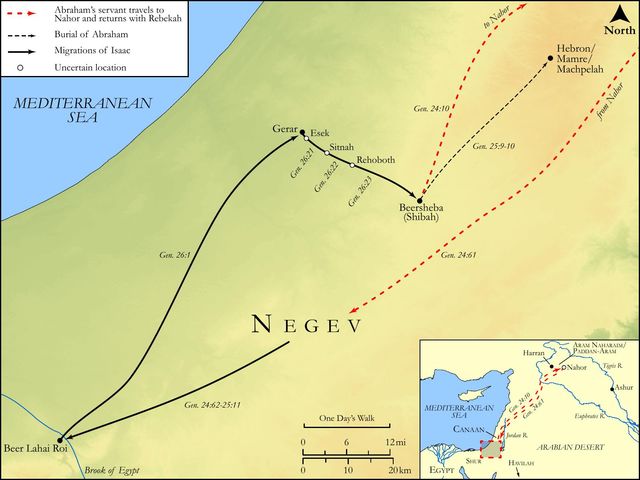
See on the biblical-era maps


Study this verse
Public-domain commentary
Matthew Henry
From his Commentary on the Whole Bible. Henry comments on passages, not single verses — this entry covers Genesis 24:54–61.
Rebekah is here taking leave of her father's house; and 1. Abraham's servant presses for a dismission. Though he and his company were very welcome, and very cheerful there, yet he said, Send me away (Gen 24:54), and again, Gen 24:56. He knew his master would expect him home with some impatience; he had business to do at home which wanted him, and therefore, as one that preferred his work before his pleasure, he was for hastening home. Note, Lingering and loitering no way become a wise and good man; when we have despatched our business abroad we must not delay our return to our business at home, nor be longer from it than needs must; for as a bird that wanders from her nest so is he that wanders from his place, Pro 27:8. 2. Rebekah's relations, from natural affection and according to the usual expression of kindness in that case, solicit for her stay some time among them, Gen 24:55. They could not think of parting with her on a sudden, especially as she was about the remove so far off and it was not likely that they would ever see one another again: Let her stay a few days, at least ten, which makes it as reasonable a request as the reading in the margin seems to make it unreasonable, a year, or at least ten months. They had consented to the marriage, and yet were loth to part with her. Note, It is an instance of the vanity of this world that there is nothing in it so agreeable but it has its alloy. Nulla est sincera voluptas - There is no unmingled pleasure. They were pleased that they had matched a daughter of their family so well, and yet, when it came to the last, it was with great reluctance that they sent her away. 3. Rebekah herself determined the matter. To her they appealed, as it was fit they should (Gen 24:57): Call the damsel (who had retired to her apartment with a modest silence) and enquire at her mouth. Note, As children ought not to marry without their parents' consent, so parents ought not to marry them without their own. Before the matter is resolved on, "Ask at the damsel's mouth;" she is a party principally concerned, and therefore ought to be principally consulted. Rebekah consented, not only to go, but to go immediately: I will go, Gen 24:58. We may hope that the notice she had taken of the servant's piety and devotion gave her such an idea of the prevalence of religion and godliness in the family she was to go to made her desirous to hasten thither, and willing to forget her own people and her father's house, where religion had not so much the ascendant. 4. Hereupon she is sent away with Abraham's servant; not, we may suppose, the very next day after, but very quickly: her friends see that she has a good heart on it, and so they dismiss her, (1.) With suitable attendants - her nurse (Gen 24:59), her damsels, Gen 24:61. It seems, then, that when she went to the well for water it was not because she had not servants at command, but because she took a pleasure in works of humble industry. Now that she was going among strangers, it was fit she should take those with her with whom she was acquainted. Here is nothing said of her portion. Her personal merits were a portion in her, she needed none with her, nor did that ever come into the treaty of marriage. (2.) With hearty good wishes: They blessed Rebekah, Gen 24:60. Note, When our relations are entering into a new condition, we ought by prayer to recommend them to the blessing and grace of God. Now that she was going to be a wife, they prayed that she might be a mother both of a numerous and of a victorious progeny. Perhaps Abraham's servant had told them of the promise God had lately made to his master, which it is likely, Abraham acquainted his household with, that God would multiply his seed as the stars of heaven, and that they should possess the gate of their enemies (Gen 22:17), to which promise they had an eye in this blessing, Be thou the mother of that seed.
Continue studying Genesis 24:57 across the web’s major study libraries — every link below opens this exact verse, chapter, or book on the destination site.
Read & Compare
 BibleGatewayThis verse in more than 200 translations and 70 languages.
 Bible.comThe YouVersion reader — hundreds of translations, reading plans, and highlights.
 ESV.orgCrossway's official English Standard Version reader.
 NET BibleThe NET translation with 60,000+ translators' notes on every rendering decision.
 STEP BibleTyndale House's free study tool — original text, vocabulary, and scholarly resources.
 BibliaLogos Bible Software's free web reader.
 USCCBThe New American Bible (Revised Edition) with the U.S. bishops' study notes.
Commentaries
 BibleHub CommentariesDozens of classic commentaries on this verse, gathered on one page.
 StudyLightMore than 100 commentary sets — the largest collection on the web.
 BibleRefPlain-English commentary on what this verse means, verse by verse.
 Enduring WordDavid Guzik's free commentary on this chapter, widely used by Bible teachers.
 Bible Study ToolsVerse commentary alongside Greek and Hebrew study aids.
Original Language & Research
- BibleHub InterlinearThe verse word by word — original language, transliteration, and English.
- BibleHub LexiconEvery word's original-language definition and Strong's entry.
 Blue Letter BibleDeep-study tools — Strong's numbers, concordance, and word studies.
 SefariaThe Hebrew text with Rashi and centuries of Jewish commentary.
Sermons, Hymns & Audio


TrulyRandomVerse is not affiliated with these sites and doesn’t control their content. They’re linked because they’re genuinely useful.
Summary
Genesis 24:57 marks a pivotal moment in the unfolding narrative of Isaac and Rebekah, capturing the decision of Rebekah's family to directly consult her regarding her immediate departure to become Isaac's wife. This verse uniquely underscores the significance of individual consent within a divinely orchestrated plan, even amidst the prevailing ancient custom of arranged marriages, highlighting a remarkable respect for personal agency.
Context
ShowHideLiterary Context
This verse is situated at a critical juncture following Abraham's servant's successful mission to find a wife for Isaac from Abraham's kin. The servant, guided by divine providence, identified Rebekah at the well, a moment detailed in Genesis 24:15-27. After revealing his purpose and presenting gifts, Rebekah's family, including Laban and Bethuel, acknowledged the Lord's clear hand in the matter, declaring, "The thing proceeds from the LORD" (Genesis 24:50). Despite this divine affirmation, the family initially sought to delay Rebekah's departure for "some days, at the least ten" (Genesis 24:55), prompting the servant's urgent plea to return to Abraham without delay (Genesis 24:56). It is in response to this tension between the family's desire for delay and the servant's urgency that the family makes the crucial decision to involve Rebekah herself in the final choice regarding her immediate departure.
Historical & Cultural Context
Among the patriarchs, marriages were typically arranged by the families, often without direct consultation of the prospective bride, especially regarding her immediate departure. The father or male head of the household held ultimate authority in such matters, as seen in various biblical accounts and extra-biblical texts. While a bride's consent might sometimes be implied or assumed, a direct, verbal inquiry about her immediate willingness to leave was not a universal custom. The act of "enquiring at her mouth" in Genesis 24:57 therefore stands out as unusual: when her brother and mother wished to delay, the question of her immediate departure was put to Rebekah herself. This unusual consultation highlights the unique nature of the covenantal lineage and God's particular involvement in this foundational marriage.
Key Themes
ShowHideThis verse contributes significantly to several overarching themes within Genesis 24 and the broader Abrahamic narrative. Primarily, it underscores the theme of Divine Providence and Human Agency, illustrating how God's sovereign plan unfolds through and respects human choices. The entire chapter is a testament to God's meticulous guidance in fulfilling His promises to Abraham, as seen in the servant's prayer and its immediate answer (Genesis 24:12-27). Yet, even within this divine orchestration, the family's decision to consult Rebekah highlights the Value of Consent and Individual Dignity. This act elevates Rebekah's status beyond a mere transactional object, demonstrating that her willing participation is integral to the divine blueprint. It also subtly introduces the theme of Departure and New Beginnings, as Rebekah's "yes" will signify her complete severance from her past life and embrace of a new destiny within the covenant community.
Exposition and Analysis
ShowHideKey Word Analysis
ShowHideA primitive root meaning "to say," used with great latitude. In this context, it signifies a decisive declaration by Rebekah's family (Laban and Bethuel) after their discussion with Abraham's servant. It conveys their collective agreement to a course of action, shifting from their previous desire for delay to a new approach involving Rebekah's direct input.
The feminine form of "youth" or "young man," referring to a girl from infancy to adolescence. This term emphasizes Rebekah's youth and perhaps her relative inexperience, making the family's decision to consult her directly even more remarkable. It highlights that even a young woman's voice was deemed important in this divinely significant matter.
A primitive root meaning "to inquire," "to request," or "to demand." Here, it signifies a direct and formal solicitation of Rebekah's opinion or decision. The use of this word underscores the intentionality behind seeking her personal input, not merely informing her of a decision, but actively asking for her response.
Verse Breakdown
ShowHide"And they said"
This phrase refers to Laban and Bethuel, Rebekah's brother and father, who had been negotiating with Abraham's servant. Their collective declaration marks a turning point in the discussion, indicating a shift in their approach from merely asserting their family's wishes (for Rebekah to stay longer) to acknowledging the need for Rebekah's direct involvement. It signifies a consensus among the male decision-makers to defer to Rebekah's personal will in this specific, crucial matter.
"We will call the damsel"
This clause describes the immediate action they intend to take. "Calling" her implies bringing her into their presence for a formal consultation, elevating the moment from a casual conversation to a significant family council. The term "damsel" (naʻărâh) emphasizes her status as a young woman, highlighting the unusual nature of her being directly consulted in such a weighty decision within that cultural context.
"and enquire at her mouth"
This is the most significant phrase, literally meaning "to ask from her mouth" (Hebrew: sha'al be-fiha). It emphasizes the directness and personal nature of the inquiry. They are not asking about her, or making a decision for her, but seeking her own verbal response. This signifies a remarkable degree of respect for her autonomy and personal consent, especially given the patriarchal societal norms of the time. Her "mouth" represents her voice, her will, and her personal agency.
Literary Devices
ShowHideThe verse employs Emphasis through the direct and specific phrasing "enquire at her mouth," highlighting the unusual and significant act of seeking Rebekah's personal verbal consent. This phrase draws attention to her individual agency in a society where women's voices were often not directly solicited in such matters. There is also an element of Divine Intervention implicitly at play; while not explicitly stated, the family's decision to consult Rebekah, contrary to typical custom, can be seen as part of God's overarching plan to ensure Rebekah's willing participation in the covenant lineage. This unusual action underscores the Symbolism of Rebekah's choice, representing not merely a personal decision but a foundational step in the unfolding of God's redemptive history, requiring a willing heart.
Theological and Thematic Connections
ShowHideThe family's decision to consult Rebekah in Genesis 24:57 beautifully illustrates the profound interplay between divine sovereignty and human free will. While God's providence meticulously orchestrates the events of the entire chapter to bring Rebekah to Isaac, He does not bypass or coerce human agency. Instead, the divine plan unfolds through the willing choices and consent of individuals. This highlights a theological truth: God invites participation rather than demanding blind obedience, honoring the dignity and choices of His human agents even within His predetermined will. This principle underscores that true faith involves a willing response to God's call, making our choices meaningful and our participation in His kingdom a matter of genuine commitment.
Reflection and Application
ShowHideThe decision to consult Rebekah in Genesis 24:57 offers profound and enduring principles for contemporary life. It serves as a powerful reminder of the indispensable importance of respecting individual autonomy and consent, particularly in life-altering decisions such as marriage, career paths, or significant commitments. This biblical narrative challenges us to move beyond assumptions or impositions, calling us instead to engage in open, direct, and respectful communication. It teaches us to ensure that all parties involved have an authentic voice, are heard, and are able to offer their willing and uncoerced participation. This principle extends beyond personal relationships to how we approach leadership, mentorship, and even spiritual guidance, recognizing that true influence invites rather than dictates. Ultimately, it reflects God's own character, as He, in His infinite wisdom and love, invites us into a relationship of willing participation in His grand redemptive plan, honoring our choices even as He sovereignly works all things for His purposes.
Questions for Reflection
ShowHideFAQ
ShowHideWhy was Rebekah's consent so important in an arranged marriage culture?
ShowHideWhile arranged marriages were common among the patriarchs, Genesis 24:57 highlights a unique emphasis on Rebekah's personal consent because her departure was immediate, final, and symbolized a complete severance from her family of origin to embark on a new life in an unknown land with a man she had never met. Her willing participation was crucial not only for the success of the union but, more significantly, for the fulfillment of God's covenantal promises through Isaac. This act underscores a divine principle that even within a pre-determined plan, individual will and choice are honored, making her a willing participant in God's redemptive history.
Does this verse suggest women had more autonomy in ancient times than commonly thought?
ShowHideGenesis 24:57 suggests that while patriarchal structures were indeed dominant, there were specific circumstances where women's voices and consent held significant weight, particularly in matters directly affecting their person and future. This instance does not negate the broader societal context of the time but rather presents a noteworthy example of individual agency within it. It is likely influenced by the extraordinary nature of the divine hand guiding the entire narrative of Isaac's marriage, elevating the importance of Rebekah's personal willingness as a key component of God's plan for His covenant people.
Christ-Centered Fulfillment
ShowHideThe narrative of Abraham's faithful servant dispatched by the father to seek a bride for Isaac, culminating in Rebekah's willing consent in Genesis 24:57 and her immediate "I will go" in Genesis 24:58, serves as a profound type of Christ and His Church. Just as the servant was sent by the father to find a bride for the son, the Holy Spirit (the "Helper" promised in John 14:26) is at work in the world, calling out and preparing a bride—the Church—for Jesus Christ, the ultimate Son. Rebekah's willing departure from her homeland and family to unite with Isaac, whom she had not yet seen, beautifully mirrors the Church's faith-filled response to Christ's call. Believers, by faith, leave behind their old ways and the world's allure (2 Corinthians 5:17) to enter into a covenant relationship with the unseen Christ (1 Peter 1:8-9). Her consent underscores the voluntary nature of salvation and the profound covenant relationship between Christ and His people, a union founded not on coercion but on mutual love, willing commitment, and the Spirit's persuasive work, preparing a glorious Church for her Bridegroom (Ephesians 5:25-27).