


Exodus 9:22
Bible text: King James Version (1769 Blayney text) · Public domain
Bible text: King James Version with Strong's numbers · Public domain
Bible text: Berean Standard Bible · Public domain
Bible text: American Standard Version (1901) · Public domain
Bible text: World English Bible, Messianic edition · Public domain
Bible text: Geneva Bible (1599) · Public domain
Bible text: Young's Literal Translation · Public domain
- וַיֹּאמֶרvai·Yo·merand he saidH559Conj-w ¦ V-Qal-ConsecImperf-3msVerb Qal Consecutive Imperfect 3rd Singular Masculineוַandיֹּאמֶרhe said
- יְהוָהYah·wehYahwehH3068N-properNoun Proper Title
- אֶל'eltoH413PrepPreposition
- מֹשֶׁהmo·shehMosesH4872N-proper-mNoun Proper Masculine
- נְטֵהne·Tehstretch outH5186V-Qal-Imp-2msVerb Qal Imperative 2nd Singular Masculine
- אֶת'et<obj.>H853DirObjMParticle Object Indicator
- יָדְךָya·de·Khayour handH3027N-csc ¦ 2msNoun Singular common gender Constructיָדְhandךָyour
- עַל'altoH5921PrepPreposition
- הַשָּׁמַיִםha·sha·Ma·yimthe heavensH8064Art ¦ N-mpNoun Plural Masculine Absoluteהַtheשָּׁמַיִםheavens
- וִיהִיvi·Hiso may it beH1961Conj-w ¦ V-Qal-Imperf-3msVerb Qal Imperfect 3rd Singular Masculineוִsoיהִיmay it be
- בָרָדva·RadhailH1259N-msNoun Singular Masculine Absolute
- בְּכָלbe·kholin allH3605Prep-b ¦ N-mscNoun Singular Masculine Constructבְּinכָלall
- אֶרֶץ'E·retz[the] land ofH776N-fscNoun Singular Feminine Construct
- מִצְרָיִםmitz·Ra·yimEgyptH4714N-properNoun Proper Location
- עַל'alonH5921PrepPreposition
- הָאָדָםha·'a·Damthe humankindH120Art ¦ N-msNoun Singular Masculine Absoluteהָtheאָדָםhumankind
- וְעַלve·'aland onH5921Conj-w ¦ PrepPrepositionוְandעַלon
- הַבְּהֵמָהha·be·he·Mahthe livestockH929Art ¦ N-fsNoun Singular Feminine Absoluteהַtheבְּהֵמָהlivestock
- וְעַלve·'Aland onH5921Conj-w ¦ PrepPrepositionוְandעַלon
- כָּלkolallH3605N-mscNoun Singular Masculine Construct
- עֵשֶׂב'E·sev[the] vegetation ofH6212N-mscNoun Singular Masculine Construct
- הַשָּׂדֶהha·sa·Dehthe fieldH7704Art ¦ N-msNoun Singular Masculine Absoluteהַtheשָּׂדֶהfield
- בְּאֶרֶץbe·'E·retzin [the] land ofH776Prep-b ¦ N-fscNoun Singular Feminine Constructבְּinאֶרֶץ[the] land of
- מִצְרָיִםmitz·Ra·yimEgyptH4714N-properNoun Proper Location
English is a literal word-by-word gloss of the Hebrew, not the KJV's wording. Why?
This is the original text the KJV's translators worked from — each Hebrew word with its own literal English meaning in this verse, prepared by scholars at Tyndale House, Cambridge. The KJV translates whole sentences, not word by word, so its wording differs: one Hebrew word can become several English words, and the KJV may choose “the LORD” where the gloss reads “Yahweh”. Both are faithful — they answer different questions. For the KJV's own rendering, switch to the KJV text.
Details
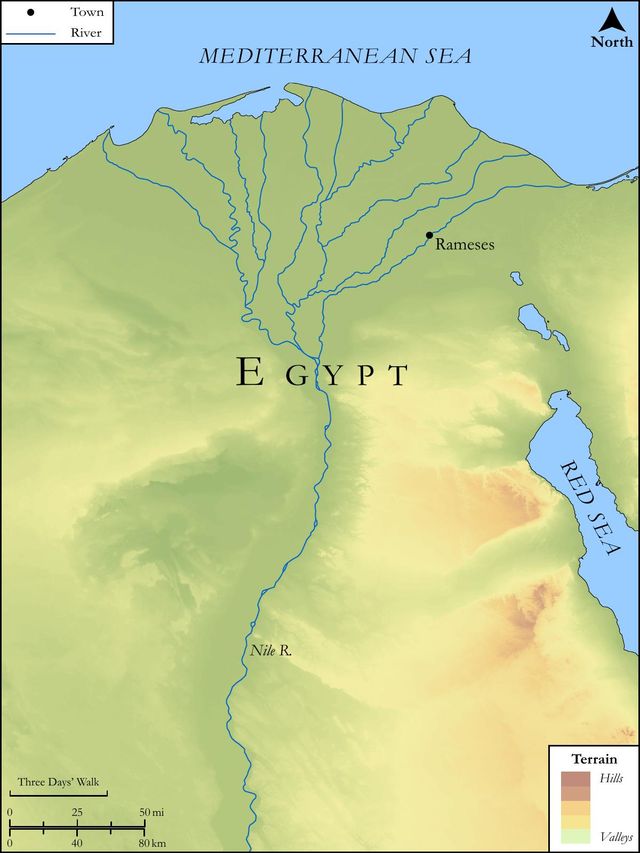
See on the biblical-era maps

Study this verse
Public-domain commentary
Matthew Henry
From his Commentary on the Whole Bible. Henry comments on passages, not single verses — this entry covers Exodus 9:22–35. His four-level outline is real structure in the source text, so it is rendered as structure.
The threatened plague of hail is here summoned by the powerful hand and rod of Moses (Exo 9:22, Exo 9:23), and it obeys the summons, or rather the divine command; for fire and hail fulfil God's word, Psa 148:8. And here we are told,
I.What desolations it made upon the earth.
The thunder, and fire from heaven (or lightning), made it both the more dreadful and the more destroying, Exo 9:23, Exo 9:24. Note, God makes the clouds, not only his store-houses whence he drops fatness on his people, but his magazines whence, when he pleases, he can draw out a most formidable train of artillery, with which to destroy his enemies. He himself speaks of the treasures of hail which he hath reserved against the day of battle and war, Job 38:22, Job 38:23. Woeful havoc this hail made in the land of Egypt. It killed both men and cattle, and battered down, not only the herbs, but the trees, Exo 9:25. The corn that was above ground was destroyed, and that only preserved which as yet had not come up, Exo 9:31, Exo 9:32. Note, God has many ways of taking away the corn in the season thereof (Hos 2:9), either by a secret blasting, or a noisy hail. In this plague the hot thunderbolts, as well as the hail, are said to destroy their flocks, Psa 78:47, Psa 78:48; and see Psa 105:32, Psa 105:33. Perhaps David alludes to this when, describing God's glorious appearances for the discomfiture of his enemies, he speaks of the hailstones and coals of fire he threw among them, Psa 18:12, Psa 18:13. And there is a plan reference to it on the pouring out of the seventh vial, Rev 16:21. Notice is here taken (Exo 9:26) of the land of Goshen's being preserved from receiving any damage by this plague. God has the directing of the pregnant clouds, and causes it to rain or hail on one city and not on another, either in mercy or in judgment.
II.What a consternation it put Pharaoh in. See what effect it had upon him,
1.He humbled himself to Moses in the language of a penitent, Exo 9:27, Exo 9:28. No man could have spoken better. He owns himself on the wrong side in his contest with the God of the Hebrews: "I have sinned in standing it out so long." He owns the equity of God's proceedings against him: The Lord is righteous, and must be justified when he speaks, though he speak in thunder and lightning. He condemns himself and his land: "I and my people are wicked, and deserve what is brought upon us." He begs the prayers of Moses: "Entreat the Lord for me, that this direful plague may be removed." And, lastly, he promises to yield up his prisoners: I will let you go. What could one desire more? And yet his heart was hardened all this while. Note, The terror of the rod often extorts penitent acknowledgments from those who have no penitent affections; under the surprise and smart of affliction, they start up, and say that which is pertinent enough, not because they are deeply affected, but because they know that they should be and that it is meet to be said.
2.Moses, hereupon, becomes an intercessor for him with God. Though he had all the reason in the world to think that he would immediately repent of his repentance, and told him so (Exo 9:30), yet he promises to be this friend in the court of heaven. Note, Even those whom we have little hopes of, yet we should continue to pray for, and to admonish, Sa1 12:23. Observe,
(1.)The place Moses chose for his intercession. He went out of the city (Exo 9:33), not only for privacy in his communion with God, but to show that he durst venture abroad into the field, notwithstanding the hail and lightning which kept Pharaoh and his servants within doors, knowing that every hail-stone had its direction from his God, who meant him no hurt. Note, Peace with God makes men thunderproof, for thunder is the voice of their Father.
(2.)The gesture: He spread abroad his hands unto the Lord - an outward expression of earnest desire and humble expectation. Those that come to God for mercy must stand ready to receive it.
(3.)The end Moses aimed at in interceding for him: That thou mayest know, and be convinced, that the earth is the Lord's (Exo 9:29), that is, that God has a sovereign dominion over all the creatures, that they all are ruled by him, and therefore that thou oughtest to be so. See what various methods God uses to bring men to their proper senses. Judgments are sent, judgments removed, and all for the same end, to make men know that he Lord reigns.
(4.)The success of it.
[1.]He prevailed with God, Exo 9:33. But,
[2.]He could not prevail with Pharaoh: He sinned yet more, and hardened his heart, Exo 9:34, Exo 9:35. The prayer of Moses opened and shut heaven, like Elias's (Jam 5:17, Jam 5:18), and such is the power of God's two witnesses (Rev 11:6); yet neither Moses nor Elias, nor those two witnesses, could subdue the hard hearts of men. Pharaoh was frightened into a compliance by the judgment, but, when it was over, his convictions vanished, and his fair promises were forgotten. Note, Little credit is to be given to confessions upon the rack. Note also, Those that are not bettered by judgments and mercies are commonly made worse.
Continue studying Exodus 9:22 across the web’s major study libraries — every link below opens this exact verse, chapter, or book on the destination site.
Read & Compare
 BibleGatewayThis verse in more than 200 translations and 70 languages.
 Bible.comThe YouVersion reader — hundreds of translations, reading plans, and highlights.
 ESV.orgCrossway's official English Standard Version reader.
 NET BibleThe NET translation with 60,000+ translators' notes on every rendering decision.
 STEP BibleTyndale House's free study tool — original text, vocabulary, and scholarly resources.
 BibliaLogos Bible Software's free web reader.
 USCCBThe New American Bible (Revised Edition) with the U.S. bishops' study notes.
Commentaries
 BibleHub CommentariesDozens of classic commentaries on this verse, gathered on one page.
 StudyLightMore than 100 commentary sets — the largest collection on the web.
 BibleRefPlain-English commentary on what this verse means, verse by verse.
 Enduring WordDavid Guzik's free commentary on this chapter, widely used by Bible teachers.
 Bible Study ToolsVerse commentary alongside Greek and Hebrew study aids.
Original Language & Research
- BibleHub InterlinearThe verse word by word — original language, transliteration, and English.
- BibleHub LexiconEvery word's original-language definition and Strong's entry.
 Blue Letter BibleDeep-study tools — Strong's numbers, concordance, and word studies.
 SefariaThe Hebrew text with Rashi and centuries of Jewish commentary.
Sermons, Hymns & Audio


TrulyRandomVerse is not affiliated with these sites and doesn’t control their content. They’re linked because they’re genuinely useful.
Summary
Exodus 9:22 introduces the devastating seventh plague upon Egypt—a catastrophic hail storm—commanded directly by the LORD to Moses. This verse serves as a powerful declaration of God's absolute sovereignty over creation, His escalating and righteous judgment against Pharaoh's persistent rebellion, and Moses's critical role as the divinely appointed agent through whom this destructive force would be unleashed, impacting every facet of Egyptian life from its people and animals to the vital agricultural fields.
Context
ShowHideLiterary Context
Exodus 9:22 is a pivotal command within the escalating narrative of the plagues, marking the transition from a series of discomforting and debilitating judgments to overtly destructive ones. Preceding this verse, Egypt had already endured six plagues: the Nile turned to blood, a proliferation of frogs, the infestation of gnats, swarms of flies, a deadly pestilence on livestock, and painful boils afflicting both Egyptians and their magicians. Despite these clear demonstrations of Yahweh's power, Pharaoh's heart remained hardened, setting the stage for even more severe and widespread judgments. Immediately following this divine decree, Exodus 9:23-26 vividly describes the terrifying execution of the hail storm, emphasizing its unprecedented severity and God's miraculous preservation of the land of Goshen, where the Israelites resided.
Historical & Cultural Context
Ancient Egypt was an agrarian society whose economic and social stability was fundamentally dependent on its fertile lands, abundant crops, and livestock. A plague of destructive hail, especially one of such unprecedented severity, represented an existential threat to their very means of survival. Beyond the physical devastation, the plagues were direct assaults on the Egyptian pantheon, designed to demonstrate the LORD's absolute supremacy over their gods. The hail plague specifically challenged deities associated with the sky, weather, and agricultural fertility, such as Nut (sky goddess), Shu (god of air), Seth (god of storms and chaos), and even Osiris (god of fertility and the underworld, whose realm included crops). The destruction of "every herb of the field" would have been particularly devastating, directly undermining the food security and economic foundation of the nation, further highlighting the futility of Pharaoh's resistance against the one true God.
Key Themes
ShowHideThis verse powerfully contributes to several overarching themes in Exodus. Firstly, it amplifies the theme of God's absolute sovereignty and power over all creation, demonstrating His ability to manipulate natural forces as instruments of His will, directly contrasting with the impotence of Egyptian deities. Secondly, it underscores the theme of divine judgment against sin and rebellion, as the escalating severity of the plagues directly correlates with Pharaoh's increasing defiance and oppression of God's people. This judgment is not arbitrary but a righteous response to injustice and idolatry, leading to the fulfillment of God's promise to deliver Israel. Thirdly, Moses's role as God's obedient agent highlights the theme of divine agency and human mediation, where God chooses and empowers individuals to carry out His purposes, even in the face of formidable opposition, as seen throughout the plague narratives (e.g., Exodus 7:19).
Exposition and Analysis
ShowHideExodus 9:22 is a concise divine command that meticulously sets the stage for one of the most destructive and terrifying plagues, revealing God's precise control and the comprehensive nature of His judgment.
Key Word Analysis
ShowHideThis term (H3068) refers to the self-Existent or Eternal God, the covenant name of God for Israel. Its presence at the beginning of the command emphasizes that this is not a random natural phenomenon but a direct, intentional act of the sovereign God, Yahweh. It underscores His unique identity as the only true God, directly challenging the polytheism of Egypt and asserting His authority over all creation and all nations.
This verb (H5186) means "to stretch or spread out," often implying a bending or extending. In this context, it describes Moses's physical action of extending his hand towards heaven. This recurring motif throughout the plague narratives signifies Moses's role not as the source of power, but as the obedient and chosen human instrument through whom God's divine power is channeled. It highlights the direct link between divine command, human obedience, and the resulting supernatural event.
This noun (H1259) refers to frozen precipitation. In the hot climate of Egypt, a severe hailstorm would have been an incredibly rare and terrifying phenomenon, immediately signaling an unnatural, supernatural event rather than a mere weather occurrence. Its destructive potential, especially when described as "fire mingled with the hail" in Exodus 9:23, underscores its nature as a potent instrument of divine judgment, specifically targeting the lifeblood of Egyptian society: its agriculture, people, and animals.
Verse Breakdown
ShowHide"¶ And the LORD said unto Moses,"
This opening clause immediately establishes the divine origin and authority behind the impending event. This is not a human initiative or a natural occurrence, but a direct, verbal command from Yahweh, the covenant God of Israel, highlighting His absolute control and intentionality in the unfolding drama of the plagues.
"Stretch forth thine hand toward heaven,"
Moses is instructed to perform a visible, symbolic action. Directing his hand "toward heaven" signifies that the judgment originates from the celestial realm, from the God who commands the very elements of the sky. This act serves as an instrumental cause, a public demonstration of Moses's role as God's mediator, channeling divine power to earth.
"that there may be hail in all the land of Egypt,"
The explicit purpose of Moses's action is stated: to bring about a specific, destructive plague. The phrase "in all the land of Egypt" emphasizes the intended widespread and comprehensive impact, signifying a judgment designed to leave no part of the nation untouched, except where God specifically chose to preserve.
"upon man, and upon beast, and upon every herb of the field, throughout the land of Egypt."
This final clause meticulously details the comprehensive targets of the hail. It would indiscriminately affect human life, animal life (crucial for labor, transportation, and food), and all vegetation (the foundational basis of their agrarian economy). The repetition of "throughout the land of Egypt" powerfully reinforces the universal, devastating scope of this judgment, indicating a direct and total assault on the very fabric of Egyptian society and livelihood.
Literary Devices
ShowHideThe verse employs divine command as its primary literary device, immediately establishing God's direct agency and absolute authority over creation and human affairs. The repetition of the phrase "all the land of Egypt" and "throughout the land of Egypt" serves to emphasize the comprehensive and inescapable nature of the impending judgment, underscoring its totality. Moses's action of "stretching forth his hand toward heaven" functions as a powerful symbolic gesture that visibly links divine power to human obedience, acting as a conduit for God's sovereign will to be executed upon the earth.
Theological and Thematic Connections
ShowHideExodus 9:22 powerfully articulates several core theological truths. Primarily, it underscores God's absolute sovereignty over creation and His ability to wield natural forces as instruments of His divine will and judgment. This plague, like those before it, demonstrates that the LORD is not merely a tribal deity but the supreme God who commands the heavens and the earth, thus challenging and utterly discrediting the false gods of Egypt associated with weather, sky, and fertility. It also highlights God's unwavering justice in response to Pharaoh's persistent rebellion and oppression of His people. The escalating severity of the plagues reveals God's patience, yet also His commitment to delivering His promises and punishing those who defy Him. Finally, Moses's obedience in stretching out his hand emphasizes the theme of divine agency, where God works through chosen human instruments to accomplish His purposes. This verse connects to the broader biblical narrative of God's covenant faithfulness and His ultimate triumph over all opposing powers. It foreshadows God's future acts of judgment against His enemies and His ultimate deliverance of His people.
Reflection and Application
ShowHideExodus 9:22 serves as a profound reminder that God is actively involved in the world, not as a distant observer, but as the sovereign Lord who orchestrates events, even those that appear to be natural disasters. For believers today, this verse reinforces trust in a God who is in ultimate control, even amidst chaos, suffering, or seemingly insurmountable challenges. It encourages us to recognize His hand in all circumstances, knowing that His purposes, though sometimes mysterious, are always just and ultimately redemptive for His people. It also serves as a solemn warning that persistent rebellion against God's will carries severe consequences, urging us to humble ourselves and obey His commands. Just as Moses faithfully stretched out his hand, we are called to be obedient agents in God's plan, trusting that His power will work through our faithfulness to bring about His will in our lives and in the world around us. This passage challenges us to consider our own posture before the Almighty: are we like Pharaoh, hardening our hearts, or like Moses, humbly submitting to His divine directives?
Questions for Reflection
ShowHideFAQ
ShowHideWhy did God use such destructive means like hail?
ShowHideGod used the plagues, including destructive hail, as a means of divine judgment to demonstrate His absolute power over Egypt's false gods and to compel Pharaoh to release the Israelites. The escalating severity was intended to break Pharaoh's stubbornness and to show both Egyptians and Israelites that the LORD alone is God, fulfilling His covenant promises to Abraham, Isaac, and Jacob. It was a necessary, powerful display to secure the deliverance of His people and to establish His name throughout the earth, as stated in Exodus 9:16.
Does God still send natural disasters today as a form of judgment?
ShowHideWhile the Bible clearly shows God using natural phenomena for specific judgment in historical contexts (like the plagues or the Flood), interpreting every modern natural disaster as a direct, specific judgment from God is complex and often misapplied. Scripture indicates that creation itself groans under the weight of sin and the curse (Romans 8:22), and natural disasters can be a consequence of a fallen world. However, they also serve as a constant reminder of God's power, the fragility of life, and our dependence on Him. They can be used by God to call people to repentance, to test and refine the faith of believers, or to reveal His glory in unexpected ways.
What is the significance of Moses stretching out his hand?
ShowHideMoses stretching out his hand is a recurring motif in the plague narratives, signifying his role as God's chosen and obedient agent. It's not that Moses himself possessed the inherent power to conjure plagues, but his physical action was the visible, human instrument through which God's divine power was channeled. This highlights that God works through human obedience and that the plagues were not random events but divinely initiated acts in response to Pharaoh's defiance, with Moses acting as the mediator of God's will. It underscores the principle that God often uses ordinary people to accomplish extraordinary purposes when they faithfully obey His commands.
Christ-Centered Fulfillment
ShowHideExodus 9:22, while describing a physical judgment in the Old Testament, finds profound Christ-centered fulfillment in several ways. The theme of God's absolute sovereignty over creation is powerfully demonstrated in Jesus Christ, who, as God incarnate, displayed ultimate authority over nature. He calmed raging storms with a mere word (Matthew 8:23-27), walked on water, and multiplied food, demonstrating that the same divine power that brought hail upon Egypt resided fully in Him. Furthermore, the plagues, including the hail, serve as a foreshadowing of God's ultimate judgment against sin and rebellion. While the hail brought physical devastation to Egypt, Jesus Christ bore the full weight of God's judgment against humanity's sin on the cross (2 Corinthians 5:21). He became the ultimate "plague" for sin, enduring the divine wrath so that those who believe in Him might be spared from eternal judgment. The deliverance of Israel from Egyptian bondage through God's mighty hand, exemplified by the plagues, points to Christ as the ultimate Deliverer from spiritual bondage to sin and death (Galatians 5:1). Just as God made a distinction between Israel and Egypt during the plagues, Christ's work on the cross establishes a new covenant, creating a people set apart from the world, protected from God's final wrath. Finally, Moses, as God's obedient agent and mediator in bringing judgment and deliverance, foreshadows Jesus Christ, the ultimate Mediator between God and humanity (1 Timothy 2:5), through whom all God's promises of salvation and judgment are perfectly fulfilled.