


Exodus 40:36
Bible text: King James Version (1769 Blayney text) · Public domain
Bible text: Berean Standard Bible · Public domain
Bible text: American Standard Version (1901) · Public domain
Bible text: World English Bible, Messianic edition · Public domain
Bible text: Geneva Bible (1599) · Public domain
Bible text: Young's Literal Translation · Public domain
- וּבְהֵעָלוֹתu·ve·he·'a·Lotand when was taken upH5927Conj-w ¦ Prep-b ¦ V-Niphal-InfVerb Niphal Infinitive Constructוּandבְwhenהֵעָלוֹתwas taken up
- הֶעָנָןhe·'a·Nanthe cloudH6051Art ¦ N-msNoun Singular Masculine Absoluteהֶtheעָנָןcloud
- מֵעַלme·'Alfrom overH5921Prep-m ¦ PrepPrepositionמֵfromעַלover
- הַמִּשְׁכָּןha·mish·Kanthe tabernacleH4908Art ¦ N-msNoun Singular Masculine Absoluteהַtheמִּשְׁכָּןtabernacle
- יִסְעוּyis·'Uthey set outH5265V-Qal-Imperf-3mpVerb Qal Imperfect 3rd Plural Masculine
- בְּנֵיbe·Nei[the] people ofH1121N-mpcNoun Plural Masculine Construct
- יִשְׂרָאֵלYis·ra·'ElIsraelH3478N-properNoun Proper Location
- בְּכֹלbe·Kholin allH3605Prep-b ¦ N-mscNoun Singular Masculine Constructבְּinכֹלall
- מַסְעֵיהֶםmas·'ei·Hemtheir journeyingsH4550N-mpc ¦ 3mpNoun Plural Masculine Constructמַסְעֵיjourneyingsהֶםtheir
English is a literal word-by-word gloss of the Hebrew, not the KJV's wording. Why?
This is the original text the KJV's translators worked from — each Hebrew word with its own literal English meaning in this verse, prepared by scholars at Tyndale House, Cambridge. The KJV translates whole sentences, not word by word, so its wording differs: one Hebrew word can become several English words, and the KJV may choose “the LORD” where the gloss reads “Yahweh”. Both are faithful — they answer different questions. For the KJV's own rendering, switch to the KJV text.
Details
See on the biblical-era maps

Study this verse
Public-domain commentary
Matthew Henry
From his Commentary on the Whole Bible. Henry comments on passages, not single verses — this entry covers Exodus 40:34–38. His two-level outline is real structure in the source text, so it is rendered as structure.
As when, in the creation, God had finished this earth, which he designed for man's habitation, he made man, and put him in possession of it, so when Moses had finished the tabernacle, which was designed for God's dwelling-place among men, God came and took possession of it. The shechinah, the divine eternal Word, though not yet made flesh, yet, as a prelude to that event, came and dwelt among them, Joh 1:14. This was henceforward the place of his throne, and the place of the soles of his feet (Eze 43:7); here he resided, here he ruled. By the visible tokens of God's coming among them to take possession of the tabernacle he testified both the return of his favour to them, which they had forfeited by the golden calf (Exo 33:7), and his gracious acceptance of all the expense they had been at, and all the care and pains they had taken about the tabernacle. Thus God owned them, showed himself well pleased with what they had done, and abundantly rewarded them. Note, God will dwell with those that prepare him a habitation. The broken and contrite heart, the clean and holy heart, that is furnished for his service, and devoted to his honour, shall be his rest for ever; here will Christ dwell by faith, Eph 3:17. Where God has a throne and an altar in the soul, there is a living temple. And God will be sure to own and crown the operations of his own grace and the observance of his own appointments.
As God had manifested himself upon mount Sinai, so he did now in this newly-erected tabernacle. We read (Exo 24:16) that the glory of the Lord abode upon mount Sinai, which is said to be like devouring fire (Exo 40:17), and that the cloud covered it on the outside, and the glory of the Lord filled it within, to which, probably there is an allusion in Zac 2:5, where God promises to be a wall of fire round about Jerusalem (and the pillar of cloud was by night a pillar of fire) and the glory in the midst of her.
I.The cloud covered the tent.
That same cloud which, as the chariot or pavilion of the shechinah, had come up before them out of Egypt and led them hither, now settled upon the tabernacle and hovered over it, even in the hottest and clearest day; for it was none of those clouds which the sun scatters. This cloud was intended to be,
1.A token of God's presence constantly visible day and night (Exo 40:38) to all Israel, even to those that lay in the remotest corners of the camp, that they might never again make a question of it, Is the Lord among us, or is he not? That very cloud which had already been so pregnant with wonders in the Red Sea, and on mount Sinai, sufficient to prove God in it of a truth, was continually in sight of all the house of Israel throughout all their journeys; so that they were inexcusable if they believed not their own eyes.
2.A concealment of the tabernacle, and the glory of God in it. God did indeed dwell among them, but he dwelt in a cloud: Verily thou art a God that hidest, thyself. Blessed be God for the gospel of Christ, in which we all with open face behold as in a glass, not in a cloud, the glory of the Lord.
3.A protection of the tabernacle. They had sheltered it with one covering upon another, but, after all, the cloud that covered it was its best guard. Those that dwell in the house of the Lord are hidden there, and are safe under the divine protection, Psa 27:4, Psa 27:5. Yet this, which was then a peculiar favour to the tabernacle, is promised to every dwelling-place of mount Zion (Isa 4:5); for upon all the glory shall be a defence.
4.A guide to the camp of Israel in their march through the wilderness, Exo 40:36, Exo 40:37. While the cloud continued on the tabernacle, they rested; when it removed, they removed and followed it, as being purely under divine direction. This is spoken of more fully, Num 9:19; Psa 78:14; Psa 105:39. As before the tabernacle was set up the Israelites had the cloud for their guide, which appeared sometimes in one place and sometimes in another, but henceforward rested on the tabernacle and was to be found there only, so the church had divine revelation for its guide from the first, before the scriptures were written, but since the making up of that canon it rests in that as its tabernacle, and there only it is to be found, as in the creation the light which was made the first day, centered in the sun the fourth day. Blessed be God for the law and the testimony!
II.The glory of the Lord filled the tabernacle, Exo 40:34, Exo 40:35.
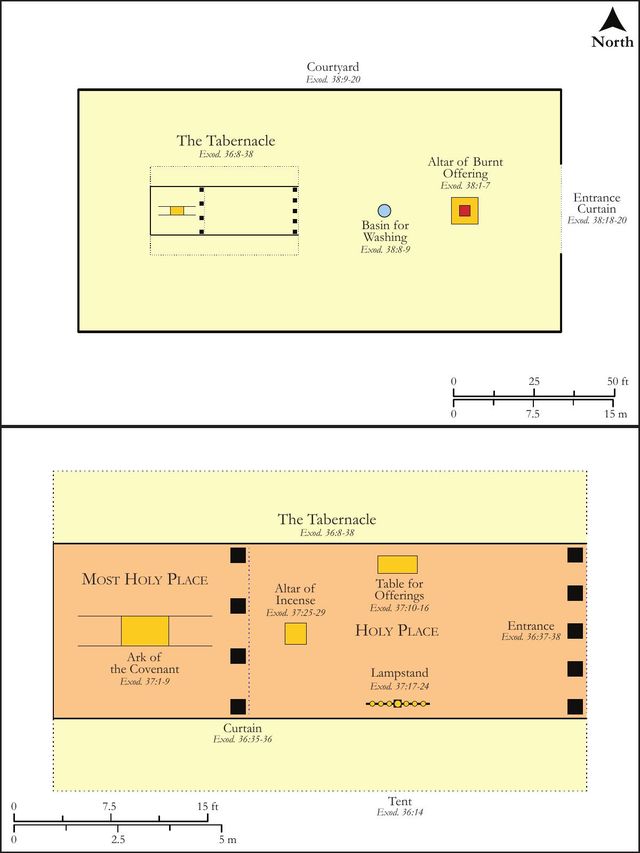
The shechinah now made an awful and pompous entry into the tabernacle, through the outer part of which it passed into the most holy place, as the presence-chamber, and there seated itself between the cherubim. It was in light and fire, and (for aught we know) no otherwise, that the shechinah made itself visible; for God is light; our God is a consuming fire. With these the tabernacle was now filled, yet, as before the bush was not consumed, so now the curtains were not so much as singed by this fire; for to those that have received the anointing the terrible majesty of God is not destroying. Yet so dazzling was the light, and so dreadful was the fire, that Moses was not able to enter into the tent of the congregation, at the door of which he attended, till the splendour had a little abated, and the glory of the Lord retired within the veil, Exo 40:35. This shows how terrible the glory and majesty of God are, and how unable the greatest and best of men are to stand before him. The divine light and fire, let forth in their full strength, will overpower the strongest heads and the purest hearts. But what Moses could not do, in that he was weak through the flesh, has been done by our Lord Jesus, whom God caused to draw near and approach, and who, as the forerunner, has for us entered, and has invited us to come boldly even to the mercy-seat. He was able to enter into the holy place not made with hands (Heb 9:24); nay, he is himself the true tabernacle, filled with the glory of God (Joh 1:14), even with the divine grace and truth prefigured by this fire and light. In him the shechinah took up its rest for ever, for in him dwells all the fulness of the godhead bodily. Blessed be God for Jesus Christ!
Continue studying Exodus 40:36 across the web’s major study libraries — every link below opens this exact verse, chapter, or book on the destination site.
Read & Compare
 BibleGatewayThis verse in more than 200 translations and 70 languages.
 Bible.comThe YouVersion reader — hundreds of translations, reading plans, and highlights.
 ESV.orgCrossway's official English Standard Version reader.
 NET BibleThe NET translation with 60,000+ translators' notes on every rendering decision.
 STEP BibleTyndale House's free study tool — original text, vocabulary, and scholarly resources.
 BibliaLogos Bible Software's free web reader.
 USCCBThe New American Bible (Revised Edition) with the U.S. bishops' study notes.
Commentaries
 BibleHub CommentariesDozens of classic commentaries on this verse, gathered on one page.
 StudyLightMore than 100 commentary sets — the largest collection on the web.
 BibleRefPlain-English commentary on what this verse means, verse by verse.
 Enduring WordDavid Guzik's free commentary on this chapter, widely used by Bible teachers.
 Bible Study ToolsVerse commentary alongside Greek and Hebrew study aids.
Original Language & Research
- BibleHub InterlinearThe verse word by word — original language, transliteration, and English.
- BibleHub LexiconEvery word's original-language definition and Strong's entry.
 Blue Letter BibleDeep-study tools — Strong's numbers, concordance, and word studies.
 SefariaThe Hebrew text with Rashi and centuries of Jewish commentary.
Sermons, Hymns & Audio


TrulyRandomVerse is not affiliated with these sites and doesn’t control their content. They’re linked because they’re genuinely useful.
Summary
Exodus 40:36 stands near the close of the Book of Exodus, vividly illustrating the divinely orchestrated system for Israel's movement through the wilderness, emphasizing their complete reliance on God's visible and sovereign guidance. This verse details how the lifting of the cloud from its resting place over the Tabernacle served as the unmistakable signal for the entire Israelite encampment to break camp and continue their journey, thereby underscoring God's constant presence, meticulous care, and absolute direction over His covenant people in every step of their pilgrimage.
Context
ShowHideLiterary Context
This verse stands within the climactic close of the Book of Exodus, immediately following the meticulous account of the Tabernacle's construction and its consecration. Exodus 40:34-35 describe the awe-inspiring moment when the Shekinah glory of the Lord filled the newly erected Tabernacle, so profoundly that even Moses could not enter. This divine indwelling signifies God's tangible commitment to dwell intimately among His people. Verses Exodus 40:36-38 then provide the practical implications of this divine presence: the cloud's movement dictated Israel's every step, serving as a continuous, visible sign of God's leading throughout their wilderness journey. This strategic placement at the book's end emphasizes that God's presence is not merely static but dynamic, actively guiding and sustaining His people, setting the stage for the narrative of their wanderings in the book of Numbers.
Historical & Cultural Context
The historical setting is the forty-year period of Israel's wilderness wanderings following their miraculous exodus from Egypt. This era was a crucible for the nascent nation, designed to forge their identity and teach them absolute reliance on Yahweh in a harsh, unforgiving environment. The miraculous cloud by day and pillar of fire by night (Exodus 13:21) was a constant, supernatural phenomenon, a visible manifestation of God's presence and leadership. In a world where nations followed earthly kings, divined signs from nature, or relied on human navigation, Israel's unique system of divine guidance set them apart as a people directly led by God. The Tabernacle itself was the central point of their vast encampment, symbolizing God's dwelling in their very midst. The cloud's movement specifically from over the Tabernacle indicated that the divine presence, which had taken up residence there, was now leading them forward, requiring the entire multitude—millions of people, their livestock, and possessions—to pack up and follow. This system fostered unity, discipline, and a deep, practical dependence on God's timing and direction for their collective survival and progress toward the Promised Land.
Key Themes
ShowHideExodus 40:36 encapsulates several profound theological and narrative themes central to the Pentateuch. Foremost is the theme of Divine Presence and Guidance, where God actively dwells among His people and meticulously directs their lives. The cloud is a tangible symbol of God's immanence and His Sovereign Providence, demonstrating His absolute control over Israel's journey, providing for their needs, and protecting them from dangers. This verse also highlights the theme of Human Dependence and Obedience, as Israel's very survival and progress were contingent upon their immediate and unwavering response to God's clear signals. Their journey was a continuous lesson in faith, teaching them to trust God's timing and direction above their own understanding, a lesson that would be reinforced throughout their wilderness experience, as seen in Numbers 9:15-23. The verse thus underscores the covenant relationship, where God faithfully leads and His people are called to faithfully follow.
Exposition and Analysis
ShowHideKey Word Analysis
ShowHideThis word (H6051) refers to a cloud (as covering the sky), specifically a nimbus or thunder-cloud. In this sacred context, however, "cloud" transcends its meteorological meaning to represent the visible, tangible manifestation of God's Shekinah glory. It signifies God's immanence, His active dwelling among His people, and His direct, sovereign control over their movements. This was not merely a natural phenomenon but a supernatural sign, a constant, miraculous reminder of God's covenant faithfulness, protective care, and guiding presence.
From the primitive root (H5927) meaning "to ascend" or "to mount." Its use here emphasizes a deliberate, visible, and unmistakable upward movement. It was not a gradual dissipation but a clear, decisive action by God, signaling the end of one encampment and the command to proceed. This precise action underscored God's clear communication and the need for Israel's immediate and discerning response, highlighting the divine initiative in their journey.
This primitive root (H5265) properly means "to pull up," especially tent-pins, thereby signifying "to start on a journey." It highlights the immediate and collective response of the Israelites to the divine signal. It implies a readiness to obey and a disciplined movement of a vast multitude, emphasizing their active participation in God's plan. Their "journeys" (H4550, maççaʻ), also derived from this root, encompass all their travels, stops, and starts, affirming God's comprehensive oversight of their entire wilderness experience.
Verse Breakdown
ShowHide"And when the cloud was taken up from over the tabernacle,"
This initial clause establishes the divine trigger for Israel's movement. The cloud, representing God's manifest presence and glory, was not static but dynamic, actively signaling God's will. Its ascent from its resting place directly above the Tabernacle served as the unequivocal command to move. This highlights God's initiative and His direct communication with His people, leaving no room for human interpretation or debate regarding the timing of their departure. It underscores that God's presence was not just a symbol of His dwelling but also the engine of their pilgrimage.
"the children of Israel went onward in all their journeys:"
This clause describes the immediate, comprehensive, and obedient response of the entire nation. Upon seeing the cloud lift, the vast encampment of Israelites, comprising millions of people, livestock, and possessions, would pack up and follow. The phrase "in all their journeys" emphasizes the totality and consistency of this pattern. Every single movement, every stop, and every start throughout their decades in the wilderness was dictated by this divine signal, illustrating their absolute dependence on God's guidance for their very survival and progress toward the Promised Land. It speaks to a disciplined faith and collective submission.
Literary Devices
ShowHideExodus 40:36 powerfully employs Symbolism, where the cloud is not merely a meteorological phenomenon but a profound symbol of God's tangible presence, His Shekinah glory, and His active guidance. It serves as a visual representation of the invisible God leading His people. The verse also utilizes Metonymy, where "the cloud" stands in for God's direct command and will; the cloud's movement is the signal from God. Furthermore, there is an element of Divine Anthropomorphism in the implied action of God "taking up" the cloud, suggesting an intentional, purposeful movement on His part to direct His people. The consistent pattern described also functions as a Leitwort (leading word/motif), with the repeated concept of "journeying" and "moving" emphasizing the dynamic nature of God's relationship with Israel and their pilgrimage towards the Promised Land. This repetition reinforces the central theme of God's unwavering guidance and Israel's continuous, responsive movement.
Theological and Thematic Connections
ShowHideThis verse profoundly underscores the themes of divine sovereignty, meticulous providence, and the absolute necessity of human dependence and obedience within the covenant relationship. God's presence was not merely a static comfort but an active, guiding force, demonstrating His unwavering commitment to lead His people through every challenge and toward His promised destination. Israel's journey was entirely contingent on God's timing and direction, teaching them that true security and progress are found not in human strength, wisdom, or strategy, but in unwavering submission to divine will. This pattern established a foundational principle of faith: God leads, and His people follow, a principle that echoes throughout biblical history and remains relevant for believers today.
Reflection and Application
ShowHideExodus 40:36 offers a timeless blueprint for the life of faith, reminding us that our spiritual journey is fundamentally one of dependence on God's leading. Just as the Israelites had no "Plan B" for their wilderness wanderings, we are called to cultivate a radical reliance on the Holy Spirit's guidance in every aspect of our lives. This means actively seeking God's will through prayer, diligent study of His Word, and discerning the promptings of the Spirit, rather than rushing ahead based on our own understanding or worldly wisdom. It also calls for patience, trusting God's perfect timing, whether He calls us to wait in a season of stillness or to move forward boldly into new territory. Our obedience is demonstrated not just by acknowledging God's voice, but by promptly and wholeheartedly responding to His direction, confident that His path is always the best path, leading us onward in our own spiritual "journeys" towards His eternal purposes. This verse challenges us to ask if we are truly following God's cloud, or if we are attempting to chart our own course.
Questions for Reflection
ShowHideFAQ
ShowHideWhat was the practical significance of the cloud's movement for the Israelites?
ShowHideThe cloud's movement was the sole and absolute determinant for all of Israel's movements throughout their wilderness journey. When the cloud rested over the Tabernacle, they encamped, sometimes for days, sometimes for months or even a year (Numbers 9:22). When it lifted, no matter the time of day or the conditions, the entire nation was commanded to pack up and follow. This system ensured that every step of their journey was divinely sanctioned, providing both security and direction in a hostile environment. It was their "GPS," their "weather forecast," and their "marching orders" all rolled into one, teaching them discipline, unity, and complete reliance on God's moment-by-moment guidance. It prevented them from making strategic errors and ensured their safety under divine protection.
Did the Israelites always obey the cloud's guidance?
ShowHideUnfortunately, no. While the system itself was perfect and God's guidance was constant, the Israelites often struggled with obedience and faith. There were instances where they complained about their circumstances (Numbers 11:1), rebelled against God's appointed leaders (Numbers 16:1-3), or even attempted to go forward without God's command, resulting in disastrous consequences (Numbers 14:44-45). These instances highlight the human tendency to stray from divine guidance, even when it is clearly manifested, underscoring the ongoing need for faith, submission, and a humble heart to truly follow God's lead.
Christ-Centered Fulfillment
ShowHideExodus 40:36, with its depiction of God's visible cloud guiding Israel through the wilderness, finds its ultimate and more profound fulfillment in Jesus Christ. While the Old Testament cloud was a temporary, external manifestation of God's presence, Christ is the very incarnation of God, the ultimate dwelling place of the divine among humanity. He is the true Tabernacle, the one in whom "the whole fullness of deity dwells bodily" (Colossians 2:9). Just as the cloud led Israel through the wilderness, Jesus, through His perfect life, authoritative teachings, atoning death, and glorious resurrection, is the divine guide for all believers, leading us on our spiritual pilgrimage from sin to salvation, from darkness to light. He declared, "I am the way, and the truth, and the life; no one comes to the Father except through me" (John 14:6). The physical guidance of the cloud is superseded by the spiritual, internal guidance of the Holy Spirit, whom Christ sent to indwell believers, promising to "guide you into all the truth" (John 16:13). Thus, the temporary, external signal of the cloud points forward to the permanent, indwelling presence of Christ through His Spirit, who continually leads us "onward" in our journey toward the heavenly Jerusalem and the ultimate promised rest in God's eternal kingdom.