


Exodus 37:20
Bible text: King James Version (1769 Blayney text) · Public domain
Bible text: Berean Standard Bible · Public domain
Bible text: American Standard Version (1901) · Public domain
Bible text: World English Bible, Messianic edition · Public domain
Bible text: Geneva Bible (1599) · Public domain
Bible text: Young's Literal Translation · Public domain
- וּבַמְּנֹרָהu·va·me·no·Rahand [were] on the lampstandH4501Conj-w ¦ Prep-b ¦ N-fsNoun Singular Feminine Absoluteוּandבַ[were] on theמְּנֹרָהlampstand
- אַרְבָּעָה'ar·ba·'AhfourH702Adj-csAdjective Numerical Singular common gender Absolute
- גְבִעִיםge·vi·'ImcupsH1375N-mpNoun Plural Masculine Absolute
- מְשֻׁקָּדִיםme·Shu·ka·Dimshaped like almond blossomsH8246V-Pual-Prtcpl-mpVerb Pual Participle Plural Masculine Absolute
- כַּפְתֹּרֶיהָkaf·to·Rei·haits bulbsH3730N-mpc ¦ 3fsNoun Plural Masculine Constructכַּפְתֹּרֶיbulbsהָits
- וּפְרָחֶיהָu·fe·ra·Chei·haand its blossomsH6525Conj-w ¦ N-mpc ¦ 3fsNoun Plural Masculine Constructוּandפְרָחֶיblossomsהָits
English is a literal word-by-word gloss of the Hebrew, not the KJV's wording. Why?
This is the original text the KJV's translators worked from — each Hebrew word with its own literal English meaning in this verse, prepared by scholars at Tyndale House, Cambridge. The KJV translates whole sentences, not word by word, so its wording differs: one Hebrew word can become several English words, and the KJV may choose “the LORD” where the gloss reads “Yahweh”. Both are faithful — they answer different questions. For the KJV's own rendering, switch to the KJV text.
Details
See on the biblical-era maps

Study this verse
Public-domain commentary
Matthew Henry
From his Commentary on the Whole Bible. Henry comments on passages, not single verses — this entry covers Exodus 37:10–24.
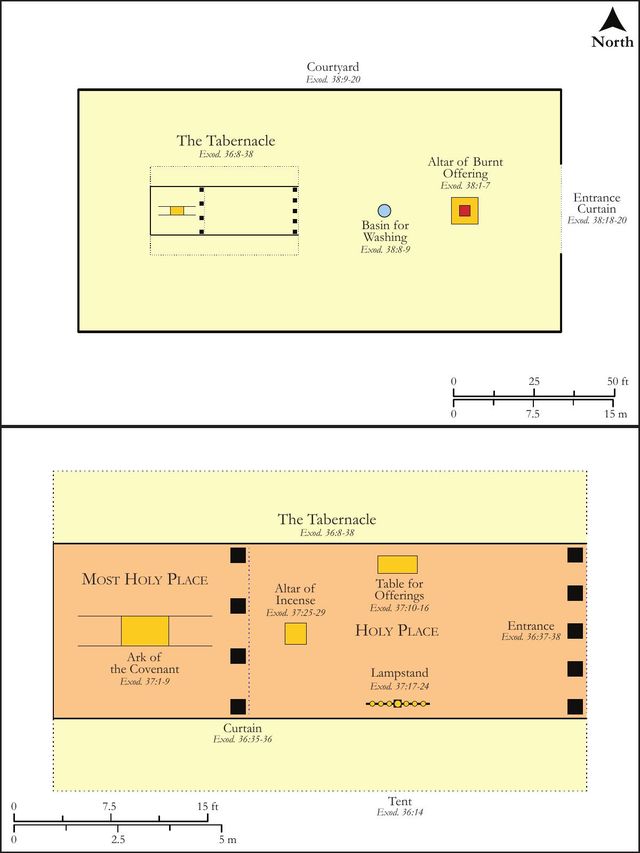
Here is, 1. The making of the table on which the show-bread was to be continually placed. God is a good householder, that always keeps a plentiful table. Is the world his tabernacle? His providence in it spreads a table for all the creatures: he provides food for all flesh. Is the church his tabernacle? His grace in it spreads a table for all believers, furnished with the bread of life. But observe how much the dispensation of the gospel exceeds that of the law. Though here was a table furnished, it was only with show-bread, bread to be looked upon, not to be fed upon, while it was on this table, and afterwards only by the priests; but to the table which Christ has spread in the new covenant all real Christians are invited guests; and to them it is said, Eat, O friends, come eat of my bread. What the law gave but a sight of at a distance, the gospel gives the enjoyment of, and a hearty welcome to. 2. The making of the candlestick, which was not of wood overlaid with gold, but all beaten work of pure gold only, Exo 37:17, Exo 37:22. This signified that light of divine revelation with which God's church upon earth (which is his tabernacle among men) has always been enlightened, being always supplied with fresh oil from Christ the good Olive, Zac 4:2, Zac 4:3. God's manifestations of himself in this world are but candle-light compared with the daylight of the future state. The Bible is a golden candlestick; it is of pure gold, Psa 19:10. From it light is diffused to every part of God's tabernacle, that by it his spiritual priests may see to minister unto the Lord, and to do the service of his sanctuary. This candlestick has not only its bowls for necessary use, but its knops and flowers for ornament; there are many things which God saw fit to beautify his word with which we can no more give a reason for than for these knops and flowers, and yet we are sure that they were added for a good purpose. Let us bless God for this candlestick, have an eye to it continually, and dread the removal of it out of its place.
Continue studying Exodus 37:20 across the web’s major study libraries — every link below opens this exact verse, chapter, or book on the destination site.
Read & Compare
 BibleGatewayThis verse in more than 200 translations and 70 languages.
 Bible.comThe YouVersion reader — hundreds of translations, reading plans, and highlights.
 ESV.orgCrossway's official English Standard Version reader.
 NET BibleThe NET translation with 60,000+ translators' notes on every rendering decision.
 STEP BibleTyndale House's free study tool — original text, vocabulary, and scholarly resources.
 BibliaLogos Bible Software's free web reader.
 USCCBThe New American Bible (Revised Edition) with the U.S. bishops' study notes.
Commentaries
 BibleHub CommentariesDozens of classic commentaries on this verse, gathered on one page.
 StudyLightMore than 100 commentary sets — the largest collection on the web.
 BibleRefPlain-English commentary on what this verse means, verse by verse.
 Enduring WordDavid Guzik's free commentary on this chapter, widely used by Bible teachers.
 Bible Study ToolsVerse commentary alongside Greek and Hebrew study aids.
Original Language & Research
- BibleHub InterlinearThe verse word by word — original language, transliteration, and English.
- BibleHub LexiconEvery word's original-language definition and Strong's entry.
 Blue Letter BibleDeep-study tools — Strong's numbers, concordance, and word studies.
 SefariaThe Hebrew text with Rashi and centuries of Jewish commentary.
Sermons, Hymns & Audio


TrulyRandomVerse is not affiliated with these sites and doesn’t control their content. They’re linked because they’re genuinely useful.
Summary
Exodus 37:20 provides a meticulous description of the Menorah, the divinely ordained seven-branched lampstand within the Tabernacle, specifically detailing the botanical ornamentation on its branches. This verse highlights "four bowls made like almonds, his knops, and his flowers," underscoring God's precise instructions for beauty, order, and symbolic richness in the sacred worship space. This intricate design points to profound theological themes of life, light, divine vitality, and God's abiding presence among His people, transforming a functional object into a vibrant symbol of spiritual truth.
Context
ShowHideLiterary Context
Exodus 37:20 is situated within the latter portion of the Book of Exodus, specifically in the detailed account of the Tabernacle's construction and the fabrication of its sacred furnishings (chapters 35-40). This section serves as the fulfillment of the exhaustive instructions God delivered to Moses on Mount Sinai in earlier chapters, particularly Exodus 25:31-40. Chapter 37 meticulously records how Bezaleel and Aholiab, the divinely gifted craftsmen introduced in Exodus 36:1-2, faithfully executed these divine blueprints. The Menorah, fashioned from a single talent of pure gold, was destined to stand in the Holy Place, serving as the sole source of illumination within that sacred chamber. The deliberate repetition of these detailed descriptions—first as divine command and then as human execution—emphatically highlights the precise, non-negotiable nature of God's requirements for worship and the profound reverence due to His sacred dwelling.
Historical & Cultural Context
The construction of the Tabernacle unfolded during Israel's formative period of wilderness wandering, a crucible for the nascent nation's identity and covenant relationship with God. The Tabernacle functioned as God's portable dwelling place, a tangible symbol of His presence, guidance, and unwavering covenant faithfulness amidst a nomadic existence. The sanctuary was made after the pattern shown to Moses in the mount, "the example and shadow of heavenly things," with its furnishings imbued with deep symbolic significance. The Menorah, as the exclusive source of light in the Holy Place—a chamber otherwise veiled in darkness and inaccessible to the common Israelite—held immense spiritual weight. Light symbolized life, truth, divine presence, and guidance, standing in stark contrast to the chaos and ignorance represented by darkness. The botanical motifs, particularly the almond, were not arbitrary decorative choices; they likely drew upon familiar natural imagery that resonated with themes of life, vitality, and even divine validation, as vividly illustrated in the later account of Aaron's rod that miraculously budded. The meticulous detail in the Menorah's design reflects the Israelite understanding that their God is a God of order, beauty, and intentionality, demanding nothing less than perfection in the symbols representing His holy presence.
Key Themes
ShowHideExodus 37:20 contributes significantly to several overarching themes within the Book of Exodus and the Pentateuch. Foremost is the theme of Divine Presence and Holiness, as the Menorah's light signifies God's dwelling among His people and the sanctity of the Tabernacle. The intricate design also emphasizes Divine Authority and Precision in Worship, demonstrating that God dictates the terms and aesthetics of His worship, leaving no room for human improvisation (Exodus 25:9). The botanical ornamentation, especially the almond, introduces the theme of Life and Vitality, linking the sacred lampstand to natural processes of growth, renewal, and fertility, thereby symbolizing God as the ultimate source of life. Furthermore, the Menorah's function as a light source in darkness reinforces the theme of Divine Revelation and Guidance, portraying God as the one who illuminates the path for His people, dispelling spiritual obscurity (Psalm 119:105). Together, these elements weave a rich tapestry of theological meaning, portraying a God who is both transcendent in His holiness and intimately present in His life-giving light.
Exposition and Analysis
ShowHideKey Word Analysis
ShowHideFrom an unused root meaning "to be convex," this term refers to a "goblet" or, by analogy, the "calyx of a flower." In the context of the Menorah, these "bowls" are not merely functional containers but are specifically shaped like the cup-like base of an almond blossom. This choice highlights the organic, botanical nature of the design, emphasizing the Menorah's symbolic connection to life and natural beauty.
Probably from an unused root meaning "to encircle," this word denotes a "chaplet," or in an architectonic sense, a "capital of a column," or a "wreath-like button or disk on the candelabrum." In the Menorah's design, "knops" represent the swelling, un-opened buds of the almond blossom. Their inclusion, alongside bowls and flowers, depicts a progression of botanical development, symbolizing nascent life and the promise of unfolding beauty and vitality.
From the verb "to bloom," this term refers to a "calyx (natural or artificial)," and generally, "bloom," "blossom," or "flower." The presence of fully opened "flowers" on the Menorah completes the botanical progression, symbolizing the flourishing of life, beauty in its prime, and the culmination of growth. Together with the bowls and knops, these elements transform the lampstand into a vibrant, living organism, emphasizing themes of life, fruitfulness, and divine vitality.
Verse Breakdown
ShowHide"And in the candlestick [were] four bowls made like almonds"
This phrase initiates the detailed description of the Menorah's ornamentation, specifying the primary decorative motif on its branches. The "bowls" (Hebrew gᵉbîyaʻ) were not simple receptacles but were meticulously crafted to resemble the calyx or cup of an almond blossom. The almond tree is significant for being one of the earliest trees to blossom in spring, often in late winter, symbolizing early life, awakening, and resurrection. The number "four" refers to the pattern repeated on each of the six side branches (three on each side) and the central shaft, indicating a total of 22 sets of almond-shaped bowls, knops, and flowers across the entire Menorah.
"his knops"
Following the almond-shaped bowls, the "knops" (Hebrew kaphtôr) represent the next developmental stage of the almond—the swelling bud just before it fully opens into a flower. This detail underscores the progression of life from its earliest, unrevealed form to its full expression. It speaks to the meticulous attention to the natural life cycle embedded within the divine design, emphasizing growth and potential.
"and his flowers"
Completing the botanical sequence, the "flowers" (Hebrew perach) signify the fully blossomed almond. This element emphasizes themes of beauty, fruitfulness, and the vibrant display of life at its peak. The combination of bowls (blossoms), knops (buds), and flowers (full blooms) on the Menorah creates a powerful visual metaphor for life, growth, and divine vitality, transforming a mere lampstand into a living, organic symbol of God's life-giving presence.
Literary Devices
ShowHideThe primary literary device at play in Exodus 37:20, and indeed throughout the description of the Menorah, is Symbolism. The entire lampstand, and specifically its almond-shaped ornamentation, is profoundly rich with symbolic meaning. The light emanating from the Menorah is symbolic of God's presence, truth, and guidance, illuminating the otherwise dark Holy Place. The almond motif is particularly potent: as one of the first trees to bloom in spring, it symbolizes new life, awakening, and resurrection, a theme powerfully reinforced later in the Old Testament with Aaron's rod that budded with almonds, signifying divine validation and life from death. The progression from "bowls made like almonds" (blossoms), to "knops" (buds), and "flowers" further enhances this symbolism of ongoing life, growth, and flourishing. The meticulous detail in the description also serves as a metaphor for God's own character: His precision, His love for beauty, and His desire for order in worship, reflecting the divine artistry in creation itself.
Theological and Thematic Connections
ShowHideExodus 37:20, in its precise description of the Menorah's ornamentation, reveals profound theological truths about God's character and His relationship with His people. It underscores His meticulous attention to detail and His desire for beauty and order in worship, indicating that every aspect of our service and devotion to Him matters. The almond motif, symbolizing life, awakening, and resurrection, powerfully points to God as the ultimate source of all life, renewal, and vitality. The Menorah's function as the sole light source in the Tabernacle further emphasizes God as the ultimate source of spiritual light and truth, guiding His people through darkness and revealing His glorious presence. This divine light is not merely functional but is intricately adorned with symbols of life, suggesting that God's truth is always life-giving, dynamic, and vibrant, inviting His people into a flourishing relationship.
Reflection and Application
ShowHideThe detailed description of the Menorah's almond-shaped bowls, knops, and flowers in Exodus 37:20 invites us to reflect deeply on the nature of God and our appropriate response to Him. God's meticulousness in outlining every detail for the Tabernacle's construction, extending even to the intricate botanical ornamentation, reminds us that He is a God who values precision, beauty, and intentionality in all things, especially in our worship and service. This divine standard challenges us to consider the quality, thoughtfulness, and intentionality we bring to every aspect of our spiritual lives, ensuring our devotion is not haphazard but heartfelt and well-ordered. Furthermore, the rich symbolism of the almond—representing new life, awakening, and resurrection—serves as a powerful reminder of God's boundless capacity for renewal, even in seemingly barren or dormant circumstances. Just as the Menorah provided essential light in a dark sacred space, we, as believers, are called to reflect the light of Christ in a world often shrouded in spiritual darkness, bearing witness to His life-giving truth and beauty in our daily interactions and through lives marked by growth and vitality.
Questions for Reflection
ShowHideFAQ
ShowHideWhy were almonds specifically chosen for the Menorah's design?
ShowHideThe choice of almonds for the Menorah's design was profoundly symbolic and intentional. Almond trees are remarkable for being among the very first trees to blossom in spring, often in late winter, signifying new life, awakening, and vitality even in seemingly dormant or barren seasons. This powerful symbolism is vividly reinforced in Numbers 17:8, where Aaron's staff miraculously blossoms and produces ripe almonds overnight, serving as divine validation of his priesthood and a sign of life from what was dead wood. Thus, the almond motif on the Menorah connected the sacred lampstand to core themes of divine life, resurrection, and God's sovereign power to bring forth life where there was none.
What is the significance of the "knops" and "flowers" alongside the "bowls made like almonds"?
ShowHideThe inclusion of "knops" (buds) and "flowers" (blossoms) alongside the "bowls made like almonds" (which also represent blossoms) is highly significant. This sequence depicts a progression of botanical life stages—from the nascent bud to the full, open bloom. This dynamic representation emphasizes the ever-unfolding nature of life and growth, transforming the Menorah from a static object into a vibrant, living symbol of flourishing life, vitality, and the continuous renewal that flows from God's presence. It suggests that God's light is not sterile or static, but is inherently life-giving, generative, and leads to spiritual fruitfulness.
Christ-Centered Fulfillment
ShowHideThe Menorah, with its intricate almond blossoms, knops, and flowers, finds its ultimate and glorious fulfillment in the person and work of Jesus Christ. As the true Light of the World, Jesus embodies the very essence that the Tabernacle's lampstand dimly foreshadowed. While the Menorah provided physical light in a confined sacred space, Jesus is the spiritual light that illumines all humanity, revealing divine truth and dispelling the darkness of sin and ignorance (John 1:4-5 and John 12:46). Furthermore, the almond motif, symbolizing new life, awakening, and resurrection, powerfully prefigures Christ's triumphant victory over death. He is the firstfruits of the resurrection, bringing forth abundant life from the barrenness of the grave, just as the almond tree blossoms early to signify life's awakening. In Him, the promise of God's life-giving presence and illuminating truth are not confined to a sacred tent but are made eternally accessible to all who believe and walk in His light. He is the living, flourishing reality to which the Menorah's botanical beauty pointed, the one through whom God's light and life eternally shine, even appearing among the lampstands in His glorified state (Revelation 1:12-13, 20 and Revelation 1:20).