


Exodus 37:19
Bible text: King James Version (1769 Blayney text) · Public domain
Bible text: King James Version with Strong's numbers · Public domain
Bible text: Berean Standard Bible · Public domain
Bible text: American Standard Version (1901) · Public domain
Bible text: World English Bible, Messianic edition · Public domain
Bible text: Geneva Bible (1599) · Public domain
Bible text: Young's Literal Translation · Public domain
- שְׁלֹשָׁהshe·lo·ShahthreeH7969Adj-csAdjective Numerical Singular common gender Absolute
- גְבִעִיםGe·vi·'imcupsH1375N-mpNoun Plural Masculine Absolute
- מְשֻׁקָּדִיםme·shu·ka·Dimshaped like almond blossomsH8246V-Pual-Prtcpl-mpVerb Pual Participle Plural Masculine Absolute
- בַּקָּנֶהba·ka·Neh[were] on the branchH7070Prep-b ¦ N-msNoun Singular Masculine Absoluteבַּ[were] on theקָּנֶהbranch
- הָאֶחָדha·'e·Chad<the> oneH259Art ¦ Adj-fsAdjective Numerical Singular Feminine Absoluteהָ<the>אֶחָדone
- כַּפְתֹּרkaf·Tora bulbH3730N-msNoun Singular Masculine Absolute
- וָפֶרַחva·fe·Rachand a blossomH6525Conj-w ¦ N-msNoun Singular Masculine Absoluteוָandפֶרַחa blossom
- וּשְׁלֹשָׁהu·she·lo·Shahand threeH7969Conj-w ¦ Adj-csAdjective Numerical Singular common gender Absoluteוּandשְׁלֹשָׁהthree
- גְבִעִיםge·vi·'ImcupsH1375N-mpNoun Plural Masculine Absolute
- מְשֻׁקָּדִיםme·shu·ka·Dimshaped like almond blossomsH8246V-Pual-Prtcpl-mpVerb Pual Participle Plural Masculine Absolute
- בְּקָנֶהbe·ka·Neh[were] on a branchH7070Prep-b ¦ N-msNoun Singular Masculine Absoluteבְּ[were] onקָנֶהa branch
- אֶחָד'e·ChadoneH259Adj-fsAdjective Numerical Singular Feminine Absolute
- כַּפְתֹּרkaf·Tora bulbH3730N-msNoun Singular Masculine Absolute
- וָפָרַחva·Fa·rachand a blossomH6525Conj-w ¦ N-msNoun Singular Masculine Absoluteוָandפָרַחa blossom
- כֵּןkenthusH3651AdvAdverb
- לְשֵׁשֶׁתle·She·shetfor [the] sixH8337Prep-l ¦ Adj-cscAdjective Numerical Singular common gender Constructלְforשֵׁשֶׁת[the] six
- הַקָּנִיםha·ka·Nimthe branchesH7070Art ¦ N-mpNoun Plural Masculine Absoluteהַtheקָּנִיםbranches
- הַיֹּצְאִיםhai·yo·tze·'Imwhich came outH3318Art ¦ V-Qal-Prtcpl-mpVerb Qal Participle Plural Masculine Absoluteהַwhichיֹּצְאִיםcame out
- מִןminfromH4480PrepPreposition
- הַמְּנֹרָהha·me·no·Rahthe lampstandH4501Art ¦ N-fsNoun Singular Feminine Absoluteהַtheמְּנֹרָהlampstand
English is a literal word-by-word gloss of the Hebrew, not the KJV's wording. Why?
This is the original text the KJV's translators worked from — each Hebrew word with its own literal English meaning in this verse, prepared by scholars at Tyndale House, Cambridge. The KJV translates whole sentences, not word by word, so its wording differs: one Hebrew word can become several English words, and the KJV may choose “the LORD” where the gloss reads “Yahweh”. Both are faithful — they answer different questions. For the KJV's own rendering, switch to the KJV text.
Details
See on the biblical-era maps

Study this verse
Public-domain commentary
Matthew Henry
From his Commentary on the Whole Bible. Henry comments on passages, not single verses — this entry covers Exodus 37:10–24.
Here is, 1. The making of the table on which the show-bread was to be continually placed. God is a good householder, that always keeps a plentiful table. Is the world his tabernacle? His providence in it spreads a table for all the creatures: he provides food for all flesh. Is the church his tabernacle? His grace in it spreads a table for all believers, furnished with the bread of life. But observe how much the dispensation of the gospel exceeds that of the law. Though here was a table furnished, it was only with show-bread, bread to be looked upon, not to be fed upon, while it was on this table, and afterwards only by the priests; but to the table which Christ has spread in the new covenant all real Christians are invited guests; and to them it is said, Eat, O friends, come eat of my bread. What the law gave but a sight of at a distance, the gospel gives the enjoyment of, and a hearty welcome to. 2. The making of the candlestick, which was not of wood overlaid with gold, but all beaten work of pure gold only, Exo 37:17, Exo 37:22. This signified that light of divine revelation with which God's church upon earth (which is his tabernacle among men) has always been enlightened, being always supplied with fresh oil from Christ the good Olive, Zac 4:2, Zac 4:3. God's manifestations of himself in this world are but candle-light compared with the daylight of the future state. The Bible is a golden candlestick; it is of pure gold, Psa 19:10. From it light is diffused to every part of God's tabernacle, that by it his spiritual priests may see to minister unto the Lord, and to do the service of his sanctuary. This candlestick has not only its bowls for necessary use, but its knops and flowers for ornament; there are many things which God saw fit to beautify his word with which we can no more give a reason for than for these knops and flowers, and yet we are sure that they were added for a good purpose. Let us bless God for this candlestick, have an eye to it continually, and dread the removal of it out of its place.
Continue studying Exodus 37:19 across the web’s major study libraries — every link below opens this exact verse, chapter, or book on the destination site.
Read & Compare
 BibleGatewayThis verse in more than 200 translations and 70 languages.
 Bible.comThe YouVersion reader — hundreds of translations, reading plans, and highlights.
 ESV.orgCrossway's official English Standard Version reader.
 NET BibleThe NET translation with 60,000+ translators' notes on every rendering decision.
 STEP BibleTyndale House's free study tool — original text, vocabulary, and scholarly resources.
 BibliaLogos Bible Software's free web reader.
 USCCBThe New American Bible (Revised Edition) with the U.S. bishops' study notes.
Commentaries
 BibleHub CommentariesDozens of classic commentaries on this verse, gathered on one page.
 StudyLightMore than 100 commentary sets — the largest collection on the web.
 BibleRefPlain-English commentary on what this verse means, verse by verse.
 Enduring WordDavid Guzik's free commentary on this chapter, widely used by Bible teachers.
 Bible Study ToolsVerse commentary alongside Greek and Hebrew study aids.
Original Language & Research
- BibleHub InterlinearThe verse word by word — original language, transliteration, and English.
- BibleHub LexiconEvery word's original-language definition and Strong's entry.
 Blue Letter BibleDeep-study tools — Strong's numbers, concordance, and word studies.
 SefariaThe Hebrew text with Rashi and centuries of Jewish commentary.
Sermons, Hymns & Audio


TrulyRandomVerse is not affiliated with these sites and doesn’t control their content. They’re linked because they’re genuinely useful.
Summary
Exodus 37:19 provides a meticulous description of the golden lampstand (Menorah) crafted for the Tabernacle, detailing the precise ornamentation of three almond-shaped bowls, a decorative bud (knop), and a flower on each of its six branches. This verse, part of the broader account of the Tabernacle's construction, underscores the divine demand for precision, beauty, and symbolic richness in the sacred furnishings dedicated to God's dwelling among His people.
Context
ShowHideLiterary Context
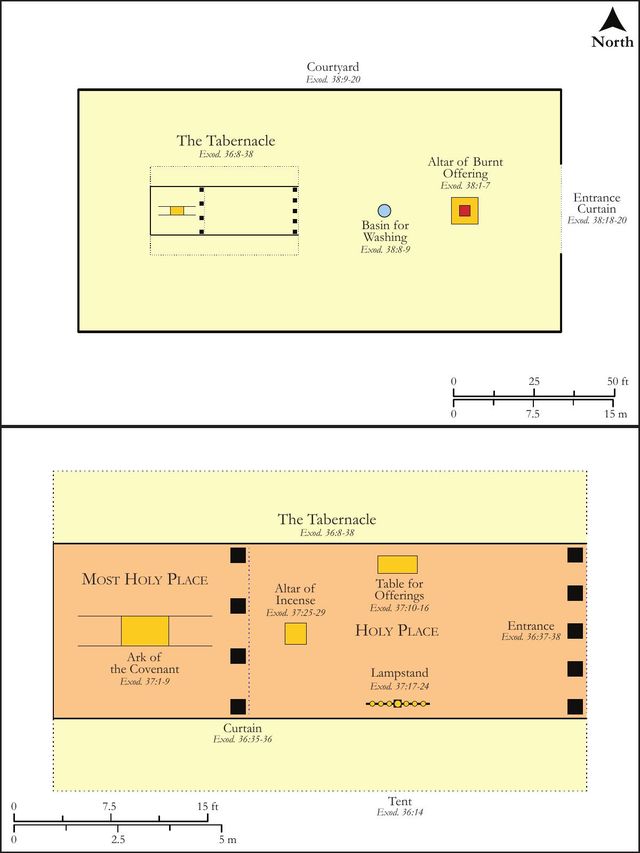
Exodus 37 is situated within the latter half of the book of Exodus, which transitions from the giving of the Law at Mount Sinai to the detailed instructions for, and subsequent construction of, the Tabernacle and its sacred implements. Specifically, this chapter recounts the faithful execution of God's blueprint by Bezalel, Oholiab, and other skilled artisans, as commanded in Exodus 35. The Menorah's design was initially revealed to Moses in Exodus 25:31-40, and Exodus 37:17-24 describes its actual fabrication, ensuring every detail matched the divine standard. This repetition and meticulous recounting emphasize the paramount importance of adherence to God's revealed will in matters of worship and the establishment of sacred space.
Historical & Cultural Context
The Tabernacle served as God's portable dwelling place among the Israelites during their wilderness wanderings, a tangible symbol of His presence and covenant faithfulness. Temples and sacred objects were adorned with elaborate designs, as the cedar of Solomon's house of the LORD was carved with knops and open flowers, reflecting the honor and reverence due to God. However, the Menorah's specific design, including the almond motif, was uniquely revealed by God, distinguishing it from pagan religious artifacts. The emphasis on pure gold and exquisite craftsmanship was not merely for aesthetic appeal but signified the holiness, preciousness, and divine origin of the object, which illuminated the Holy Place, a space where God's presence was uniquely manifested to His people, as detailed in Exodus 40.
Key Themes
ShowHideThis verse contributes significantly to several key themes prevalent in Exodus and the Pentateuch. It highlights the theme of Divine Prescription and Human Obedience, demonstrating God's meticulousness in outlining His desires for worship and the Israelites' faithful adherence to these commands. The intricate design, particularly the almond motif, reinforces the theme of Life and Divine Vigilance, as the almond tree is one of the first to blossom, symbolizing new life and God's watchful care. Furthermore, the Menorah itself, as the source of light in the Holy Place, embodies the theme of Divine Presence and Illumination, signifying God's guiding truth and illuminating presence among His people, a concept foundational to the covenant relationship established at Sinai (see Exodus 13:21).
Exposition and Analysis
ShowHideKey Word Analysis
ShowHideFrom an unused root meaning "to be convex," this term refers to a goblet or, by analogy, the calyx of a flower. In the context of the Menorah, these are cup-shaped ornaments. The verse specifies they are "made after the fashion of almonds" (from H8246 shâqad, "to be almond-shaped"), indicating a design that mimics the cup-like base of an almond blossom or the shape of the almond fruit itself. This detail suggests an organic, natural beauty integrated into the metallic structure, symbolizing life and growth.
This word likely derives from a root meaning "to encircle" and refers to a chaplet, capital of a column, or a wreath-like button/disk. On the Menorah, it represents a decorative knob or a protuberance, likely a stylized bud or a rounded ornament, positioned between the bowls and the flower. It signifies the transition from the base of the blossom (bowls) to the full bloom (flower), representing stages of growth and the unfolding of life.
From a root meaning "to blossom," this term denotes a calyx (natural or artificial) or generally, a bloom or blossom. On the Menorah, it represents the fully opened blossom, completing the sequence initiated by the "bowls" (calyx/base) and "knop" (bud). The inclusion of the flower emphasizes the theme of life, beauty, and fruitfulness inherent in the Menorah's design, reflecting the vibrancy of God's presence.
Verse Breakdown
ShowHide"Three bowls made after the fashion of almonds in one branch,"
This clause specifies the initial set of ornamentation on each of the six side branches. The "bowls" are not just generic cups but are specifically shaped to resemble almonds, highlighting the precise and symbolic nature of the design, which points to themes of life and divine watchfulness.
"a knop and a flower;"
Following the three almond-shaped bowls, each branch was to feature a "knop" (a bud-like swelling) and then a "flower" (a blossom). This sequence suggests a progression from bud to bloom, reinforcing the theme of life, growth, and the unfolding beauty inherent in the almond motif, symbolizing a complete cycle of natural development.
"and three bowls made like almonds in another branch, a knop and a flower:"
This clause emphasizes the repetitive nature of the design. The exact same pattern of three almond-shaped bowls, a knop, and a flower was to be replicated on each of the six branches, ensuring uniformity, consistency, and absolute adherence to the divine blueprint across the entire lampstand.
"so throughout the six branches going out of the candlestick."
This concluding phrase confirms that the described pattern was not unique to one or two branches but was to be applied identically to all six branches extending from the central shaft of the Menorah. This underscores the meticulous and comprehensive nature of God's instructions, leaving no room for human improvisation in the construction of His sacred dwelling.
Literary Devices
ShowHideThe verse primarily employs Repetition to emphasize the uniformity and precision required in the Menorah's construction. The phrase "three bowls made after the fashion of almonds in one branch, a knop and a flower" is repeated almost verbatim for "another branch," and then generalized to "throughout the six branches." This literary device underscores the divine demand for exact adherence to the pattern and highlights the consistency of God's design. Symbolism is profoundly present, though implicitly, as the entire Menorah, and specifically its almond-blossom design, is rich with meaning, representing life, light, watchfulness, and divine approval. The detailed description itself serves as a form of Metonymy, where the specific parts (bowls, knops, flowers) stand for the meticulousness and beauty of the whole sacred object and, by extension, the holiness and glory of God's dwelling.
Theological and Thematic Connections
ShowHideExodus 37:19, with its exacting detail for the Menorah's ornamentation, powerfully communicates God's nature as a God of order, beauty, and intentionality. Every element of the Tabernacle, down to the smallest decorative feature, was divinely prescribed, demonstrating that God cares deeply about the manner in which He is approached and worshipped. The Menorah's design, particularly the almond motif, speaks to themes of life, vigilance, and divine approval, vividly recalling how God confirmed Aaron's priestly authority through an almond-blossoming rod. This attention to detail in the earthly sanctuary foreshadows the perfection and glory of the heavenly reality it represented, pointing to a divine standard that transcends human capacity.
Reflection and Application
ShowHideThe meticulous instructions for the Menorah's design in Exodus 37:19 serve as a profound reminder that God is a God of infinite detail and intentionality. Just as He prescribed every "knop" and "flower" for His dwelling place, He orchestrates the intricate details of creation and redemption, working all things according to the counsel of His will. This should inspire us to approach our own lives and service with a similar commitment to excellence and intentionality. While we no longer construct physical tabernacles, the principle remains: our worship, our work, and our relationships should reflect the beauty, order, and excellence of the God we serve. It calls us to consider how we use our gifts and resources, ensuring they are offered with the highest quality and deepest devotion, not for human praise, but for God's glory. This verse encourages a mindful, purposeful approach to all aspects of life, recognizing that even the smallest details can honor God.
Questions for Reflection
ShowHideFAQ
ShowHideWhy was the almond chosen as a motif for the Menorah?
ShowHideThe almond was chosen for its rich symbolic meaning. The Hebrew word for almond, shaqed, is closely related to shaqad, meaning "to watch" or "to be watchful," suggesting God's constant vigilance over His covenant and His people. Furthermore, the almond tree is one of the first to blossom in spring, symbolizing new life, awakening, and divine favor. This symbolism is notably reinforced in Numbers 17:8, where Aaron's rod miraculously budded, blossomed, and produced almonds, serving as a divine confirmation of his priestly authority. Thus, on the Menorah, the almond motif likely pointed to God's watchful care, the life-giving nature of His presence, and the divinely appointed priesthood, all essential elements of the Tabernacle's purpose.
What was the overall purpose of such detailed instructions for the Tabernacle furnishings?
ShowHideThe detailed instructions for the Tabernacle and its furnishings, including the Menorah, served multiple crucial purposes. Firstly, they ensured that the sanctuary was built precisely according to God's heavenly pattern, making it a sacred space where His presence could dwell among His people (Exodus 25:9). Secondly, the meticulous craftsmanship and precious materials underscored the holiness and glory of God, demanding the Israelites' utmost reverence and obedience. Thirdly, each element carried profound symbolic meaning, teaching the people about God's character, His redemptive plan, and the way to approach Him. The Menorah, as a source of light, specifically symbolized God's illuminating presence and truth, guiding His people through the darkness of the wilderness and revealing the path to Him.
Christ-Centered Fulfillment
ShowHideThe Menorah, with its intricate design of almond blossoms, knops, and flowers, finds its ultimate fulfillment in Jesus Christ. As the sole source of light in the Holy Place of the Tabernacle, the Menorah prefigured Christ, who declared Himself to be the "light of the world" (John 8:12). Just as the Menorah illuminated the path for the priests, Christ illuminates the path to God, revealing divine truth and dispelling spiritual darkness (John 1:4-5). The almond motif, symbolizing new life, watchfulness, and divine approval, powerfully points to Christ's resurrection—the ultimate demonstration of new life and God's approval of His Son's perfect sacrifice, confirming His eternal priesthood (compare Hebrews 7:16). Moreover, the Tabernacle itself, with all its furnishings, was a "copy and shadow of the heavenly things" (Hebrews 8:5), pointing to Christ as the true and perfect High Priest who entered a "greater and more perfect tabernacle, not made with hands" (Hebrews 9:11-12) to secure eternal redemption through His own blood. In Revelation, Christ is depicted walking among seven golden lampstands, representing the churches, signifying His active presence and oversight among His people (Revelation 1:12-13), fulfilling the Menorah's purpose as a symbol of divine presence, illumination, and the life of God's people.