


Exodus 37:18
Bible text: King James Version (1769 Blayney text) · Public domain
Bible text: King James Version with Strong's numbers · Public domain
Bible text: Berean Standard Bible · Public domain
Bible text: American Standard Version (1901) · Public domain
Bible text: World English Bible, Messianic edition · Public domain
Bible text: Geneva Bible (1599) · Public domain
Bible text: Young's Literal Translation · Public domain
- וְשִׁשָּׁהve·shi·Shahand sixH8337Conj-w ¦ Adj-csAdjective Numerical Singular common gender Absoluteוְandשִׁשָּׁהsix
- קָנִיםka·NimbranchesH7070N-mpNoun Plural Masculine Absolute
- יֹצְאִיםyo·tze·'Im[were] going outH3318V-Qal-Prtcpl-mpVerb Qal Participle Plural Masculine Absolute
- מִצִּדֶּיהָmi·tzi·Dei·hafrom its sidesH6654Prep-m ¦ N-mpc ¦ 3fsNoun Plural Masculine Constructמִfromצִּדֶּיsidesהָits
- שְׁלֹשָׁהshe·lo·ShahthreeH7969Adj-csAdjective Numerical Singular common gender Absolute
- קְנֵיke·Neibranches ofH7070N-mpcNoun Plural Masculine Construct
- מְנֹרָהme·no·RahlampstandH4501N-fsNoun Singular Feminine Absolute
- מִצִּדָּהּmi·tzi·Dah[were] from its sideH6654Prep-m ¦ N-msc ¦ 3fsNoun Singular Masculine Constructמִ[were] fromצִּדָּsideהּits
- הָאֶחָדha·'e·Chad<the> oneH259Art ¦ Adj-fsAdjective Numerical Singular Feminine Absoluteהָ<the>אֶחָדone
- וּשְׁלֹשָׁהu·she·lo·Shahand threeH7969Conj-w ¦ Adj-csAdjective Numerical Singular common gender Absoluteוּandשְׁלֹשָׁהthree
- קְנֵיke·Neibranches ofH7070N-mpcNoun Plural Masculine Construct
- מְנֹרָהme·no·RahlampstandH4501N-fsNoun Singular Feminine Absolute
- מִצִּדָּהּmi·tzi·Dah[were] from its sideH6654Prep-m ¦ N-msc ¦ 3fsNoun Singular Masculine Constructמִ[were] fromצִּדָּsideהּits
- הַשֵּׁנִיha·she·Ni<the> secondH8145Art ¦ Adj-msAdjective Numerical Position Singular Masculine Absoluteהַ<the>שֵּׁנִיsecond
English is a literal word-by-word gloss of the Hebrew, not the KJV's wording. Why?
This is the original text the KJV's translators worked from — each Hebrew word with its own literal English meaning in this verse, prepared by scholars at Tyndale House, Cambridge. The KJV translates whole sentences, not word by word, so its wording differs: one Hebrew word can become several English words, and the KJV may choose “the LORD” where the gloss reads “Yahweh”. Both are faithful — they answer different questions. For the KJV's own rendering, switch to the KJV text.
Details
See on the biblical-era maps

Study this verse
Public-domain commentary
Matthew Henry
From his Commentary on the Whole Bible. Henry comments on passages, not single verses — this entry covers Exodus 37:10–24.
Here is, 1. The making of the table on which the show-bread was to be continually placed. God is a good householder, that always keeps a plentiful table. Is the world his tabernacle? His providence in it spreads a table for all the creatures: he provides food for all flesh. Is the church his tabernacle? His grace in it spreads a table for all believers, furnished with the bread of life. But observe how much the dispensation of the gospel exceeds that of the law. Though here was a table furnished, it was only with show-bread, bread to be looked upon, not to be fed upon, while it was on this table, and afterwards only by the priests; but to the table which Christ has spread in the new covenant all real Christians are invited guests; and to them it is said, Eat, O friends, come eat of my bread. What the law gave but a sight of at a distance, the gospel gives the enjoyment of, and a hearty welcome to. 2. The making of the candlestick, which was not of wood overlaid with gold, but all beaten work of pure gold only, Exo 37:17, Exo 37:22. This signified that light of divine revelation with which God's church upon earth (which is his tabernacle among men) has always been enlightened, being always supplied with fresh oil from Christ the good Olive, Zac 4:2, Zac 4:3. God's manifestations of himself in this world are but candle-light compared with the daylight of the future state. The Bible is a golden candlestick; it is of pure gold, Psa 19:10. From it light is diffused to every part of God's tabernacle, that by it his spiritual priests may see to minister unto the Lord, and to do the service of his sanctuary. This candlestick has not only its bowls for necessary use, but its knops and flowers for ornament; there are many things which God saw fit to beautify his word with which we can no more give a reason for than for these knops and flowers, and yet we are sure that they were added for a good purpose. Let us bless God for this candlestick, have an eye to it continually, and dread the removal of it out of its place.
Continue studying Exodus 37:18 across the web’s major study libraries — every link below opens this exact verse, chapter, or book on the destination site.
Read & Compare
 BibleGatewayThis verse in more than 200 translations and 70 languages.
 Bible.comThe YouVersion reader — hundreds of translations, reading plans, and highlights.
 ESV.orgCrossway's official English Standard Version reader.
 NET BibleThe NET translation with 60,000+ translators' notes on every rendering decision.
 STEP BibleTyndale House's free study tool — original text, vocabulary, and scholarly resources.
 BibliaLogos Bible Software's free web reader.
 USCCBThe New American Bible (Revised Edition) with the U.S. bishops' study notes.
Commentaries
 BibleHub CommentariesDozens of classic commentaries on this verse, gathered on one page.
 StudyLightMore than 100 commentary sets — the largest collection on the web.
 BibleRefPlain-English commentary on what this verse means, verse by verse.
 Enduring WordDavid Guzik's free commentary on this chapter, widely used by Bible teachers.
 Bible Study ToolsVerse commentary alongside Greek and Hebrew study aids.
Original Language & Research
- BibleHub InterlinearThe verse word by word — original language, transliteration, and English.
- BibleHub LexiconEvery word's original-language definition and Strong's entry.
 Blue Letter BibleDeep-study tools — Strong's numbers, concordance, and word studies.
 SefariaThe Hebrew text with Rashi and centuries of Jewish commentary.
Sermons, Hymns & Audio


TrulyRandomVerse is not affiliated with these sites and doesn’t control their content. They’re linked because they’re genuinely useful.
Summary
Exodus 37:18 meticulously describes the intricate design of the golden lampstand, or menorah, a central furnishing within the Tabernacle. This verse specifically details the symmetrical arrangement of its six branches, emphasizing that three extended from one side of the central shaft and three from the other. It underscores the divine blueprint's demand for precise execution and perfect order in the sacred space, highlighting the faithful and skilled craftsmanship of Bezalel and the artisans in fulfilling God's exact commands for His dwelling place.
Context
ShowHideLiterary Context
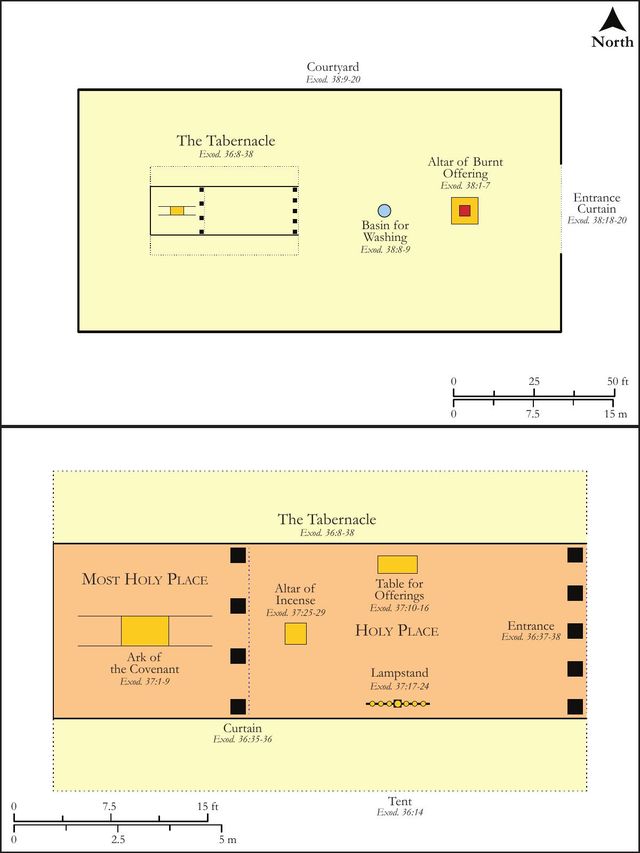
This verse is embedded within Exodus chapters 35-40, which pivot from the divine instructions for the Tabernacle's construction (given in Exodus 25-31) to their faithful execution by the Israelite artisans. Chapter 37 specifically recounts the crafting of the most sacred furnishings: the Ark of the Covenant, the Mercy Seat, the table of showbread, the golden lampstand, the altar of incense, and the anointing oil and incense. The repetition of details from the earlier command chapters serves a crucial literary function, emphasizing the Israelites' diligent obedience and the meticulous fulfillment of God's precise specifications. The description of the menorah's branches here, following the instructions in Exodus 25:31-40, reinforces the theme of divine authority and human faithfulness in establishing God's presence among His people.
Historical & Cultural Context
The construction of the Tabernacle occurred during Israel's formative period in the wilderness, a time when God was establishing His covenant relationship with the newly liberated nation. Unlike the permanent, often idolatrous temples of the surrounding nations, the Tabernacle was a portable sanctuary, designed to accompany God's people on their journey, symbolizing His active presence and guidance. The meticulous detail in its construction, including the precise arrangement of the menorah's branches, stood in stark contrast to the often chaotic and improvisational nature of pagan worship. Every element, from the materials to the dimensions and arrangement, was divinely ordained, signifying God's holiness, His desire for ordered worship, and the specific means by which His people could approach Him. This careful adherence to the divine blueprint was a foundational act of worship and covenant faithfulness for a people being set apart by God, preparing them for the promised land as described in Exodus 33.
Key Themes
ShowHideExodus 37:18 contributes to several overarching themes within the book of Exodus and the Pentateuch. Firstly, it highlights the paramount theme of Divine Sovereignty and Precision, demonstrating that God is a God of order who dictates every detail of His worship and dwelling place. Secondly, it underscores Human Obedience and Faithfulness, as Bezalel and the artisans meticulously follow the divine blueprint, setting an example for all generations of believers. Thirdly, the menorah itself contributes to the theme of Divine Presence and Illumination, as it was the sole source of light in the Holy Place, symbolizing God as the source of all truth, guidance, and life for His people. This theme is further developed in passages like Psalm 119:105. The symmetry described also speaks to God's Order and Beauty, reflecting His perfect nature in the design of His sanctuary.
Exposition and Analysis
ShowHideKey Word Analysis
ShowHideThis term (H7070, קָנֶה) literally means "reed," "stalk," or "shaft." In the context of the menorah, it refers to the six arms that extended from the central stem, designed to hold the oil lamps. The word evokes a sense of organic growth, perhaps subtly hinting at the menorah's later symbolic connection to life and flourishing, even though its primary function here is structural. The precision in specifying "six branches" and their symmetrical arrangement underscores the deliberate and intentional design of the lampstand.
The verb (H3318, יָצָא) means "to go out," "to come forth," or "to proceed." Here, it describes the physical extension of the branches from the central shaft of the menorah. This word choice emphasizes the dynamic aspect of the lampstand's structure, not merely a static object, but one from which elements actively emerge. It highlights the functional design where light would emanate from these extensions.
This noun (H6654, צַד) refers to a "side" or "flank." Its repeated use in the verse ("out of the sides thereof," "out of the one side thereof," "out of the other side thereof") is crucial for establishing the precise, bilateral symmetry of the menorah's branches. It dictates the spatial arrangement, ensuring that the six branches are distributed evenly and oppositely from the central axis, contributing to the lampstand's balanced and ordered appearance.
Verse Breakdown
ShowHide"And six branches going out of the sides thereof;"
This initial clause introduces the primary structural elements extending from the central shaft of the lampstand. It immediately quantifies these elements as "six branches" and specifies their general orientation as "going out of the sides thereof," indicating their lateral projection from the main body of the menorah. This sets the stage for the detailed distribution that follows.
"three branches of the candlestick out of the one side thereof,"
This part provides the first specific detail regarding the distribution of the six branches. It clarifies that exactly three of these branches emerged from one specific side of the central lampstand. This precise numerical and directional information underscores the exactness required in the divine blueprint, leaving no room for ambiguity in the artisans' construction.
"and three branches of the candlestick out of the other side thereof:"
This concluding clause completes the description of the branches' symmetrical arrangement. It confirms that the remaining three branches extended from the opposing side of the central shaft. The repetition of "three branches of the candlestick out of the... side thereof" emphatically reinforces the perfect balance, symmetry, and intentionality of the divine design, ensuring that the artisans followed the blueprint with absolute precision.
Literary Devices
ShowHideExodus 37:18 primarily employs Enumeration and Repetition to convey the precise architectural details of the menorah. The verse explicitly enumerates the "six branches" and then meticulously breaks down their arrangement: "three branches... out of the one side" and "three branches... out of the other side." This exact counting and detailing underscore the divine demand for Precision in the Tabernacle's construction. The repetition of the phrase "three branches of the candlestick out of the... side thereof" serves to emphasize the perfect Symmetry and Balance of the lampstand's design, reinforcing the idea that every detail was divinely ordained and to be executed without deviation. While the verse is descriptive, it contributes to the broader Symbolism of the menorah as a whole, representing light, God's presence, and the divine order.
Theological and Thematic Connections
ShowHideExodus 37:18, though a seemingly simple descriptive verse, profoundly underscores God's demand for divine precision and order in all matters related to His worship and presence. The meticulous detailing of the menorah's branches reflects a theology where God is sovereign over every detail, leaving no room for human improvisation in sacred matters. This exactness points to His holiness and the necessity of approaching Him on His terms, not ours. Furthermore, the faithful execution of these instructions by Bezalel and the artisans exemplifies the paramount importance of obedience to God's revealed will, a foundational theme throughout the Pentateuch. The menorah, as the sole source of illumination in the Holy Place, also foreshadows the broader theme of God as the ultimate source of all light, truth, and guidance for His people, dispelling the darkness of ignorance and sin.
Reflection and Application
ShowHideThe profound attention to detail in Exodus 37:18 serves as a powerful reminder that God cares deeply about the specifics of our worship, our service, and indeed, our entire lives. Just as the ancient Israelites were called to construct the Tabernacle with utmost precision according to a divine blueprint, so too are believers today called to live lives of intentionality, diligence, and faithfulness, adhering to God's revealed Word. This isn't about legalism, but about recognizing that our God is a God of order, beauty, and purpose, and our devotion should reflect His excellence and character. The menorah's exact design, providing essential light in the darkness of the Holy Place, challenges us to consider how we, as followers of Christ, are called to reflect His light in a world often shrouded in spiritual darkness. This reflection is not through our own ingenuity or haphazard efforts, but by faithfully embodying His truth and love, allowing His light to shine through us. Our "branches"—our gifts, our relationships, our daily actions—should be arranged and utilized in a way that brings maximum glory to the One who is the true Light.
Questions for Reflection
ShowHideFAQ
ShowHideWhy is the description of the menorah's branches so detailed?
ShowHideThe detailed description of the menorah's branches in Exodus 37:18, mirroring the earlier instructions in Exodus 25:31-40, emphasizes God's demand for absolute precision and adherence to His divine blueprint for the Tabernacle. This meticulousness underscores several critical theological points: God's holiness and His specific requirements for worship, the paramount importance of obedience from His people, and the symbolic significance of every element in His dwelling place. It signifies that the Tabernacle was not a human invention but a divinely ordained structure, every part of which pointed to deeper spiritual truths about God's character and His plan of salvation.
What is the significance of "three branches out of one side, and three out of the other"?
ShowHideThe specification of "three branches out of the one side thereof, and three branches of the candlestick out of the other side thereof" highlights the perfect symmetry and balance of the menorah's design. This symmetrical arrangement, along with the central shaft, resulted in a total of seven lamp holders, a number often associated with completeness, perfection, and divine wholeness in biblical numerology, as seen in the seven days of creation in Genesis 1. This precise balance was crucial not only for the lampstand's aesthetic beauty and functional stability but also for its profound symbolic representation of divine order and wholeness within the sacred space, reflecting God's own perfect and harmonious nature.
Christ-Centered Fulfillment
ShowHideWhile Exodus 37:18 describes a physical object in the Old Testament Tabernacle, its Christ-centered fulfillment is profoundly significant. The menorah, as the sole source of light in the Holy Place, powerfully foreshadows Jesus Christ, who declared, "I am the light of the world." Just as the lampstand illuminated the path within the Tabernacle, Christ illuminates the path to God, revealing truth and dispelling spiritual darkness. The seven-branched menorah, with its perfect symmetry and divine design, points to Christ as the perfect and complete revelation of God, the one through whom all spiritual light and understanding flow. Furthermore, the meticulous obedience of Bezalel in crafting the menorah according to God's precise instructions finds its ultimate parallel in Christ's perfect obedience to the Father's will, even to the point of death on the cross (Philippians 2:8). Through His sacrifice and resurrection, Christ became the true "lampstand" in the heavenly sanctuary, providing eternal light and access to God's presence, as hinted at in the vision of the New Jerusalem where "the Lamb is its lamp. Believers, united with Him, are then called to be "the light of the world," reflecting His glory through their lives, much like the individual lamps on the menorah shared in its unified purpose of illumination, drawing others to the one true Light.