


Daniel 1:11
Bible text: King James Version (1769 Blayney text) · Public domain
Bible text: Berean Standard Bible · Public domain
Bible text: American Standard Version (1901) · Public domain
Bible text: World English Bible, Messianic edition · Public domain
Bible text: Geneva Bible (1599) · Public domain
Bible text: Young's Literal Translation · Public domain
- וַיֹּאמֶרvai·Yo·merand he saidH559Conj-w ¦ V-Qal-ConsecImperf-3msVerb Qal Consecutive Imperfect 3rd Singular Masculineוַandיֹּאמֶרhe said
- דָּנִיֵּאלda·ni·YelDanielH1840N-proper-mNoun Proper Masculine
- אֶל'eltoH413PrepPreposition
- הַמֶּלְצַרha·mel·Tzarthe guardianH4453Art ¦ N-msNoun Singular Masculine Absoluteהַtheמֶּלְצַרguardian
- אֲשֶׁר'a·SherwhomH834RelParticle Relative
- מִנָּהmi·Nahhe had assignedH4487V-Piel-Perf-3msVerb Piel Perfect 3rd Singular Masculine
- שַׂרsar[the] chief ofH8269N-mscNoun Singular Masculine Construct
- הַסָּרִיסִיםha·sa·ri·Simthe officialsH5631Art ¦ N-mpNoun Plural Masculine Absoluteהַtheסָּרִיסִיםofficials
- עַל'aloverH5921PrepPreposition
- דָּנִיֵּאלda·ni·YelDanielH1840N-proper-mNoun Proper Masculine
- חֲנַנְיָהcha·nan·YahHananiahH2608N-proper-mNoun Proper Masculine
- מִישָׁאֵלmi·sha·'ElMishaelH4332N-proper-mNoun Proper Masculine
- וַעֲזַרְיָהva·'a·zar·Yahand AzariahH5838Conj-w ¦ N-proper-mNoun Proper MasculineוַandעֲזַרְיָהAzariah
English is a literal word-by-word gloss of the Hebrew, not the KJV's wording. Why?
This is the original text the KJV's translators worked from — each Hebrew word with its own literal English meaning in this verse, prepared by scholars at Tyndale House, Cambridge. The KJV translates whole sentences, not word by word, so its wording differs: one Hebrew word can become several English words, and the KJV may choose “the LORD” where the gloss reads “Yahweh”. Both are faithful — they answer different questions. For the KJV's own rendering, switch to the KJV text.
Details
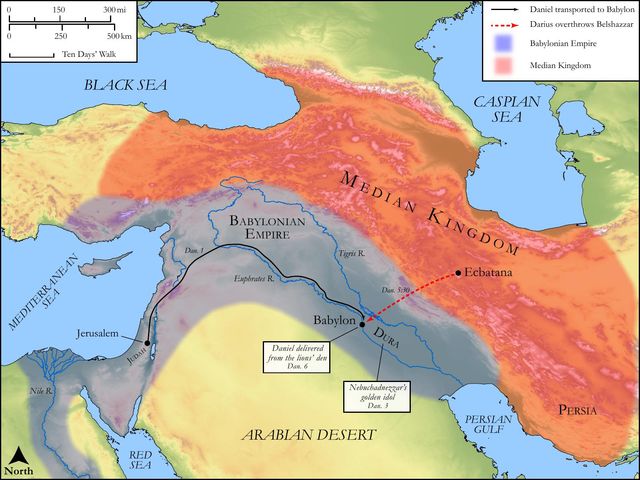
See on the biblical-era map
Study this verse
Public-domain commentary
Matthew Henry
From his Commentary on the Whole Bible. Henry comments on passages, not single verses — this entry covers Daniel 1:8–16. His two-level outline is real structure in the source text, so it is rendered as structure.
We observe here, very much to our satisfaction,
I.That Daniel was a favourite with the prince of the eunuchs (Dan 1:9), as Joseph was with the keeper of the prison; he had a tender love for him. No doubt Daniel deserved it, and recommended himself by his ingenuity and sweetness of temper (he was greatly beloved, Dan 9:23); and yet it is said here that it was God that brought him into favour with the prince of the eunuchs, for every one does not meet with acceptance according to his merits. Note, The interest which we think we make for ourselves we must acknowledge to be God's gift, and must ascribe to him the glory of it. Whoever are in favour, it is God that has brought them into favour; and it is by him that they find good understanding. Herein was again verified That work (Psa 106:46), He made them to be pitied of all those that carried them captives. Let young ones know that the way to be acceptable is to be tractable and dutiful.
II.That Daniel was still firm to his religion.
They had changed his name, but they could not change his nature. Whatever they pleased to call him, he still retained the spirit of an Israelite indeed. He would apply his mind as closely as any of them to his books, and took pains to make himself master of the learning and tongue of the Chaldeans, but he was resolved that he would not defile himself with the portion of the king's meat, he would not meddle with it, nor with the wine which he drank, Dan 1:8. And having communicated his purpose, with the reasons of it, to his fellows, they concurred in the same resolution, as appears, Dan 1:11. This was not out of sullenness, or peevishness, or a spirit of contradiction, but from a principle of conscience. Perhaps it was not in itself unlawful for them to eat of the king's meat or to drink of his wine. But,
1.They were scrupulous concerning the meat, lest it should be sinful. Sometimes such meat would be set before them as was expressly forbidden by their law, as swine's flesh; or they were afraid lest it should have been offered in sacrifice to an idol, or blessed in the name of an idol. The Jews were distinguished from other nations very much by their meats (Lev 11:45, Lev 11:46), and these pious young men, being in a strange country, thought themselves obliged to keep up the honour of their being a peculiar people. Though they could not keep up their dignity as princes, they would not lose it as Israelites; for on that they most valued themselves. Note, When God's people are in Babylon they have need to take special care that they partake not in her sins. Providence seemed to lay this meat before them; being captives they must eat what they could get and must not disoblige their masters; yet, if the command be against it, they must abide by that. Though Providence says, Kill and eat, conscience says, Not so, Lord, for nothing common or unclean has come into my mouth.
2.They were jealous over themselves, lest, though it should not be sinful in itself, it should be an occasion of sin to them, lest, by indulging their appetites with these dainties, they should grow sinful, voluptuous, and in love with the pleasures of Babylon. They had learned David's prayer, Let me not eat of their dainties (Psa 141:4), and Solomon's precept, Be not desirous of dainties, for they are deceitful meat (Pro 23:3), and accordingly they form their resolution. Note, It is very much the praise of all, and especially of young people, to be dead to the delights of sense, not to covet them, not to relish them, but to look upon them with indifference. Those that would excel in wisdom and piety must learn betimes to keep under the body and bring it into subjection.
3.However, they thought it unseasonable now, when Jerusalem was in distress, and they themselves were in captivity. They had no heart to drink wine in bowls, so much were they grieved for the affliction of Joseph. Though they had royal blood in their veins, yet they did not think it proper to have royal dainties in their mouths when they were thus brought low. Note, It becomes us to be humble under humbling providences. Call me not Naomi; call me Marah. See the benefit of affliction; by the account Jeremiah gives of the princes and great men now at Jerusalem it appears that they were very corrupt and wicked, and defiled themselves with things offered to idols, while these young gentlemen that were in captivity would not defile themselves, no, not with their portion of the king's meat. How much better is it with those that retain their integrity in the depths of affliction than with those that retain their iniquity in the heights of prosperity! Observe, The great thing that Daniel avoided was defiling himself with the pollutions of sin; that is the thing we should be more afraid of than of any outward trouble. Daniel, having taken up this resolution, requested of the prince of the eunuchs that he might not defile himself, not only that he might not be compelled to do it, but that he might not be tempted to do it, that the bait might not be laid before him, that he might not see the portion appointed him of the king's meat, nor look upon the wine when it was red. It will be easier to keep the temptation at a distance than to suffer it to come near and then be forced to put a knife to our throat. Note, We cannot better improve our interest in any with whom we have found favour than by making use of them to keep us from sin.
III.That God wonderfully owned him herein.
When Daniel requested that he might have none of the king's meat or wine set before him the prince of the eunuchs objected that, if he and his fellows were not found in as good case as any of their companions, he should be in danger of having anger and of losing his head, Dan 1:10. Daniel, to satisfy him that there would be no danger of any bad consequence, desires the matter might be put to a trial. He applies himself further to the under-officer, Melzar, or the steward: "Prove us for ten days; during that time let us have nothing but pulse to eat, nothing but herbs and fruits, or parched peas or lentils, and nothing but water to drink, and see how we can live upon that, and proceed accordingly," Dan 1:13. People will not believe the benefit of abstemiousness and a spare diet, nor how much it contributes to the health of the body, unless they try it. Trial was accordingly made. Daniel and his fellows lived for ten days upon pulse and water, hard fare for young men of genteel extraction and education, and which one would rather expect they should have indented against than petitioned for; but at the end of the ten days they were compared with the other children, and were found fairer and fatter in flesh, of a more healthful look and better complexion, than all those who did eat the portion of the king's meat, Dan 1:15. This was in part a natural effect of their temperance, but it must be ascribed to the special blessing of God, which will make a little to go a great way, a dinner of herbs better than a stalled ox. By this it appears that man lives not by bread alone; pulse and water shall be the most nourishing food if God speak the word. See what it is to keep ourselves pure from the pollutions of sin; it is the way to have that comfort and satisfaction which will be health to the navel and marrow to the bones, while the pleasures of sin are rottenness to the bones.
IV.That his master countenanced him.
The steward did not force them to eat against their consciences, but, as they desired, gave them pulse and water (Dan 1:16), the pleasures of which they enjoyed, and we have reason to think were not envied the enjoyment. Here is a great example of temperance and contentment with mean things; and (as Epicurus said) "he that lives according to nature will never be poor, but he that lives according to opinion will never be rich." This wonderful abstemiousness of these young men in the days of their youth contributed to the fitting of them,
1.For their eminent services. Hereby they kept their minds clear and unclouded, and fit for contemplation, and saved for the best employments a great deal both of time and thought; and thus they prevented those diseases which indispose men for the business of age that owe their rise to the intemperances of youth.
2.For their eminent sufferings. Those that had thus inured themselves to hardship, and lived a life of self-denial and mortification, could the more easily venture upon the fiery furnace and the den of lions, rather than sin against God.
Continue studying Daniel 1:11 across the web’s major study libraries — every link below opens this exact verse, chapter, or book on the destination site.
Read & Compare
 BibleGatewayThis verse in more than 200 translations and 70 languages.
 Bible.comThe YouVersion reader — hundreds of translations, reading plans, and highlights.
 ESV.orgCrossway's official English Standard Version reader.
 NET BibleThe NET translation with 60,000+ translators' notes on every rendering decision.
 STEP BibleTyndale House's free study tool — original text, vocabulary, and scholarly resources.
 BibliaLogos Bible Software's free web reader.
 USCCBThe New American Bible (Revised Edition) with the U.S. bishops' study notes.
Commentaries
 BibleHub CommentariesDozens of classic commentaries on this verse, gathered on one page.
 StudyLightMore than 100 commentary sets — the largest collection on the web.
 BibleRefPlain-English commentary on what this verse means, verse by verse.
 Enduring WordDavid Guzik's free commentary on this chapter, widely used by Bible teachers.
 Bible Study ToolsVerse commentary alongside Greek and Hebrew study aids.
Original Language & Research
- BibleHub InterlinearThe verse word by word — original language, transliteration, and English.
- BibleHub LexiconEvery word's original-language definition and Strong's entry.
 Blue Letter BibleDeep-study tools — Strong's numbers, concordance, and word studies.
 SefariaThe Hebrew text with Rashi and centuries of Jewish commentary.
Sermons, Hymns & Audio


TrulyRandomVerse is not affiliated with these sites and doesn’t control their content. They’re linked because they’re genuinely useful.
Summary
Daniel 1:11 records a pivotal moment where Daniel, having resolved to maintain his spiritual integrity, initiates a diplomatic conversation with Melzar, the Babylonian steward appointed over him and his three companions, Hananiah, Mishael, and Azariah. This verse highlights Daniel's proactive wisdom and faith, setting the stage for a practical test of his commitment to God's laws within the challenging environment of the Babylonian court, demonstrating his reliance on divine favor and strategic discernment rather than confrontational defiance.
Context
ShowHideLiterary Context
This verse is deeply embedded in the introductory narrative of the Book of Daniel, immediately following Daniel's decisive "purpose in his heart" not to defile himself with the king's rich food and wine, as detailed in Daniel 1:8. It builds upon the initial scene of the Babylonian conquest and the selection of choice young men for royal service, described in Daniel 1:1-7. Daniel's direct address to Melzar is a practical outworking of his earlier resolve, demonstrating his proactive approach to maintaining his spiritual integrity without outright rebellion against the authorities. The success of this appeal, detailed in subsequent verses like Daniel 1:12-16, is foundational for the subsequent tests and divine interventions throughout the book, establishing Daniel's character and God's faithfulness to those who honor Him. This initial test of faithfulness in a seemingly small matter foreshadows the greater trials of faith that Daniel and his friends will face, such as the fiery furnace in Daniel 3 and the lions' den in Daniel 6.
Historical & Cultural Context
The setting is the Babylonian court under King Nebuchadnezzar, following the siege of Jerusalem around 605 BC, as mentioned in Daniel 1:1. It was customary for conquering empires to assimilate elite captives into their culture, often through re-education, language training, and adoption of local customs and religious practices, symbolized by the royal food and wine. Such provisions were likely offered to idols, making them ritually impure for devout Jews, or included non-kosher items forbidden by Mosaic law. The "prince of the eunuchs" (Ashpenaz, mentioned in Daniel 1:3) held a position of significant authority and trust within the palace, overseeing the king's personal attendants and often serving as a key advisor. Melzar, likely a title rather than a personal name, indicates a specific administrative role, emphasizing the hierarchical structure and the high stakes of Daniel's request within such a powerful and pagan environment. Daniel's approach reflects an understanding of this hierarchy and a desire to work within it rather than against it.
Key Themes
ShowHideDaniel 1:11 powerfully contributes to several overarching themes within the book. Firstly, Faithful Obedience is paramount, as Daniel's initiative stems directly from his commitment to God's law, even when faced with significant personal risk in a foreign land. This highlights the principle that true faith is demonstrated through action, not just intention. Secondly, Wisdom and Discernment are evident in Daniel's diplomatic approach; instead of a confrontational refusal, he seeks a practical, respectful solution, appealing to Melzar who had already shown him favor, as noted in Daniel 1:9. This highlights the importance of strategic thinking and gracious engagement in navigating ethical dilemmas, demonstrating that faithfulness does not always equate to defiance. Lastly, the verse subtly underscores Divine Providence and Favor, as Daniel's ability to even make such a request, and Melzar's willingness to consider it, points to God's unseen hand at work, preparing the way for His servants to stand firm and ultimately be exalted.
Exposition and Analysis
ShowHideKey Word Analysis
ShowHideVerse Breakdown
ShowHide"Then said Daniel to Melzar"
This clause emphasizes Daniel's initiative and direct communication. Having resolved in his heart not to defile himself, as stated in Daniel 1:8, Daniel now acts upon that conviction by approaching the specific individual responsible for their daily provisions. His choice to speak directly to Melzar, the steward, rather than a lesser servant or the prince himself, demonstrates his wisdom and respect for the chain of command, seeking a practical solution within the existing structure. This highlights Daniel's courage to act on his faith while also exhibiting shrewd discernment.
"whom the prince of the eunuchs had set over Daniel, Hananiah, Mishael, and Azariah"
This clarifies Melzar's authority and specific charge. He was not merely a servant but an appointed official, entrusted by a high-ranking court officer (the prince of the eunuchs) with the care and oversight of these particular young men. This detail underscores the gravity of Daniel's request, as Melzar's compliance could put him at significant risk if the king's decree was strictly enforced. It also highlights the collective nature of the challenge, as Daniel represents himself and his three companions, whose faithfulness and well-being are intertwined with his own. This emphasizes the communal aspect of their commitment to God.
Literary Devices
ShowHideThe verse primarily employs Characterization and Foreshadowing. Through Characterization, Daniel is presented as a man of both unwavering conviction and profound wisdom. His proactive "said" (Hebrew, ʼâmar') to Melzar, rather than a passive refusal or open defiance, reveals his strategic thinking and diplomatic skill. He is not merely a recipient of circumstances but an agent of change, seeking a solution that honors God without unnecessarily provoking conflict or jeopardizing the lives of his friends. This subtle portrayal sets him apart as a wise and trustworthy figure early in the narrative, establishing his integrity and resourcefulness. Furthermore, the verse functions as Foreshadowing, hinting at the greater tests and divine interventions that will follow. Daniel's successful negotiation here, enabled by divine favor, sets a precedent for how God will work through him and his companions in future, more perilous situations, such as the fiery furnace (Daniel 3:19-30) and the lions' den (Daniel 6:16-23). The seemingly small act of seeking a dietary alternative becomes a microcosm of their larger journey of faith and God's faithfulness in the face of overwhelming odds.
Theological and Thematic Connections
ShowHideDaniel 1:11 serves as a profound illustration of faithful obedience coupled with practical wisdom. It demonstrates that commitment to God's principles does not always necessitate confrontational defiance but can involve prayerful discernment and diplomatic engagement with authority. Daniel's approach, seeking a way to honor God without directly violating the king's command, highlights the biblical call to be "wise as serpents and innocent as doves," as taught by Jesus in Matthew 10:16. This verse also subtly introduces the theme of divine favor, as Daniel's ability to even present his case, and Melzar's receptiveness, are attributed to God's providential hand working behind the scenes, preparing the way for His people to stand firm in their convictions. It underscores that God honors those who honor Him, often by opening doors of opportunity and granting favor in unexpected places.
Reflection and Application
ShowHideDaniel 1:11 provides a powerful blueprint for navigating the complexities of living out one's faith in a pluralistic or even hostile environment. Daniel's example teaches us that integrity is not merely about saying "no" to compromise, but also about proactively seeking wise and respectful solutions that honor God while engaging with the world around us. His approach reminds us that faithfulness in seemingly small, daily decisions can pave the way for God's greater purposes to unfold. We are called to cultivate both unwavering conviction and discerning wisdom, trusting that God will open doors and provide the means for us to live righteously, even when circumstances seem overwhelmingly against us. This verse encourages us to consider how we can uphold our values with grace and strategic intelligence, rather than defaulting to either passive conformity or aggressive defiance. It challenges us to pray for wisdom, seek God's favor, and act with courage and diplomacy in our spheres of influence.
Questions for Reflection
ShowHideFAQ
ShowHideWho was Melzar, and why is his role significant?
ShowHideMelzar (H4453, meltsâr) is generally understood not as a personal name but as a title, likely meaning "steward," "inspector," or "overseer of provisions." He was the specific official whom the "prince of the eunuchs" (Ashpenaz, mentioned in Daniel 1:3) had appointed to oversee Daniel and his three friends. His role is significant because he was directly responsible for their daily care and adherence to the king's dietary regimen. Daniel's decision to approach Melzar directly, rather than a higher authority or a lesser servant, demonstrates his wisdom and respect for the established hierarchy. Melzar's willingness to listen and agree to Daniel's request, as seen in Daniel 1:14, was crucial for the success of Daniel's plan and highlights God's providential hand in granting Daniel favor (Daniel 1:9).
Why was Daniel's request regarding food and wine so significant?
ShowHideDaniel's request was significant for several reasons beyond mere dietary preference. Firstly, the king's food and wine likely included items forbidden by Mosaic law (e.g., non-kosher meats) or food that had been offered to idols, which would defile a devout Jew. By purposing in his heart not to defile himself (Daniel 1:8), Daniel was making a stand for his spiritual and religious integrity in a pagan land. Secondly, partaking in the king's provisions was a common practice for integrating and indoctrinating conquered peoples into the culture and religion of the conquering empire. Refusing the king's food was a subtle but profound act of resistance against cultural assimilation and an affirmation of his allegiance to God. Thirdly, it was a high-stakes request; defying the king's decree could have resulted in severe punishment, even death, for Daniel and his friends. Their faithfulness in this "small" matter set the precedent for their future integrity and God's miraculous deliverance in greater tests, such as the fiery furnace (Daniel 3:19-30) and the lions' den (Daniel 6:16-23).
Christ-Centered Fulfillment
ShowHideDaniel's faithful obedience and diplomatic wisdom in Daniel 1:11, coupled with God's providential favor, powerfully foreshadow the ultimate obedience and favor found in Jesus Christ. Just as Daniel purposed in his heart not to defile himself, Jesus, the perfect Son of God, lived a life of absolute purity and unwavering obedience to His Father's will, even unto death on the cross, as described in Philippians 2:8. While Daniel navigated the challenges of a pagan court, Jesus faced the ultimate temptation in the wilderness, resisting every attempt of the adversary to compromise His mission and calling, as recorded in Matthew 4:1-11. Daniel's request for an alternative diet, leading to a visible demonstration of God's blessing and superior health, points to Christ as the true spiritual sustenance, the "bread of life" who satisfies all hunger and thirst for righteousness, as He Himself declared in John 6:35. Moreover, the divine favor granted to Daniel, allowing him to thrive and be exalted in a hostile environment, prefigures the boundless grace and favor God bestows upon all who are "in Christ," making them accepted in the Beloved, as articulated in Ephesians 1:6. Ultimately, Daniel's story of integrity and deliverance in Babylon finds its complete fulfillment in Christ, who perfectly embodies faithfulness, wisdom, and divine favor, securing eternal deliverance and true spiritual nourishment for all who believe in Him, for He is our sympathetic High Priest who was tempted in every way, yet without sin (Hebrews 4:15).