


Daniel 1:9
Bible text: King James Version (1769 Blayney text) · Public domain
Bible text: Berean Standard Bible · Public domain
Bible text: American Standard Version (1901) · Public domain
Bible text: World English Bible, Messianic edition · Public domain
Bible text: Geneva Bible (1599) · Public domain
Bible text: Young's Literal Translation · Public domain
- וַיִּתֵּןvai·yi·Tenand he gaveH5414Conj-w ¦ V-Qal-ConsecImperf-3msVerb Qal Consecutive Imperfect 3rd Singular Masculineוַandיִּתֵּןhe gave
- הָאֱלֹהִיםha·'E·lo·Him<the> GodH430Art ¦ N-mpNoun Plural Masculine Absoluteהָ<the>אֱלֹהִיםGod
- אֶת'et<obj.>H853DirObjMParticle Object Indicator
- דָּנִיֵּאלda·ni·YelDanielH1840N-proper-mNoun Proper Masculine
- לְחֶסֶדle·Che·sed<to> favorH2617Prep-l ¦ N-msNoun Singular Masculine Absoluteלְ<to>חֶסֶדfavor
- וּלְרַחֲמִיםu·le·ra·cha·Mimand <to> compassion<s>H7356Conj-w ¦ Prep-l ¦ N-mpNoun Plural Masculine Absoluteוּandלְ<to>רַחֲמִיםcompassion<s>
- לִפְנֵיlif·Nei<to> beforeH6440Prep-l ¦ N-mpcNoun Plural Masculine Constructלִ<to>פְנֵיbefore
- שַׂרsar[the] chief ofH8269N-mscNoun Singular Masculine Construct
- הַסָּרִיסִיםha·sa·ri·Simthe officialsH5631Art ¦ N-mpNoun Plural Masculine Absoluteהַtheסָּרִיסִיםofficials
English is a literal word-by-word gloss of the Hebrew, not the KJV's wording. Why?
This is the original text the KJV's translators worked from — each Hebrew word with its own literal English meaning in this verse, prepared by scholars at Tyndale House, Cambridge. The KJV translates whole sentences, not word by word, so its wording differs: one Hebrew word can become several English words, and the KJV may choose “the LORD” where the gloss reads “Yahweh”. Both are faithful — they answer different questions. For the KJV's own rendering, switch to the KJV text.
Details
See on the biblical-era map
Study this verse
Public-domain commentary
Matthew Henry
From his Commentary on the Whole Bible. Henry comments on passages, not single verses — this entry covers Daniel 1:8–16. His two-level outline is real structure in the source text, so it is rendered as structure.
We observe here, very much to our satisfaction,
I.That Daniel was a favourite with the prince of the eunuchs (Dan 1:9), as Joseph was with the keeper of the prison; he had a tender love for him. No doubt Daniel deserved it, and recommended himself by his ingenuity and sweetness of temper (he was greatly beloved, Dan 9:23); and yet it is said here that it was God that brought him into favour with the prince of the eunuchs, for every one does not meet with acceptance according to his merits. Note, The interest which we think we make for ourselves we must acknowledge to be God's gift, and must ascribe to him the glory of it. Whoever are in favour, it is God that has brought them into favour; and it is by him that they find good understanding. Herein was again verified That work (Psa 106:46), He made them to be pitied of all those that carried them captives. Let young ones know that the way to be acceptable is to be tractable and dutiful.
II.That Daniel was still firm to his religion.
They had changed his name, but they could not change his nature. Whatever they pleased to call him, he still retained the spirit of an Israelite indeed. He would apply his mind as closely as any of them to his books, and took pains to make himself master of the learning and tongue of the Chaldeans, but he was resolved that he would not defile himself with the portion of the king's meat, he would not meddle with it, nor with the wine which he drank, Dan 1:8. And having communicated his purpose, with the reasons of it, to his fellows, they concurred in the same resolution, as appears, Dan 1:11. This was not out of sullenness, or peevishness, or a spirit of contradiction, but from a principle of conscience. Perhaps it was not in itself unlawful for them to eat of the king's meat or to drink of his wine. But,
1.They were scrupulous concerning the meat, lest it should be sinful. Sometimes such meat would be set before them as was expressly forbidden by their law, as swine's flesh; or they were afraid lest it should have been offered in sacrifice to an idol, or blessed in the name of an idol. The Jews were distinguished from other nations very much by their meats (Lev 11:45, Lev 11:46), and these pious young men, being in a strange country, thought themselves obliged to keep up the honour of their being a peculiar people. Though they could not keep up their dignity as princes, they would not lose it as Israelites; for on that they most valued themselves. Note, When God's people are in Babylon they have need to take special care that they partake not in her sins. Providence seemed to lay this meat before them; being captives they must eat what they could get and must not disoblige their masters; yet, if the command be against it, they must abide by that. Though Providence says, Kill and eat, conscience says, Not so, Lord, for nothing common or unclean has come into my mouth.
2.They were jealous over themselves, lest, though it should not be sinful in itself, it should be an occasion of sin to them, lest, by indulging their appetites with these dainties, they should grow sinful, voluptuous, and in love with the pleasures of Babylon. They had learned David's prayer, Let me not eat of their dainties (Psa 141:4), and Solomon's precept, Be not desirous of dainties, for they are deceitful meat (Pro 23:3), and accordingly they form their resolution. Note, It is very much the praise of all, and especially of young people, to be dead to the delights of sense, not to covet them, not to relish them, but to look upon them with indifference. Those that would excel in wisdom and piety must learn betimes to keep under the body and bring it into subjection.
3.However, they thought it unseasonable now, when Jerusalem was in distress, and they themselves were in captivity. They had no heart to drink wine in bowls, so much were they grieved for the affliction of Joseph. Though they had royal blood in their veins, yet they did not think it proper to have royal dainties in their mouths when they were thus brought low. Note, It becomes us to be humble under humbling providences. Call me not Naomi; call me Marah. See the benefit of affliction; by the account Jeremiah gives of the princes and great men now at Jerusalem it appears that they were very corrupt and wicked, and defiled themselves with things offered to idols, while these young gentlemen that were in captivity would not defile themselves, no, not with their portion of the king's meat. How much better is it with those that retain their integrity in the depths of affliction than with those that retain their iniquity in the heights of prosperity! Observe, The great thing that Daniel avoided was defiling himself with the pollutions of sin; that is the thing we should be more afraid of than of any outward trouble. Daniel, having taken up this resolution, requested of the prince of the eunuchs that he might not defile himself, not only that he might not be compelled to do it, but that he might not be tempted to do it, that the bait might not be laid before him, that he might not see the portion appointed him of the king's meat, nor look upon the wine when it was red. It will be easier to keep the temptation at a distance than to suffer it to come near and then be forced to put a knife to our throat. Note, We cannot better improve our interest in any with whom we have found favour than by making use of them to keep us from sin.
III.That God wonderfully owned him herein.
When Daniel requested that he might have none of the king's meat or wine set before him the prince of the eunuchs objected that, if he and his fellows were not found in as good case as any of their companions, he should be in danger of having anger and of losing his head, Dan 1:10. Daniel, to satisfy him that there would be no danger of any bad consequence, desires the matter might be put to a trial. He applies himself further to the under-officer, Melzar, or the steward: "Prove us for ten days; during that time let us have nothing but pulse to eat, nothing but herbs and fruits, or parched peas or lentils, and nothing but water to drink, and see how we can live upon that, and proceed accordingly," Dan 1:13. People will not believe the benefit of abstemiousness and a spare diet, nor how much it contributes to the health of the body, unless they try it. Trial was accordingly made. Daniel and his fellows lived for ten days upon pulse and water, hard fare for young men of genteel extraction and education, and which one would rather expect they should have indented against than petitioned for; but at the end of the ten days they were compared with the other children, and were found fairer and fatter in flesh, of a more healthful look and better complexion, than all those who did eat the portion of the king's meat, Dan 1:15. This was in part a natural effect of their temperance, but it must be ascribed to the special blessing of God, which will make a little to go a great way, a dinner of herbs better than a stalled ox. By this it appears that man lives not by bread alone; pulse and water shall be the most nourishing food if God speak the word. See what it is to keep ourselves pure from the pollutions of sin; it is the way to have that comfort and satisfaction which will be health to the navel and marrow to the bones, while the pleasures of sin are rottenness to the bones.
IV.That his master countenanced him.
The steward did not force them to eat against their consciences, but, as they desired, gave them pulse and water (Dan 1:16), the pleasures of which they enjoyed, and we have reason to think were not envied the enjoyment. Here is a great example of temperance and contentment with mean things; and (as Epicurus said) "he that lives according to nature will never be poor, but he that lives according to opinion will never be rich." This wonderful abstemiousness of these young men in the days of their youth contributed to the fitting of them,
1.For their eminent services. Hereby they kept their minds clear and unclouded, and fit for contemplation, and saved for the best employments a great deal both of time and thought; and thus they prevented those diseases which indispose men for the business of age that owe their rise to the intemperances of youth.
2.For their eminent sufferings. Those that had thus inured themselves to hardship, and lived a life of self-denial and mortification, could the more easily venture upon the fiery furnace and the den of lions, rather than sin against God.
Historical interpretation
Historical reception
1 surviving comment on this verse from the historical church.
Verse 9. "God gave Daniel favor and compassion in the sight of the prince of eunuchs..." He who was taken into captivity on account of the sins of his forebears received an immediate recompense for the magnitude of his own virtues. For he had purposed in his heart that he would not be denied by food from the king's table, and preferred humble fare to royal delicacies; therefore by the bounteous bestowal of the Lord he received favor and compassion in the sight of the prince of the eunuchs. By this we may understand that if ever under pressing circumstances holy men are loved by unbelievers, it is a matter of the mercy of God, not of the goodness of perverted men.
Continue studying Daniel 1:9 across the web’s major study libraries — every link below opens this exact verse, chapter, or book on the destination site.
Read & Compare
 BibleGatewayThis verse in more than 200 translations and 70 languages.
 Bible.comThe YouVersion reader — hundreds of translations, reading plans, and highlights.
 ESV.orgCrossway's official English Standard Version reader.
 NET BibleThe NET translation with 60,000+ translators' notes on every rendering decision.
 STEP BibleTyndale House's free study tool — original text, vocabulary, and scholarly resources.
 BibliaLogos Bible Software's free web reader.
 USCCBThe New American Bible (Revised Edition) with the U.S. bishops' study notes.
Commentaries
 BibleHub CommentariesDozens of classic commentaries on this verse, gathered on one page.
 StudyLightMore than 100 commentary sets — the largest collection on the web.
 BibleRefPlain-English commentary on what this verse means, verse by verse.
 Enduring WordDavid Guzik's free commentary on this chapter, widely used by Bible teachers.
 Bible Study ToolsVerse commentary alongside Greek and Hebrew study aids.
Original Language & Research
- BibleHub InterlinearThe verse word by word — original language, transliteration, and English.
- BibleHub LexiconEvery word's original-language definition and Strong's entry.
 Blue Letter BibleDeep-study tools — Strong's numbers, concordance, and word studies.
 SefariaThe Hebrew text with Rashi and centuries of Jewish commentary.
Sermons, Hymns & Audio


TrulyRandomVerse is not affiliated with these sites and doesn’t control their content. They’re linked because they’re genuinely useful.
Summary
Daniel 1:9 marks a pivotal moment in the narrative of Daniel's early exile, revealing God's direct and sovereign intervention to grant His faithful servant profound favor and deep affection from Ashpenaz, the chief official overseeing the young Jewish captives. This divine enablement was not incidental but a crucial provision for Daniel's well-being and future influence within the Babylonian court, demonstrating God's active hand in orchestrating circumstances for those who honor Him, even amidst hostile and challenging environments.
Context
ShowHideLiterary Context
This verse immediately follows Daniel's principled and courageous decision in Daniel 1:8. Having been selected for a three-year assimilation program into the Babylonian court, Daniel and his three companions (Hananiah, Mishael, and Azariah) resolved not to defile themselves with the king's rich food and wine, which likely included items offered to idols or forbidden by Mosaic dietary laws. Their unwavering commitment to Yahweh's commands, even at great personal risk, sets the stage for God's immediate and gracious response. Daniel 1:9 highlights that the favorable disposition of the "prince of the eunuchs" (Ashpenaz, introduced in Daniel 1:3) towards Daniel was not a result of Daniel's charisma or human manipulation, but a direct divine act. This divine intervention is presented as a crucial turning point, paving the way for Daniel's subsequent request for a dietary test and the positive outcome detailed in Daniel 1:11-16. It underscores the principle that God honors those who honor Him.
Historical & Cultural Context
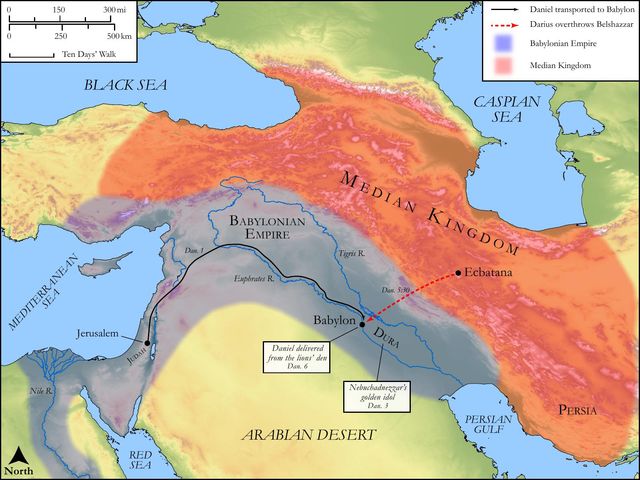
The historical backdrop is Babylon, shortly after Nebuchadnezzar's initial conquest of Jerusalem around 605 BC, as recounted in Daniel 1:1-2. Daniel, a young man from a noble Judean family, was among the first wave of exiles forcibly transported to Babylon. There, he was conscripted into a rigorous three-year training program designed to indoctrinate and assimilate the most promising foreign youths into Babylonian culture and prepare them for service in the king's court. This curriculum included instruction in the Chaldean language and literature, alongside provision of food and wine from the royal table. The "prince of the eunuchs" (Hebrew: sar ha-sarisim), identified as Ashpenaz, was a high-ranking and influential official, likely a chief steward or chamberlain, responsible for the king's personal staff and the oversight of these foreign trainees. Eunuchs often held positions of immense trust and power in the royal courts of that day, as their physical condition typically precluded dynastic ambitions. Gaining the favor of such a powerful figure was absolutely critical for any captive, especially one who intended to defy royal decrees concerning diet, as refusal could be interpreted as disloyalty and lead to severe punishment.
Key Themes
ShowHideDaniel 1:9 powerfully articulates several major themes that resonate throughout the book of Daniel and the broader biblical narrative. Firstly, it prominently features Divine Providence and Intervention, explicitly stating that "God had brought Daniel into favour." This emphasizes God's absolute sovereignty over human affairs, His ability to work behind the scenes, and His active involvement in the lives of His faithful servants, even when they are in seemingly impossible or hostile circumstances. Secondly, the verse illustrates the Reward for Faithfulness. Daniel's unwavering commitment to God's laws, expressed in Daniel 1:8, is immediately met with divine blessing and favor, demonstrating that obedience to God often yields unexpected and positive outcomes, even when it involves personal sacrifice or appears to contradict worldly wisdom. Thirdly, it introduces the crucial theme of Favor and Influence. God grants Daniel not just general goodwill, but "tender love" from a powerful figure, a deep personal regard that would prove essential for Daniel to navigate the complexities of the Babylonian court, maintain his integrity, and ultimately fulfill his divinely appointed role as a prophet and wise counselor to kings. This theme of divine favor enabling influence is a recurring motif in the biblical narrative, evident in the lives of figures like Joseph in Egypt and Esther in Persia.
Exposition and Analysis
ShowHideKey Word Analysis
ShowHideH430 - This plural form, often used with a singular verb, refers to the supreme God of Israel. Its explicit presence here is crucial, as it attributes Daniel's favorable outcome directly to divine agency, not to chance, Daniel's inherent charm, or human cunning. It underscores the monotheistic conviction of the author and the active, sovereign hand of the one true God in the affairs of His people, even in exile and under the dominion of pagan powers.
H5414 - A primitive root meaning "to give," "to put," or "to grant." In this context, it signifies God's active bestowal or intentional placement of Daniel into a position of favor. It is not a passive observation of circumstances but an active, deliberate act by God, demonstrating His power to orchestrate events and incline human hearts according to His will and purpose.
H2617 - This rich Hebrew term denotes kindness, grace, goodwill, or loyal love. While chesed often describes God's covenantal faithfulness, here it describes the benevolent regard shown by the prince of the eunuchs towards Daniel. It implies a positive disposition and a willingness to help, extending beyond mere professional courtesy to a genuine inclination to assist.
H7356 - Derived from a root associated with the womb, this word conveys deep compassion, mercy, or profound affection. It suggests a strong emotional bond or a nurturing, protective feeling, akin to parental love. The combination of chesed and racham indicates that the prince's regard for Daniel was not superficial but a deep, empathetic connection, making his willingness to accommodate Daniel's unusual request all the more remarkable and divinely inspired.
Verse Breakdown
ShowHide"Now God had brought Daniel into favour"
This opening clause immediately establishes the divine source of Daniel's good fortune. It is not Daniel's inherent qualities, intelligence, or political maneuvering that secured his position, but the direct, sovereign intervention of God. The verb "brought" (Hebrew nâthan) emphasizes God's active, intentional role in placing Daniel in this advantageous situation. This highlights the theme of divine providence, where God orchestrates events and inclines human hearts to fulfill His purposes for His faithful servants. This statement counters any notion of mere coincidence, firmly rooting Daniel's success in God's will.
"and tender love"
This phrase intensifies the nature of the favor Daniel received. "Tender love" (Hebrew racham) signifies a deep, compassionate, and affectionate regard, going beyond mere goodwill or professional respect. It suggests that the prince of the eunuchs felt a genuine, empathetic connection with Daniel, making him exceptionally receptive to Daniel's unusual request regarding the food. This profound personal affection was a direct gift from God, softening the heart of a powerful official who would otherwise have been bound by strict royal protocol.
"with the prince of the eunuchs"
This specifies the recipient of God's influence. The prince of the eunuchs, Ashpenaz, was a key figure in Daniel's immediate environment, holding significant authority over the young men in training and their daily provisions. Gaining his favor was absolutely critical for Daniel's survival and his ability to maintain his religious convictions in a foreign, pagan court where deviation from royal decree could mean death. God's work in the heart of this specific individual demonstrates His ability to use those in positions of authority, even non-believers, to advance His plans and protect His people.
Literary Devices
ShowHideThe verse primarily employs Divine Intervention as a central literary and theological device, explicitly stating "God had brought Daniel into favour." This direct attribution of the outcome to God's action emphasizes His absolute sovereignty and active involvement in human affairs, contrasting sharply with any notion of mere chance, human effort, or the whims of a pagan king. There is also an element of Irony or Paradox at play: Daniel, a captive in a foreign land, seemingly powerless and at the mercy of his captors, is granted profound favor by a high-ranking official of those very captors. This occurs not through Daniel's own manipulation, but through the unseen, yet potent, hand of his God. This highlights the power of God to reverse human expectations and give favor to the weak. Furthermore, the phrase "favour and tender love" utilizes Juxtaposition of two distinct but complementary Hebrew terms (chesed and racham) to convey a comprehensive and deep level of benevolent regard, enriching the reader's understanding of the quality of the relationship God divinely established for Daniel with a crucial authority figure.
Theological and Thematic Connections
ShowHideDaniel 1:9 powerfully articulates the principle of divine providence and God's faithfulness to those who honor Him. It demonstrates that God is not confined by political boundaries, hostile environments, or the decrees of earthly kings; He actively works in the hearts of individuals, even those in positions of power who do not acknowledge Him, to accomplish His divine purposes. Daniel's experience serves as a profound testament to the truth that when one's ways please the Lord, He can make even one's enemies to be at peace with them, or at least to show them favor. This divine favor is not earned by human merit alone but is a gracious gift, often bestowed in response to a prior act of obedience and trust, as seen in Daniel's unwavering resolve in the preceding verse. It reassures believers that God is actively involved in their circumstances, orchestrating events for their good and His glory.
Reflection and Application
ShowHideDaniel 1:9 offers profound encouragement and practical guidance for believers navigating challenging or unfamiliar circumstances in today's world. It reminds us that our ultimate security, well-being, and success do not depend on our own abilities, connections, or the benevolence of human authorities, but on the sovereign hand of God. When we commit to honoring God in our decisions, even when it seems costly, counter-cultural, or risky, we can trust that He is actively at work, orchestrating events and inclining hearts in ways we cannot foresee or manipulate. This verse calls us to cultivate a life of integrity, faithfulness, and unwavering trust in God's providence, knowing that He can open doors, provide unexpected favor, and even soften the hearts of those who might otherwise be adversaries or obstacles. Our obedience, though never a means to manipulate God, often becomes the very channel through which His providential care flows, enabling us to stand firm, maintain our convictions, and ultimately fulfill our divinely appointed purpose in whatever "Babylon" we find ourselves. It teaches us to look beyond immediate circumstances to the unseen hand of God at work.
Questions for Reflection
ShowHideFAQ
ShowHideWhat does "favour and tender love" mean in this context?
ShowHideThe phrase "favour and tender love" describes the exceptionally positive and deeply personal disposition of the prince of the eunuchs toward Daniel. "Favour" (Hebrew chêçêd) denotes kindness, goodwill, or grace, suggesting a positive regard that would make the official inclined to help Daniel. "Tender love" (Hebrew racham) is a stronger term, implying deep compassion, mercy, or even profound affection, often associated with a parent's love for a child or a profound empathy. Together, these terms indicate that the prince's regard for Daniel was not merely professional respect or a superficial liking, but a genuine, heartfelt connection and concern, divinely orchestrated to make him exceptionally receptive to Daniel's unusual request to alter his diet, as further evidenced in Daniel 1:10.
Why was it so important for Daniel to gain the favor of the "prince of the eunuchs"?
ShowHideThe "prince of the eunuchs" (Ashpenaz) was a high-ranking and powerful official responsible for the care, training, and well-being of the young men brought into the king's service, including Daniel. He held immense authority over their daily lives, including their diet, education, and overall conduct. For Daniel to refuse the royal food and wine, which was a direct provision and expectation from the king, would have been seen as an act of insubordination, potentially punishable by death. Therefore, gaining Ashpenaz's personal favor and trust was absolutely crucial for Daniel to even propose an alternative diet without immediately incurring severe consequences. God's intervention here was a direct provision for Daniel's safety and his ability to maintain his spiritual integrity in a hostile environment, demonstrating God's sovereign control over human authorities.
Does this verse imply that God will always grant us favor if we are faithful?
ShowHideWhile Daniel 1:9 clearly shows God granting favor in response to Daniel's faithfulness, it does not guarantee that every act of faithfulness will result in immediate, tangible favor or the avoidance of hardship. The Bible also records numerous instances where faithful individuals faced severe persecution, imprisonment, or even martyrdom (e.g., Hebrews 11:36-38). However, this verse does affirm God's sovereign power to intervene and His unwavering commitment to His people. It teaches us to trust in His providence, knowing that He works all things for the good of those who love Him and are called according to His purpose, whether that "good" manifests as earthly favor, as strength to endure trials for His glory (as seen in the fiery furnace in Daniel 3), or as eternal reward. God's ways are higher than our ways, and His wisdom determines the best outcome for His glory and our ultimate good.
Christ-Centered Fulfillment
ShowHideDaniel 1:9, with its emphasis on God granting favor to His faithful servant, finds its ultimate and most profound fulfillment in the person and work of Jesus Christ. While Daniel received favor from an earthly prince, Jesus, the Son of God, is the one in whom all divine favor eternally rests. From His baptism, where the Father declared, "This is my beloved Son, in whom I am well pleased," to His perfect life of obedience and His sacrificial death, Jesus consistently walked in the Father's perfect favor. He is the ultimate faithful servant, who, unlike Daniel, never had to purpose in His heart not to defile Himself, for He was "without sin" (though tempted in every way). Through Christ, believers now receive the ultimate "favour and tender love" from God. We are not merely granted temporary favor by an earthly ruler, but through faith in Him, we are "accepted in the beloved" and have "access to God's grace" and presence. Daniel's experience foreshadows the greater reality that in Christ, we are adopted as "children of God" and given an eternal standing in the presence of the King of Kings, who has "made us accepted in the Beloved" and seated us "with him in the heavenly places." Thus, Daniel's favor points to the immeasurable, eternal, and redemptive favor we receive through our union with the perfectly obedient and beloved Son.