


Acts 28:19
Bible text: King James Version (1769 Blayney text) · Public domain
Bible text: Berean Standard Bible · Public domain
Bible text: American Standard Version (1901) · Public domain
Bible text: World English Bible, Messianic edition · Public domain
Bible text: Geneva Bible (1599) · Public domain
Bible text: Young's Literal Translation · Public domain
- ἀντιλεγόντωνantilegontōnWhen were objectingG483V-PAP-GPMVerb Present Active Participle Genitive Plural Masculine
- δὲdehoweverG1161CONJConjunction
- τῶνtōntheG3588T-GPMDefinite article Genitive Plural Masculine
- ἸουδαίωνIoudaiōnJewsG2453N-GPM-PGNoun Genitive Plural Masculine Person Gentilic
- ἠναγκάσθηνēnagkasthēnI was compelledG315V-API-1SVerb Aorist Passive Indicative 1st Singular
- ἐπικαλέσασθαιepikalesasthaito appeal toG1941V-AMNVerb Aorist Middle Infinitive
- ΚαίσαραKaisaraCaesarG2541N-ASM-TNoun Accusative Singular Masculine Title
- οὐχouchnotG3756PRT-NNegative Particle Negative
- ὡςhōsas ifG5613PRTParticle or Disjunctive
- τοῦtoutheG3588T-GSNDefinite article Genitive Singular Neuter
- ἔθνουςethnousnationG1484N-GSNNoun Genitive Singular Neuter
- μουmouof mineG3165P-1GSPersonal pronoun Genitive 1st Singular
- ἔχωνechōnhavingG2192V-PAP-NSMVerb Present Active Participle Nominative Singular Masculine
- τιtianythingG5100X-ASNIndefinite pronoun Accusative Singular Neuter
- κατηγορεῖνkatēgoreinto lay againstG2723V-PANVerb Present Active Infinitive
English is a literal word-by-word gloss of the Greek, not the KJV's wording. Why?
This is the original text the KJV's translators worked from — each Greek word with its own literal English meaning in this verse, prepared by scholars at Tyndale House, Cambridge. The KJV translates whole sentences, not word by word, so its wording differs: one Greek word can become several English words, and the KJV may choose “charity” where the gloss reads “love”. Both are faithful — they answer different questions. For the KJV's own rendering, switch to the KJV text.
Details
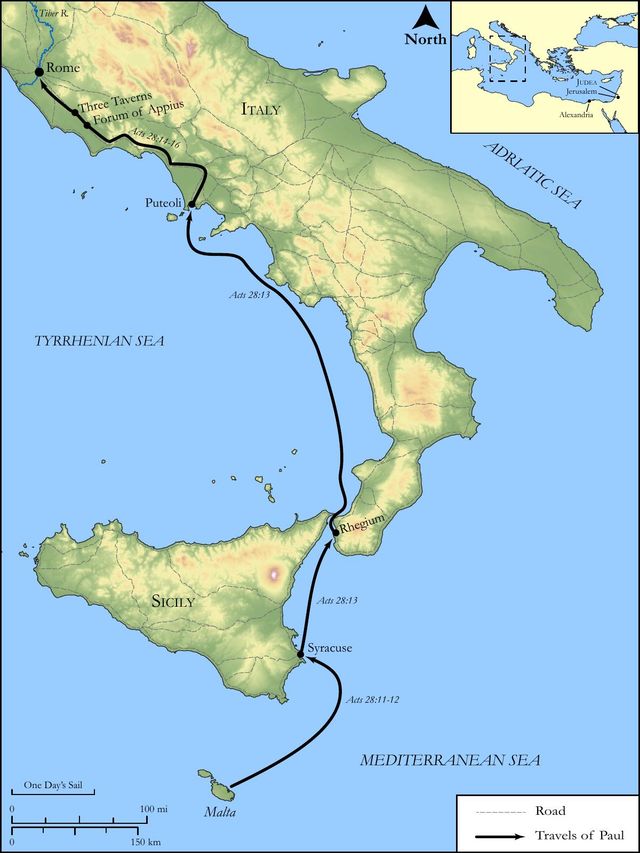
See on the biblical-era maps


Study this verse
Public-domain commentary
Matthew Henry
From his Commentary on the Whole Bible. Henry comments on passages, not single verses — this entry covers Acts 28:17–22. His two-level outline is real structure in the source text, so it is rendered as structure.
Paul, with a great deal of expense and hazard, is brought a prisoner to Rome, and when he has come nobody appears to prosecute him or lay any thing to his charge; but he must call his own cause; and here he represents it to the chief of the Jews at Rome. It was not long since, by an edict of Claudius, all the Jews were banished from Rome, and kept out till his death; but, in the five years since then, many Jews had come thither, for the advantage of trade, though it does not appear that they were allowed any synagogue there or place of public worship; but these chief of the Jews were those of best figure among them, the most distinguished men of that religion, who had the best estates and interests. Paul called them together, being desirous to stand right in their opinion, and that there might be a good understanding between him and them. And here we are told,
I.What he said to them, and what account he gave them of his cause.
He speaks respectfully to them, calls them men and brethren, and thereby intimates that he expects to be treated by them both as a man and as a brother, and engages to treat them as such and to tell them nothing but the truth; for we are members one of another - all we are brethren. Now,
1.He professes his own innocency, and that he had not given any just occasion to the Jews to bear him such an ill will as generally they did: "I have committed nothing against the people of the Jews, have done nothing to the prejudice of their religion or civil liberties, have added no affliction to their present miseries, they know I have not; nor have I committed any thing against the customs of our fathers, either by abrogating or by innovating in religion." It is true Paul did not impose the customs of the fathers upon the Gentiles: they were never intended for them. But it is as true that he never opposed them in the Jews, but did himself, when he was among them, conform to them. He never quarrelled with them for practising according to the usages of their own religion, but only for their enmity to the Gentiles, Gal 2:12. Paul had the testimony of his conscience for him that he had done his duty to the Jews.
2.He modestly complains of the hard usage he had met with - that, though he had given them no offence, yet he was delivered prisoner from Jerusalem into the hands of the Romans. If he had spoken the whole truth in this matter, it would have looked worse than it did upon the Jews, for they would have murdered him without any colour of law or justice if the Romans had not protected him; but, however, they accused him as a criminal, before Felix the governor, and, demanding judgment against him, were, in effect delivering him prisoner into the hands of the Romans, when he desired no more than a fair and impartial trial by their own law.
3.He declares the judgment of the Roman governors concerning him, Act 28:18. They examined him, enquired into his case, heard what was to be said against him, and what he had to say for himself. The chief captain examined him, so did Felix, and Festus, and Agrippa, and they could find no cause of death in him; nothing appeared to the contrary but that he was an honest, quiet, conscientious, good man, and therefore they would never gratify the Jews with a sentence of death upon him; but, on the contrary, would have let him go, and have let him go on in his work too, and have given him no interruption, for they all heard him and liked his doctrine well enough. It was for the honour of Paul that those who most carefully examined his case acquitted him, and none condemned him but unheard, and such as were prejudiced against him.
4.He pleads the necessity he was under to remove himself and his cause to Rome; and that it was only in his own defence, and not with any design to recriminate, or exhibit a cross bill against the complainants, (Act 28:19): When the Jews spoke against it, and entered a caveat against his discharge, designing, if they could not have him condemned to die, yet to have him made a prisoner for life, he was constrained to appeal unto Caesar, finding that the governors, one after another, stood so much in awe of the Jews that they could not discharge him, for fear of making him their enemies, which made it necessary for him to pray the assistance of the higher powers. This was all he aimed at in this appeal; not to accuse his nation, but only to vindicate himself. Every man has a right to plead in his own defence, who yet ought not to find fault with his neighbours. It is an invidious thing to accuse, especially to accuse a nation, such a nation. Paul made intercession for them, but never against them. The Roman government had at this time an ill opinion of the Jewish nation, as factious, turbulent, disaffected, and dangerous; and it had been an easy thing for a man with such a fluent tongue as Paul had, a citizen of Rome, and so injured as he was, to have exasperated the emperor against the Jewish nation. But Paul would not for ever so much do such a thing; he was for making the best of every body, and not making bad worse.
5.He puts his sufferings upon the true footing, and gives them such an account of the reason of them as should engage them not only not to join with his persecutors against him, but to concern themselves for him, and to do what they could on his behalf (Act 28:20): "For this cause I have called for you, not to quarrel with you, for I have no design to incense the government against you, but to see you and speak with you as my countrymen, and men that I would keep up a correspondence with, because for the hope of Israel I am bound with this chain." He carried the mark of his imprisonment about with him, and probably was chained to the soldier that kept him; and it was, (1.) Because he preached that the Messiah was come, who was the hope of Israel, he whom Israel hoped for. "Do not all the Jews agree in this, that the Messiah will be the glory of his people Israel? And therefore he is to be hoped for, and this Messiah I preach, and prove he is come. They would keep up such a hope of a Messiah yet to come as must end in a despair of him; I preach such a hope in a Messiah already come as must produce a joy in him." (2.) Because he preached that the resurrection of the dead would come. This also was the hope of Israel; so he had called it, Act 23:6; Act 24:15; Act 26:6, Act 26:7. "They would have you still expect a Messiah that would free you from the Roman yoke, and make you great and prosperous upon earth, and it is this that occupies their thoughts; and they are angry at me for directing their expectations to the great things of another world, and persuading them to embrace a Messiah who will secure those to them, and not external power and grandeur. I am for bringing you to the spiritual and eternal blessedness upon which our fathers by faith had their eye, and this is what they hate me for, - because I would take you off from that which is the cheat of Israel, and will be its shame and ruin, the notion of a temporal Messiah, and lead you to that which is the true and real hope of Israel, and the genuine sense of all the promises made to the fathers, a spiritual kingdom of holiness and love set up in the hearts of men, to be the pledge of, and preparative for, the joyful resurrection of the dead and the life of the world to come."
II.What was their reply.
They own, 1. That they had nothing to say in particular against him; nor had any instructions to appear as his prosecutors before the emperor, either by letter or word of mouth (Act 28:21): "We have neither received letters out of Judea concerning thee (have no orders to prosecute thee) nor have any of the brethren of the Jewish nation that have lately come up to Rome (as many occasions drew the Jews thither now that their nation was a province of that empire) shown or spoken any harm of thee." This was very strange, that that restless and inveterate rage of the Jews which had followed Paul wherever he went should not follow him to Rome, to get him condemned there. Some think they told a lie here, and had orders to prosecute him, but durst not own it, being themselves obnoxious to the emperor's displeasure, who though he had not, like his predecessors, banished them all from Rome, yet gave them no countenance there. But I am apt to think that what they said was true, and Paul now found he had gained the point he aimed at in appealing to Caesar, which was to remove his cause into a court to which they durst not follow it. This was David's policy, and it was his security (Sa1 27:1): There is nothing better for me than to escape into the land of the Philistines, and Saul shall despair of me, to seek me any more in any coasts of Israel; so shall I escape out of his hands: and it proved so, Act 28:4. When Saul heard that David had fled to Gath, he sought no more again for him. Thus did Paul by his appeal: he fled to Rome, where he was out of their reach; and they said, "Even let him go." 2. That they desired to know particularly concerning the doctrine he preached, and the religion he took so much pains to propagate in the face of so much opposition (Act 28:22): "We desire to hear of thee what thou thinkest - ha phroneis what thy opinions or sentiments are, what are those things which thou art so wise about, and hast such a relish of and such a zeal for; for, though we know little else of Christianity, we know it is a sect every where spoken against." Those who said this scornful spiteful word of the Christian religion were Jews, the chief of the Jews at Rome, who boasted of their knowledge (Rom 2:17), and yet this was all they knew concerning the Christian religion, that it was a sect every where spoken against. They put it into an ill name, and then ran it down. (1.) They looked upon it to be a sect, and this was false. True Christianity establishes that which is of common concern to all mankind, and is not built upon such narrow opinions and private interests as sects commonly owe their original to. It aims at no worldly benefit or advantage as sects do; but all its gains are spiritual and eternal. And, besides, it has a direct tendency to the uniting of the children of men, and not the dividing of them, and setting them at variance, as sects have. (2.) They said it was every where spoken against, and this was too true. All that they conversed with spoke against it, and therefore they concluded every body did: most indeed did. It is, and always has been, the lot of Christ's holy religion to be every where spoken against.
Historical interpretation
Historical reception
3 surviving comments on this verse. Each one is dated, so this reads as a timeline rather than a list.
"Who having examined me," says he, "found nothing in me." When those ought to have rescued, they "delivered him into the hands of the Romans." And such the superabundance, because those had not power to condemn but delivered him prisoner. "Not as having aught to accuse my nation of," am I come. See what friendliness of expression "my nation:" he does not hold them as aliens. He does not say, I do not accuse, but, "I have not whereof to accuse:" although he had suffered so many evils at their hands. But nothing of all this does he say, nor make his speech offensive: neither does he seem to be sparing them as matter of favor. For this was the main point, to show that they delivered him prisoner to the Romans, when those ought to have condemned him. "For this cause," he says, "I wished to see you:" that it might not be in any man's power to accuse me, and to say what naturally might suggest itself, that having escaped their hands I have come for this: not to bring evils upon others, but myself fleeing from evils. "I was compelled to appeal unto Caesar."
He wished to exculpate both himself and others; himself, that they might not accuse him, and by so doing hurt themselves; and those others, that it might not seem that the whole thing was of their doing. For it was likely that a report was prevalent, that he had been delivered up by the Jews; and this was enough to alarm them. He therefore addresses himself to this, and defends himself as to his own conduct.
Wherefore, he says, "I was constrained to appeal unto Caesar:" so that his whole speech is of a forgiving nature. What then? didst thou this, that thou mightest accuse them? No, he says: "Not that I had aught to accuse my nation of:" but that I might escape the danger.
Continue studying Acts 28:19 across the web’s major study libraries — every link below opens this exact verse, chapter, or book on the destination site.
Read & Compare
 BibleGatewayThis verse in more than 200 translations and 70 languages.
 Bible.comThe YouVersion reader — hundreds of translations, reading plans, and highlights.
 ESV.orgCrossway's official English Standard Version reader.
 NET BibleThe NET translation with 60,000+ translators' notes on every rendering decision.
 STEP BibleTyndale House's free study tool — original text, vocabulary, and scholarly resources.
 BibliaLogos Bible Software's free web reader.
 USCCBThe New American Bible (Revised Edition) with the U.S. bishops' study notes.
Commentaries
 BibleHub CommentariesDozens of classic commentaries on this verse, gathered on one page.
 StudyLightMore than 100 commentary sets — the largest collection on the web.
 BibleRefPlain-English commentary on what this verse means, verse by verse.
 Enduring WordDavid Guzik's free commentary on this chapter, widely used by Bible teachers.
 Bible Study ToolsVerse commentary alongside Greek and Hebrew study aids.
Original Language & Research
- BibleHub InterlinearThe verse word by word — original language, transliteration, and English.
- BibleHub LexiconEvery word's original-language definition and Strong's entry.
 Blue Letter BibleDeep-study tools — Strong's numbers, concordance, and word studies.
 CNTR CollationThe earliest Greek manuscripts of this verse, collated letter by letter.
Sermons, Hymns & Audio


TrulyRandomVerse is not affiliated with these sites and doesn’t control their content. They’re linked because they’re genuinely useful.
Summary
In Acts 28:19, Paul explains to the Jewish leaders in Rome that his appeal to Caesar was a necessary legal action, not an act of malice or accusation against his own people. Having been unjustly accused and facing a biased legal system in Judea, he was compelled to exercise his right as a Roman citizen to seek justice from the highest authority, all while maintaining his deep affection and loyalty to his Jewish heritage and nation.
Context
ShowHideLiterary Context
This verse is part of Paul's initial address to the leading Jews in Rome, whom he summoned three days after his arrival under house arrest. Paul's immediate goal was to clarify his situation and preempt any negative rumors or misunderstandings about his imprisonment and the charges against him. He begins by stating that he was delivered as a prisoner from Jerusalem into Roman hands, despite having done nothing against the Jewish people or their ancestral customs (Acts 28:17). He recounts how the Roman authorities, after examining his case, wished to release him because they found no capital offense (Acts 28:18). It is in this immediate narrative flow that Paul explains why he appealed to Caesar, framing it as a defensive measure rather than an offensive one against his own nation. This sets the stage for his subsequent proclamation of the gospel of the kingdom of God and the things concerning Jesus Christ (Acts 28:31).
Historical & Cultural Context
Paul's appeal to Caesar was a legal right afforded to Roman citizens, known as provocatio ad populum (appeal to the people) or, in the imperial era, provocatio ad Caesarem. This right allowed a citizen to appeal a magistrate's decision to a higher authority, ultimately to the emperor, especially in cases involving capital punishment or perceived injustice. Paul had previously asserted his Roman citizenship to avoid scourging (Acts 22:25) and to secure a fair trial. The Jewish leaders in Jerusalem, particularly those associated with the Sanhedrin, had repeatedly sought to condemn Paul, even plotting to assassinate him (Acts 23:12-15). Given the deep-seated animosity and the perceived lack of justice in Judea, Paul's appeal was a pragmatic and legally sound decision to preserve his life and ministry. Rome, as the capital of the empire, was also a strategic location for the spread of the gospel, a goal Paul had long desired to achieve (Romans 1:10-11).
Key Themes
ShowHideThis verse highlights several key themes within Acts and Paul's ministry. Firstly, it underscores Divine Providence in Paul's journey; despite his imprisonment, God's plan to bring the gospel to Rome and even to Caesar's household was being fulfilled, as explicitly promised by the Lord to Paul in Acts 23:11. Secondly, it emphasizes Paul's Integrity and Loyalty, demonstrating his unwavering commitment to his Jewish heritage even while being the apostle to the Gentiles. His appeal was not to accuse his nation, but to defend himself and the gospel, reflecting his deep sorrow and concern for his people's salvation (Romans 9:1-3). Thirdly, it showcases the Advancement of the Gospel through Adversity, illustrating how Paul's legal entanglements and suffering ultimately served to further the kingdom of God, even in the imperial capital, echoing the broader narrative of Acts where the Word of God continues to spread despite opposition (Acts 19:20).
Exposition and Analysis
ShowHideKey Word Analysis
ShowHideDerived from anagkē (necessity), this verb means "to compel," "to force," or "to necessitate." Paul uses it to convey that his appeal was not a choice born of vindictiveness or personal ambition, but rather a defensive measure imposed by circumstances. He was left with no other viable option to secure justice and protect his life and ministry from the relentless opposition of some Jewish factions. This highlights the involuntary nature of his action.
In the middle voice, this verb means "to call upon," "to invoke," or "to appeal to." Specifically in a legal context, it refers to the act of invoking a higher authority for a decision or judgment. Paul's use of this term emphasizes his exercise of a recognized legal right within the Roman system, seeking the emperor's judgment as a last resort against what he perceived as an unfair process in Judea.
This verb means "to be a plaintiff," "to charge with some offense," or "to denounce." Paul explicitly states that his appeal was not for the purpose of accusing his own nation. This disclaimer is crucial, demonstrating his desire to clarify his motives and to avoid any perception that he was betraying his people or seeking their condemnation. It underscores his consistent love and concern for Israel, despite the persecution he faced from some within it.
Verse Breakdown
ShowHide"But when the Jews spake against [it],"
This clause refers to the persistent and intense opposition Paul faced from certain Jewish groups, particularly in Jerusalem and throughout his missionary journeys. The phrase "spake against [it]" (Greek, antilégō) implies contradiction, gainsaying, and disputing, reflecting the contentious nature of the accusations leveled against him. This opposition was the direct catalyst for his legal predicament and subsequent appeal.
"I was constrained to appeal unto Caesar;"
Here, Paul explains the direct consequence of the Jewish opposition. The verb "constrained" (Greek, anankázō) indicates that he was compelled by necessity, not by choice or desire to accuse his people. His appeal to Caesar was a legal right exercised as a Roman citizen to escape what he believed would be an unjust verdict or continued imprisonment in Judea, thereby protecting his life and his apostolic mission.
"not that I had ought to accuse my nation of."
This final clause is a crucial clarification of Paul's motives. He explicitly denies any intention of bringing charges against his fellow Jews. Despite their relentless persecution of him, Paul's heart remained burdened for their salvation, and his legal maneuver was purely defensive, aimed at securing his own freedom and the continuation of his gospel ministry, rather than retaliating or condemning his own people.
Literary Devices
ShowHideThe verse primarily employs Apologia (a formal defense or justification) as Paul explains his actions to the Roman Jewish leaders. His statement is a carefully crafted defense, presenting his appeal to Caesar not as an act of aggression or accusation against his nation, but as a necessary, compelled response to unjust circumstances. There is also an element of Understatement in "not that I had ought to accuse my nation of," given the severe and often life-threatening opposition he had endured from some Jewish factions. This measured language underscores his integrity and his persistent love for his people, even in the face of their hostility.
Theological and Thematic Connections
ShowHideActs 28:19 powerfully illustrates the intersection of divine sovereignty and human agency in the spread of the gospel. Paul's appeal to Caesar, while a human legal maneuver born out of necessity, was simultaneously part of God's overarching plan to bring the message of Christ to the heart of the Roman Empire. It highlights that even in the midst of unjust accusations and legal battles, God can use difficult circumstances to advance His kingdom. Paul's integrity in declaring that he had no desire to accuse his nation underscores the biblical principle of loving one's neighbor, even those who oppose you, and prioritizing the spread of the gospel over personal vindication or retribution. This verse also speaks to the Christian's right to utilize just legal systems for protection and justice, provided it does not compromise their witness or biblical principles.
Reflection and Application
ShowHidePaul's experience in Acts 28:19 offers profound lessons for believers navigating opposition and injustice today. His example teaches us the importance of integrity in our responses, even when facing hostility. We are called to defend the truth and ourselves when necessary, but always with a heart free from malice or a desire for retaliation against those who oppose us. Paul's primary concern was the advancement of the gospel, not personal revenge or condemnation of his accusers. This challenges us to examine our own motives when we are wronged: are we seeking to vindicate ourselves, or to glorify God and further His kingdom? Furthermore, Paul's utilization of his legal rights as a Roman citizen reminds us that Christians are not called to be passive in the face of injustice. We can and should leverage legitimate systems and rights available to us in society to protect ourselves, our ministries, and to advocate for truth and righteousness, always discerning whether such actions align with God's purposes and do not compromise our witness. Ultimately, Paul's journey reminds us to trust in God's sovereign plan, knowing that He can use even our trials and adversities to accomplish His greater purposes.
Questions for Reflection
ShowHideFAQ
ShowHideWhy was Paul "constrained" to appeal to Caesar if he didn't want to accuse his nation?
ShowHidePaul was "constrained" (Greek, anankázō) because the circumstances forced his hand. He had been held prisoner for two years in Caesarea, and the Roman governors (Felix and Festus) had delayed his case, seemingly to appease the Jews (Acts 24:27 and Acts 25:9). When Festus proposed taking Paul back to Jerusalem for trial before the Sanhedrin, Paul knew this would be a death sentence or at least a biased trial, as Jewish leaders had previously plotted to kill him (Acts 23:12-15). To escape this certain injustice and to ensure his survival and the continuation of his ministry, Paul, as a Roman citizen, exercised his legal right to appeal to the highest court—that of Caesar himself. His appeal was a defensive measure to secure justice and protect his life, not an offensive move to condemn his Jewish brethren.
Christ-Centered Fulfillment
ShowHidePaul's compelled appeal to Caesar, driven by unjust accusations and a desire to avoid condemning his own people, powerfully foreshadows and reflects aspects of Christ's own journey and the broader redemptive narrative. Like Paul, Jesus faced relentless opposition and false accusations from religious leaders of His own nation, ultimately leading to His unjust trial and crucifixion (Matthew 26:59-66). Yet, even in His suffering, Jesus did not accuse His nation but prayed for their forgiveness (Luke 23:34). Paul's willingness to suffer and be imprisoned for the sake of the gospel, even to the point of appearing before Caesar, mirrors Christ's submission to the Father's will, which led Him to the cross for the salvation of humanity. Paul's journey to Rome, though under chains, was a divinely ordained path for the gospel to reach the imperial capital, echoing how Christ's ultimate "appeal" to the Father's will, through His death and resurrection, secured the victory of the kingdom of God and ensured the worldwide spread of His message (Philippians 2:8-11). Thus, Paul's constrained appeal to Caesar is a testament to the sovereign plan of God, who uses the trials of His servants to advance the cause of Christ, demonstrating that even through apparent setbacks, the gospel of the King continues to triumph (Philippians 1:12-14).